AQA · A-Level · Business
Choosing strategic direction (A-level only)
Choosing strategic direction is the ultimate high-stakes decision for any corporate board, determining where a firm competes and how it positions itself to survive. This study guide breaks down the essential models—the Ansoff Matrix and Porter's Generic Strategies—equipping you with senior-examiner-level analytical tools to dissect corporate growth and competitive positioning for maximum marks.
- 7 min read
- 3 worked examples
- 5 practice questions
- 6 key terms
Study Notes
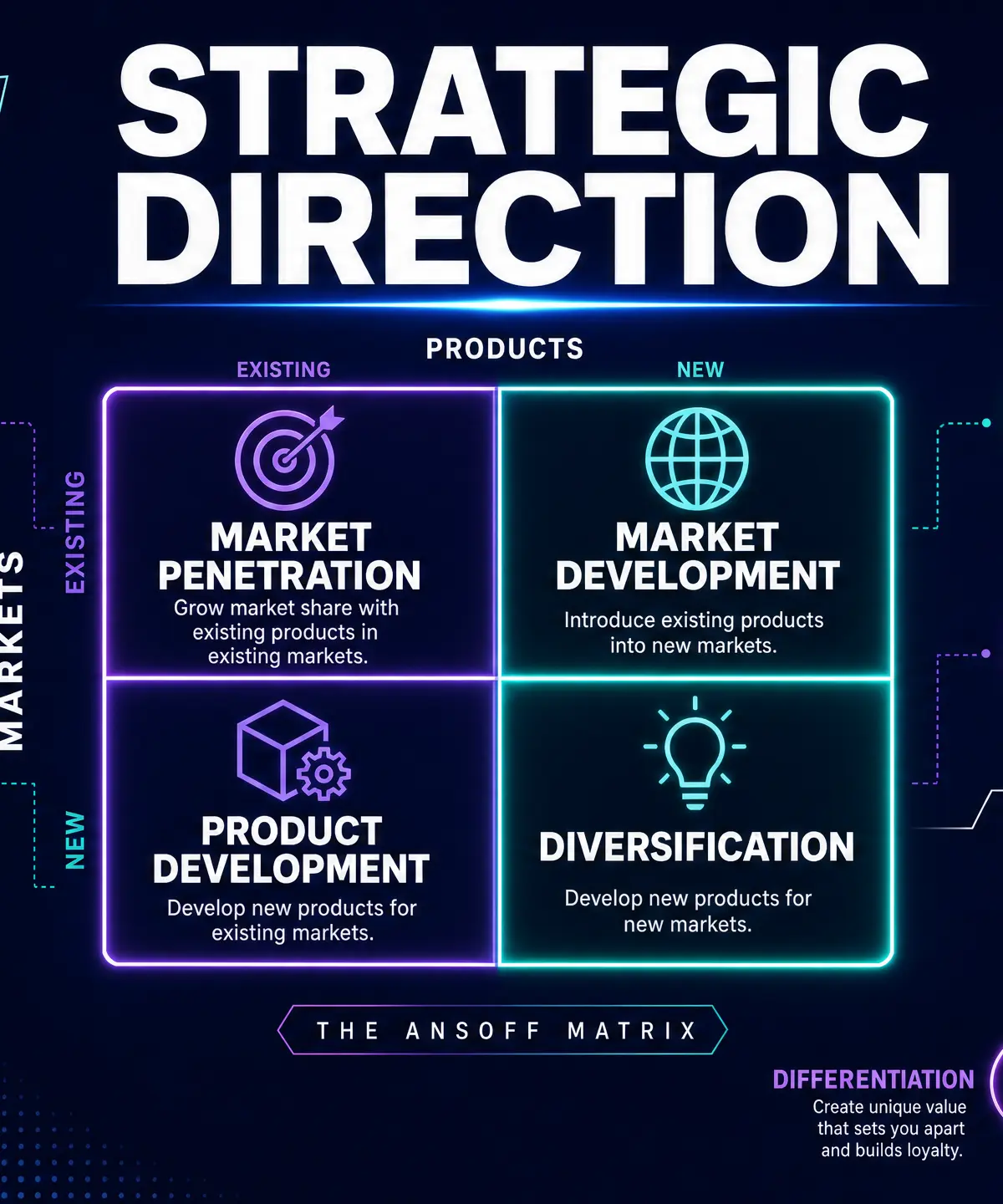
Overview
Strategic direction is the long-term plan that outlines how a business intends to achieve its objectives by choosing which markets to enter and which products to offer. At the A-Level, senior examiners do not reward simple descriptive lists; they look for a deep, analytical appreciation of choice and risk. Choosing strategic direction requires a firm to evaluate its internal core competencies against the volatile dynamics of the external environment. This guide explores the two dominant theoretical frameworks required for the examination: Igor Ansoff's Growth Matrix (1957) and Michael Porter's Generic Competitive Strategies (1980). Candidates must master not only the theoretical quadrants of these matrices but also the practical trade-offs, financial implications, and barriers to sustaining a competitive advantage in a globalised economy.
Key Strategic Frameworks
1. Igor Ansoff's Product/Market Growth Matrix
Developed by Igor Ansoff, this tool provides a structured framework for analyzing the risk associated with different growth strategies. The matrix is divided into four distinct strategic directions based on whether a business is targeting existing or new markets, and whether it is offering existing or new products.
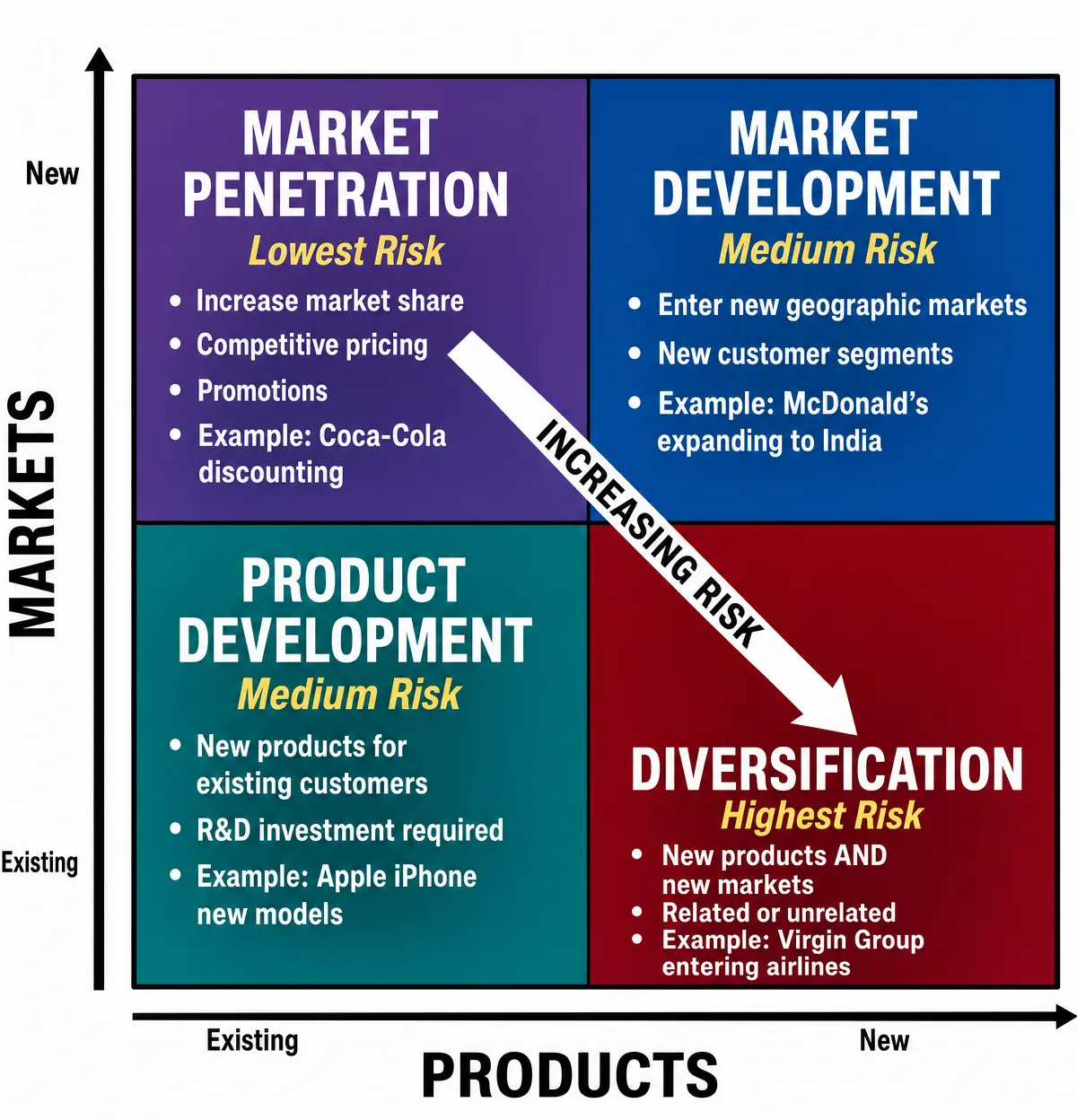
A. Market Penetration (Existing Products, Existing Markets)
- Strategic Focus: Maximizing market share in current markets using current products. This is achieved through aggressive marketing, competitive pricing, volume discounts, and loyalty schemes.
- Risk Profile: Lowest Risk. The business leverages existing customer knowledge, operational channels, and brand equity. However, growth is limited by market saturation and retaliatory price wars from competitors.
- A-Level Exemplar: Coca-Cola using promotional campaigns, sponsorship of global sporting events, and price discounting to increase consumption frequency among existing cola drinkers.
B. Market Development (Existing Products, New Markets)
- Strategic Focus: Identifying and entering new customer segments or geographical regions with the business's current product portfolio.
- Risk Profile: Medium Risk. While product development costs are avoided, the firm faces significant marketing risks due to unfamiliarity with new consumer behavior, cultural barriers, or local regulatory frameworks.
- A-Level Exemplar: Tesco expanding its retail format into Central Europe, or Starbucks entering the Chinese market by adapting store formats while maintaining its core beverage menu.
C. Product Development (New Products, Existing Markets)
- Strategic Focus: Introducing innovative or modified products to an established, loyal customer base. This strategy relies heavily on continuous research and development (R&D) and market research.
- Risk Profile: Medium Risk. The business understands the market but faces high product-failure risks, substantial R&D capital expenditure, and potential cannibalization of its existing product lines.
- A-Level Exemplar: Apple launching the Apple Watch or AirPods to its massive, pre-existing base of iPhone users, leveraging brand loyalty to drive adoption.
D. Diversification (New Products, New Markets)
- Strategic Focus: Moving into completely new markets with entirely new products. This can be related diversification (within the same broad industry, e.g., a brewery buying a pub chain) or unrelated diversification (entering completely separate industries).
- Risk Profile: Highest Risk. The business is operating entirely outside its core competencies, with no prior experience in either the product technology or the target market. It requires massive capital investment and carries a high probability of failure, but offers the benefit of spreading business risk across multiple industries.
- A-Level Exemplar: The Virgin Group expanding from its core music business into commercial aviation (Virgin Atlantic), rail transport, and financial services.
2. Michael Porter's Generic Competitive Strategies
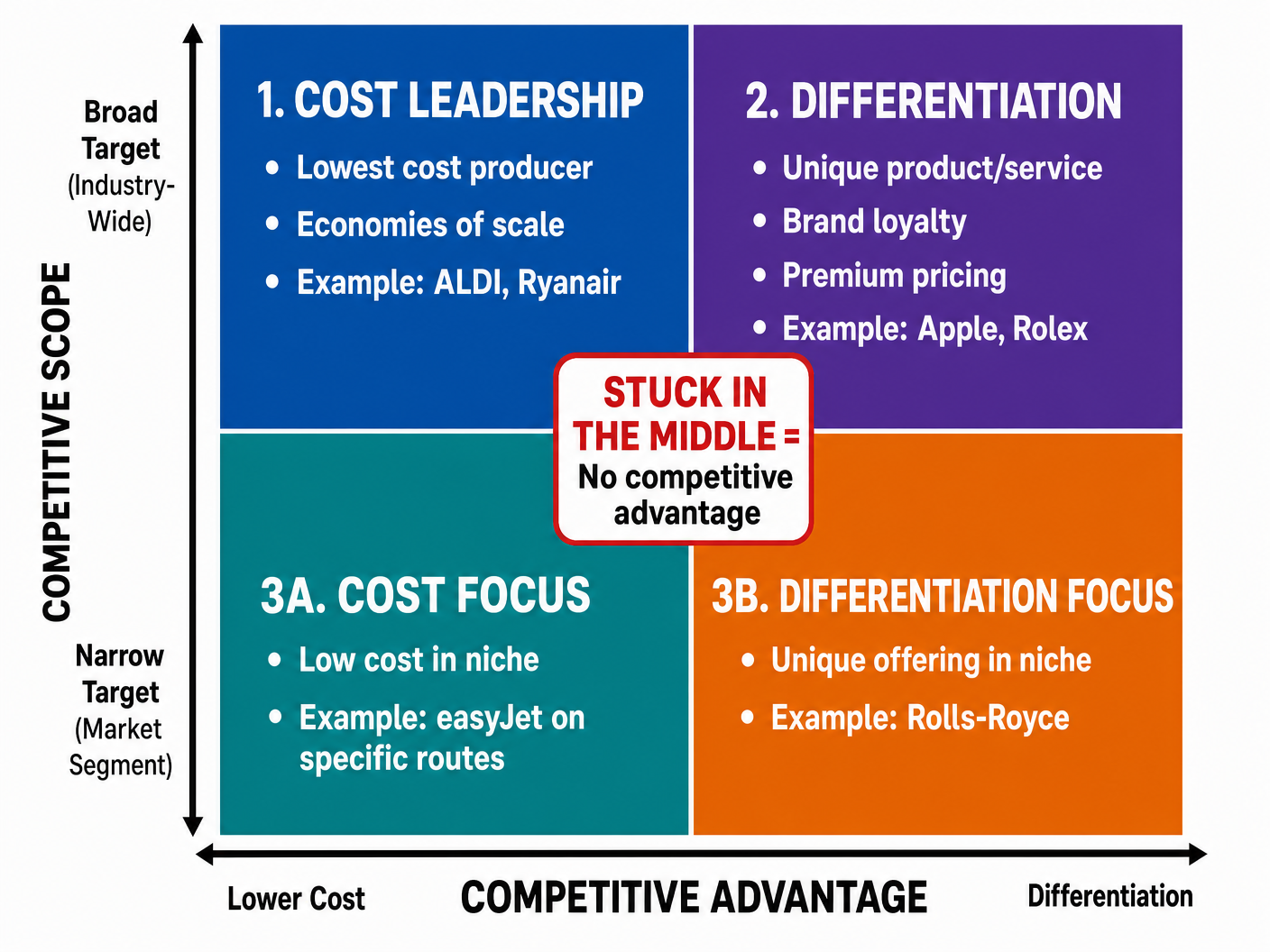
Michael Porter argued that to achieve sustainable competitive advantage, a business must make a definitive choice regarding its positioning. He identified two dimensions: the source of competitive advantage (low cost vs. differentiation) and the competitive scope (broad target vs. narrow niche).
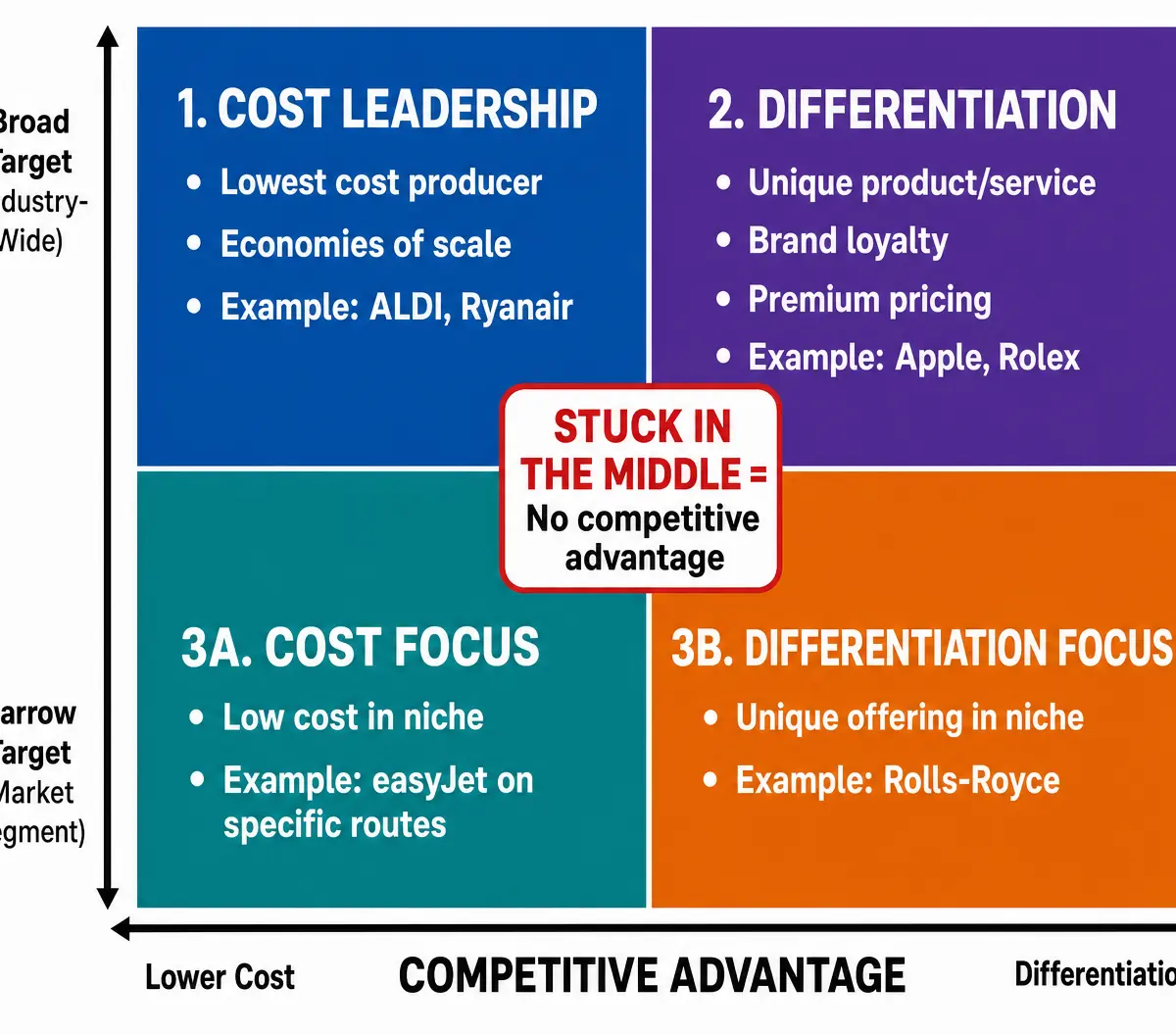
| Competitive Scope | Source: Low Cost | Source: Differentiation |
|---|---|---|
| Broad Target | Cost Leadership<br>Focus: Lowest cost producer in the industry.<br>Examples: ALDI, Ryanair, Primark | Differentiation<br>Focus: Offering unique features that command a premium.<br>Examples: Apple, Dyson, BMW |
| Narrow Target | Cost Focus<br>Focus: Lowest cost within a highly specific niche.<br>Examples: easyJet on specific regional routes | Differentiation Focus<br>Focus: Highly customized, unique product for a niche.<br>Examples: Rolls-Royce, Hotel Chocolat |
A. Cost Leadership
- Mechanism: Becoming the absolute lowest-cost producer in the industry. This is not the same as charging the lowest price. A cost leader can charge industry-average prices and enjoy exceptionally high profit margins, or charge low prices to drive out competitors.
- Key Drivers: Economies of scale, high capacity utilization, lean production systems, standardized product design, and tight control over overheads and supply chains.
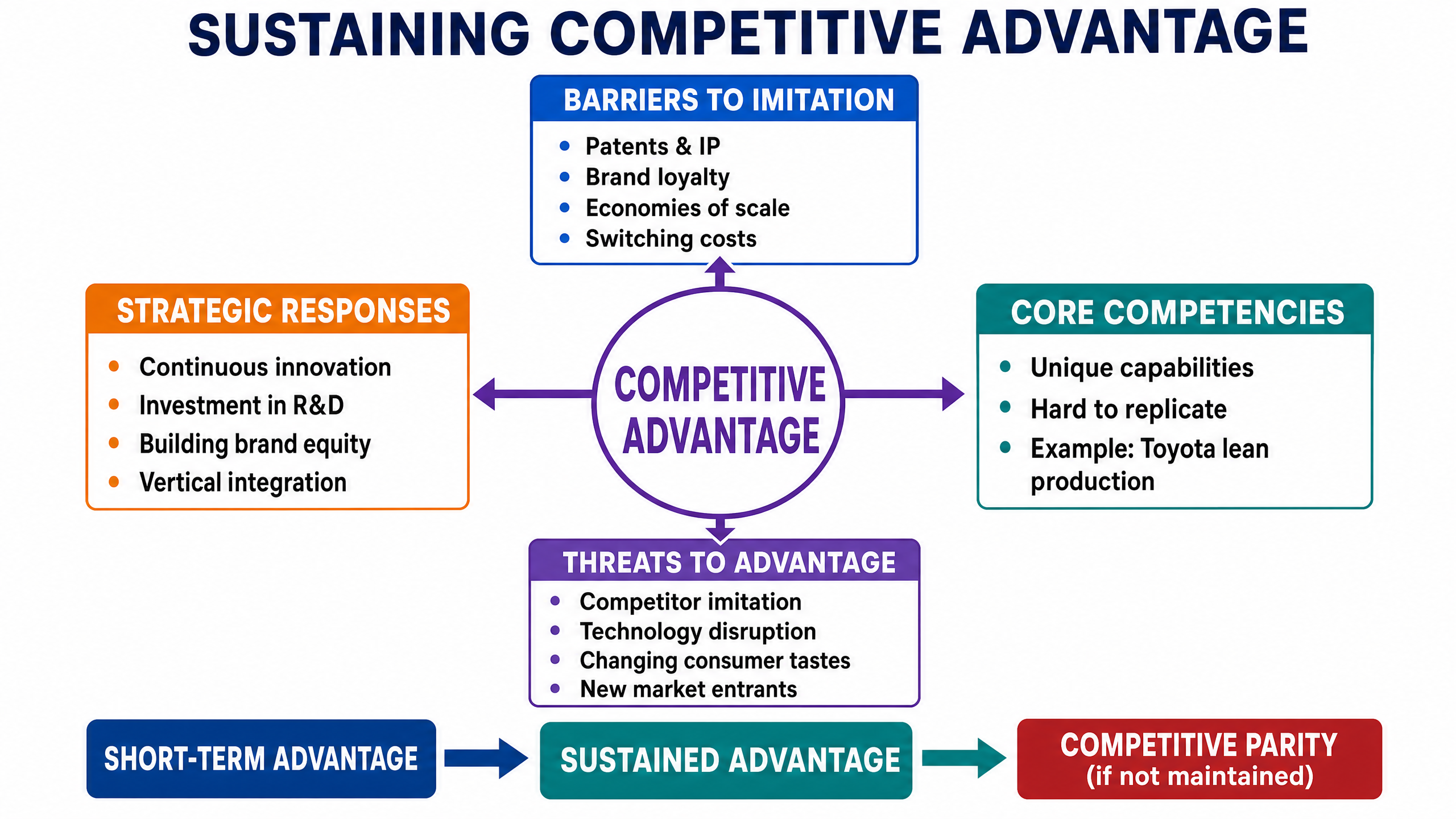
- Strategic Risk: Competitors may copy cost-cutting methods, technology changes may render production facilities obsolete, or consumers may reject extreme product standardization.
B. Differentiation
- Mechanism: Creating a product or service that is perceived industry-wide as unique, allowing the firm to charge a substantial premium price that more than covers the additional costs of differentiation.
- Key Drivers: High-quality raw materials, superior R&D, powerful branding, exceptional customer service, and innovative design.
- Strategic Risk: The price premium may become too large for consumers to justify, or competitors may successfully imitate the differentiating features, eroding the brand's unique appeal.
C. Focus Strategies (Cost Focus & Differentiation Focus)
- Mechanism: Targeting a highly specific, narrow market segment (a niche) and tailoring the entire strategic mix to serve those specialist customers, either by offering lowest costs (Cost Focus) or a highly differentiated product (Differentiation Focus).
- Strategic Risk: The niche segment may disappear due to changing consumer tastes, or broad-market competitors may launch targeted sub-brands that squeeze the niche player out.
D. The Danger of Being "Stuck in the Middle"
- Porter warned that a business that fails to make a clear strategic choice will become stuck in the middle. Such firms attempt to offer differentiation while also trying to compete on cost. This results in high operational costs without the brand equity or unique features needed to command a premium price, leading to guaranteed long-term underperformance.
Visual Resources
3 diagrams and illustrations
Interactive Diagrams
1 interactive diagram to visualise key concepts
Conceptual Flow Outline
Overview of Strategic Direction Decisions and Frameworks
Worked Examples
3 worked examples — open one to explore the question and available guidance.
Practice Questions
Test your understanding — click to reveal model answers
Analyse the strategic benefits of a business adopting a Differentiation strategy rather than a Cost Leadership strategy. (9 marks)
Hint: Focus on brand loyalty, price sensitivity, and margins. Use connective language to show clear business outcomes.
To what extent is Market Development always a more attractive growth strategy than Product Development for an established brick-and-mortar retail business? (25 marks)
Hint: Contrast the risks of entering new geographical/demographic markets with the risks of R&D and inventory costs in retail. Consider the impact of e-commerce.
Analyse the difficulties a business might face when trying to maintain a competitive advantage. (9 marks)
Hint: Consider external factors like competitor actions, technological change, and internal factors like complacency or rising costs.
Explain how a niche business can use Porter's Differentiation Focus strategy to compete against broad-market cost leaders. (6 marks)
Hint: Focus on the specific needs of a narrow segment and why broad-market players cannot meet them efficiently.
Analyse the risks associated with a business becoming 'stuck in the middle' of Porter's Generic Strategies. (9 marks)
Hint: Explain what 'stuck in the middle' means and analyze the impact on costs, pricing power, and profitability.