AQA · A-Level · Business
Human resource management
A high-impact, examiner-aligned study guide covering Human Resource Management (HRM) for GCSE Business. This resource masterfully bridges quantitative workforce metrics with qualitative motivational theories and organizational design, equipping candidates with the exact analytical tools and terminology required to secure Grade 9 marks.
- 18 min read
- 3 worked examples
- 5 practice questions
- 6 key terms
Study Notes

Overview of Human Resource Management (HRM)
Human Resource Management (HRM) represents the strategic and functional management of a business's workforce to achieve organizational objectives. In the contemporary global economy, where physical assets can be easily replicated, a business’s workforce—its human capital—serves as the primary source of sustainable competitive advantage. Senior examiners consistently emphasize that HRM is not merely an administrative or 'back-office' function; rather, it is a dynamic, strategic driver of operational efficiency, customer satisfaction, and long-term profitability.
From an assessment perspective, candidates are expected to demonstrate a comprehensive understanding of how HRM decisions influence, and are influenced by, the wider business environment. This includes analyzing the balance between labor costs and productivity, designing organizational structures that facilitate rapid communication, and implementing motivational strategies that align employee goals with corporate objectives. Furthermore, candidates must evaluate how external factors—such as technological advancements (e.g., remote working, artificial intelligence), ethical considerations, and labor market legislation—shape modern HR practices.
To secure top marks (Level 3 and 4 descriptors), candidates must move beyond simple rote description of HR functions. You must actively analyze the trade-offs inherent in every HR decision. For instance, while cutting training budgets may improve short-term cash flow, it frequently leads to long-term declines in labor productivity and employee retention. This guide is designed to instill that exact style of evaluative, examiner-level thinking.
Hard vs. Soft HRM: The Strategic Spectrum
A fundamental conceptual pillar of GCSE Business is the distinction between Hard HRM and Soft HRM approaches to workforce management. These represent two contrasting philosophies regarding how employees are viewed and treated by a business.
Hard HRM: Employees as a Resource
Under a Hard HRM approach, employees are treated primarily as a resource of the business, analogous to machinery, raw materials, or financial capital. This approach is highly transactional and focuses heavily on cost control, operational efficiency, and maximizing output per worker.
- Key Characteristics: Minimal employee empowerment, top-down (autocratic) communication, narrow job designs, flat-rate or piece-rate pay systems, and a reliance on external monitoring.
- Strategic Advantages: Low labor costs in the short term, high predictability of output, rapid decision-making, and ease of recruitment for low-skilled roles.
- Strategic Drawbacks: High labor turnover, low employee morale, minimal innovation, and potential damage to the employer brand, which can increase recruitment costs over time.
- Typical Context: High-volume manufacturing, call centers, and gig-economy platforms (e.g., fast-food delivery).
Soft HRM: Employees as an Asset
Conversely, a Soft HRM approach views employees as the business's most valuable asset and a primary source of competitive advantage. This philosophy aligns with modern progressive management practices, emphasizing long-term employee development, mutual trust, and shared values.
- Key Characteristics: High investment in training and development, decentralized decision-making (empowerment), flat organizational structures, flexible working arrangements, and performance-related pay or profit-sharing.
- Strategic Advantages: Enhanced employee motivation, lower labor turnover, superior customer service, high levels of innovation, and a strong employer brand that attracts top-tier talent.
- Strategic Drawbacks: High short-term costs (training, benefits), slower consensus-based decision-making, and the risk of over-investing in employees who may ultimately leave for competitors.
- Typical Context: Professional services, creative industries, and technology firms (e.g., software development).
Examiner's Tip: Contrasting in Extended Writing
When a 9-mark or 12-mark question asks you to evaluate whether a business should transition from a hard to a soft HRM approach, you must structure your answer around balanced trade-offs. Use contrasting connectives such as 'whereas', 'on the other hand', or 'conversely' to demonstrate clear analytical distinction. For example:
"While implementing a Hard HRM approach in a manufacturing plant minimizes immediate labor costs per unit, it conversely risks escalating labor turnover, which ultimately inflates recruitment and retraining expenses."
HR Data: Quantitative Workforce Metrics
Candidates must be highly proficient in calculating and interpreting key HR data. Examiners frequently include quantitative data in Case Studies and reward candidates who can perform accurate calculations and use the resulting metrics to evaluate business performance.
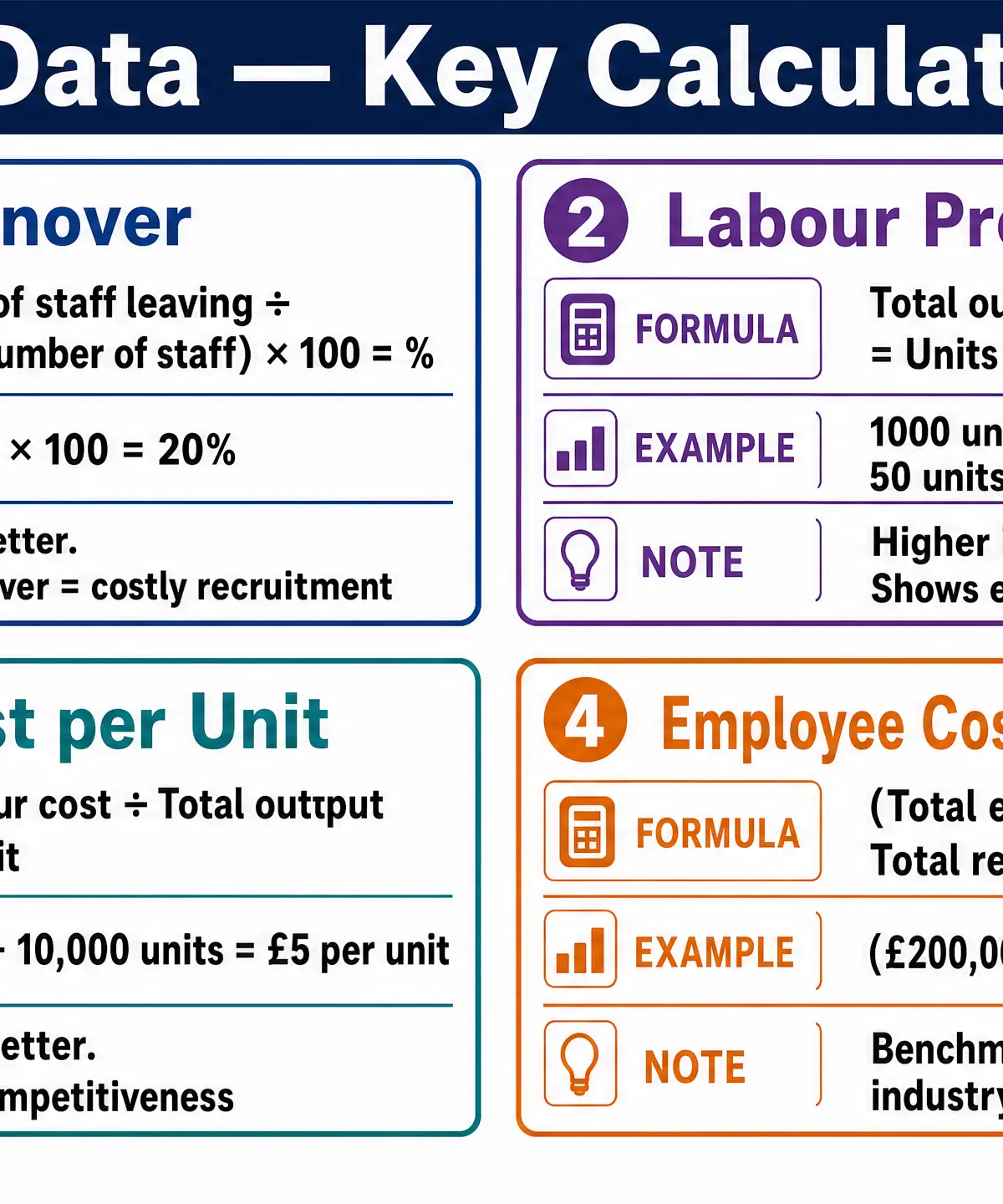
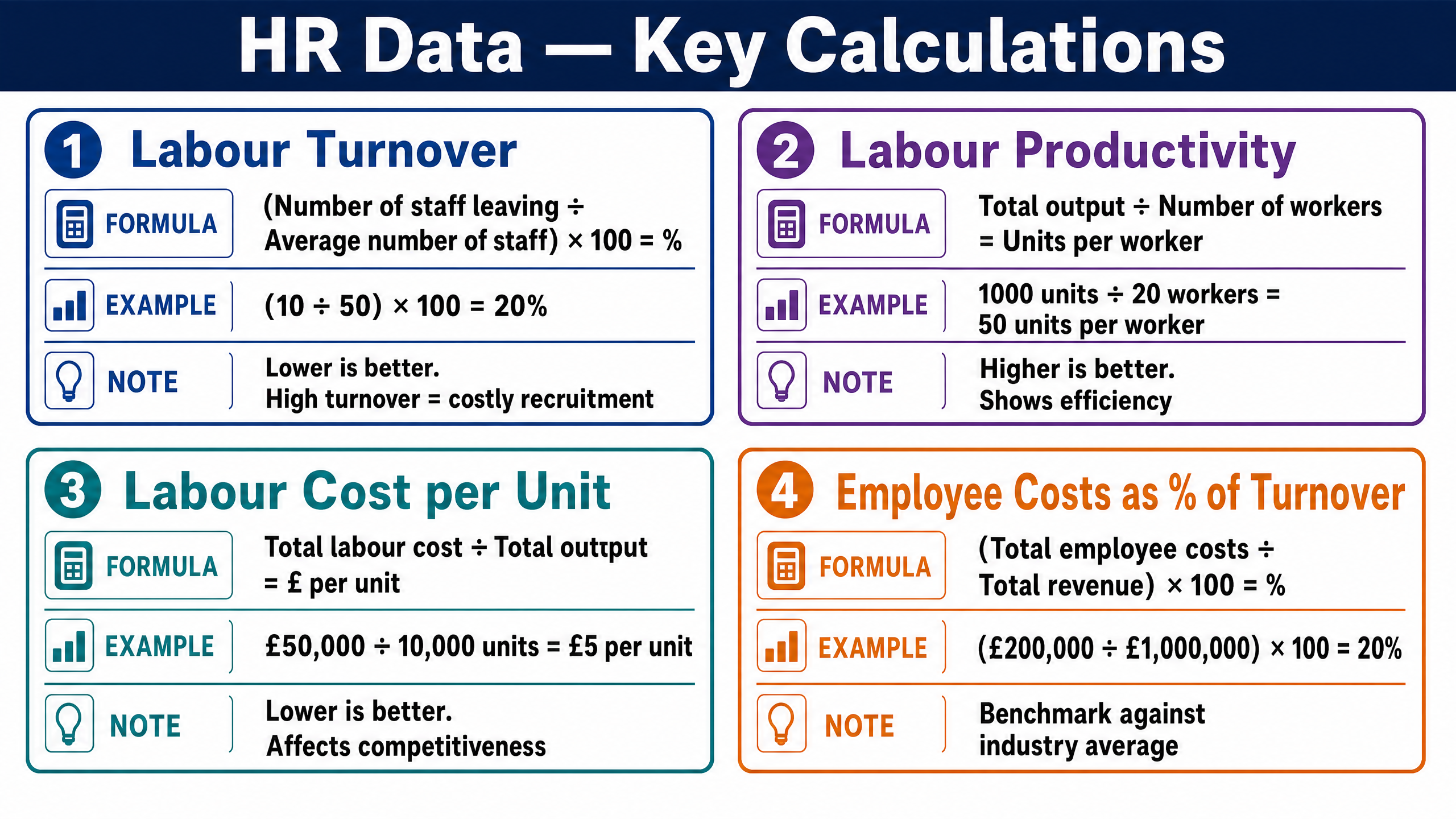
1. Labour Turnover
Labour turnover measures the rate at which employees leave a business over a specific period (typically one year). It is expressed as a percentage of the total workforce.
\text{Labour Turnover (%)} = \left( \frac{\text{Number of staff leaving during period}}{\text{Average number of staff employed during period}} \right) \times 100
- Interpretation: A high labor turnover rate (e.g., above 15-20% in non-seasonal industries) typically indicates poor employee motivation, inadequate working conditions, or uncompetitive pay. It is highly disruptive and costly, as the business must continually incur recruitment and induction training costs.
- Examiner Note: Always ensure you use the average number of staff in the denominator, not the starting or ending number, unless explicitly directed by the case study.
2. Labour Productivity
Labour productivity measures the efficiency of the workforce by calculating the output produced per employee over a given period.
\text{Labour Productivity} = \frac{\text{Total Output over a period}}{\text{Number of Employees}}
- Interpretation: Higher labor productivity is a critical driver of competitiveness. It means the business is generating more output from its labor inputs, which spreads fixed overhead costs over a larger volume of goods, thereby reducing the average cost of production.
- Examiner Note: Productivity is a rate (e.g., '50 units per worker per week'). Never confuse productivity with total output; a business can increase its total output while its productivity actually declines if it hires disproportionately more workers.
3. Labour Cost per Unit
This metric calculates the direct labor cost associated with producing a single unit of output. It directly links wage rates with productivity.
\text{Labour Cost per Unit (\pounds)} = \frac{\text{Total Labour Costs}}{\text{Total Output}}
- Interpretation: This is a vital metric for price-competitive markets. A business can afford to pay high wages if its workers are highly productive, as high productivity keeps the labor cost per unit low. Conversely, low wages combined with very low productivity can result in a high labor cost per unit, damaging price competitiveness.
4. Employee Costs as a Percentage of Turnover
This financial ratio measures the proportion of a business’s total revenue (turnover) that is consumed by employee compensation (wages, salaries, pensions, and benefits).
\text{Employee Costs as a % of Turnover} = \left( \frac{\text{Total Employee Costs}}{\text{Total Revenue (Turnover)}} \right) \times 100
- Interpretation: This metric varies significantly by industry. Service-based businesses (e.g., accounting firms, restaurants) typically have high percentages (50-70%), whereas capital-intensive manufacturing firms may have much lower percentages (10-20%). A rising percentage over time without a corresponding increase in profitability indicates declining workforce efficiency.
Organisational Design and Structures
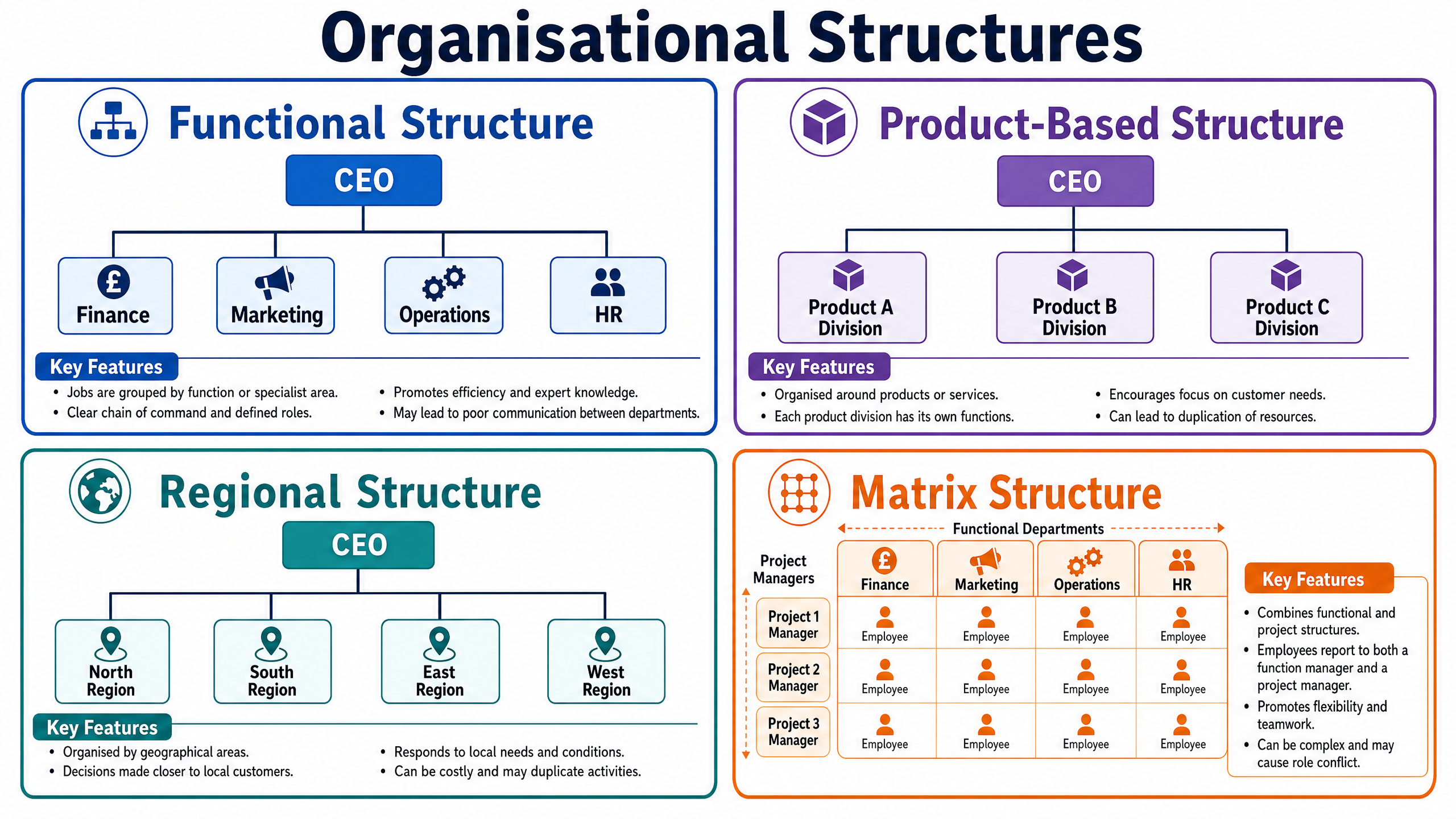
Organisational design determines how a business structures its workforce, allocates roles, and establishes lines of authority and communication. Candidates must understand the structural mechanics and strategic implications of four distinct organizational models.
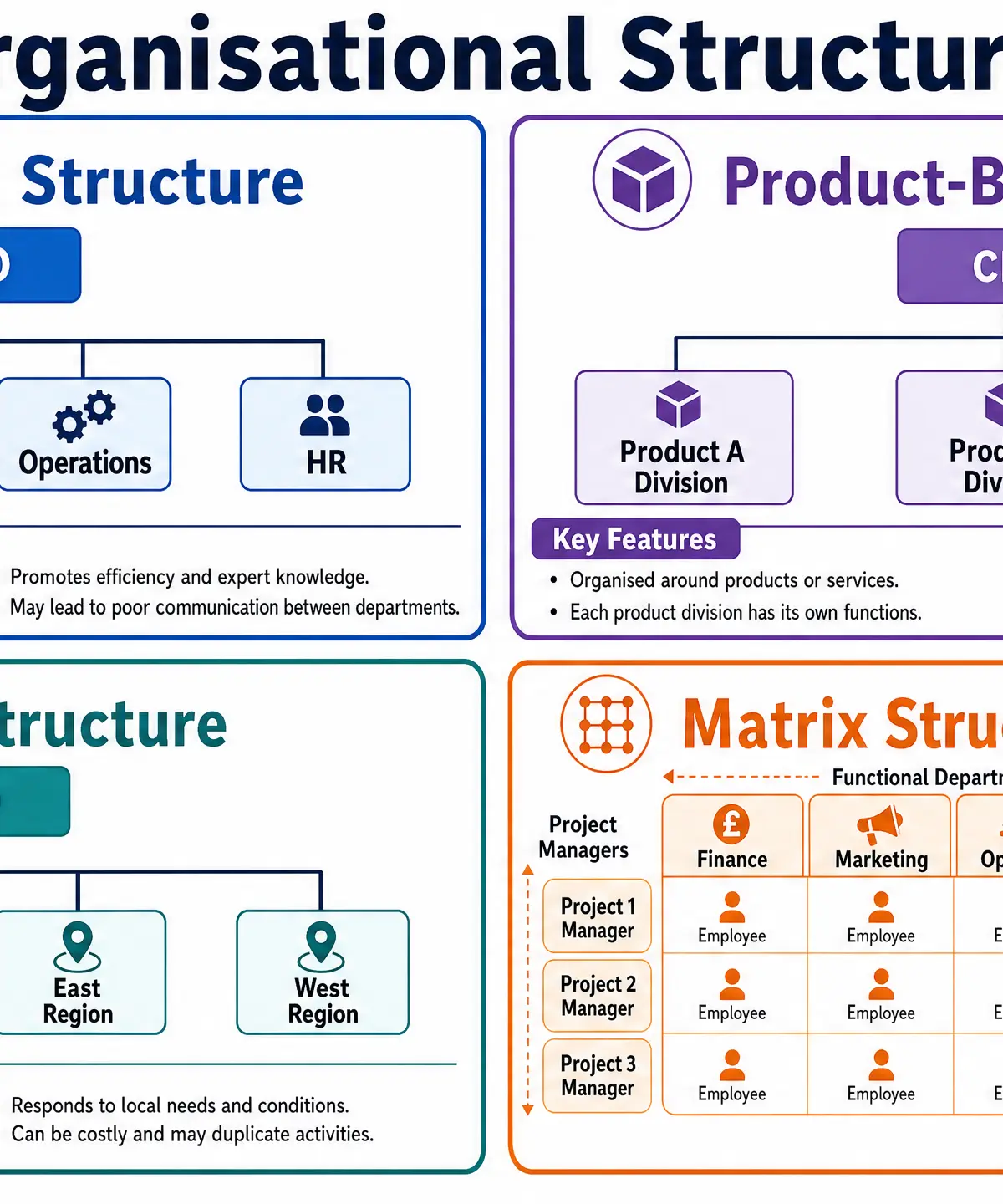
1. Functional Structure
A functional structure groups employees based on their specialist business function (e.g., Finance, Marketing, Operations, Human Resources). Each department is led by a functional director who reports directly to the Chief Executive Officer (CEO).
- Strategic Benefits: Promotes high levels of specialization, clear career progression pathways within departments, and economies of scale through centralized purchasing and operations.
- Strategic Drawbacks: Can create 'silos' where departments fail to communicate effectively with one another, leading to slow decision-making and a lack of focus on overall corporate goals.
2. Product-Based Structure
A product-based structure organizes the business's divisions around specific product lines or services. Each product division operates as a semi-autonomous business unit, containing its own functional teams (e.g., its own dedicated marketing and finance personnel).
- Strategic Benefits: Enables deep specialization in specific product markets, fosters rapid response to changing customer needs, and allows for clear performance evaluation of individual product lines.
- Strategic Drawbacks: Leads to significant duplication of resources (e.g., maintaining four separate marketing departments across four product lines), which increases total administrative overheads.
3. Regional (Geographical) Structure
This model structures the organization based on geographical territories (e.g., Northern Europe, North America, Asia-Pacific). It is widely utilized by multinational corporations (MNCs) and national retail chains.
- Strategic Benefits: Allows the business to tailor its marketing, products, and HR policies to local cultural preferences, language requirements, and legal frameworks.
- Strategic Drawbacks: Can result in a loss of central control, inconsistency in brand image across regions, and high coordination costs between international offices.
4. Matrix Structure
A matrix structure is a fluid, grid-like model where employees report to multiple managers simultaneously—typically a functional department manager (e.g., Head of Engineering) and a project-specific manager (e.g., Project X Lead).
- Strategic Benefits: Highly flexible, facilitates cross-departmental collaboration, optimizes the utilization of specialist staff, and breaks down traditional departmental silos.
- Strategic Drawbacks: Creates a high risk of role conflict and power struggles between managers, leads to heavy administrative meetings, and can cause significant stress for employees due to dual reporting lines.
Motivation in the Workplace: Theoretical Frameworks
Motivation is the cognitive and emotional drive that influences an employee’s commitment, effort, and persistence at work. Examiners frequently test a candidate’s ability to apply, contrast, and evaluate motivation theories within specific business contexts.
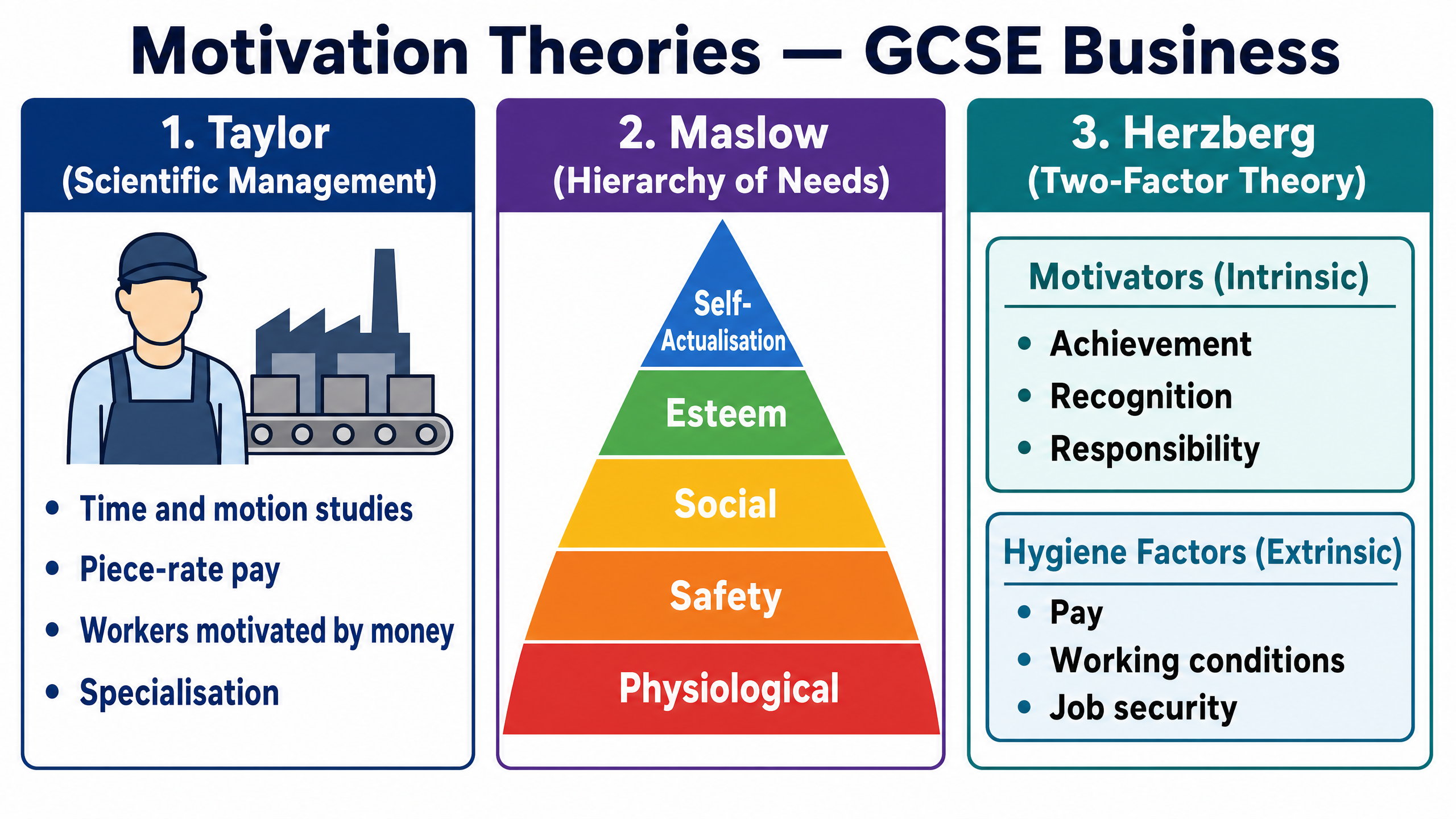
1. Frederick Winslow Taylor: Scientific Management
Taylor's early 20th-century theory is rooted in the assumption that workers are rational, economic agents motivated solely by financial reward (the 'economic man' concept).
- Core Methodology: Managers should break complex tasks down into simple, highly repetitive movements, establish the single most efficient way to perform them (via 'time and motion' studies), train workers to execute these movements precisely, and incentivize them using piece-rate pay (paying a set fee per unit produced).
- Modern Application: Still visible in Amazon fulfillment centers, food-processing plants, and gig-economy delivery services.
- Examiner Evaluation: Highly effective for boosting short-term output in low-skilled, repetitive environments. However, it ignores social and psychological needs, leading to extreme boredom, low job satisfaction, high labor turnover, and potential industrial action.
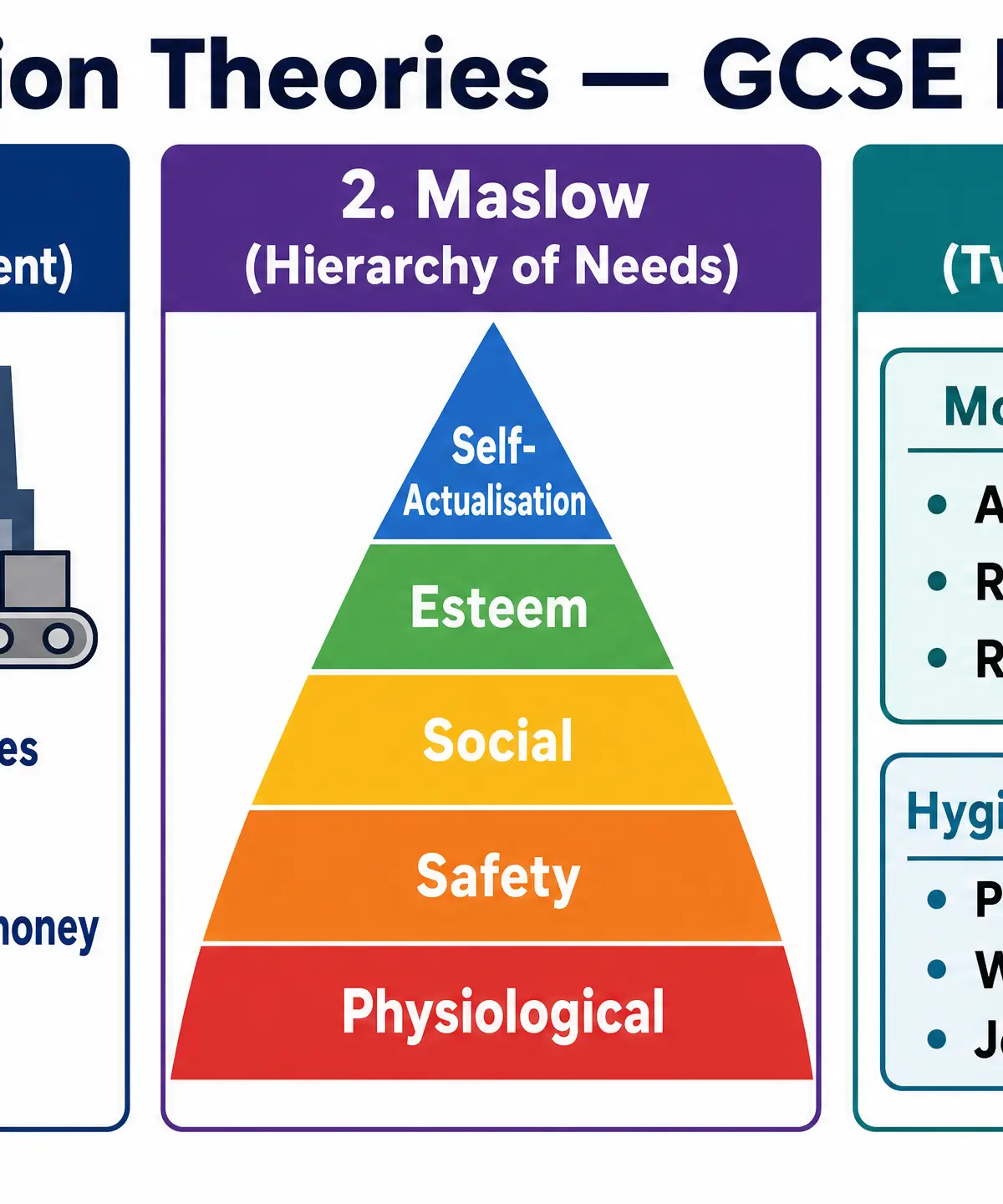
2. Abraham Maslow: Hierarchy of Needs
Maslow proposed that human motivation is driven by a progressive hierarchy of five distinct needs. An individual cannot be motivated by a higher-level need until their lower-level needs are substantially satisfied.
- Physiological Needs: Basic survival requirements (food, water, shelter). Workplace application: A fair basic wage that covers living costs.
- Safety Needs: Security and protection from physical and emotional harm. Workplace application: Safe working conditions, clear employment contracts, and pension schemes.
- Social (Belonging) Needs: Love, affection, and acceptance by peers. Workplace application: Team-working opportunities, social events, and collaborative workspaces.
- Esteem Needs: Self-respect, autonomy, status, and recognition. Workplace application: Job titles, employee of the month awards, and public praise.
- Self-Actualisation: Personal growth, fulfilling one's potential, and creative expression. Workplace application: Highly challenging projects, promotion opportunities, and autonomy over work.
- Examiner Evaluation: Provides a comprehensive framework for understanding that motivation is multi-dimensional. However, it is highly subjective; what constitutes 'self-actualization' varies widely between individuals, and the hierarchy is not always linear (some workers may prioritize social belonging over safety, for example).
3. Frederick Herzberg: Two-Factor Theory
Herzberg conducted extensive research to conclude that job satisfaction and job dissatisfaction are not opposites, but rather two entirely separate dimensions governed by different sets of factors.
-
Hygiene Factors (Extrinsic): These factors must be present to prevent dissatisfaction, but their presence does not actively motivate employees. They relate to the environment in which the work is performed. Examples include: basic pay, working conditions, company policies, job security, and relations with supervisors.
-
Motivators (Intrinsic): These factors actively drive motivation, job satisfaction, and high performance. They relate to the content of the job itself. Examples include: achievement, recognition, responsibility, meaningful work, advancement, and personal growth.
-
Examiner Evaluation: Critically highlights that simply increasing pay (a hygiene factor) will not motivate staff in the long term; it merely prevents them from being unhappy. To truly motivate staff, a business must implement job enrichment (redesigning jobs to provide more responsibility and challenge). However, Herzberg's theory assumes that all employees desire job enrichment, which may not be true for workers who prefer low-stress, routine tasks.
Methods of Motivation: Financial and Non-Financial
To operationalize motivation theories, businesses deploy a combination of financial and non-financial rewards. Candidates must be prepared to recommend and justify specific motivational packages based on a company's financial position and the nature of its workforce.
Financial Methods of Motivation
| Method | Description | Strategic Advantages | Strategic Drawbacks |
|---|---|---|---|
| Piece-Rate Pay | Paying workers a fixed amount for each unit of output produced. | Directly links reward to effort; maximizes output volume. | Can lead to rushed work and poor quality; ignores teamwork. |
| Commission | A percentage payment based on the value of sales achieved. | Highly motivating for sales staff; aligns labor cost with revenue. | Can lead to high-pressure sales tactics; unpredictable income for staff. |
| Bonuses | One-off lump sum payments awarded for meeting specific targets. | Highly flexible; rewards exceptional performance without raising fixed costs. | Can create resentment if targets are perceived as unfair or unachievable. |
| Profit Sharing | Distributing a percentage of the business's profits to all employees. | Fosters a strong sense of unity and collective responsibility. | Individual effort is weakly linked to the final reward; profits can fluctuate. |
Non-Financial Methods of Motivation
- Job Rotation: Moving employees systematically from one task to another within the same skill level. This reduces monotony, broadens the employee's skill set, and provides the business with greater operational flexibility.
- Job Enrichment: Vertically expanding a job role by giving employees more complex, challenging tasks and greater decision-making authority (autonomy). This aligns directly with Herzberg's 'motivators' and Maslow's 'esteem' and 'self-actualization' needs.
- Flexible Working: Allowing employees to choose their working hours, work compressed hours, or work remotely. This significantly enhances work-life balance, reduces absenteeism, and serves as a powerful recruitment tool.
- Training and Development: Investing in formal training courses or professional qualifications. This signals to employees that the business values their long-term career progression, boosting loyalty and labor productivity.
Employer-Employee Relations and Representation
The relationship between employers and employees can be cooperative or adversarial. Effective HRM seeks to minimize conflict and foster collaboration through formal mechanisms of employee representation.
Trade Unions
A trade union is an independent organization that represents the collective interests of workers in negotiations with employers regarding pay, working conditions, safety standards, and job security.
- Collective Bargaining: The process where trade union representatives negotiate on behalf of all union members. This significantly increases workers' bargaining power compared to individual negotiations.
- Strategic Benefits for Businesses: Simplifies negotiations by dealing with a single representative body rather than hundreds of individual employees, and can lead to a more stable, structured workforce.
- Strategic Drawbacks for Businesses: Can lead to industrial action (e.g., strikes, work-to-rule) if negotiations break down, which severely disrupts operations and damages customer relations.
Works Councils
A works council is a formal, joint committee of employee representatives and management that meets regularly to discuss and consult on operational workplace issues, such as health and safety, technological changes, and training programs.
- Strategic Focus: Unlike trade unions, works councils focus on consultation and collaboration rather than adversarial pay negotiations. They aim to align employee and employer interests to improve workplace harmony and productivity.
Listen to the HRM Revision Podcast
To reinforce your understanding of these complex concepts, listen to our comprehensive 10-minute educational podcast. Our senior tutor breaks down the core concepts of Hard vs. Soft HRM, walks you through the essential quantitative calculations, analyzes organizational structures and motivation theories, and concludes with a high-impact quick-fire recall quiz to test your knowledge.

References and External Resources
- [1] AQA GCSE Business Specification - Official curriculum requirements for Human Resource Management.
- [2] Edexcel GCSE Business Specification - Official guide to quantitative HR metrics and organizational design.
- [3] Tutor2u Business: HRM Study Notes - Comprehensive revision resources for GCSE and A-Level students.
Visual Resources
3 diagrams and illustrations
Interactive Diagrams
2 interactive diagrams to visualise key concepts
Conceptual Flow Outline
Functional Organisational Structure showing clear top-down lines of authority.
Conceptual Flow Outline
Core Quantitative HR Metrics and Formulas.
Worked Examples
3 worked examples — open one to explore the question and available guidance.
Practice Questions
Test your understanding — click to reveal model answers
Analyze the impact of a high Labour Turnover rate on a high-street retail business. (6 marks)
Hint: Consider both direct financial costs and indirect qualitative impacts like customer service quality.
Explain how a business could use Herzberg's Two-Factor Theory to motivate its factory workers. (4 marks)
Hint: Remember that Herzberg separates hygiene factors from motivators. You must address both to achieve motivation.
A luxury hotel chain wants to improve employee motivation. Recommend whether it should introduce profit sharing (financial) or job enrichment (non-financial). (9 marks)
Hint: Compare the effectiveness of both methods in a high-end service environment where customer experience is paramount.
Calculate the Labour Cost per Unit for Company Y using the following annual data. Show your working. (2 marks)
- Total Output: 50,000 units
- Total Revenue: £500,000
- Total Labour Cost: £150,000
- Number of Employees: 25
Hint: Identify the correct formula and ignore the redundant data (Total Revenue and Number of Employees) provided in the question.
Explain one reason why a business might experience a high Labour Turnover rate. (3 marks)
Hint: Focus on the cause-and-effect relationship using the BLT structure.