AQA · A-Level · Business
Managers, leadership and decision making
Master the critical distinction between managers and leaders, and learn how businesses make scientific decisions. This topic is heavily examined and tests your ability to evaluate leadership styles and quantitative decision-making tools.
- 4 min read
- 3 worked examples
- 5 practice questions
- 6 key terms
Study Notes
Overview
This study guide covers the essential topic of Managers, Leadership, and Decision Making. Examiners consistently test candidates on their ability to distinguish between management (organising resources) and leadership (inspiring people). You will need to understand four key leadership styles, apply the Tannenbaum-Schmidt continuum, calculate expected values using decision trees, and evaluate how stakeholders influence business choices using Mendelow's Matrix. Mastery of this topic requires both precise knowledge of definitions and the ability to apply these concepts to specific business scenarios.
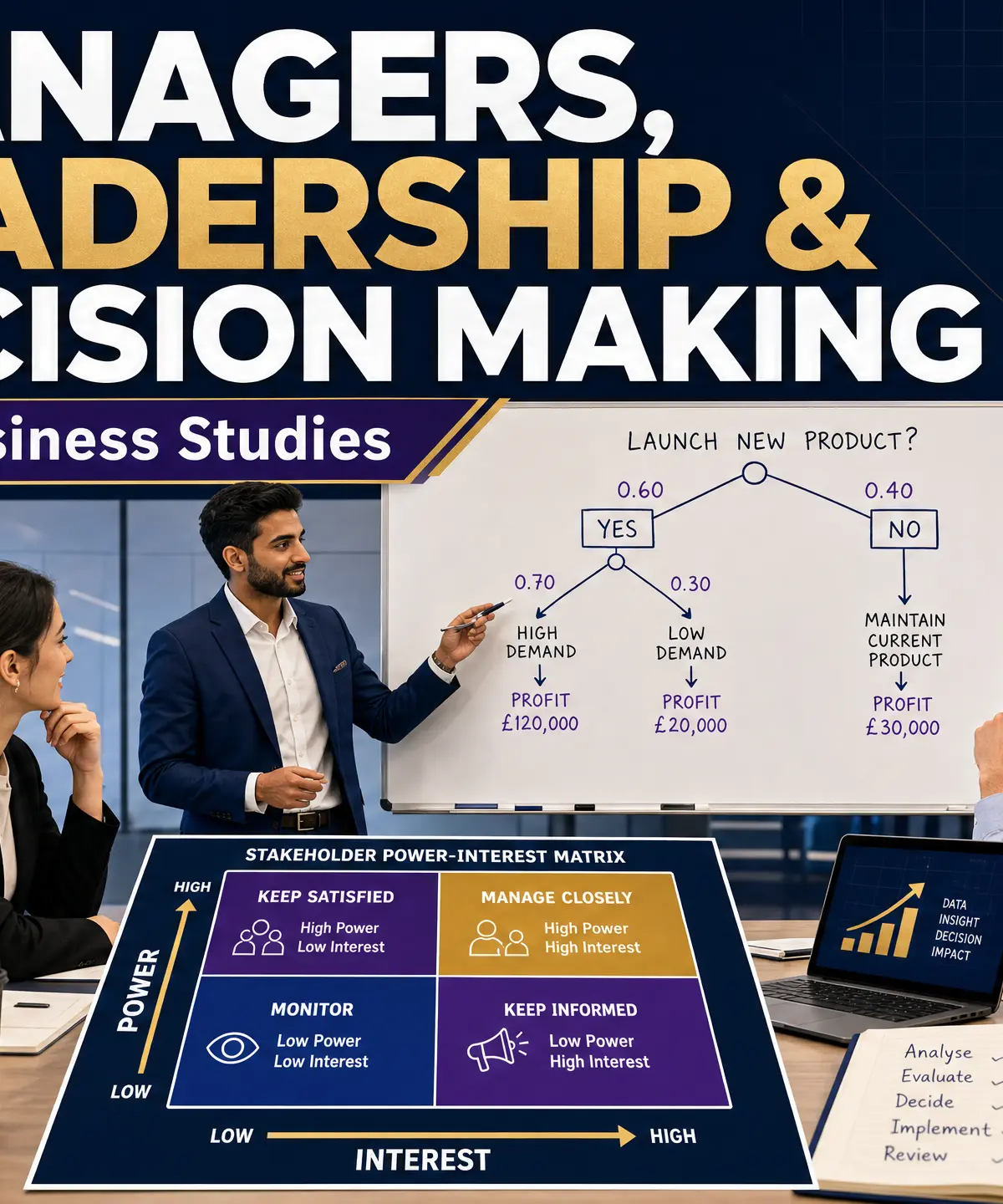
Management vs Leadership
Managers
Role: Organise resources (people, money, time, equipment) to achieve business objectives.
Key Actions: Planning, coordinating, and controlling.
Impact: Ensure the day-to-day operations run smoothly and efficiently. "Managers do things right."
Leaders
Role: Inspire and motivate people.
Key Actions: Setting a vision, taking risks, and getting others to follow them.
Impact: Drive change and set the strategic direction of the business. "Leaders do the right things."
Leadership Styles
Examiners expect you to know four main styles and be able to recommend the most appropriate one for a given scenario.
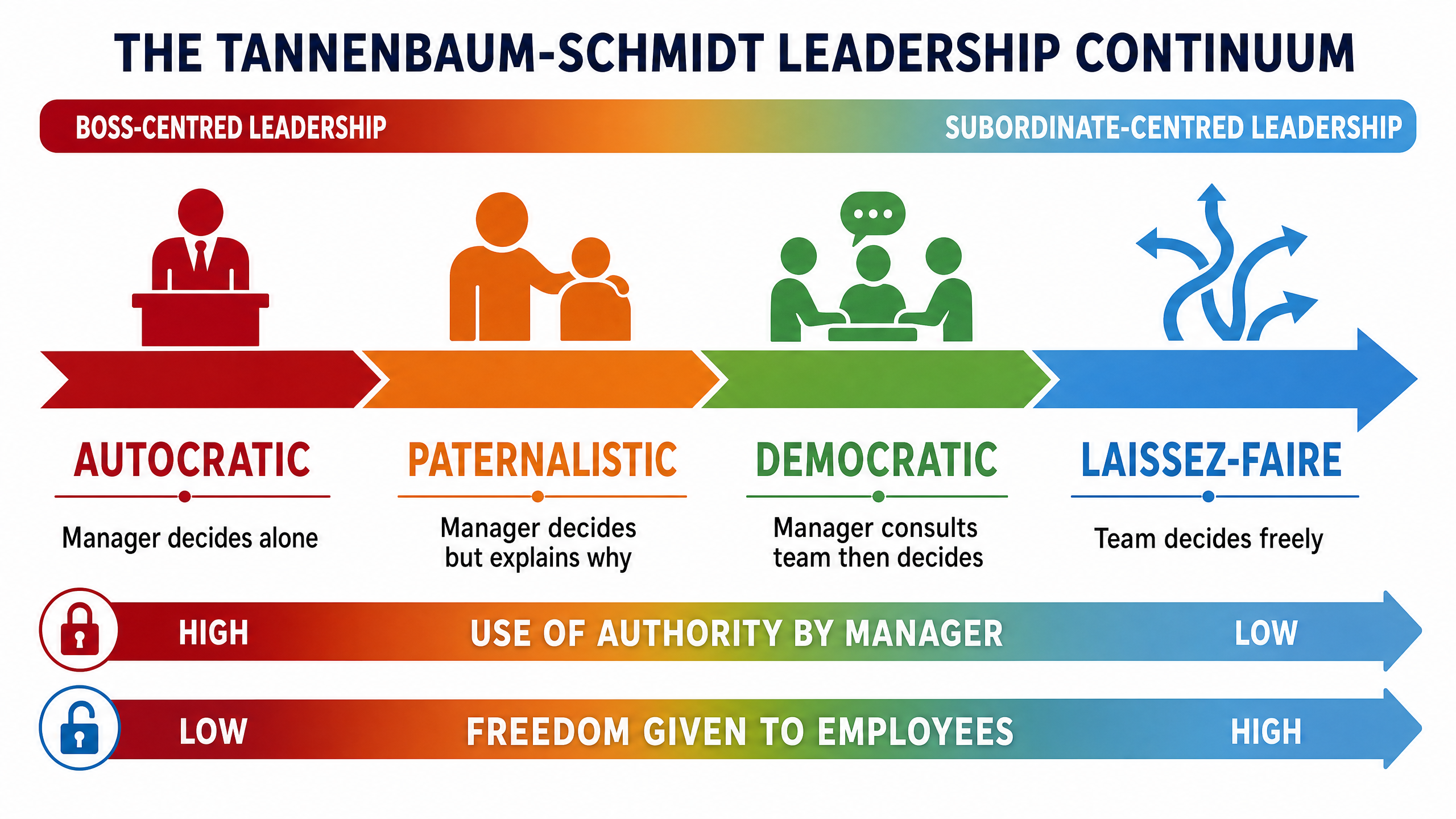
- Autocratic: The manager makes all decisions alone. Communication is one-way (top-down). Best for crisis situations or with unskilled workers, but can demotivate staff over time.
- Paternalistic: The manager makes decisions but explains why, showing care for employee wellbeing. Builds loyalty but limits real employee influence.
- Democratic: The manager consults the team widely before deciding. Boosts motivation and creativity, but decision-making can be slow.
- Laissez-faire: Employees have maximum freedom to make decisions. Best for highly skilled professionals, but risky if staff lack direction.
The Tannenbaum-Schmidt Continuum
This model shows that leadership style is not fixed; it exists on a spectrum from boss-centred to subordinate-centred leadership.
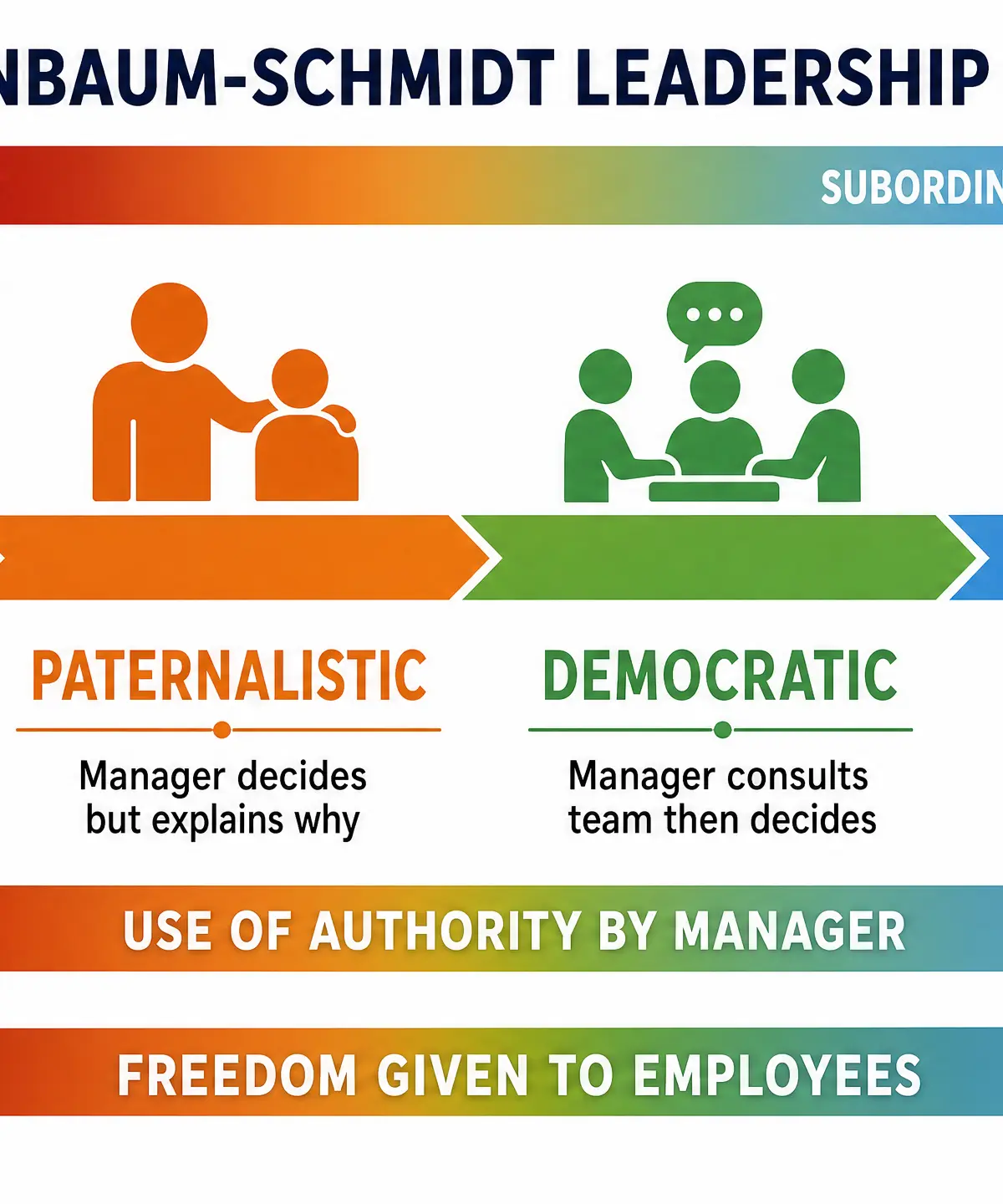
Effective leaders adapt their style based on:
- The urgency of the decision
- The skill and experience of the team
- The nature of the task
- The culture of the organisation
Scientific Decision Making
Businesses use a structured approach to reduce risk: identify the problem, gather data, generate options, evaluate using quantitative tools, decide, implement, and review.
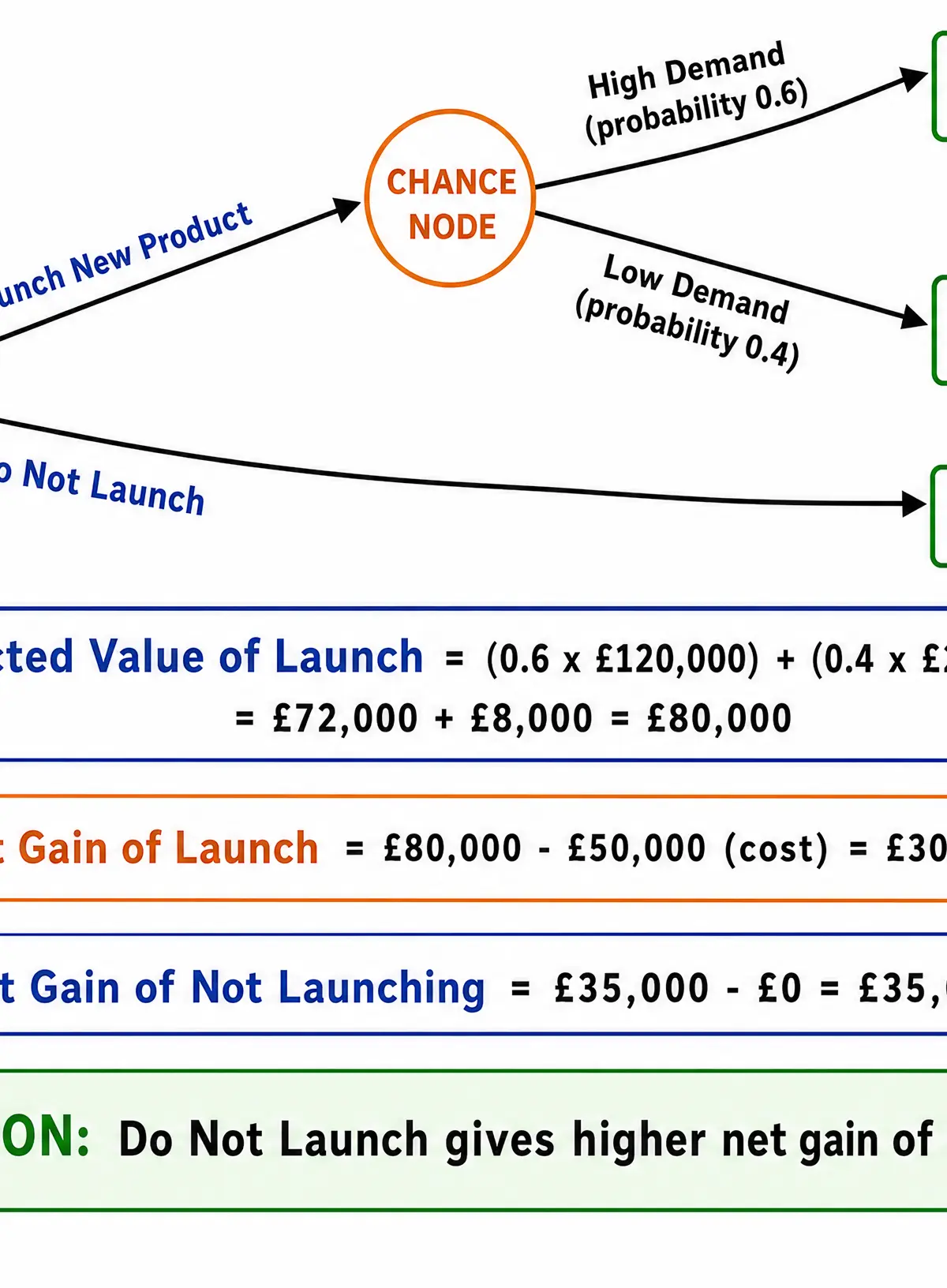
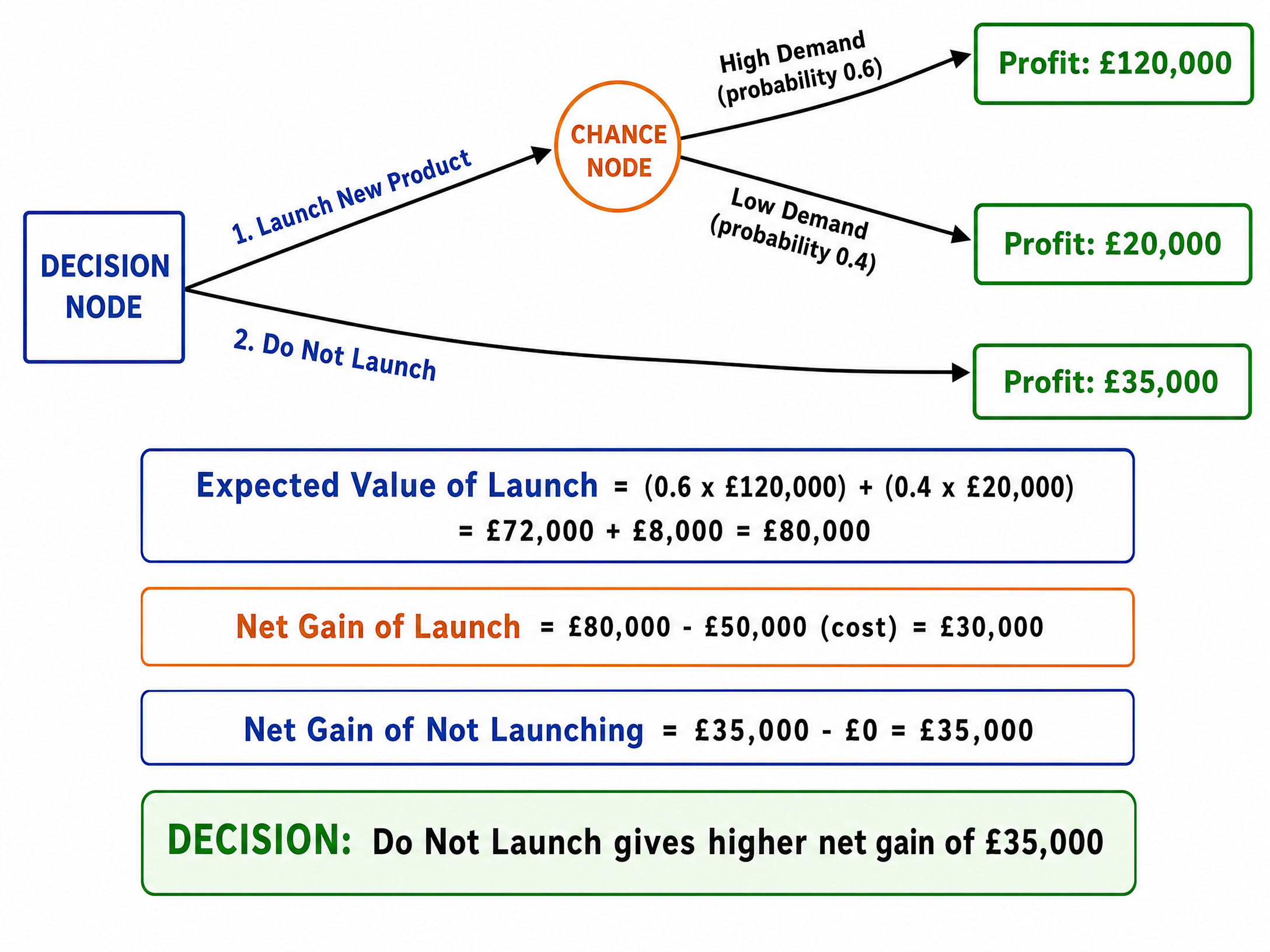
The most important quantitative tool is the Decision Tree.
- Square nodes: Decision points
- Circle nodes: Chance events (with probabilities)
- Expected Value: (Probability of outcome A × Financial value of A) + (Probability of outcome B × Financial value of B)
- Net Gain: Expected Value - Cost of the decision
Factors Influencing Decision Making
- Risk: The measurable chance of a negative outcome.
- Uncertainty: When probabilities cannot be reliably estimated.
- Opportunity Cost: The value of the next best alternative given up. Always include this in evaluation answers.
- Intuitive Decision Making: Relying on experience and gut feeling rather than data.
Stakeholder Mapping
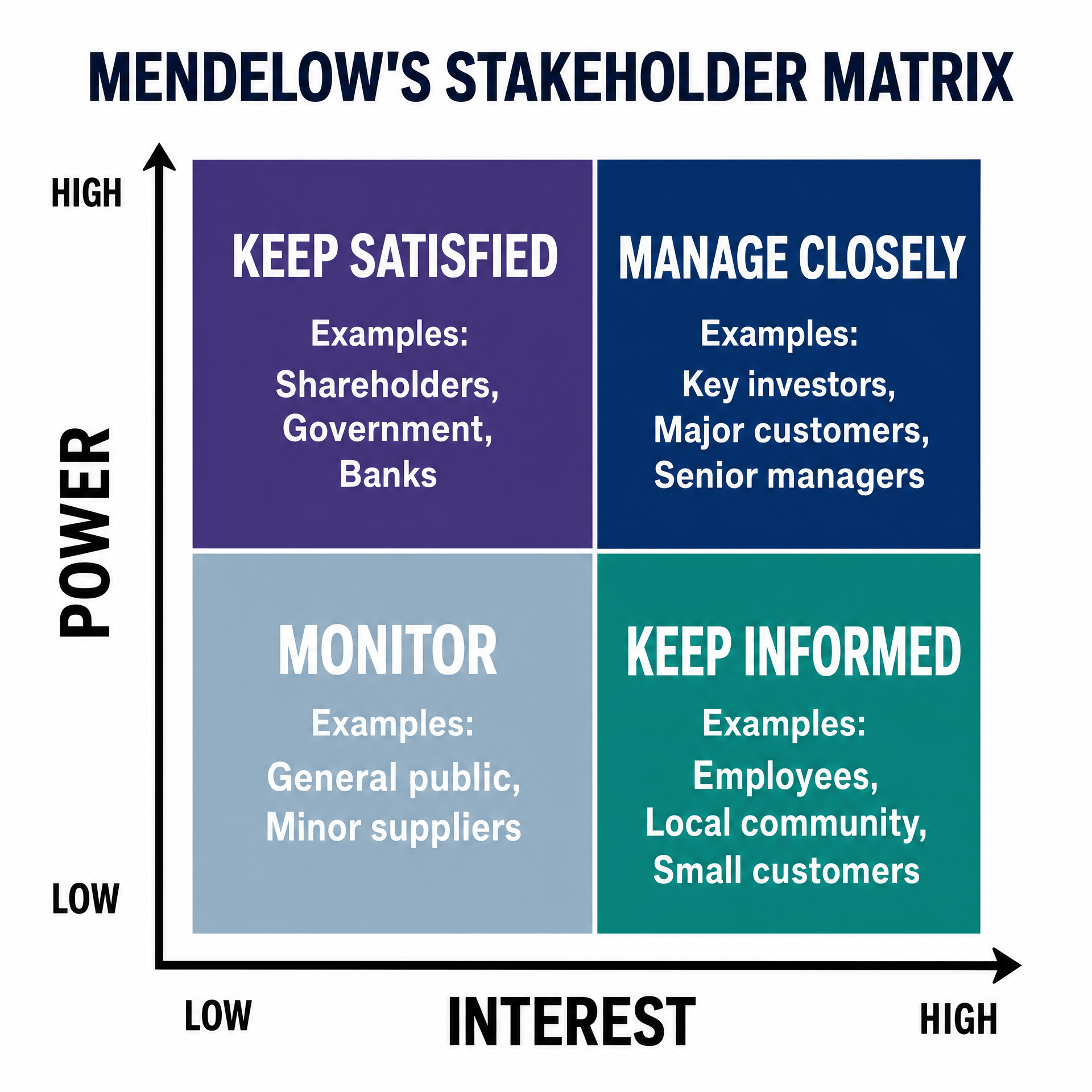
A stakeholder is any individual or group with an interest in the business. Mendelow's Matrix maps them by Power and Interest.
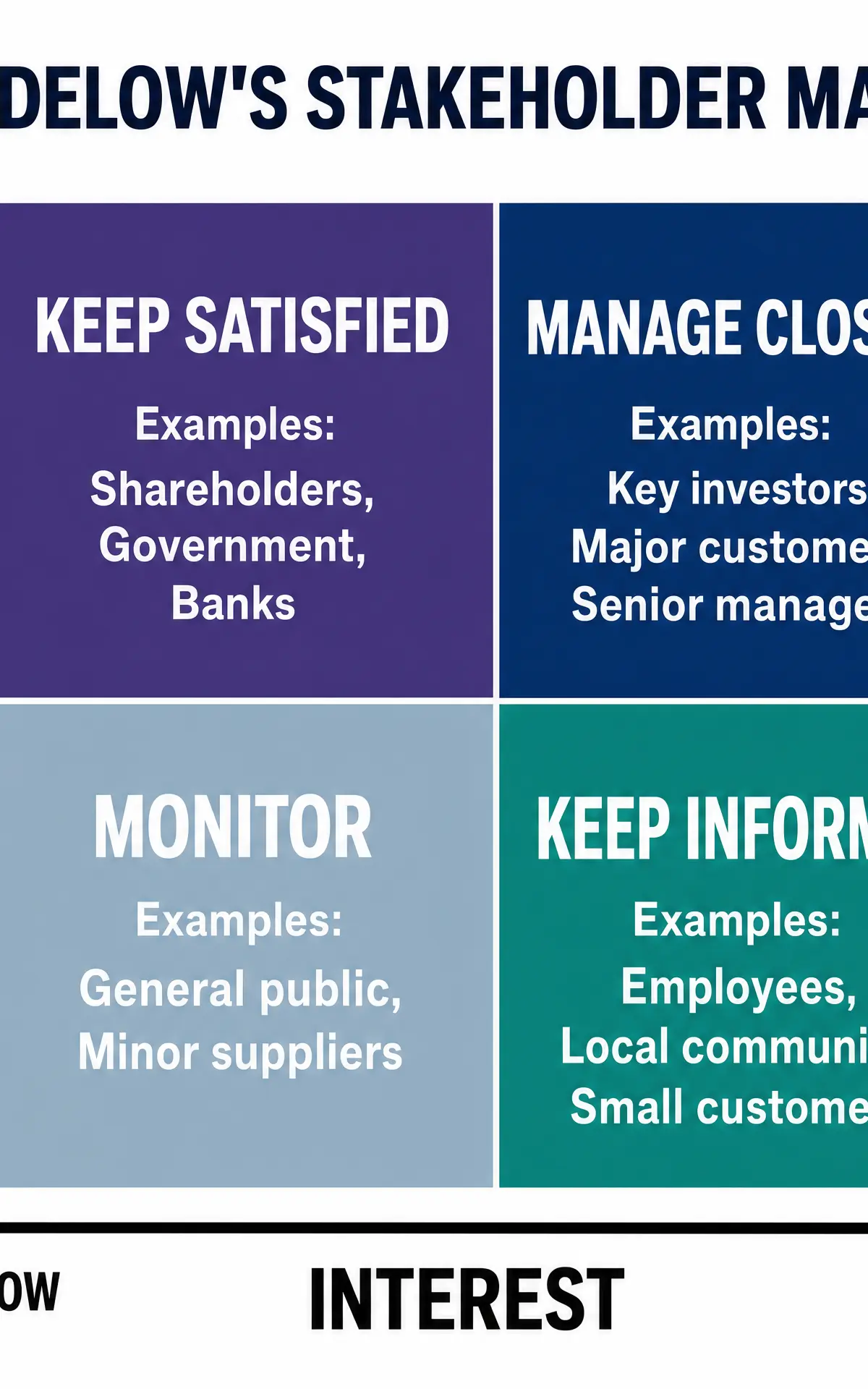
- High Power, High Interest: Manage closely (e.g., major investors)
- High Power, Low Interest: Keep satisfied (e.g., government)
- Low Power, High Interest: Keep informed (e.g., local community)
- Low Power, Low Interest: Monitor (e.g., general public)
Podcast Episode
Listen to our comprehensive audio guide on this topic, covering all key concepts, exam tips, and a quick-fire recall quiz.

Visual Resources
3 diagrams and illustrations
Interactive Diagrams
1 interactive diagram to visualise key concepts
Conceptual Flow Outline
The Scientific Decision Making Process
Worked Examples
3 worked examples — open one to explore the question and available guidance.
Practice Questions
Test your understanding — click to reveal model answers
State two differences between a manager and a leader. (2 marks)
Hint: Think about their main focus: operational vs strategic.
Explain how a business might use Mendelow's Matrix to manage a local community group protesting against a factory expansion. (4 marks)
Hint: Determine the power and interest level of the protesting group.
A tech startup employs 15 highly skilled software developers. Recommend the most appropriate leadership style for the CEO to use. Justify your answer. (9 marks)
Hint: Consider the nature of the workforce and the type of work they do.
Calculate the expected value if an option has a 30% chance of generating £50,000 and a 70% chance of generating £10,000. (2 marks)
Hint: Multiply each probability by its financial value and add them together.
Explain the concept of opportunity cost using an example of a business deciding to invest in a new IT system. (3 marks)
Hint: Define the term and apply it directly to the IT system scenario.