AQA · A-Level · Business
What is business?
This essential GCSE Business guide explores the fundamental nature of business, why they exist, their objectives, and the legal structures they choose. Master the key formulas for revenue, costs, and profit while understanding how the dynamic external environment impacts day-to-day operations to secure top marks.
- 18 min read
- 3 worked examples
- 5 practice questions
- 6 key terms
Study Notes
Overview: The Nature of Business Activity
This unit introduces the foundational principles of business activity, examining why businesses are established, how they set objectives, and the legal forms they adopt. At its most fundamental level, business activity exists to satisfy human needs and wants. A need is an essential item required for survival, such as water, food, shelter, and clothing. A want is a luxury item that is desirable but not essential, such as a smartphone, a designer handbag, or a luxury holiday. Businesses combine the factors of production (land, labour, capital, and enterprise) to produce goods or provide services that meet these needs and wants.
Understanding the distinction between goods and services is crucial for GCSE success:
- Goods are physical, tangible items that can be touched and held, such as a loaf of bread, a car, or a pair of shoes.
- Services are non-physical, intangible activities provided by other people, such as a haircut, a bus journey, or internet access.
Senior examiners frequently test candidates on their ability to analyze why a business might choose or change its legal structure, and how external factors—such as interest rates, competition, and demographic shifts—influence operational decisions, demand, and costs. Candidates must be able to apply these concepts to real-world business scenarios to secure high marks.
Section 1: Business Objectives and Their Dynamic Nature
Every business requires clear direction, which is provided through its objectives. Objectives are specific, measurable targets that a business sets itself to achieve within a given timeframe. They act as a roadmap for decision-making and allow the business to measure its success.
Core Business Objectives
GCSE candidates must be able to define, explain, and apply the following five core business objectives:
- Survival: This is the primary objective for almost all new start-up businesses. Survival involves ensuring that the business has enough cash coming in to pay its immediate bills, such as rent, wages, and suppliers. Therefore, a start-up must focus on staying afloat rather than making massive profits during the initial trading period.
- Profit Maximisation: Profit is the ultimate reward for business owners and entrepreneurs for taking risks. Profit maximisation means making as much profit as possible over a given period. This is achieved by either maximizing sales revenue, minimizing costs, or both. For private sector businesses, profit is a critical objective because it funds dividend payments and provides retained profit for reinvestment.
- Growth and Market Share: Growth involves expanding the scale of a business's operations. This can be organic (e.g., opening new stores, hiring more staff, or launching new products) or inorganic (e.g., merging with or taking over another business). Market share is the percentage of total sales in a market that is made by one business. It is calculated as:
\text{Market Share (%)} = \left( \frac{\text{Sales of One Business}}{\text{Total Market Sales}} \right) \times 100
A larger market share gives a business more power over suppliers and competitors, allowing it to benefit from economies of scale. - Cash Flow: Cash flow refers to the continuous movement of money into and out of a business. A business can be highly profitable on paper but still fail if it runs out of cash to pay its day-to-day expenses (insolvency). Managing cash flow is a vital operational objective to ensure liquidity.
- Social, Ethical, and Environmental Objectives: Many modern businesses set objectives that go beyond financial gain. These involve operating in a way that benefits society, treats employees fairly, and protects the environment. Examples include reducing carbon emissions, minimizing plastic packaging, paying employees a living wage, or sourcing raw materials from Fairtrade suppliers.
Why Objectives Conflict
Examiners frequently reward candidates who can analyze how different business objectives can conflict with one another. A business cannot always achieve all of its goals simultaneously:
- Profit vs. Social/Ethical Objectives: Sourcing organic, Fairtrade ingredients or using 100% recyclable packaging increases a business's variable costs. This rise in total costs reduces the profit margin per unit, directly conflicting with the goal of profit maximisation.
- Growth vs. Cash Flow: Rapid expansion requires significant cash outflows for premises, equipment, and stock. This heavy investment can drain cash reserves, creating severe cash flow difficulties in the short term.
How Objectives Change Over Time
A business's objectives are not static; they evolve as the business matures and as the external environment changes:
- Start-up: The focus is entirely on survival and establishing a loyal customer base.
- Established: Once survival is secured and cash flow stabilizes, the business pivots toward profit maximisation to reward the owners.
- Expansion: The business reinvests profits to focus on growth and increasing market share.
- Maturity: As a business becomes a dominant market leader, it may place greater emphasis on social and ethical objectives to protect its reputation and meet corporate social responsibility (CSR) standards.
Section 2: Legal Forms of Business Ownership
When establishing a business, an entrepreneur must decide on its legal structure. This decision affects how the business raises finance, who controls decision-making, how profits are shared, and the level of personal financial risk the owners face.
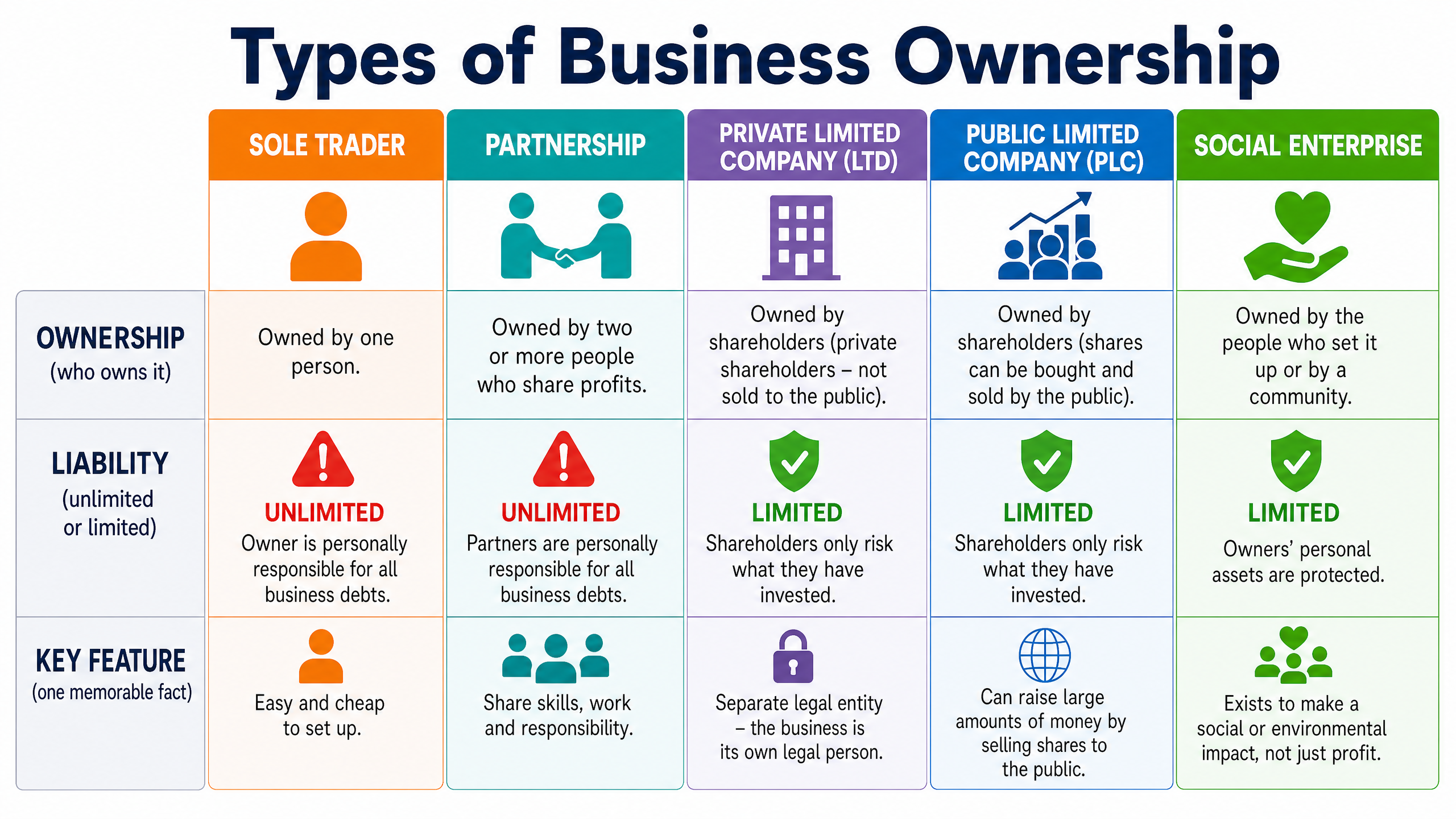
Unincorporated Businesses (Unlimited Liability)
An unincorporated business is one where there is no legal distinction between the business and its owners. This leads to the critical concept of unlimited liability:
Unlimited Liability: The legal obligation where the owners of a business are personally responsible for all debts incurred by the business. If the business fails and cannot pay its creditors, the owners' personal assets (such as their home, car, and personal savings) can be legally seized and sold to settle the debts.
1. Sole Traders
A sole trader is an individual who owns and runs a business alone.
- Advantages: Easy and cheap to set up; complete control over all decisions; retention of all profits; complete privacy as financial accounts do not have to be published publicly.
- Disadvantages: Unlimited liability; limited sources of finance; heavy workload; lack of continuity if the owner falls ill or dies.
2. Partnerships
A partnership is a business structure where between 2 and 20 people share ownership and responsibility for running the business.
- Advantages: Shared skills and workload; more capital can be raised as multiple partners can pool their personal savings; shared decision-making and support.
- Disadvantages: Joint and several unlimited liability; potential for conflict over business direction; profits must be shared; lack of continuity if a partner leaves or dies.
Incorporated Businesses (Limited Liability)
An incorporated business is one that has gone through the legal process of incorporation to become a separate legal entity from its owners. This leads to the concept of limited liability:
Limited Liability: The legal protection where shareholders are only liable for the debts of the business up to the value of their investment in shares. If the business fails, the shareholders' personal assets are fully protected. They can only lose the money they originally spent purchasing their shares.
3. Private Limited Companies (Ltd)
A private limited company is owned by shareholders, who buy shares in the business. Shares can only be sold privately to family, friends, or selected investors.
- Advantages: Limited liability; easier to raise finance by selling shares to new private investors; separate legal identity (continuity); increased credibility with suppliers.
- Disadvantages: Complex and expensive to set up; loss of privacy as accounts must be submitted annually and are publicly available; dividends must be shared with investors; cannot sell shares privately.
4. Public Limited Companies (PLC)
A public limited company is a large corporation owned by shareholders, where shares are listed and traded publicly on a stock exchange.
- Advantages: Enormous capital raising potential by issuing new shares to the public; ability to achieve economies of scale; high prestige and market dominance.
- Disadvantages: High setup costs; risk of hostile takeover if a rival buys a controlling interest (51%+); extreme regulation and scrutiny; divorce of ownership and control.
Alternative Business Forms
5. Social Enterprises
A social enterprise is a business that trades for social, community, or environmental purposes. They reinvest their profits back into their social mission rather than distributing them to shareholders. A classic example is The Big Issue, which employs homeless people to sell magazines, or Divine Chocolate, which is co-owned by cocoa farmers to ensure fair trade.
6. Public vs. Private Sector
Candidates must distinguish between the two sectors of the UK economy:
- Private Sector: Businesses owned and run by private individuals or shareholders. Their primary goal is usually profit maximisation (e.g., Apple, local shops, Ltds, PLCs).
- Public Sector: Organisations owned, funded, and run by the government on behalf of the public. Their primary goal is to provide essential services to society, free or subsidized at the point of use, rather than making a profit (e.g., the NHS, state schools, BBC, police force).
Section 3: Financial Mechanics: Revenue, Costs, and Profit
A thorough understanding of business finance is mandatory. Examiners frequently include calculation questions in Section A and B of the exam papers. Showing formulas, working, and correct units is essential to secure maximum marks.
1. Revenue
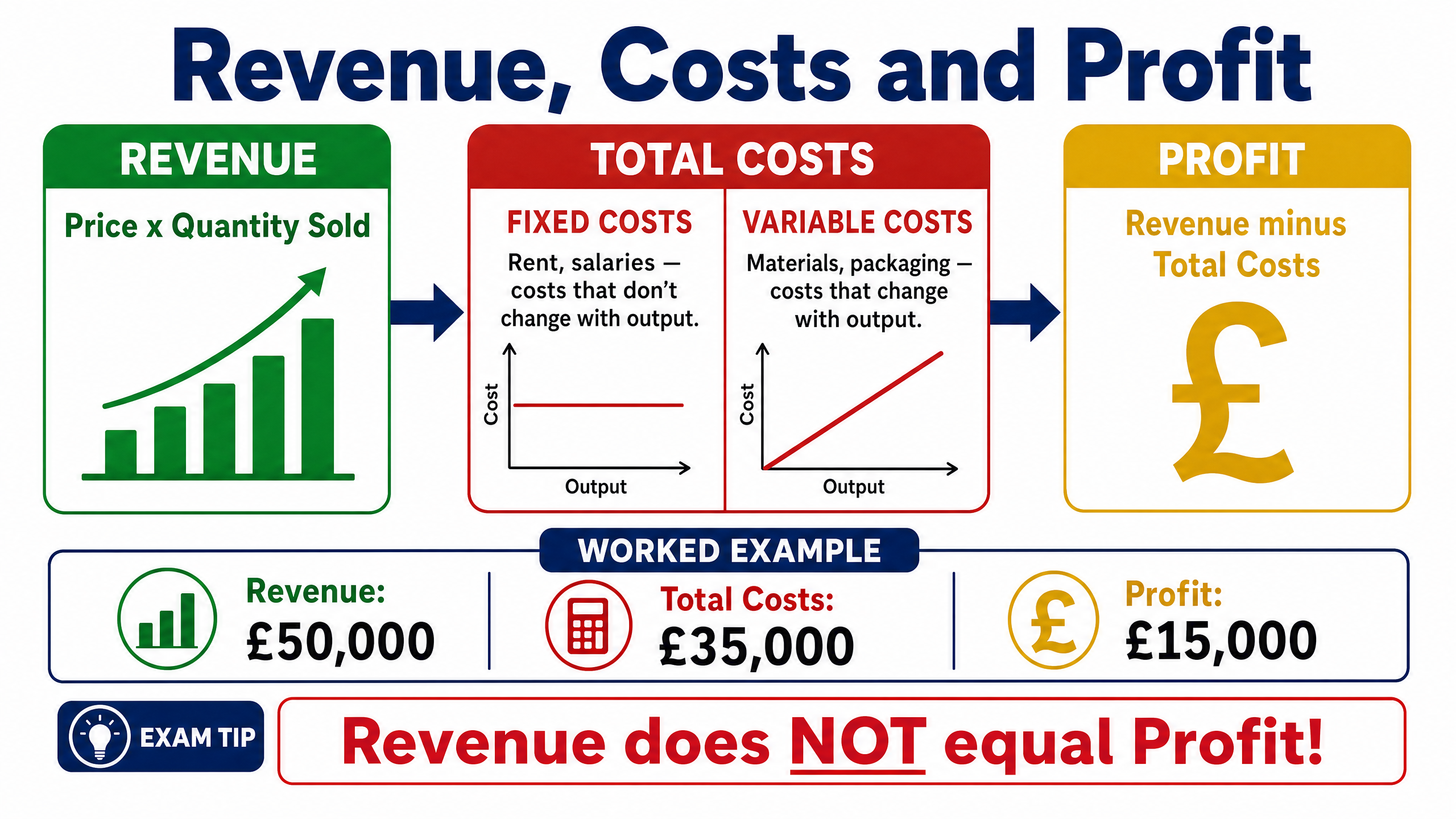
Revenue is the total amount of money a business receives from selling its goods or services over a period of time.
The Revenue Formula:
\text{Revenue} = \text{Selling Price per Unit} \times \text{Quantity Sold}
- Worked Example: If a specialty coffee shop sells 450 cups of artisan coffee in a day at a price of £3.50 per cup, its daily revenue is:
\text{Revenue} = \pounds3.50 \times 450 = \pounds1,575 - Examiner Warning: Revenue is NOT profit. Revenue is the total cash inflow from sales before any expenses or costs have been deducted. Never use the word 'money made' in an exam; use 'revenue received' or 'profit generated'.
2. Costs
A business must spend money to operate. These expenses are called costs. For exam purposes, costs are classified into two main categories based on how they behave when output changes:
A. Fixed Costs (FC)
Fixed costs are expenses that do not change when the level of output or sales changes. They must be paid even if the business produces absolutely nothing.
- Examples: Factory rent, business rates, manager salaries, insurance, interest on bank loans.
- Key Concept: If a bakery produces 0 loaves of bread or 10,000 loaves of bread, its landlord still charges the exact same rent. On a graph, fixed costs are represented as a flat, horizontal line.
B. Variable Costs (VC)
Variable costs are expenses that change directly in proportion to the level of output or sales. If output increases, variable costs increase. If output is zero, variable costs are zero.
- Examples: Raw materials, packaging, petrol for delivery vans, piece-rate wages for factory workers.
- The Variable Cost Formula:
\text{Total Variable Cost} = \text{Variable Cost per Unit} \times \text{Quantity Produced} - Worked Example: If the raw ingredients and packaging for one cake cost £1.20, and the bakery produces 800 cakes, the total variable cost is:
\text{Total Variable Cost} = \pounds1.20 \times 800 = \pounds960
C. Total Costs (TC)
Total costs represent the sum of all expenses incurred by a business to produce a given level of output.
The Total Costs Formula:
\text{Total Costs} = \text{Fixed Costs} + \text{Total Variable Costs}
- Worked Example: If a bakery has monthly fixed costs of £3,500 and produces 1,500 cakes with a variable cost of £1.50 per cake:
\text{Total Variable Cost} = \pounds1.50 \times 1,500 = \pounds2,250
\text{Total Costs} = \pounds3,500 + \pounds2,250 = \pounds5,750
3. Profit
Profit is the financial surplus remaining after all of a business's costs have been deducted from its sales revenue. It is the ultimate measure of financial success.
The Profit Formula:
\text{Profit} = \text{Total Revenue} - \text{Total Costs}
- Worked Example: Continuing with the bakery example, if the 1,500 cakes are sold at a price of £6.00 each:
\text{Total Revenue} = \pounds6.00 \times 1,500 = \pounds9,000
Using the total costs calculated above (£5,750):
\text{Profit} = \pounds9,000 - \pounds5,750 = \pounds3,250
Section 4: The Dynamic External Environment
Businesses do not operate in a vacuum. They exist within a dynamic external environment that is constantly changing. Factors outside a business's control can create significant opportunities or pose severe threats. GCSE candidates must be able to analyze how the following six external factors affect business costs and consumer demand.
1. Competition
Competition refers to other businesses offering similar products or services to the same target market.
- Impact on Demand: When competition increases, the original business's demand is likely to fall as customers try the rival. To retain customers, the business may have to lower prices or invest heavily in marketing, which reduces revenue or increases costs.
- Impact on Costs: To compete effectively, a business may need to upgrade its facilities, improve product quality, or offer better customer service. This requires spending on capital investment or training, raising fixed and variable costs.
2. Market Conditions and Consumer Incomes
The state of the economy determines consumer confidence and spending power.
- Economic Boom (Rising Incomes): When the economy is growing, unemployment is low, and consumer incomes rise. Demand for normal goods and luxury goods increases significantly. Businesses can raise prices and enjoy higher sales revenue.
- Economic Recession (Falling Incomes): During a recession, unemployment rises, and disposable incomes fall. Consumers become highly price-sensitive and cut back on luxury spending.
- The Inferior Goods Effect: Interestingly, demand for inferior goods actually increases during a recession as consumers 'trade down' from premium brands to save money.
3. Interest Rates
An interest rate is the cost of borrowing money and the reward for saving money, expressed as a percentage of the total amount. In the UK, interest rates are set by the Bank of England.
- Impact of High Interest Rates:
- On Consumers: Consumers with mortgages or credit card debt face higher monthly repayments. This reduces their disposable income, leading to a fall in demand for non-essential, expensive goods like cars, furniture, and luxury holidays.
- On Businesses: Businesses with outstanding bank loans will see their monthly interest expenses rise, directly increasing their fixed costs and squeezing profit margins. Furthermore, the cost of borrowing to fund expansion projects becomes more expensive, leading businesses to delay investment.
4. Demographic Changes
Demographics refer to the characteristics of a population, such as age, gender, ethnicity, and household size.
- The Ageing Population: The UK has an ageing population, meaning the proportion of elderly people is increasing while the birth rate is falling.
- Opportunities: Businesses selling retirement housing, healthcare, mobility aids, or leisure services for retirees experience a significant increase in demand.
- Threats: Businesses targeting teenagers or babies face a shrinking market and falling demand.
5. Environmental and Ethical Pressures
Society is increasingly concerned about the environmental impact of business activity, including carbon footprints, plastic waste, and ethical sourcing.
- Impact on Costs: To meet consumer expectations and avoid negative publicity, businesses are investing in sustainable packaging, sourcing Fairtrade ingredients, or switching to renewable energy. These ethical choices often carry higher supplier prices, raising variable costs.
- Impact on Demand: Businesses that fail to act sustainably face consumer boycotts and damage to their brand image, leading to a severe fall in demand. Conversely, businesses with strong ethical credentials can use this as a unique selling point (USP) to charge premium prices, boosting revenue.
Section 5: Senior Examiner's Blueprint: Securing Top Marks
To secure a Grade 8 or 9 in GCSE Business, you must understand how examiners award marks. Many students write long, detailed paragraphs but only receive half marks because they fail to demonstrate the specific skills required by the Assessment Objectives (AOs).
The Assessment Objectives (AOs)
GCSE Business exams test three core skills:
| Objective | Skill | What it means | How to earn it |
|---|---|---|---|
| AO1 | Knowledge | Demonstrating accurate knowledge and understanding of business terms, concepts, and formulas. | Provide precise definitions and state correct formulas. Avoid vague, everyday language. |
| AO2 | Application | Applying business knowledge and understanding to a variety of given contexts (case studies). | Use the name of the business, its specific product, its customers, and its competitors in your answer. Never write a generic response. |
| AO3 | Analysis & Evaluation | Analysing business issues (chains of reasoning) and making fully justified, balanced judgements. | Use connective words to build logical chains of cause and effect. Reach a clear conclusion that answers the question. |
The BLT Analytical Chain (For 6 and 9-Mark Questions)
To secure maximum AO3 analysis marks, you must avoid making simple, undeveloped statements. Instead, build a logical chain of cause and effect using the BLT technique:
- B - Because: State your point and explain why it happens.
- L - Leads to: Explain the direct consequence of this point on the business's operations, customers, or employees.
- T - Therefore: Conclude the chain by explaining the final impact on the business's costs, revenue, or profit.
Example of an undeveloped answer (Low Marks):
"An increase in interest rates is bad because consumers have less money to spend, so the business will make less sales."
Example of a high-scoring BLT analytical chain (Full Marks):
"An increase in interest rates means consumers with mortgages will face higher monthly repayments. Because of this, their disposable income will fall, which leads to a reduction in their spending on non-essential items. Therefore, the luxury holiday company will experience a drop in bookings, resulting in a fall in sales revenue and a squeeze on their profit margins."
Podcast Revision Lesson

Listen to this 10-minute audio lesson led by a senior examiner. It covers the core concepts, common exam mistakes, and features a quick-fire recall quiz at the end to test your knowledge!
Visual Resources
2 diagrams and illustrations
Interactive Diagrams
1 interactive diagram to visualise key concepts
Conceptual Flow Outline
The Structure of the UK Economy: Sectors and Business Forms
Worked Examples
3 worked examples — open one to explore the question and available guidance.
Practice Questions
Test your understanding — click to reveal model answers
A business sells 1,200 handmade candles for £15 each. Its fixed costs are £4,500 and variable costs are £4 per candle. Calculate the business's profit. (3 marks)
Hint: First calculate total revenue, then total variable costs, then total costs, and finally subtract total costs from revenue.
Explain one reason why a new business might set 'survival' as its primary objective rather than 'growth'. (3 marks)
Hint: Think about the challenges a brand-new business faces in its first year, especially regarding cash and competition.
Analyse how an increase in consumer incomes might affect a budget supermarket like Aldi. (6 marks)
Hint: Consider whether budget supermarkets sell 'normal' or 'inferior' goods, and how consumer shopping habits change when they have more money.
State two features of a public limited company (PLC). (2 marks)
Hint: Think about how PLCs raise money and who can buy their shares.
Explain the difference between a private sector business and a public sector organisation. (3 marks)
Hint: Who owns them, and what are their primary goals?