AQA · GCSE · Business
Course version: 8132 · Version from Sept 2017
Evaluate which legal structure would be most appropriate for a variety of…
Full specification wording
Business ownership: evaluate which legal structure would be most appropriate for a variety of business examples, including new start-up businesses and large established businesses.
You must judge the best legal structure for different businesses, including new start-ups and large established firms.
Checked against the AQA 8132 specification (opens in a new tab) on .
- Point 9 of 9
- 4 key terms
Study notes
From the checked teaching notes for this specification point.
The idea
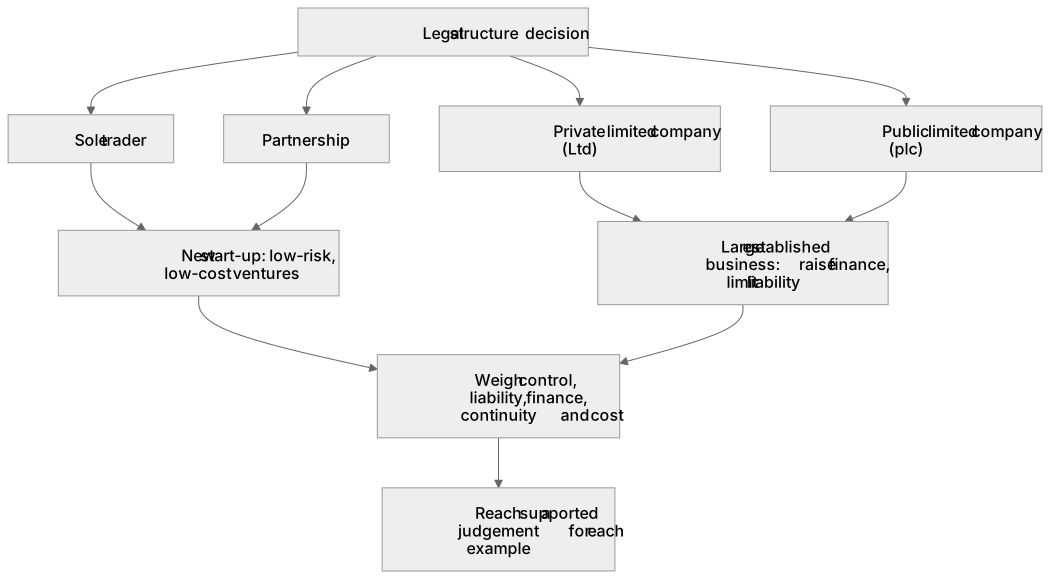
You must judge the best legal structure for different businesses, including new start-ups and large established firms. Consider sole trader, partnership, private limited company (Ltd) and public limited company (plc). Weigh control, liability, finance, continuity and cost. For a new start-up, a sole trader may suit low-risk, low-cost ventures, but a partnership can share skills and capital. A large established business may need a Ltd or plc to raise finance and limit liability, though plc brings disclosure and takeover risk. Reach a supported judgement for each example.
What earns the marks
- Identifies and describes at least two legal structures, such as sole trader, partnership, private limited company (Ltd) and public limited company (plc), using correct business terminology.
- Explains advantages and disadvantages of each structure in context, for example unlimited liability for a sole trader, shared decision-making in a partnership, or ability to sell shares for a plc.
- Applies the structures to a new start-up business, considering factors such as limited finance, owner control, risk and ease of set-up.
- Applies the structures to a large established business, considering factors such as raising capital, limited liability, continuity and public scrutiny.
- Reaches a justified conclusion that compares structures and selects the most appropriate one for each example, using evidence from the context.
Common mistakes and how to put them right
Listing structures without linking them to the business example.
Put it right: Apply each structure to the specific start-up or established business and explain why it fits or does not fit.
Confusing unlimited liability with limited liability.
Put it right: State clearly that sole traders and ordinary partners have unlimited liability, while shareholders in a Ltd or plc have limited liability.
Assuming a plc is always best because it can raise the most finance.
Put it right: Weigh drawbacks such as loss of control, disclosure requirements and cost of incorporation before judging.
Ignoring the new start-up context and recommending a plc.
Put it right: Consider that a new start-up may lack the trading record, finance and scale needed for a plc.
Exam tips
- Use the business context in every paragraph: name the example and link each advantage or disadvantage directly to it.
- Structure your answer around a clear judgement: compare at least two structures, then state which is most appropriate and why.
- Include a counter-argument or limitation to show evaluation, for example why a partnership might still fail despite shared capital.
- Keep your conclusion decisive: avoid sitting on the fence and avoid repeating earlier points without adding judgement.
Try the lesson
The start of the Business ownership: evaluate which legal structure would be most appropriate for a variety of business examples, including new start-up businesses and large established businesses. lesson, made from checked teaching notes for this specification point.
Have a go first
Priya wants to open a small hairdressing salon on her own and keep all of the profit for herself. Which legal structure is most appropriate for Priya's new start-up business?
Listen
You must judge the best legal structure for different businesses, including new start-ups and large established firms. Consider sole trader, partnership, private limited company (Ltd) and public limited company (plc). Weigh control, liability, finance, continuity and cost. For a new start-up, a sole trader may suit low-risk, low-cost ventures, but a partnership can share skills and capital. A large established business may need a Ltd or plc to raise finance and limit liability, though plc brings disclosure and takeover risk. Reach a supported judgement for each example. A strong answer earns marks for these points. Identifies and describes at least two legal structures, such as sole trader, partnership, private limited company (Ltd) and public limited company (plc), using correct business terminology. Explains advantages and disadvantages of each structure in context, for example unlimited liability for a sole trader, shared decision-making in a partnership, or ability to sell shares for a plc. Applies the structures to a new start-up business, considering factors such as limited finance, owner control, risk and ease of set-up. Applies the structures to a large established business, considering factors such as raising capital, limited liability, continuity and public scrutiny. A common slip: Listing structures without linking them to the business example. Instead, apply each structure to the specific start-up or established business and explain why it fits or does not fit. Exam tip: Use the business context in every paragraph: name the example and link each advantage or disadvantage directly to it.
See it
Key words
Say what each word means before you turn the card.
Sole trader
Try answering aloud or in your head before turning the card.
Partnership
Try answering aloud or in your head before turning the card.
Private limited company (Ltd)
Try answering aloud or in your head before turning the card.
Public limited company (plc)
Try answering aloud or in your head before turning the card.
See every definition
- Sole trader
- A legal structure that may suit low-risk, low-cost ventures, and whose owner has unlimited liability.
- Partnership
- A legal structure that can share skills and capital, with shared decision-making and ordinary partners having unlimited liability.
- Private limited company (Ltd)
- A legal structure that may be needed by a large established business to raise finance and limit liability.
- Public limited company (plc)
- A legal structure that can sell shares to raise finance, but brings disclosure and takeover risk.
Label the diagram
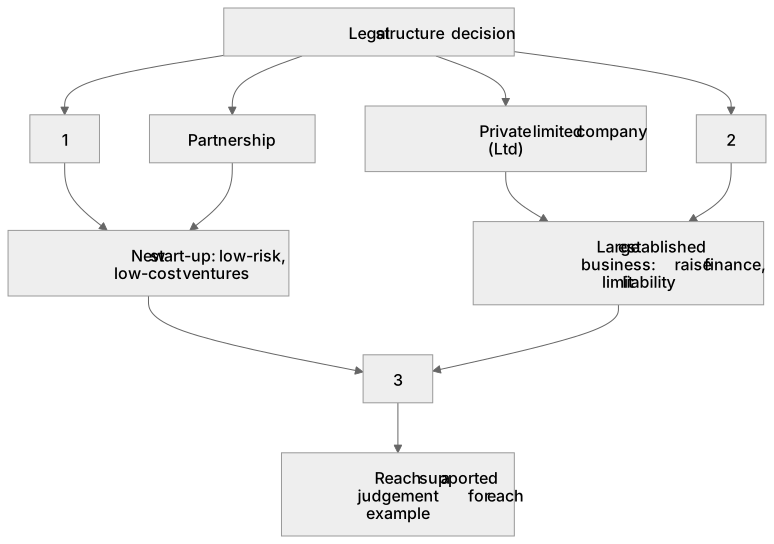
Some boxes have lost their names. Pick the right name for each number.
1Box 1
2Box 2
3Box 3
There is more to this lesson
The full lesson goes on to check your understanding and help you earn the marks. Create a free account to carry on, with your progress saved.
A week of Premium from your first lesson · Then the free plan continues · No card, no charge
Test your understanding of Business ownership: evaluate which legal structure would be most appropriate for a variety of business examples, including new start-up businesses and large established businesses.
Active recall beats re-reading. Take an instant quiz now to test what you’ve learned and lock it into long-term memory.
A week of Premium from your first lesson · Then the free plan continues · No card, no charge