AQA · GCSE · Business
Course version: 8132 · Version from Sept 2017
Impact on businesses of operating in competitive markets
Full specification wording
Competitive environment: Impact on businesses of operating in competitive markets
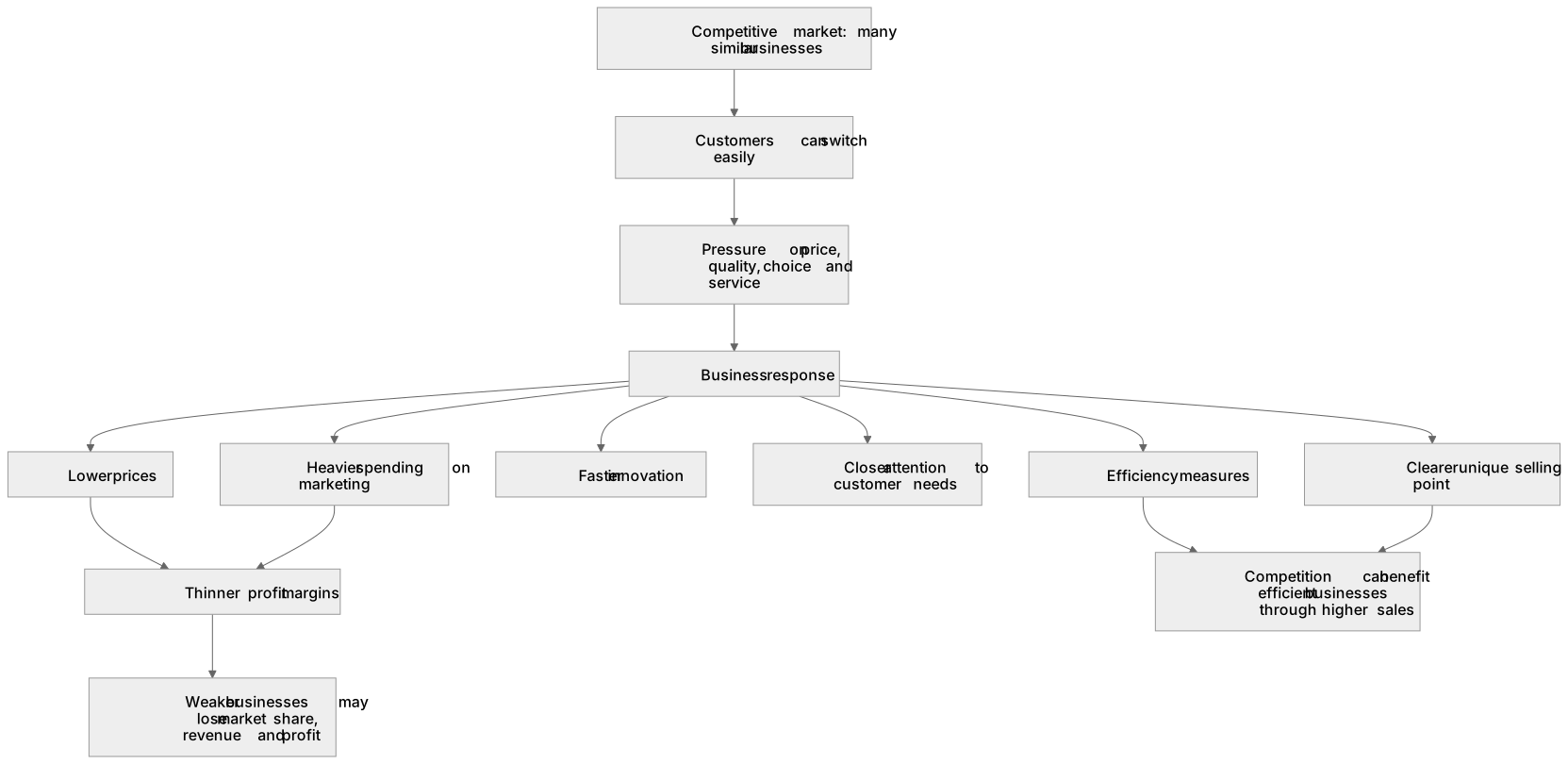
A competitive market has many businesses offering similar goods or services, so customers can switch easily.
Checked against the AQA 8132 specification (opens in a new tab) on .
- Point 1 of 6
- 2 key terms
Study notes
From the checked teaching notes for this specification point.
The idea
A competitive market has many businesses offering similar goods or services, so customers can switch easily. This pressures businesses on price, quality, choice and service. You should be able to explain effects such as lower prices and thinner profit margins, heavier spending on marketing, faster innovation and closer attention to customer needs. Competition can also benefit a business by forcing efficiency and creating a clear unique selling point. For example, a cafe facing three rivals may cut prices, improve its menu and promote loyalty offers, which reduces margin per sale but can raise total sales. Learn to trace a chain from market pressure to a business response and then to a consequence.
What earns the marks
- Competitive markets usually involve several similar businesses, giving customers choice and bargaining power.
- Price competition can reduce prices and profit margins, so businesses must control costs or differentiate.
- Non-price competition includes quality, branding, convenience, customer service and product range.
- Businesses may respond with marketing, innovation, efficiency measures or a clearer unique selling point.
- Competition can benefit customers through lower prices and better quality, and can benefit efficient businesses through higher sales.
- Weaker businesses may lose market share, revenue and profit, and may eventually exit the market.
Common mistakes and how to put them right
Assuming competition only harms businesses.
Put it right by explaining that it can drive efficiency, innovation and stronger customer focus.
Confusing competition with monopoly.
Put it right by noting that a monopoly has little or no rival pressure, while a competitive market has many alternatives.
Listing responses without consequences.
Put it right by linking each response to an effect on sales, costs, profit or market share.
Exam tips
- Use the case study to name the actual rivals or substitutes and the specific pressure they create.
- Develop each point with a consequence, for example lower prices reduce unit profit but may increase sales volume.
- For evaluation questions, weigh benefits such as innovation against drawbacks such as lower margins before judging.
Try the lesson
The start of the Competitive environment: Impact on businesses of operating in competitive markets lesson, made from checked teaching notes for this specification point.
Have a go first
Two cafés open on the same street and both sell similar coffee. Which effect of this competition is most likely for each café?
Listen
A competitive market has many businesses offering similar goods or services, so customers can switch easily. This pressures businesses on price, quality, choice and service. You should be able to explain effects such as lower prices and thinner profit margins, heavier spending on marketing, faster innovation and closer attention to customer needs. Competition can also benefit a business by forcing efficiency and creating a clear unique selling point. For example, a cafe facing three rivals may cut prices, improve its menu and promote loyalty offers, which reduces margin per sale but can raise total sales. Learn to trace a chain from market pressure to a business response and then to a consequence. A strong answer earns marks for these points. Competitive markets usually involve several similar businesses, giving customers choice and bargaining power. Price competition can reduce prices and profit margins, so businesses must control costs or differentiate. Non-price competition includes quality, branding, convenience, customer service and product range. Businesses may respond with marketing, innovation, efficiency measures or a clearer unique selling point. A common slip: Assuming competition only harms businesses. Instead, explaining that it can drive efficiency, innovation and stronger customer focus. Exam tip: Use the case study to name the actual rivals or substitutes and the specific pressure they create.
See it
Key words
Say what each word means before you turn the card.
Price and non-price competition
Try answering aloud or in your head before turning the card.
Business response
Try answering aloud or in your head before turning the card.
See every definition
- Price and non-price competition
- Price competition can reduce prices and profit margins, while non-price competition includes quality, branding, convenience, customer service and product range.
- Business response
- Businesses may respond with marketing, innovation, efficiency measures or a clearer unique selling point.
Label the diagram
Some boxes have lost their names. Pick the right name for each number.
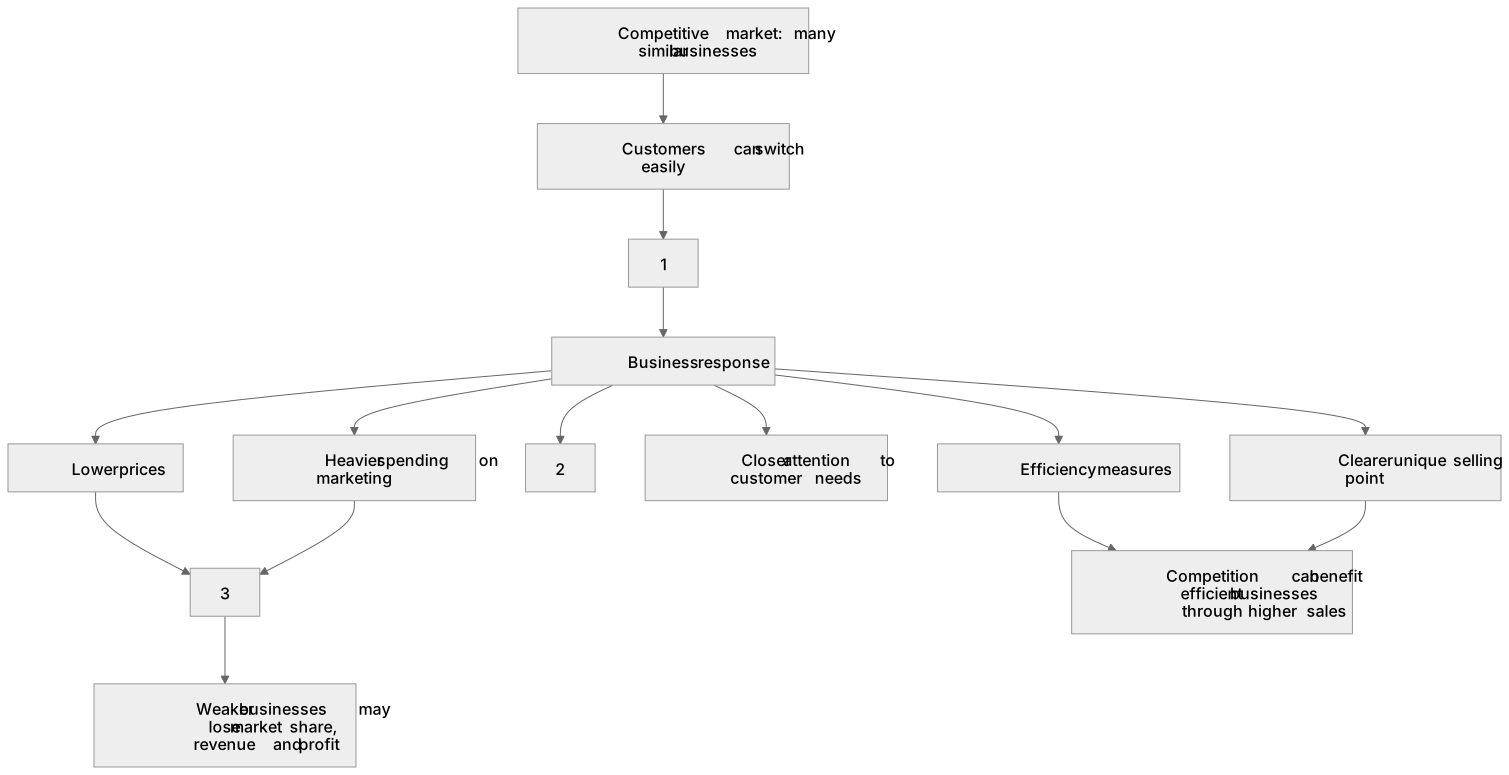
1Box 1
2Box 2
3Box 3
There is more to this lesson
The full lesson goes on to check your understanding and help you earn the marks. Create a free account to carry on, with your progress saved.
A week of Premium from your first lesson · Then the free plan continues · No card, no charge
Test your understanding of Competitive environment: Impact on businesses of operating in competitive markets
Active recall beats re-reading. Take an instant quiz now to test what you’ve learned and lock it into long-term memory.
A week of Premium from your first lesson · Then the free plan continues · No card, no charge