AQA · GCSE · Business
Course version: 8132 · Version from Sept 2017
Financial terms and calculations: Basic financial calculations
Basic financial calculations use the terms revenue, costs and profit to measure business performance.
Checked against the AQA 8132 specification (opens in a new tab) on .
- Point 2 of 10
- 4 key terms
Study notes
From the checked teaching notes for this specification point.
The idea
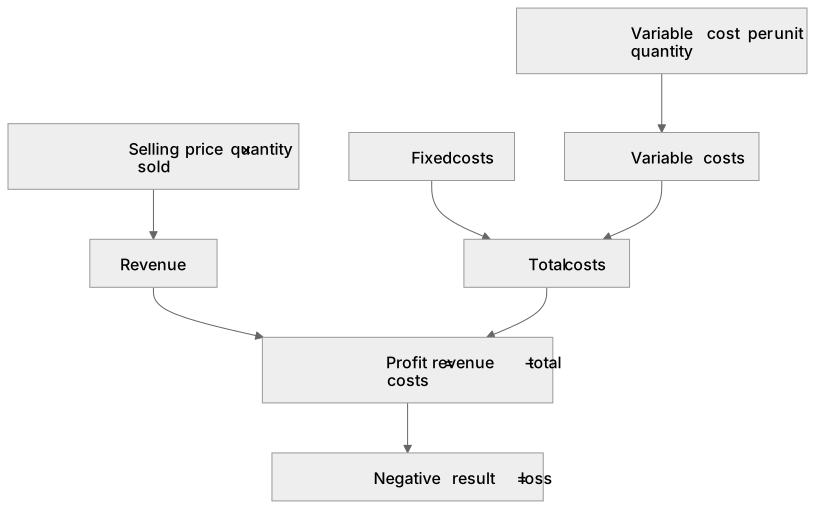
Basic financial calculations use the terms revenue, costs and profit to measure business performance. Revenue is selling price × quantity sold. Total costs are fixed costs + variable costs, where variable costs are variable cost per unit × quantity. Profit is revenue − total costs; a negative result is a loss. These calculations allow a business to check viability and compare options. For example, a firm sells 500 units at £12 each, giving revenue of £6,000. Fixed costs are £2,000 and variable cost per unit is £5, so variable costs are £2,500 and total costs are £4,500. Profit is £6,000 − £4,500 = £1,500. If variable cost per unit rose to £9, variable costs would be £4,500, total costs £6,500 and the result would be a loss of £500. Accurate substitution and units are essential.
What earns the marks
- Revenue is calculated as selling price × quantity sold, with the result expressed in pounds (£).
- Variable costs are calculated as variable cost per unit × quantity produced or sold.
- Total costs are calculated as fixed costs + variable costs.
- Profit is calculated as revenue − total costs; if total costs exceed revenue, the result is a loss.
- Calculations should be set out step by step so that each stage can be followed and checked.
- Units must be consistent: if price is in pounds and quantity is in units, revenue is in pounds; mixing units such as pence and pounds without conversion leads to errors.
Common mistakes and how to put them right
Subtracting only variable costs from revenue instead of total costs.
Put it right by calculating total costs first.
Forgetting to multiply variable cost per unit by the quantity.
Put it right by multiplying before adding fixed costs.
Mixing pounds and pence without converting.
Put it right by converting all money figures to the same unit before calculating.
Omitting units or labelling a loss as a profit.
Put it right: State whether the final figure is a profit or a loss and include the currency symbol.
Exam tips
- Write down the formula you are using before substituting numbers; this makes your method clear and helps secure method marks.
- Check whether the question asks for revenue, total costs or profit, and ensure you have not stopped at an intermediate stage.
- Use a calculator for larger numbers but show the substituted values so the examiner can follow your reasoning.
Try the lesson
The start of the Financial terms and calculations: Basic financial calculations lesson, made from checked teaching notes for this specification point.
Have a go first
A market stall has total revenue of £800 and total costs of £500. Using the profit formula, what is the stall's profit?
Listen
Basic financial calculations use the terms revenue, costs and profit to measure business performance. Revenue is selling price × quantity sold. Total costs are fixed costs + variable costs, where variable costs are variable cost per unit × quantity. Profit is revenue − total costs; a negative result is a loss. These calculations allow a business to check viability and compare options. For example, a firm sells 500 units at £12 each, giving revenue of £6,000. Fixed costs are £2,000 and variable cost per unit is £5, so variable costs are £2,500 and total costs are £4,500. Profit is £6,000 − £4,500 = £1,500. If variable cost per unit rose to £9, variable costs would be £4,500, total costs £6,500 and the result would be a loss of £500. Accurate substitution and units are essential. A strong answer earns marks for these points. Revenue is calculated as selling price × quantity sold, with the result expressed in pounds (£). Variable costs are calculated as variable cost per unit × quantity produced or sold. Total costs are calculated as fixed costs + variable costs. Profit is calculated as revenue − total costs; if total costs exceed revenue, the result is a loss. A common slip: Subtracting only variable costs from revenue instead of total costs: profit requires revenue minus total costs, which include fixed costs. Instead, calculating total costs first. Exam tip: Write down the formula you are using before substituting numbers; this makes your method clear and helps secure method marks.
See it
Key words
Say what each word means before you turn the card.
Revenue
Try answering aloud or in your head before turning the card.
Total costs
Try answering aloud or in your head before turning the card.
Profit
Try answering aloud or in your head before turning the card.
Variable costs
Try answering aloud or in your head before turning the card.
See every definition
- Revenue
- Selling price × quantity sold, with the result expressed in pounds (£).
- Total costs
- Fixed costs + variable costs, where variable costs are variable cost per unit × quantity.
- Profit
- Revenue − total costs; if total costs exceed revenue, the result is a loss.
- Variable costs
- Variable cost per unit × quantity produced or sold.
Label the diagram
Some boxes have lost their names. Pick the right name for each number.
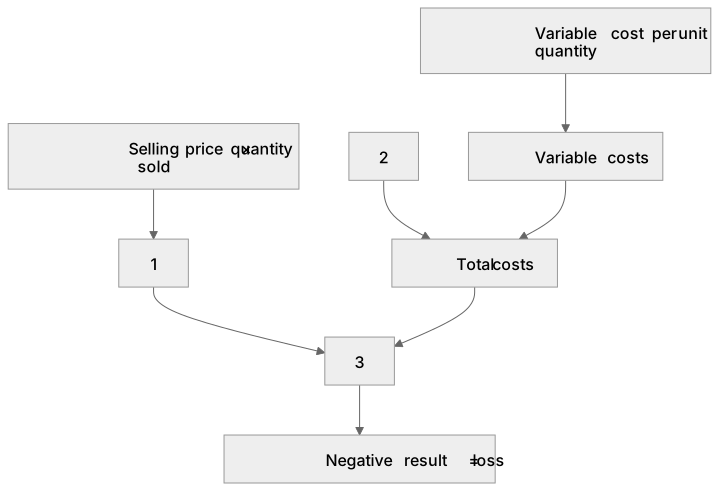
1Box 1
2Box 2
3Box 3
There is more to this lesson
The full lesson goes on to check your understanding and help you earn the marks. Create a free account to carry on, with your progress saved.
A week of Premium from your first lesson · Then the free plan continues · No card, no charge
Test your understanding of Financial terms and calculations: Basic financial calculations
Active recall beats re-reading. Take an instant quiz now to test what you’ve learned and lock it into long-term memory.
A week of Premium from your first lesson · Then the free plan continues · No card, no charge