AQA · GCSE · Business
Course version: 8132 · Version from Sept 2017
Globalisation: How UK businesses compete internationally, offering:
UK businesses compete internationally by choosing an appropriate offering.
Checked against the AQA 8132 specification (opens in a new tab) on .
- Point 1 of 5
- 4 key terms
Study notes
From the checked teaching notes for this specification point.
The idea
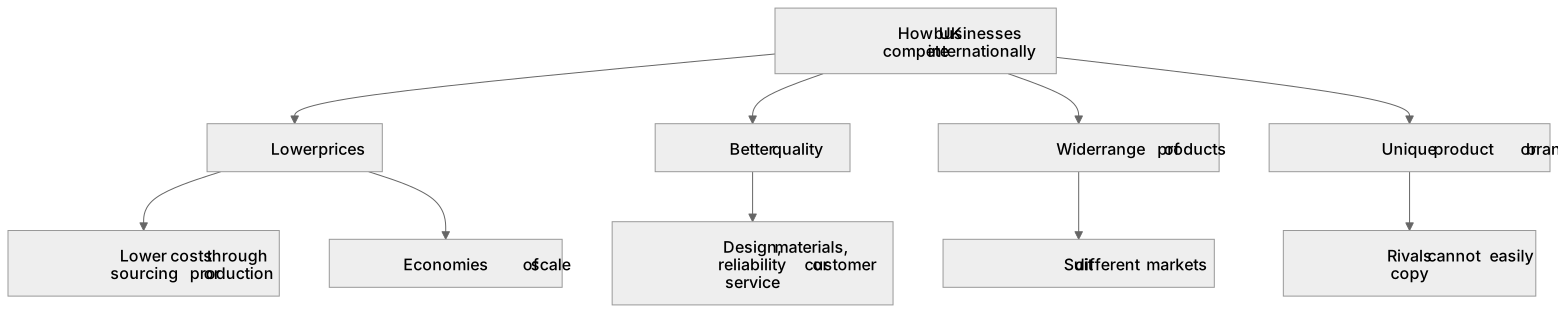
UK businesses compete internationally by choosing an appropriate offering. They may offer lower prices by sourcing or producing where costs are lower, or by achieving economies of scale. They may offer better quality through design, materials, reliability or customer service. They may offer a wider range of products to suit different markets, or a unique product or brand that rivals cannot easily copy. For example, a UK clothing firm might sell online at competitive prices, while a UK engineering firm might win contracts by offering high-quality, customised equipment. The best choice depends on costs, target customers, competitors and the firm's strengths. Competing internationally is assessed through questions that ask students to explain or analyse how a named offering helps a UK business win sales abroad.
What earns the marks
- Better quality can help a UK business compete internationally by building a reputation for reliability, performance or design, which can justify a higher price and encourage repeat purchases from overseas customers.
- A wider range of products can help a UK business compete internationally by meeting the different needs and preferences of customers in several countries, increasing the number of potential buyers.
- A unique product or brand can help a UK business compete internationally by differentiating it from rivals, reducing direct price competition and making customers willing to pay more.
Common mistakes and how to put them right
Assuming that competing internationally always means charging the lowest price.
Put it right: Lower price is only one possible offering; better quality, wider range or a unique product or brand can also win international sales.
Treating all overseas markets as identical.
Put it right: Customer needs, incomes and competitors differ between countries, so the offering should be matched to the market.
Listing an offering without explaining how it helps the business compete.
Put it right: Each point should show the link between the offering and the reason overseas customers choose the business.
Exam tips
- Read the question carefully to identify which offering is being asked about, then apply it to the named UK business or market rather than writing generally.
- Use connectives such as because, therefore and which means that to show the chain of reasoning from the offering to international competitiveness.
- Where the question allows a choice, briefly justify why the chosen offering suits the business better than an alternative.
Try the lesson
The start of the Globalisation: How UK businesses compete internationally, offering: lesson, made from checked teaching notes for this specification point.
Have a go first
Which of the following is a common method used by UK businesses to compete internationally?
Listen
UK businesses compete internationally by choosing an appropriate offering. They may offer lower prices by sourcing or producing where costs are lower, or by achieving economies of scale. They may offer better quality through design, materials, reliability or customer service. They may offer a wider range of products to suit different markets, or a unique product or brand that rivals cannot easily copy. For example, a UK clothing firm might sell online at competitive prices, while a UK engineering firm might win contracts by offering high-quality, customised equipment. The best choice depends on costs, target customers, competitors and the firm's strengths. Competing internationally is assessed through questions that ask students to explain or analyse how a named offering helps a UK business win sales abroad. A strong answer earns marks for these points. Lower prices can help a UK business compete internationally when it can reduce costs through cheaper sourcing, efficient production or economies of scale, allowing it to attract price-sensitive customers in overseas markets. Better quality can help a UK business compete internationally by building a reputation for reliability, performance or design, which can justify a higher price and encourage repeat purchases from overseas customers. A wider range of products can help a UK business compete internationally by meeting the different needs and preferences of customers in several countries, increasing the number of potential buyers. A unique product or brand can help a UK business compete internationally by differentiating it from rivals, reducing direct price competition and making customers willing to pay more. A common slip: Assuming that competing internationally always means charging the lowest price. Instead, lower price is only one possible offering; better quality, wider range or a unique product or brand can also win international sales. Exam tip: Read the question carefully to identify which offering is being asked about, then apply it to the named UK business or market rather than writing generally.
See it
Key words
Say what each word means before you turn the card.
International competitiveness
Try answering aloud or in your head before turning the card.
Price and cost advantage
Try answering aloud or in your head before turning the card.
Quality and reputation
Try answering aloud or in your head before turning the card.
Product range and differentiation
Try answering aloud or in your head before turning the card.
See every definition
- International competitiveness
- How UK businesses compete internationally by choosing an appropriate offering, such as lower prices, better quality, a wider range of products or a unique product or brand.
- Price and cost advantage
- Offering lower prices by sourcing or producing where costs are lower, or by achieving economies of scale, which can attract price-sensitive customers in overseas markets.
- Quality and reputation
- Offering better quality through design, materials, reliability or customer service, building a reputation that can justify a higher price and encourage repeat purchases from overseas customers.
- Product range and differentiation
- Offering a wider range of products to suit different markets, or a unique product or brand that rivals cannot easily copy, reducing direct price competition.
Label the diagram
Some boxes have lost their names. Pick the right name for each number.
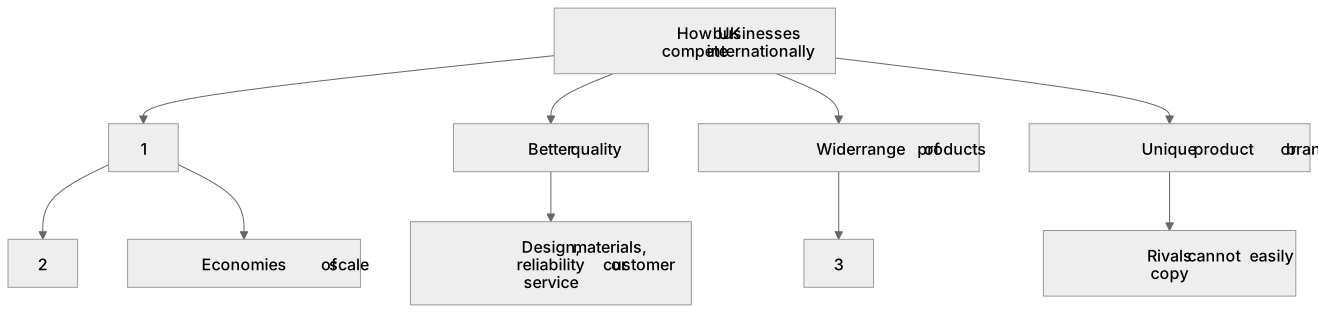
1Box 1
2Box 2
3Box 3
There is more to this lesson
The full lesson goes on to check your understanding and help you earn the marks. Create a free account to carry on, with your progress saved.
A week of Premium from your first lesson · Then the free plan continues · No card, no charge
Test your understanding of Globalisation: How UK businesses compete internationally, offering:
Active recall beats re-reading. Take an instant quiz now to test what you’ve learned and lock it into long-term memory.
A week of Premium from your first lesson · Then the free plan continues · No card, no charge