AQA · GCSE · Business
Course version: 8132 · Version from Sept 2017
Identifying and understanding customers: be competitive.
Being competitive means a business can attract and keep customers better than rivals.
Checked against the AQA 8132 specification (opens in a new tab) on .
- Point 7 of 7
- 4 key terms
Study notes
From the checked teaching notes for this specification point.
The idea
Being competitive means a business can attract and keep customers better than rivals. Understanding customers is central because it reveals what buyers value, such as price, quality, convenience or service. For example, a small bakery might learn that local customers want fresh, affordable lunch options, so it introduces a meal deal that undercuts a nearby supermarket. This helps the bakery compete on value rather than just price. Competitiveness can be achieved through lower prices, better quality, stronger branding, superior customer service or innovation. By identifying customer needs, a business can choose the most effective way to compete and avoid wasting resources on features customers do not want. Ultimately, being competitive supports sales, market share and survival.
What earns the marks
- Defines competitiveness as the ability to attract and retain customers relative to rivals.
- Explains how customer understanding helps a business identify what customers value, such as price or quality.
- Gives an example of a business using customer insight to compete, for example by improving a product or service.
- Links competitiveness to outcomes such as increased sales, market share or customer loyalty.
- Shows that being competitive may involve different strategies, not only low prices.
Common mistakes and how to put them right
Equating being competitive only with having the lowest price.
Put it right: Competitiveness can come from quality, service, convenience or brand.
Thinking that competitiveness is a one-off action.
Put it right: It requires ongoing customer understanding and adaptation.
Ignoring the cost of competing.
Put it right: Strategies to be competitive must be sustainable and affordable for the business.
Exam tips
- Use a specific example to show how customer understanding led to a competitive advantage.
- Explain the link between customer needs and the chosen competitive strategy.
- For higher marks, analyse how being competitive affects market share or long-term survival.
Try the lesson
The start of the Identifying and understanding customers: be competitive. lesson, made from checked teaching notes for this specification point.
Have a go first
A sandwich shop learns that its customers want a cheaper lunch option because a rival shop sells sandwiches for less. Which action would best help the sandwich shop be competitive?
Listen
Being competitive means a business can attract and keep customers better than rivals. Understanding customers is central because it reveals what buyers value, such as price, quality, convenience or service. For example, a small bakery might learn that local customers want fresh, affordable lunch options, so it introduces a meal deal that undercuts a nearby supermarket. This helps the bakery compete on value rather than just price. Competitiveness can be achieved through lower prices, better quality, stronger branding, superior customer service or innovation. By identifying customer needs, a business can choose the most effective way to compete and avoid wasting resources on features customers do not want. Ultimately, being competitive supports sales, market share and survival. A strong answer earns marks for these points. Defines competitiveness as the ability to attract and retain customers relative to rivals. Explains how customer understanding helps a business identify what customers value, such as price or quality. Gives an example of a business using customer insight to compete, for example by improving a product or service. Links competitiveness to outcomes such as increased sales, market share or customer loyalty. A common slip: Equating being competitive only with having the lowest price. Instead, competitiveness can come from quality, service, convenience or brand. Exam tip: Use a specific example to show how customer understanding led to a competitive advantage.
See it
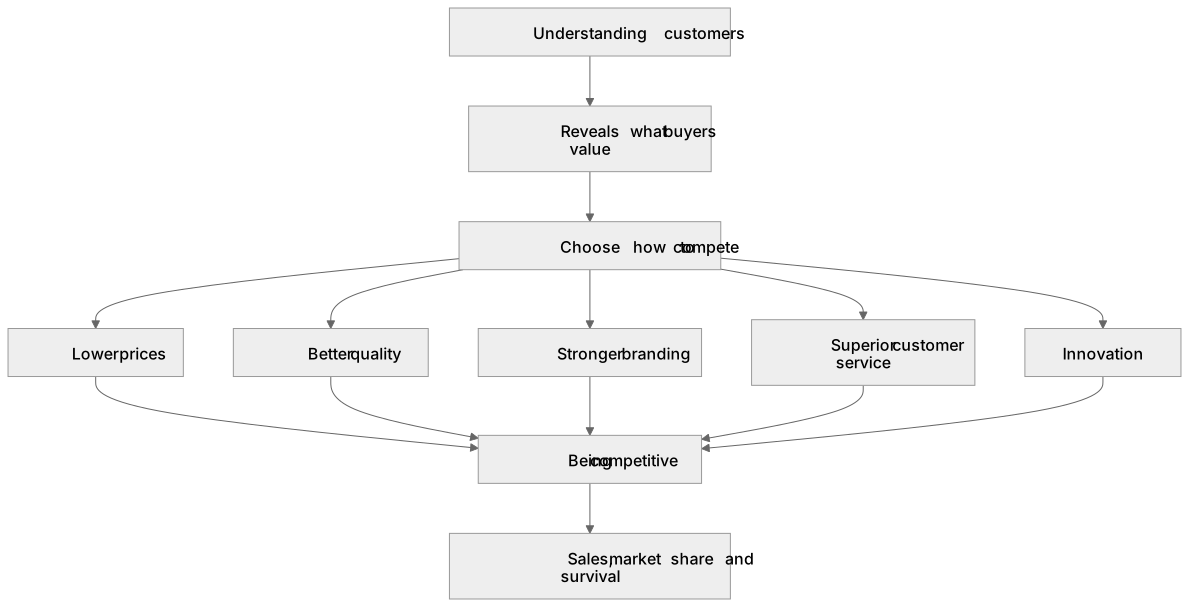
Key words
Say what each word means before you turn the card.
Competitive advantage
Try answering aloud or in your head before turning the card.
Customer value
Try answering aloud or in your head before turning the card.
Market share
Try answering aloud or in your head before turning the card.
Business strategy
Try answering aloud or in your head before turning the card.
See every definition
- Competitive advantage
- Gained when customer understanding shows what buyers value, so a business can compete on value rather than just price.
- Customer value
- What buyers value, such as price, quality, convenience or service, revealed by understanding customers.
- Market share
- An outcome supported by being competitive, alongside sales and survival.
- Business strategy
- The most effective way to compete, chosen by identifying customer needs to avoid wasting resources on features customers do not want.
Label the diagram
Some boxes have lost their names. Pick the right name for each number.
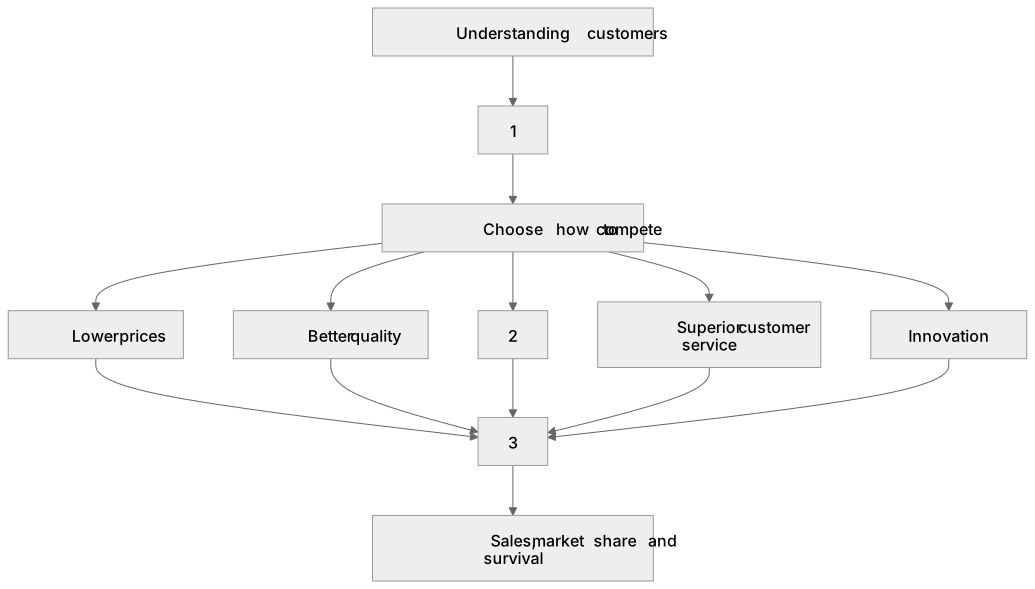
1Box 1
2Box 2
3Box 3
There is more to this lesson
The full lesson goes on to check your understanding and help you earn the marks. Create a free account to carry on, with your progress saved.
A week of Premium from your first lesson · Then the free plan continues · No card, no charge
Test your understanding of Identifying and understanding customers: be competitive.
Active recall beats re-reading. Take an instant quiz now to test what you’ve learned and lock it into long-term memory.
A week of Premium from your first lesson · Then the free plan continues · No card, no charge