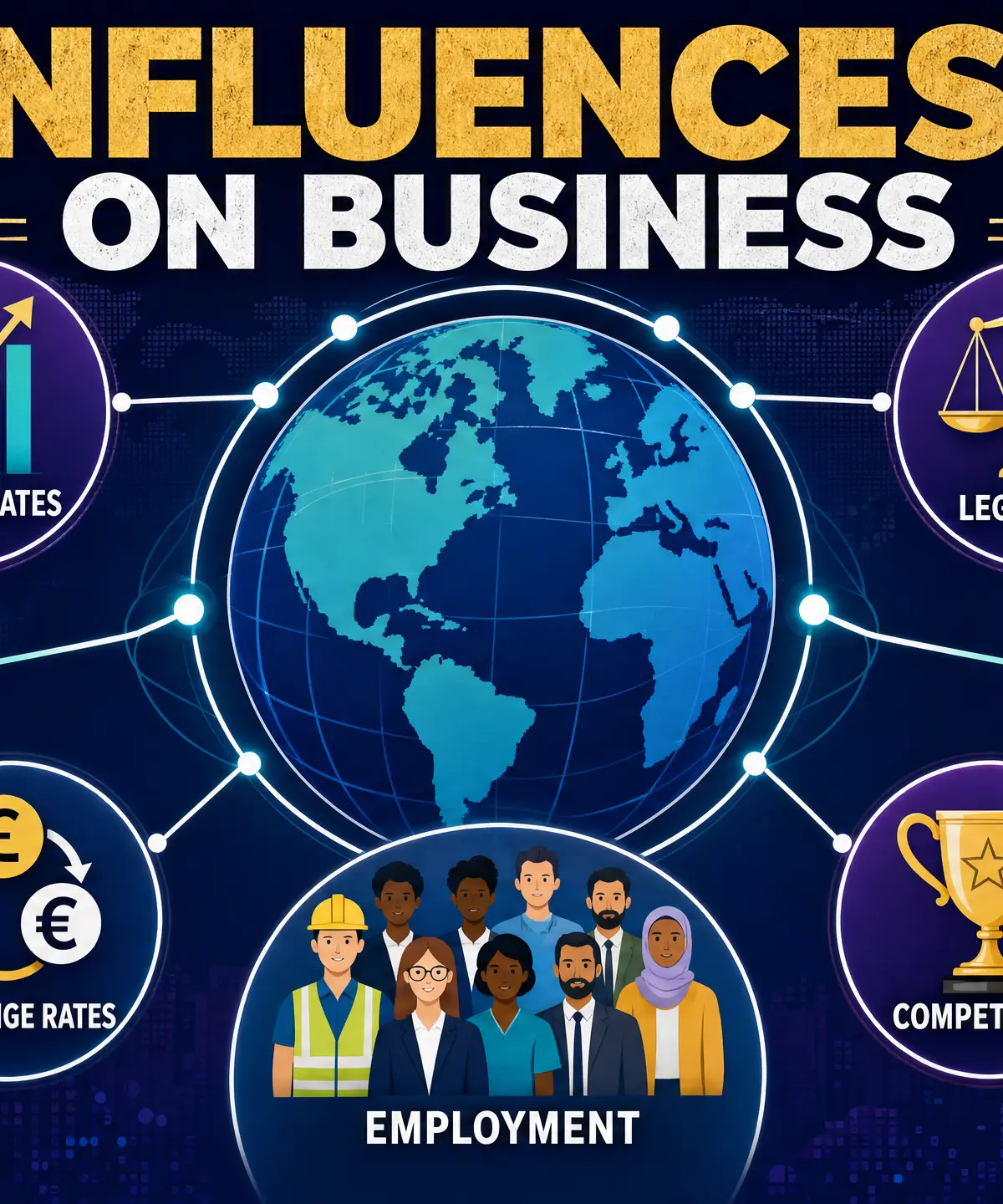
Influences on business Revision Notes

    Subject: Business | Level: GCSE | Exam Board: AQA

    Master the external factors that shape every business decision. This guide covers how interest rates, exchange rates, legislation, and ethical choices impact the four functional areas, giving you the analytical edge examiners reward.

    Revision Notes & Key Concepts

    ![Influences on Business Overview](https://xnnrgnazirrqvdgfhvou.supabase.co/storage/v1/object/public/study-guide-assets/guide_09eaadd0-c988-42a7-926e-35e493ea94d1/header_image.png) ## Overview Businesses do not operate in a vacuum. They are constantly affected by external forces they cannot control—ranging from changes in the Bank of England's interest rates to new government legislation, and from shifts in consumer environmental awareness to the fluctuating value of the pound. This topic, **Influences on Business**, is crucial because examiners use it to test your ability to think synoptically. They want to see if you can link an external change to a specific internal consequence across the four functional areas: Operations, Human Resources, Marketing, and Finance. Top candidates don't just state that 'costs rise'; they explain *why* costs rise and *what* that means for profit and pricing. This guide will walk you through the key influences, providing the exact chains of reasoning required to access Level 3 marks in extended answers. ![Influences on Business Revision Podcast](https://xnnrgnazirrqvdgfhvou.supabase.co/storage/v1/object/public/study-guide-assets/guide_09eaadd0-c988-42a7-926e-35e493ea94d1/influences_on_business_podcast.wav) ## 1. The Economic Climate ### Interest Rates The cost of borrowing money and the reward for saving. When interest rates change, businesses are hit twice: directly (through their own borrowing costs) and indirectly (through consumer spending). **Impact of a Rise in Interest Rates**: * **Direct**: Loan and overdraft repayments increase. This raises fixed costs, reducing overall profit margins. Businesses may delay expansion plans. * **Indirect**: Consumers face higher mortgage and credit card repayments. Disposable income falls. Demand for non-essential (luxury) goods drops, leading to lower sales revenue. ![Impact of Interest Rates](https://xnnrgnazirrqvdgfhvou.supabase.co/storage/v1/object/public/study-guide-assets/guide_09eaadd0-c988-42a7-926e-35e493ea94d1/interest_rates_diagram.png) ### Exchange Rates The value of one currency in terms of another (e.g., £1 = $1.25). The impact depends entirely on whether the business is an **importer** or an **exporter**. **SPICED Mnemonic**: **S**trong **P**ound **I**mports **C**heaper, **E**xports **D**earer. * **Strong Pound (Appreciation)**: Good for importers (raw materials from abroad cost less, lowering variable costs). Bad for exporters (UK goods look more expensive to foreign buyers, reducing international sales). * **Weak Pound (Depreciation)**: Bad for importers (costs rise). Good for exporters (UK goods become cheaper abroad, boosting international competitiveness). ![Exchange Rates: Importers vs Exporters](https://xnnrgnazirrqvdgfhvou.supabase.co/storage/v1/object/public/study-guide-assets/guide_09eaadd0-c988-42a7-926e-35e493ea94d1/exchange_rates_diagram.png) ### Employment Levels The proportion of the working-age population currently in work. * **High Employment**: Consumers have higher incomes, boosting demand. However, businesses struggle to recruit staff and must offer higher wages, increasing labour costs. * **High Unemployment**: Consumer spending falls. However, businesses find it easier to recruit and can often keep wage costs lower due to the larger pool of available workers. ## 2. Ethics and the Environment ### The Trade-off: Ethics vs Profit Ethical behaviour involves doing what is morally right, even if it is not legally required (e.g., paying above the minimum wage, using fairtrade suppliers). **The Trade-off**: Acting ethically almost always increases costs in the short term, which reduces immediate profit. However, examiners reward candidates who recognize that ethical behaviour can boost *long-term* profit by building brand loyalty, attracting ethical investors, and motivating staff. ![Ethics vs Profit Trade-off](https://xnnrgnazirrqvdgfhvou.supabase.co/storage/v1/object/public/study-guide-assets/guide_09eaadd0-c988-42a7-926e-35e493ea94d1/ethics_vs_profit_diagram.png) ### Environmental Considerations Businesses face pressure from consumers, pressure groups, and the government to reduce their environmental impact (e.g., pollution, traffic congestion, waste, carbon emissions). * **Impact**: Implementing green policies (like switching to renewable energy or sustainable packaging) requires investment, raising costs. Failure to do so risks reputational damage and lost sales from eco-conscious consumers. ## 3. Globalisation The increasing interconnectedness of global markets. * **Opportunities**: Access to larger markets for selling goods; ability to source cheaper raw materials or labour from overseas (offshoring/outsourcing). * **Threats**: Increased competition from multinational corporations; vulnerability to global supply chain disruptions. ## 4. Legislation Laws passed by the government that businesses must comply with. Examiners want you to focus on the *practical impact* on operations and costs. * **Employment Law**: (e.g., National Minimum Wage, Equality Act). **Impact**: Increases wage costs; requires HR investment in training and fair recruitment processes. * **Health and Safety Law**: **Impact**: Increases compliance costs (providing PPE, conducting risk assessments); may slow down production processes to ensure safety. * **Consumer Law**: (e.g., Consumer Rights Act). Goods must be fit for purpose and as described. **Impact**: Increases costs related to quality control and managing returns/refunds; restricts misleading marketing claims. ![Key Legislation and Business Impact](https://xnnrgnazirrqvdgfhvou.supabase.co/storage/v1/object/public/study-guide-assets/guide_09eaadd0-c988-42a7-926e-35e493ea94d1/legislation_impact_diagram.png) ## 5. The Competitive Environment Businesses must constantly adapt to the actions of their rivals. This involves managing risk (measurable outcomes, like the chance of a marketing campaign failing) and uncertainty (unpredictable events, like a sudden global pandemic). Businesses respond to competition by lowering prices, increasing advertising, or differentiating their products.

    Revision Podcast Transcript

    Welcome to your GCSE Business revision podcast. I'm your tutor, and today we're diving into one of the most important topics on your specification: Influences on Business. This is a topic that examiners absolutely love, because it tests whether you can think like a real business analyst — not just recite facts, but actually explain how the world around a business shapes every decision it makes. So grab a pen, get comfortable, and let's get started. Before we jump in, here's why this topic matters. Every business — from a small corner shop to a multinational like Nike or Tesco — operates in an environment it cannot fully control. Interest rates change. New laws get passed. The pound rises or falls. Competitors emerge. Consumers become more environmentally conscious. Your job in the exam is to show that you understand how these external forces ripple through a business and affect its operations, its people, its marketing, and its finances. Examiners call these the four functional areas — and linking external influences back to them is how you pick up the top marks. Let's work through the key influences one by one. First up: interest rates. The interest rate is the cost of borrowing money. In the UK, the Bank of England sets the base rate, and commercial banks use this to set their own lending rates. So why does this matter to businesses? Think about it this way. Most businesses borrow money — through bank loans or overdrafts — to fund their operations or expansion. If interest rates rise, the cost of those loans goes up. Monthly repayments increase, which means costs rise and profit falls. That's the direct impact on the business itself. But there's a second effect that candidates often miss: the impact on consumers. When interest rates are high, consumers also face higher mortgage repayments and credit card costs. They have less disposable income. So they spend less. Demand for products and services falls. Revenue drops. This is why high interest rates can be devastating for businesses selling non-essential goods — think luxury items, holidays, or new cars. Conversely, when interest rates fall, borrowing becomes cheaper. Businesses can invest more. Consumers have more money to spend. Demand rises. Revenue increases. The key exam tip here: always make the chain of reasoning explicit. Don't just say 'interest rates affect business.' Say: 'If interest rates rise, the business's loan repayments increase, which raises costs and reduces profit. Additionally, consumers have less disposable income, so demand for the product falls, further reducing revenue.' Next, let's talk about exchange rates. This is another area where candidates lose marks by being vague. The exchange rate is the value of one currency compared to another — for example, how many US dollars you get for one British pound. This matters enormously for businesses that trade internationally. Here's the key distinction you must know: the impact is different for importers and exporters. An importer is a business that buys goods or materials from overseas. If the pound strengthens — meaning one pound buys more foreign currency — imports become cheaper. That's good for importers. Their costs fall. But if the pound weakens, imports become more expensive, and costs rise. An exporter is a business that sells goods to overseas customers. If the pound strengthens, UK goods become more expensive for foreign buyers, so demand from abroad falls. That's bad for exporters. But if the pound weakens, UK goods become relatively cheaper overseas, so foreign demand rises. That's great for exporters. A classic exam mistake is to say 'a strong pound is good for business' without specifying which type of business. Always distinguish. Always link to a specific consequence. Now let's move on to employment levels. When employment is high — meaning most people who want a job have one — consumers have more income. They spend more. Demand rises across the economy. Businesses benefit from higher sales. However, high employment also means businesses may struggle to recruit staff, and they may need to offer higher wages to attract workers, which increases labour costs. When unemployment is high, consumers have less money. Demand falls. Businesses may struggle to sell their products. However, there is a silver lining for businesses: there's a larger pool of workers available, often willing to work for lower wages, which can reduce labour costs. The employment level also affects the HR function directly. In a tight labour market, businesses must invest more in recruitment, training, and staff retention. In a high unemployment environment, recruitment is easier and cheaper. Let's turn to the environment. Businesses today face growing pressure to operate sustainably. Environmental concerns include pollution, waste management, carbon emissions, and traffic congestion — particularly for businesses with large delivery fleets or manufacturing operations. Consumers increasingly choose brands that demonstrate environmental responsibility. Investors and shareholders also apply pressure. Governments introduce environmental regulations that businesses must comply with. The practical impact on business is significant. Businesses may need to invest in cleaner production methods, reduce packaging, switch to electric vehicles, or offset their carbon emissions. These changes increase costs in the short term. However, they can also enhance brand reputation, attract environmentally conscious customers, and reduce long-term regulatory risk. Now for a topic that generates great exam answers: ethics versus profit. Business ethics refers to the moral principles that guide how a business behaves. Ethical behaviour might include paying suppliers fairly, ensuring safe working conditions, avoiding misleading advertising, or reducing environmental impact. Here's the trade-off that examiners want you to explore: ethical behaviour often increases costs and reduces short-term profit. Paying fair wages to overseas workers costs more than using cheap labour. Using sustainable materials is more expensive than conventional alternatives. However, ethical behaviour can increase long-term profit by building customer loyalty, enhancing brand reputation, attracting ethical investors, and motivating staff. The key exam error here is assuming that ethics always leads to higher profits. It doesn't — at least not immediately. The best answers acknowledge the trade-off and use the phrase 'it depends' — for example, it depends on whether consumers are willing to pay a premium for ethical products, and whether the business can absorb the higher costs in the short term. Let's look at globalisation. Globalisation refers to the increasing interconnectedness of the world's economies, with goods, services, capital, and labour moving more freely across borders. For UK businesses, globalisation presents both opportunities and threats. The opportunities include: access to larger international markets, the ability to source cheaper materials or labour from overseas, and the chance to benefit from economies of scale. Companies like Dyson, Burberry, and Rolls-Royce have grown significantly by selling globally. The threats include: increased competition from overseas businesses — particularly from countries with lower production costs — and the risk of supply chain disruption if international suppliers face problems. A small UK manufacturer may struggle to compete with a Chinese factory producing similar goods at a fraction of the cost. Finally, legislation. Businesses must comply with a range of laws, and examiners expect you to know the practical impact — not just the name of the law. Employment law sets out the rights of workers. This includes the National Minimum Wage, contracts of employment, and anti-discrimination legislation. The impact on business includes higher wage costs, the need for HR training, and more complex recruitment processes. Health and Safety law requires businesses to provide safe working conditions, conduct risk assessments, and provide appropriate personal protective equipment. The impact includes compliance costs, potential changes to production processes, and the need for regular staff training. Consumer law protects buyers. The Consumer Rights Act gives customers the right to a refund, repair, or replacement for faulty goods. The General Data Protection Regulation, known as GDPR, controls how businesses collect and use customer data. The impact includes the cost of managing returns, investment in data security systems, and changes to marketing practices. Now let's talk exam technique. This is where marks are won and lost. The most common mistake candidates make is giving generic answers. Saying 'legislation increases costs' earns very few marks. Saying 'the introduction of the National Minimum Wage means the business must pay all workers at least the legal minimum rate per hour, which increases the wage bill and reduces profit' earns significantly more. Be specific. Name the law. Name the consequence. Quantify where possible. The second big mistake is failing to link external influences to the four functional areas. When you discuss an external influence, always ask yourself: how does this affect operations? How does it affect HR? How does it affect marketing? How does it affect finance? Examiners reward this cross-functional thinking. The third mistake is treating all businesses the same. A rise in interest rates affects a highly indebted business far more than one with no borrowing. A weak pound is great for an exporter but terrible for an importer. Always use the 'it depends' approach and justify your reasoning. For command words: 'Explain' questions need a chain of reasoning — cause, effect, and consequence. 'Analyse' questions need you to develop the point further, exploring the implications. 'Evaluate' or 'Justify' questions need a balanced argument and a clear, justified conclusion. Now for your quick-fire recall quiz. Cover your notes and try to answer these questions out loud. Question one: What happens to a business's loan repayments when interest rates rise? They increase — meaning higher costs and lower profit. Question two: A UK business imports raw materials from the USA. The pound weakens against the dollar. What happens to the business's costs? They increase — because each pound buys fewer dollars, so the same materials cost more in pounds. Question three: Name two pieces of legislation that affect businesses and give one practical impact for each. For example: Employment law — increases wage costs due to minimum wage requirements. Consumer law — requires businesses to accept returns of faulty goods, increasing operational costs. Question four: What is the difference between an ethical business decision and a profit-maximising decision? An ethical decision prioritises moral principles — such as fair pay or environmental responsibility — which may increase costs and reduce short-term profit. A profit-maximising decision focuses on minimising costs and maximising revenue, which may involve less ethical choices. Question five: Give one benefit and one drawback of globalisation for a UK business. Benefit: access to larger overseas markets, increasing potential revenue. Drawback: increased competition from lower-cost overseas producers, threatening market share. Let's wrap up. The key takeaways from today are: always link external influences to specific business consequences; distinguish between different types of businesses when discussing exchange rates; remember the trade-off between ethics and short-term profit; know the practical impact of legislation, not just its name; and use the 'it depends' approach in evaluation questions to access the highest marks. External influences are interconnected — a rise in interest rates, for example, can affect consumer spending, which affects demand, which affects revenue, which affects the business's ability to invest. The best exam answers show this chain of cause and effect clearly and confidently. You've got this. Keep revising, keep practising past papers, and remember — every mark you earn in the exam comes from showing the examiner that you can think analytically about the real business world. Good luck, and I'll see you in the next episode.

    Key Terms & Definitions

    Interest Rate
    The cost of borrowing money and the reward for saving, expressed as a percentage.
    Exchange Rate
    The price of one currency expressed in terms of another currency.
    Business Ethics
    Moral principles that guide the way a business behaves, often going beyond legal requirements.
    Globalisation
    The trend for markets to become worldwide in scope, with increasing interconnectedness of economies.
    Legislation
    Laws passed by the government that businesses must comply with.
    Uncertainty
    External events that are unpredictable and cannot be accurately measured or foreseen.

    Worked Examples

    Practice Questions

    Influences on business

    AQA
    GCSE
    Business

    Master the external factors that shape every business decision. This guide covers how interest rates, exchange rates, legislation, and ethical choices impact the four functional areas, giving you the analytical edge examiners reward.

    6
    Min Read
    3
    Examples
    5
    Questions
    6
    Key Terms
    🎙 Podcast Episode
    Influences on business
    0:00-0:00

    Study Notes

    Influences on Business Overview

    Overview

    Businesses do not operate in a vacuum. They are constantly affected by external forces they cannot control—ranging from changes in the Bank of England's interest rates to new government legislation, and from shifts in consumer environmental awareness to the fluctuating value of the pound. This topic, Influences on Business, is crucial because examiners use it to test your ability to think synoptically. They want to see if you can link an external change to a specific internal consequence across the four functional areas: Operations, Human Resources, Marketing, and Finance.

    Top candidates don't just state that 'costs rise'; they explain why costs rise and what that means for profit and pricing. This guide will walk you through the key influences, providing the exact chains of reasoning required to access Level 3 marks in extended answers.

    Influences on Business Revision Podcast

    1. The Economic Climate

    Interest Rates

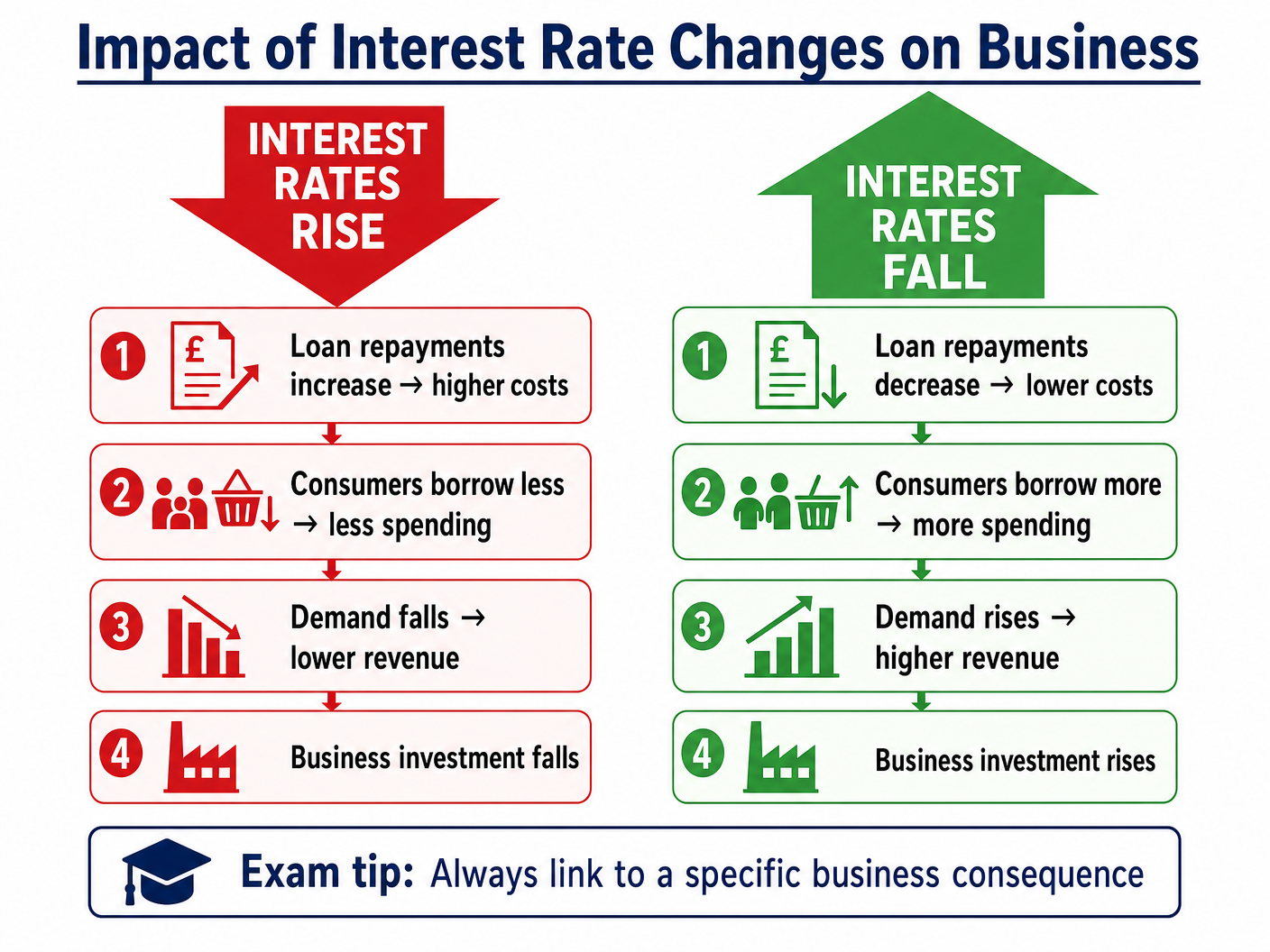
    The cost of borrowing money and the reward for saving. When interest rates change, businesses are hit twice: directly (through their own borrowing costs) and indirectly (through consumer spending).

    Impact of a Rise in Interest Rates:

    • Direct: Loan and overdraft repayments increase. This raises fixed costs, reducing overall profit margins. Businesses may delay expansion plans.
    • Indirect: Consumers face higher mortgage and credit card repayments. Disposable income falls. Demand for non-essential (luxury) goods drops, leading to lower sales revenue.
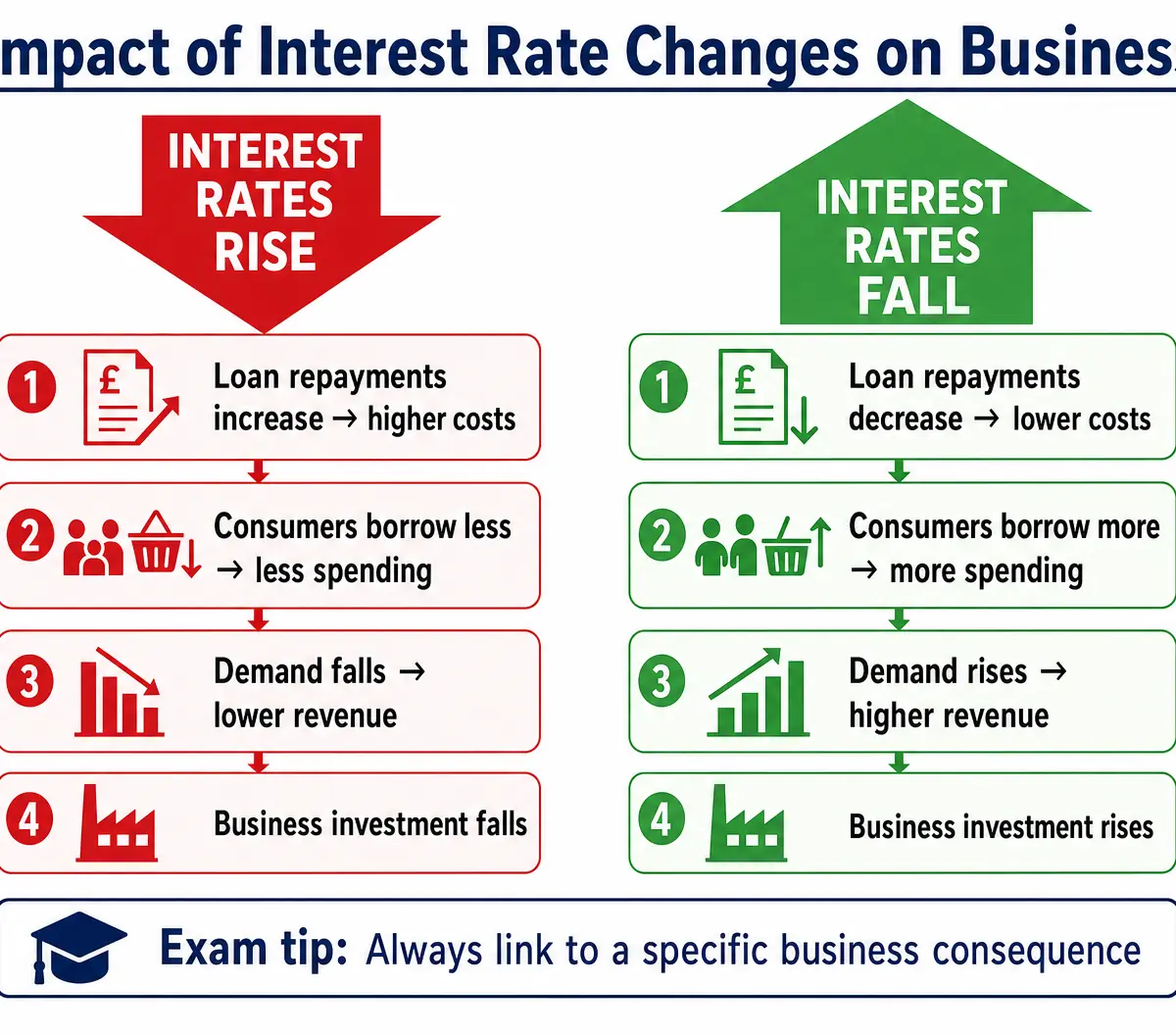
    Impact of Interest Rates

    Exchange Rates

    The value of one currency in terms of another (e.g., £1 = $1.25). The impact depends entirely on whether the business is an importer or an exporter.

    SPICED Mnemonic: Strong Pound Imports Cheaper, Exports Dearer.

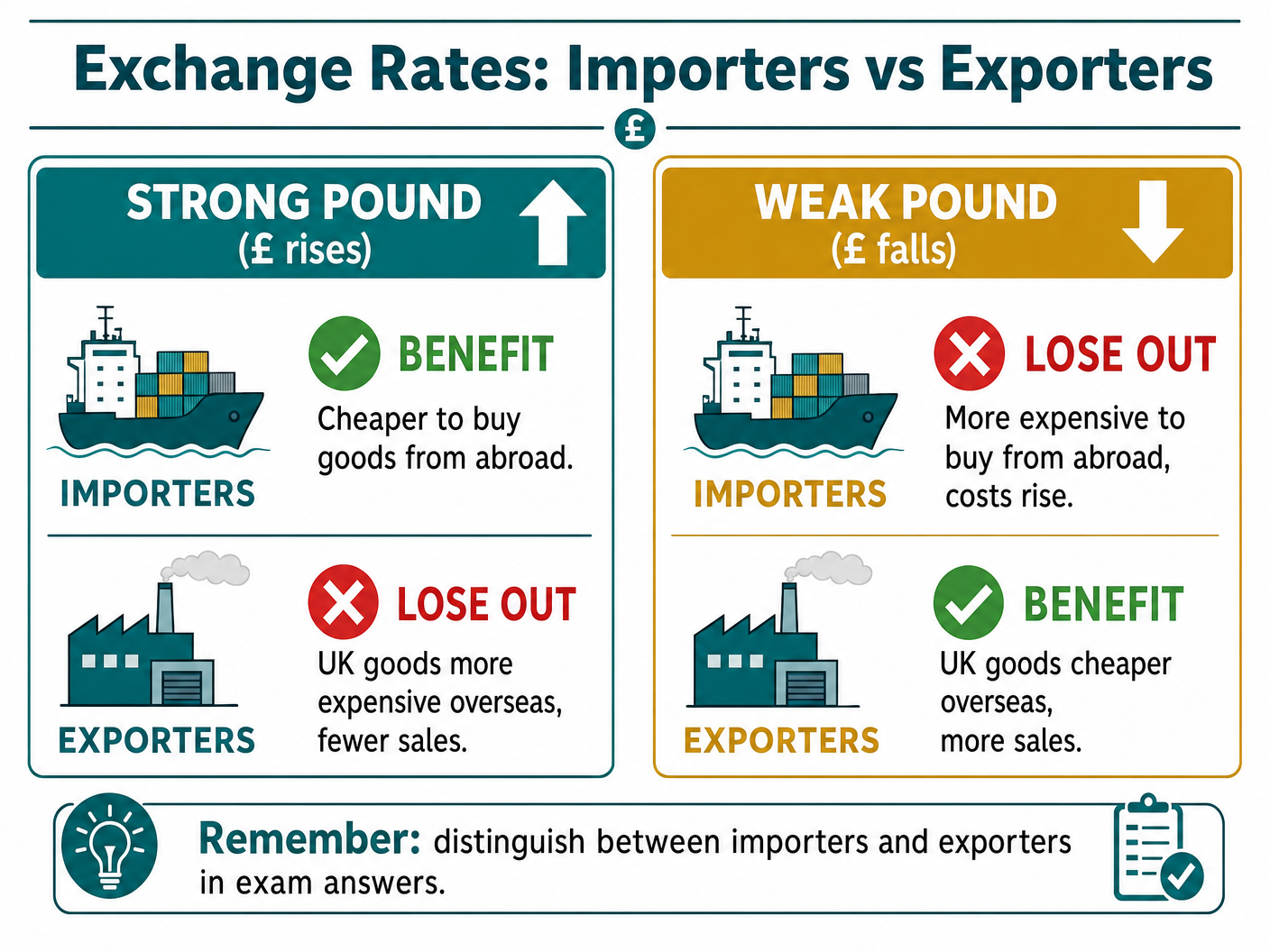
    • Strong Pound (Appreciation): Good for importers (raw materials from abroad cost less, lowering variable costs). Bad for exporters (UK goods look more expensive to foreign buyers, reducing international sales).
    • Weak Pound (Depreciation): Bad for importers (costs rise). Good for exporters (UK goods become cheaper abroad, boosting international competitiveness).
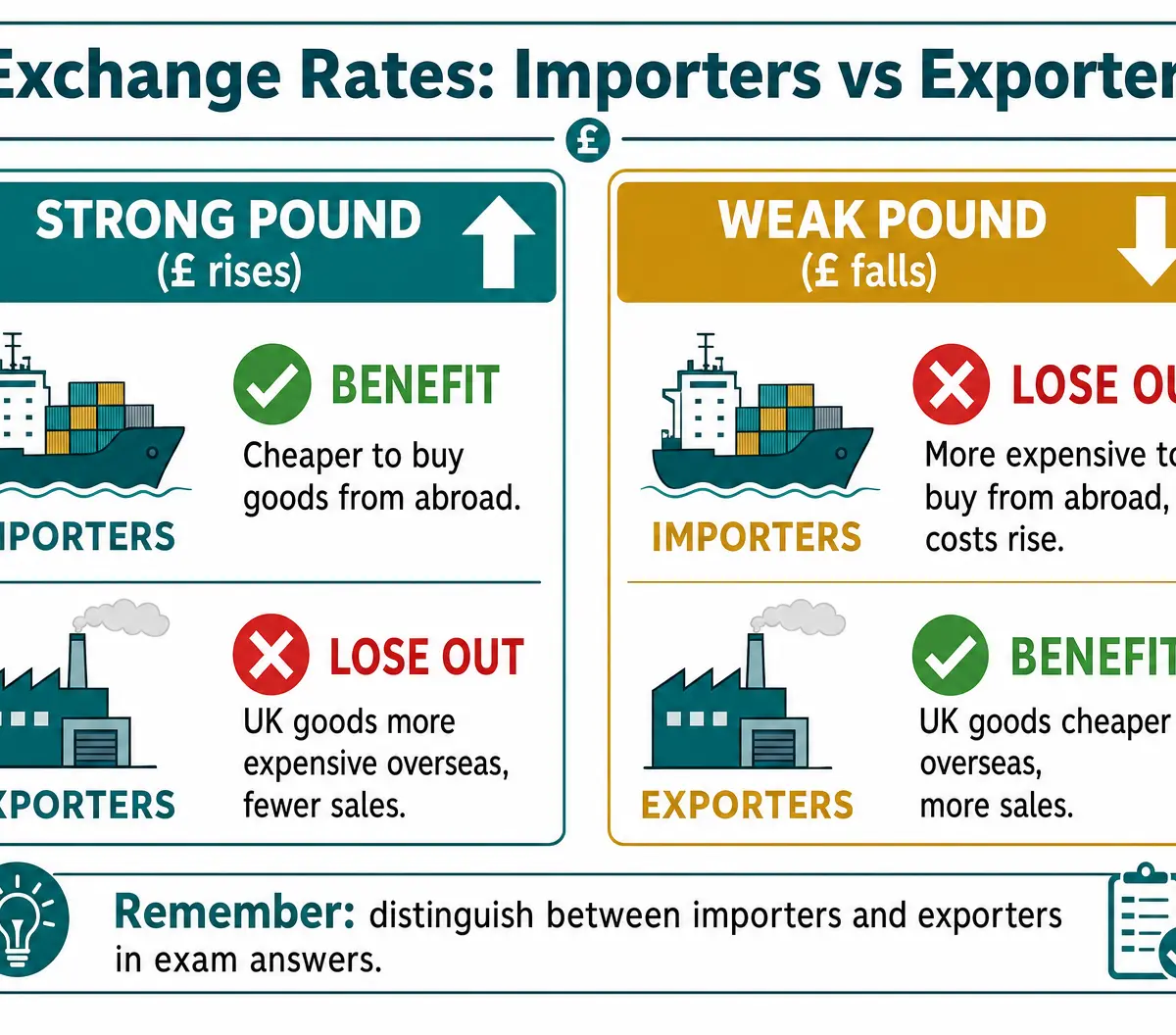
    Exchange Rates: Importers vs Exporters

    Employment Levels

    The proportion of the working-age population currently in work.

    • High Employment: Consumers have higher incomes, boosting demand. However, businesses struggle to recruit staff and must offer higher wages, increasing labour costs.
    • High Unemployment: Consumer spending falls. However, businesses find it easier to recruit and can often keep wage costs lower due to the larger pool of available workers.

    2. Ethics and the Environment

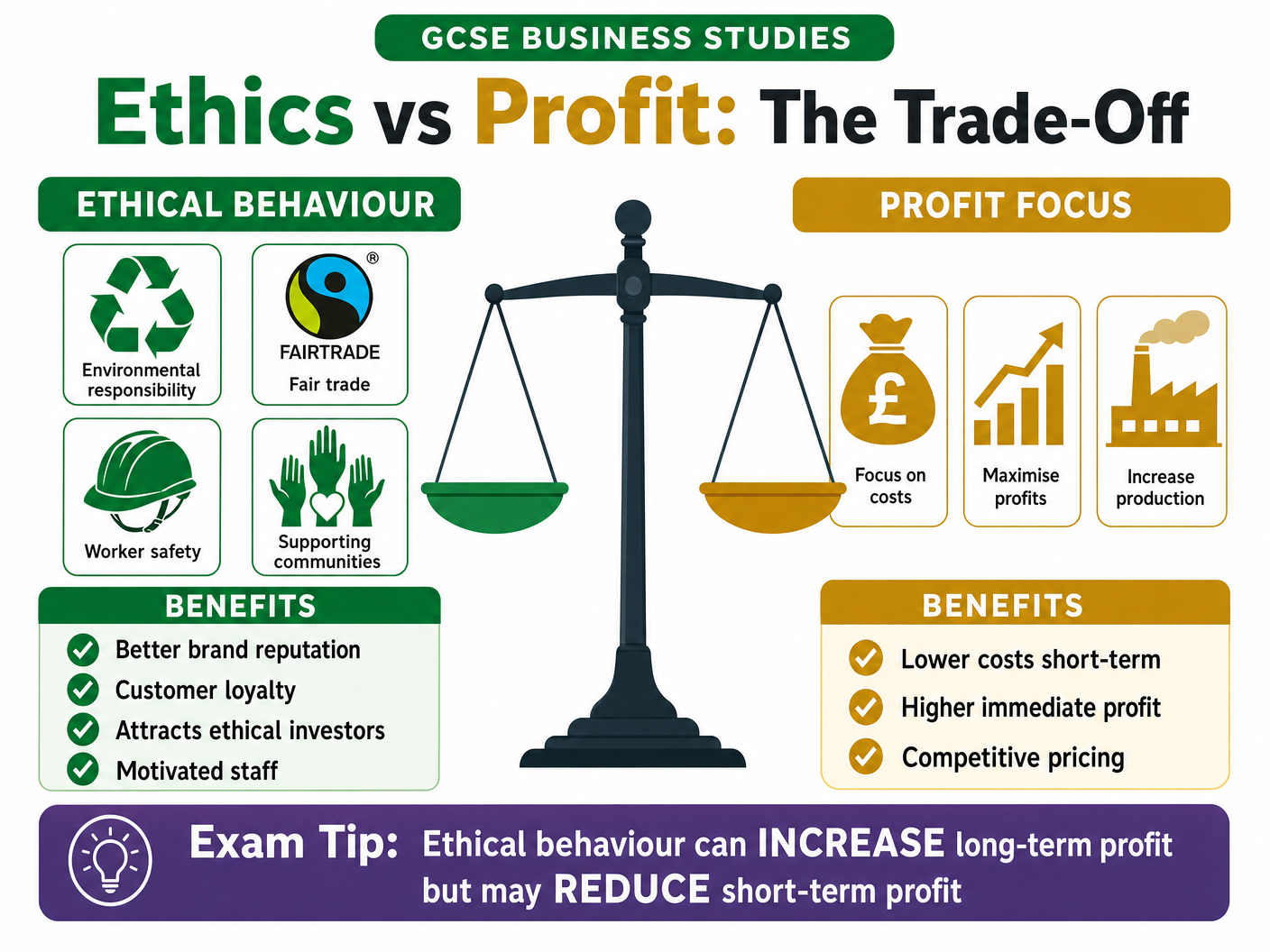
    The Trade-off: Ethics vs Profit

    Ethical behaviour involves doing what is morally right, even if it is not legally required (e.g., paying above the minimum wage, using fairtrade suppliers).

    The Trade-off: Acting ethically almost always increases costs in the short term, which reduces immediate profit. However, examiners reward candidates who recognize that ethical behaviour can boost long-term profit by building brand loyalty, attracting ethical investors, and motivating staff.
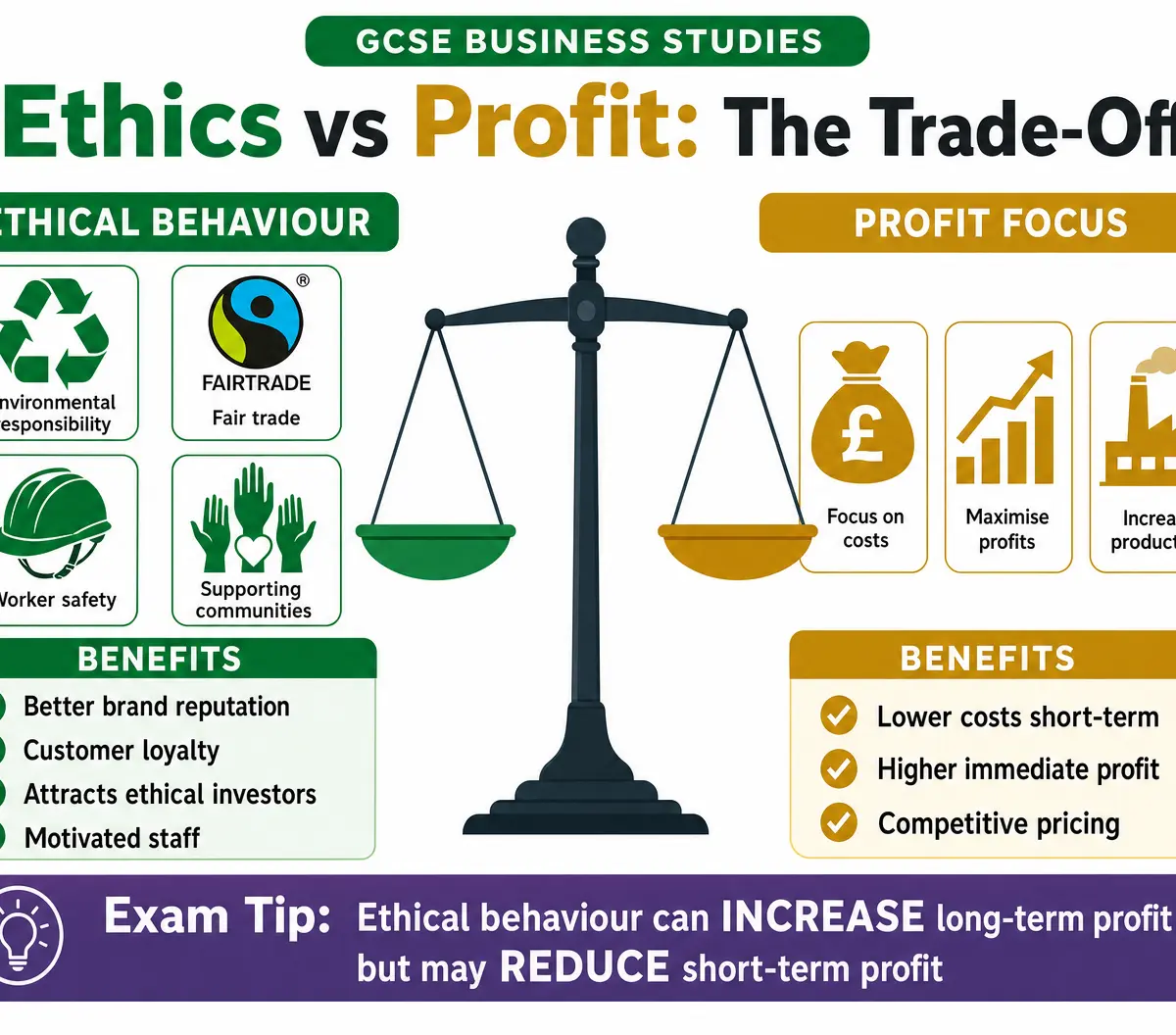
    Ethics vs Profit Trade-off

    Environmental Considerations

    Businesses face pressure from consumers, pressure groups, and the government to reduce their environmental impact (e.g., pollution, traffic congestion, waste, carbon emissions).

    • Impact: Implementing green policies (like switching to renewable energy or sustainable packaging) requires investment, raising costs. Failure to do so risks reputational damage and lost sales from eco-conscious consumers.

    3. Globalisation

    The increasing interconnectedness of global markets.

    • Opportunities: Access to larger markets for selling goods; ability to source cheaper raw materials or labour from overseas (offshoring/outsourcing).
    • Threats: Increased competition from multinational corporations; vulnerability to global supply chain disruptions.

    4. Legislation

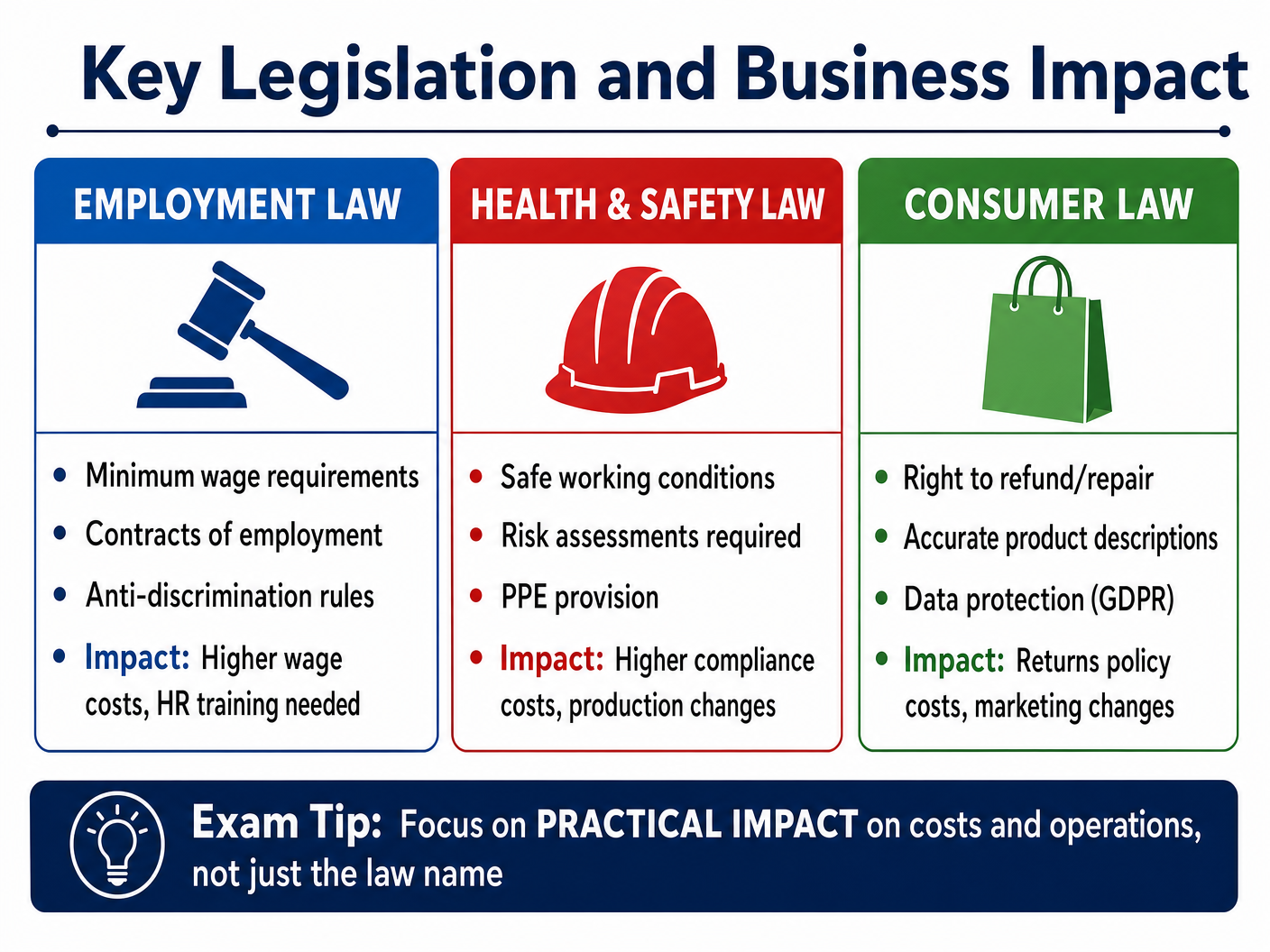
    Laws passed by the government that businesses must comply with. Examiners want you to focus on the practical impact on operations and costs.

    • Employment Law: (e.g., National Minimum Wage, Equality Act). Impact: Increases wage costs; requires HR investment in training and fair recruitment processes.
    • Health and Safety Law: Impact: Increases compliance costs (providing PPE, conducting risk assessments); may slow down production processes to ensure safety.
    • Consumer Law: (e.g., Consumer Rights Act). Goods must be fit for purpose and as described. Impact: Increases costs related to quality control and managing returns/refunds; restricts misleading marketing claims.
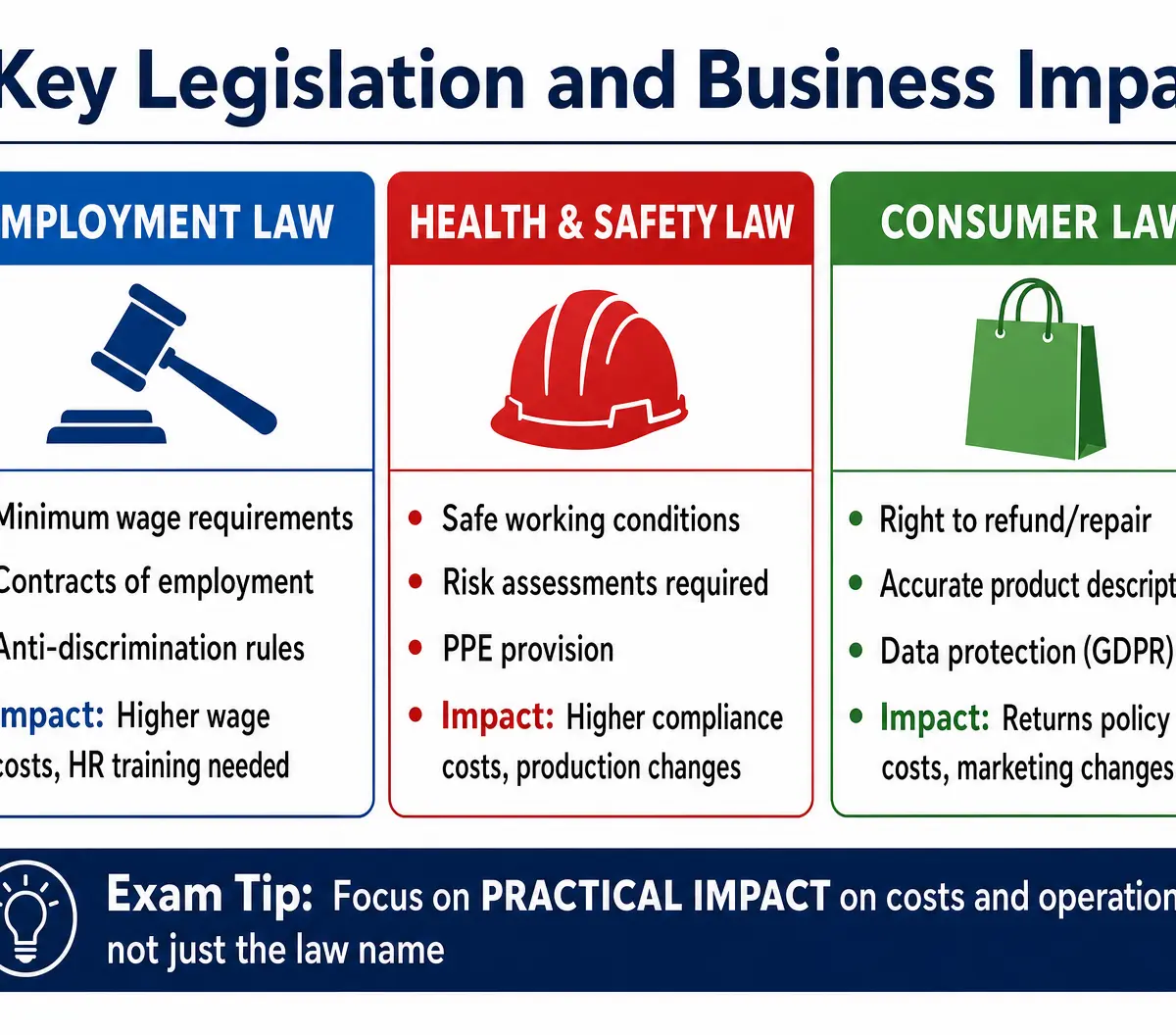
    Key Legislation and Business Impact

    5. The Competitive Environment

    Businesses must constantly adapt to the actions of their rivals. This involves managing risk (measurable outcomes, like the chance of a marketing campaign failing) and uncertainty (unpredictable events, like a sudden global pandemic). Businesses respond to competition by lowering prices, increasing advertising, or differentiating their products.
    Visual Resources

    4 diagrams and illustrations

    Impact of Interest Rates
    Impact of Interest Rates
    Exchange Rates: Importers vs Exporters
    Exchange Rates: Importers vs Exporters
    Ethics vs Profit Trade-off
    Ethics vs Profit Trade-off
    Key Legislation and Business Impact
    Key Legislation and Business Impact

    Worked Examples

    3 detailed examples with solutions and examiner commentary

    Practice Questions

    Test your understanding — click to reveal model answers

    Q1

    State two ways a business could respond to increased competition. (2 marks)

    2 marks
    standard

    Hint: Think about the marketing mix (price, product, promotion).

    Q2

    Explain how a fall in unemployment might affect a local restaurant. (3 marks)

    3 marks
    standard

    Hint: Consider both the impact on customers (demand) and the impact on the restaurant's staffing.

    Q3

    Analyse the impact of the Consumer Rights Act on a business that sells electrical goods. (6 marks)

    6 marks
    hard

    Hint: What does the law say about faulty goods? How does this cost the business money?

    Q4

    Evaluate whether a clothing retailer should switch to using only fairtrade, ethically sourced cotton. (9 marks)

    9 marks
    hard

    Hint: Use the ethics vs profit trade-off. Weigh short-term costs against long-term brand benefits.

    Q5

    Explain how a strong pound affects a UK business that exports cars to Europe. (3 marks)

    3 marks
    standard

    Hint: Use the SPICED mnemonic. What happens to exports when the pound is strong?

    Explore this topic further

    View Topic PageAll Business Topics

    Key Terms

    Essential vocabulary to know