AQA · GCSE · Business
Course version: 8132 · Version from Sept 2017
Legislation: Consumer law
Consumer law protects buyers of goods and services.
Checked against the AQA 8132 specification (opens in a new tab) on .
- Point 3 of 11
- 4 key terms
Study notes
From the checked teaching notes for this specification point.
The idea
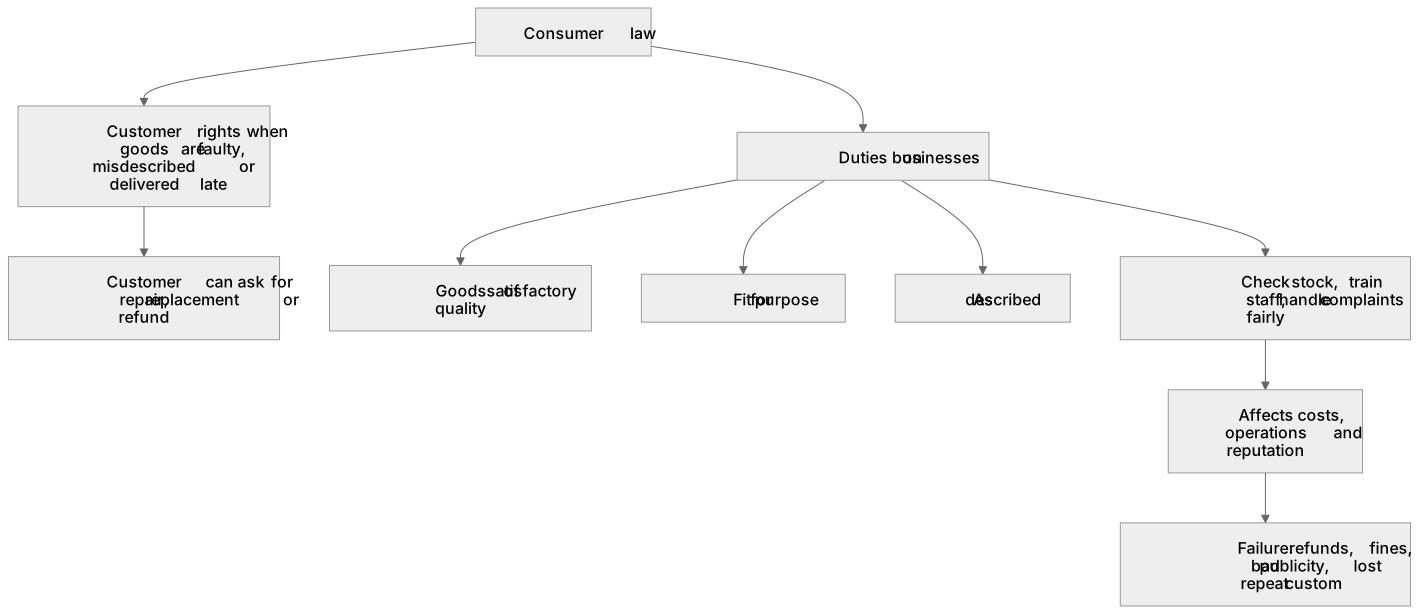
Consumer law protects buyers of goods and services. It gives customers rights when products are faulty, misdescribed or delivered late, and it imposes duties on businesses. For example, goods must be of satisfactory quality, fit for purpose and as described. If a business sells a faulty kettle, the customer can ask for a repair, replacement or refund. Businesses must therefore check stock, train staff and handle complaints fairly. Failure can lead to refunds, fines, bad publicity and lost repeat custom.
What earns the marks
- Consumer law gives customers legal rights when goods or services are faulty, not as described or not fit for purpose.
- Businesses must ensure products meet quality standards and that descriptions, prices and delivery promises are accurate.
- Complying can raise costs, for example refunds, replacements, staff training and better quality control.
- Failure can lead to legal penalties, compensation claims, damaged reputation and reduced customer loyalty.
Common mistakes and how to put them right
Thinking consumer law only applies to expensive items.
Put it right: It applies to all consumer purchases, so correction is to apply it to low-value goods too.
Confusing consumer law with employment law.
Put it right: Is to link consumer law to customers and product quality, not to wages or contracts.
Assuming all faulty goods automatically lead to a full refund.
Put it right: Is to explain that repair or replacement may be offered first, depending on the situation.
Exam tips
- Use a named product or service to show how consumer law works in practice.
- When assessing impact, link each effect to costs, training, recruitment or consequences of failure.
- Use business terms such as reputation, customer loyalty, compliance and compensation accurately.
Try the lesson
The start of the Legislation: Consumer law lesson, made from checked teaching notes for this specification point.
Have a go first
Under consumer law, goods sold to a customer must be of satisfactory quality. What does this requirement mean for a business selling goods?
Listen
Consumer law protects buyers of goods and services. It gives customers rights when products are faulty, misdescribed or delivered late, and it imposes duties on businesses. For example, goods must be of satisfactory quality, fit for purpose and as described. If a business sells a faulty kettle, the customer can ask for a repair, replacement or refund. Businesses must therefore check stock, train staff and handle complaints fairly. Failure can lead to refunds, fines, bad publicity and lost repeat custom. A strong answer earns marks for these points. Consumer law gives customers legal rights when goods or services are faulty, not as described or not fit for purpose. Businesses must ensure products meet quality standards and that descriptions, prices and delivery promises are accurate. Complying can raise costs, for example refunds, replacements, staff training and better quality control. Failure can lead to legal penalties, compensation claims, damaged reputation and reduced customer loyalty. A common slip: Confusing consumer law with employment law. Instead, is to link consumer law to customers and product quality, not to wages or contracts. Exam tip: Use a named product or service to show how consumer law works in practice.
See it
Key words
Say what each word means before you turn the card.
Customer rights
Try answering aloud or in your head before turning the card.
Product quality
Try answering aloud or in your head before turning the card.
Business costs
Try answering aloud or in your head before turning the card.
Reputation and compliance
Try answering aloud or in your head before turning the card.
See every definition
- Customer rights
- Consumer law gives customers legal rights when goods or services are faulty, not as described or not fit for purpose.
- Product quality
- Businesses must ensure products meet quality standards and that descriptions, prices and delivery promises are accurate.
- Business costs
- Complying can raise costs, for example refunds, replacements, staff training and better quality control.
- Reputation and compliance
- Failure can lead to legal penalties, compensation claims, damaged reputation and reduced customer loyalty.
Label the diagram
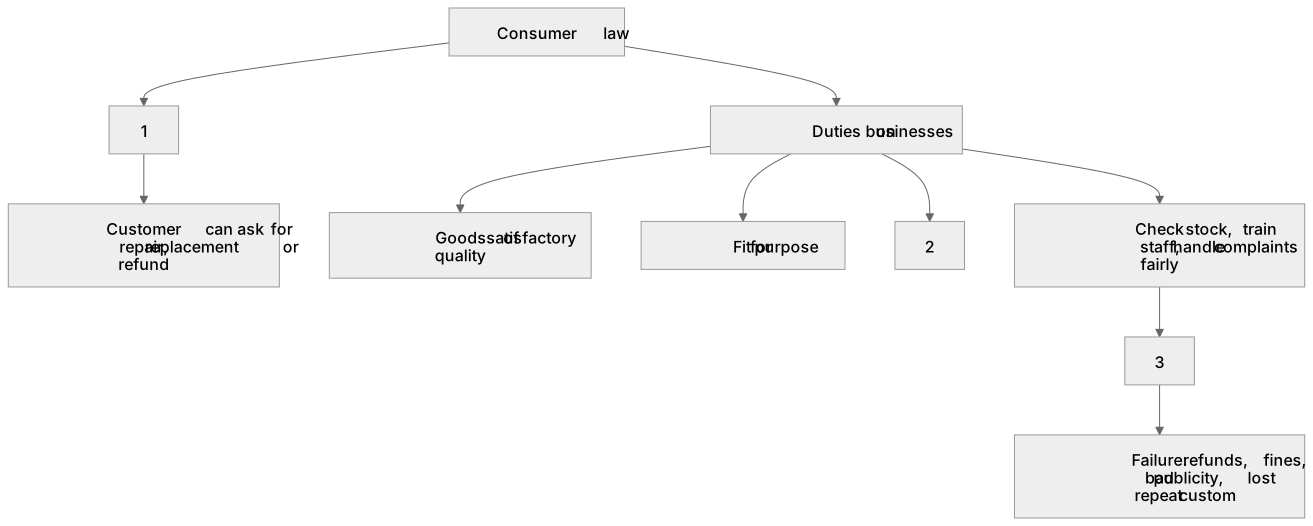
Some boxes have lost their names. Pick the right name for each number.
1Box 1
2Box 2
3Box 3
There is more to this lesson
The full lesson goes on to check your understanding and help you earn the marks. Create a free account to carry on, with your progress saved.
A week of Premium from your first lesson · Then the free plan continues · No card, no charge
Test your understanding of Legislation: Consumer law
Active recall beats re-reading. Take an instant quiz now to test what you’ve learned and lock it into long-term memory.
A week of Premium from your first lesson · Then the free plan continues · No card, no charge