AQA · GCSE · Business
Course version: 8132 · Version from Sept 2017
Understand the use of non-financial methods of motivation, including…
Full specification wording
Motivating employees: understand the use of non-financial methods of motivation, including styles of management, importance of training and greater responsibility, fringe benefits.
Non-financial motivation uses factors other than pay to encourage employees.
Checked against the AQA 8132 specification (opens in a new tab) on .
- Point 5 of 5
- 4 key terms
Study notes
From the checked teaching notes for this specification point.
The idea
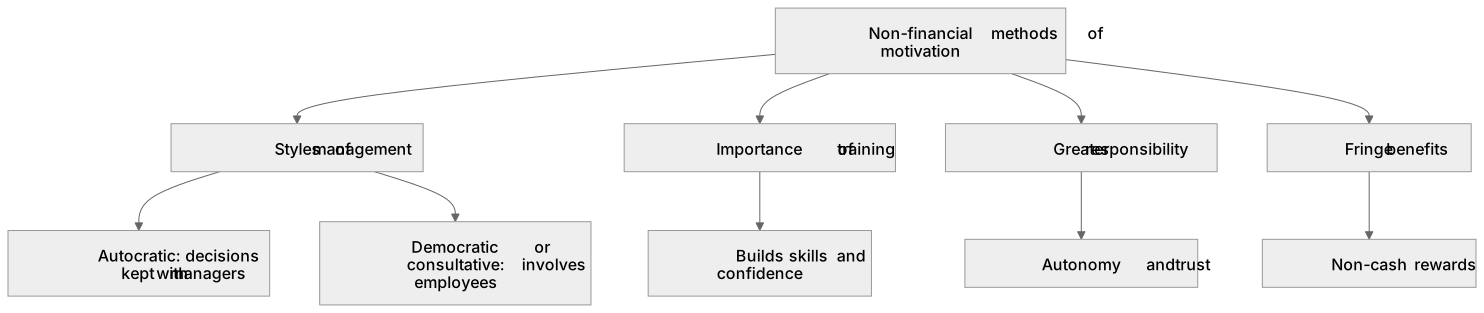
Non-financial motivation uses factors other than pay to encourage employees. Styles of management matter: an autocratic style keeps decisions with managers and can suit urgent or unskilled work, while a democratic or consultative style involves employees and can raise engagement. Training is important because it builds skills and confidence, shows the business values staff, and can improve performance and promotion prospects. Greater responsibility, such as job enrichment or leading a team, gives employees autonomy and trust, which can increase motivation. Fringe benefits are non-cash rewards such as a company car, private health cover, staff discounts or flexible working; they can attract and retain staff and signal that the business cares. These methods often work best alongside fair financial rewards.
What earns the marks
- Styles of management: autocratic management centralises decisions and can be quick but may reduce employee input; democratic or consultative management involves employees and can increase engagement and motivation.
- Importance of training: induction, on-the-job and off-the-job training develop skills, build confidence, improve performance and show employees that the business invests in them.
- Greater responsibility: giving employees more autonomy, decision-making power or team leadership through job enrichment or delegation can raise motivation and job satisfaction.
- Fringe benefits: non-cash rewards such as company cars, health cover, discounts or flexible working can attract and retain employees and improve satisfaction.
- Combination: non-financial methods often work best with fair financial rewards; their effect depends on employee needs and the business context.
Common mistakes and how to put them right
Treating fringe benefits as cash payments.
Put it right by describing them as benefits in kind.
Assuming democratic management always suits every business.
Put it right by matching the style to the situation.
Confusing training with greater responsibility.
Put it right by separating the two ideas.
Exam tips
- Link each non-financial method to a specific motivational effect, such as training building confidence or responsibility increasing autonomy.
- Use case-study details to judge which method is most suitable, rather than describing all methods equally.
- For evaluation, state a condition: for example, greater responsibility motivates when employees have the skills and desire for autonomy.
Try the lesson
The start of the Motivating employees: understand the use of non-financial methods of motivation, including styles of management, importance of training and greater responsibility, fringe benefits. lesson, made from checked teaching notes for this specification point.
Have a go first
Which of the following is a non-financial method of motivating employees?
Listen
Non-financial motivation uses factors other than pay to encourage employees. Styles of management matter: an autocratic style keeps decisions with managers and can suit urgent or unskilled work, while a democratic or consultative style involves employees and can raise engagement. Training is important because it builds skills and confidence, shows the business values staff, and can improve performance and promotion prospects. Greater responsibility, such as job enrichment or leading a team, gives employees autonomy and trust, which can increase motivation. Fringe benefits are non-cash rewards such as a company car, private health cover, staff discounts or flexible working; they can attract and retain staff and signal that the business cares. These methods often work best alongside fair financial rewards. A strong answer earns marks for these points. Styles of management: autocratic management centralises decisions and can be quick but may reduce employee input; democratic or consultative management involves employees and can increase engagement and motivation. Importance of training: induction, on-the-job and off-the-job training develop skills, build confidence, improve performance and show employees that the business invests in them. Greater responsibility: giving employees more autonomy, decision-making power or team leadership through job enrichment or delegation can raise motivation and job satisfaction. Fringe benefits: non-cash rewards such as company cars, health cover, discounts or flexible working can attract and retain employees and improve satisfaction. A common slip: Treating fringe benefits as cash payments: they are non-financial rewards such as a company car or health cover. Instead, describing them as benefits in kind. Exam tip: Link each non-financial method to a specific motivational effect, such as training building confidence or responsibility increasing autonomy.
See it
Key words
Say what each word means before you turn the card.
Non-financial motivation
Try answering aloud or in your head before turning the card.
Autocratic management
Try answering aloud or in your head before turning the card.
Democratic or consultative management
Try answering aloud or in your head before turning the card.
Fringe benefits
Try answering aloud or in your head before turning the card.
See every definition
- Non-financial motivation
- Uses factors other than pay to encourage employees, and often works best alongside fair financial rewards.
- Autocratic management
- A style that keeps decisions with managers and centralises decisions, which can be quick but may reduce employee input.
- Democratic or consultative management
- A style that involves employees and can raise engagement and motivation.
- Fringe benefits
- Non-cash rewards such as a company car, private health cover, staff discounts or flexible working, which can attract and retain staff and signal that the business cares.
Label the diagram
Some boxes have lost their names. Pick the right name for each number.
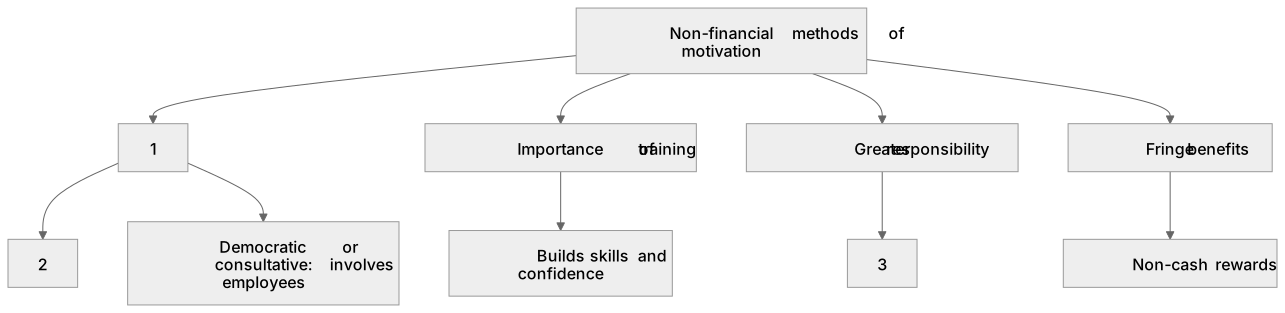
1Box 1
2Box 2
3Box 3
There is more to this lesson
The full lesson goes on to check your understanding and help you earn the marks. Create a free account to carry on, with your progress saved.
A week of Premium from your first lesson · Then the free plan continues · No card, no charge
Test your understanding of Motivating employees: understand the use of non-financial methods of motivation, including styles of management, importance of training and greater responsibility, fringe benefits.
Active recall beats re-reading. Take an instant quiz now to test what you’ve learned and lock it into long-term memory.
A week of Premium from your first lesson · Then the free plan continues · No card, no charge