AQA · GCSE · Business
Course version: 8132 · Version from Sept 2017
Students should be familiar with job and flow production methods and…
Full specification wording
Production processes: Students should be familiar with job and flow production methods and understand when each is appropriate.
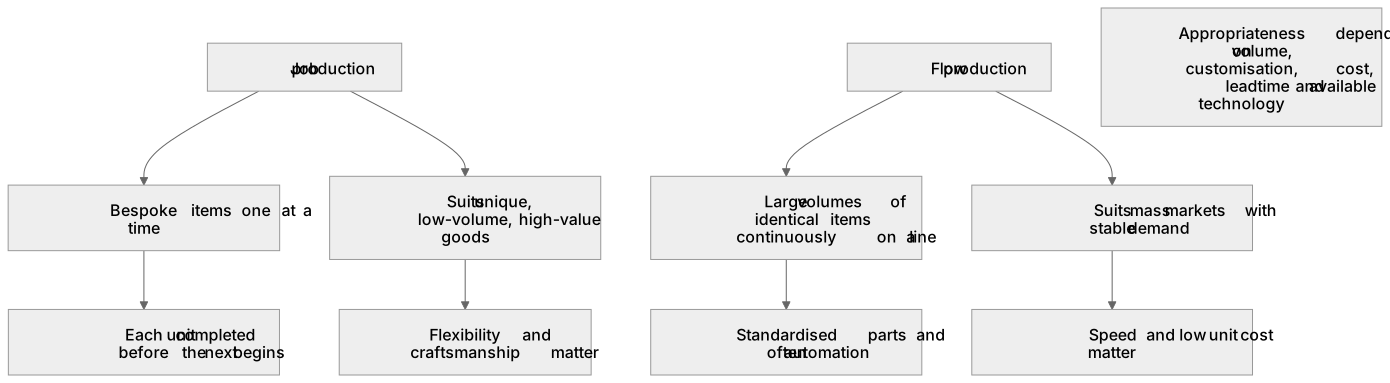
Job production makes bespoke items one at a time, with each unit completed before the next begins.
Checked against the AQA 8132 specification (opens in a new tab) on .
- Point 2 of 8
- 4 key terms
Study notes
From the checked teaching notes for this specification point.
The idea
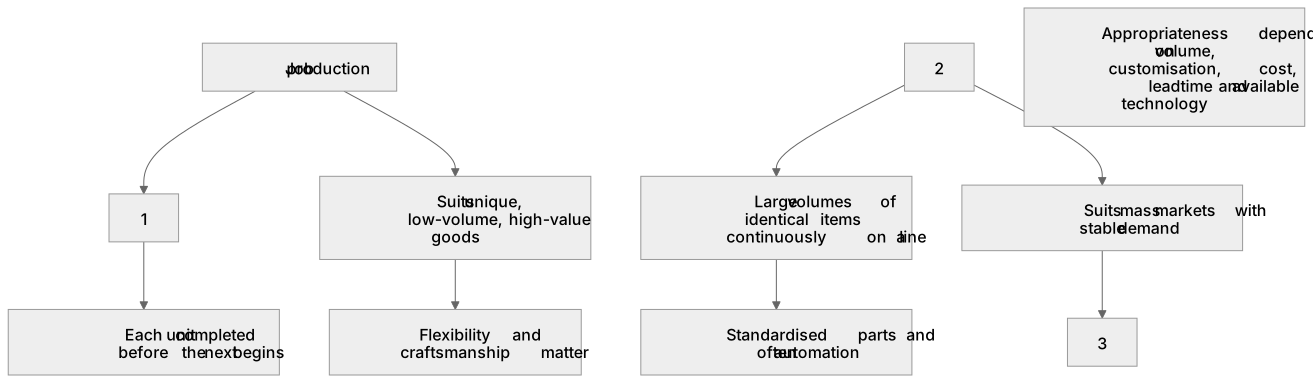
Job production makes bespoke items one at a time, with each unit completed before the next begins. Flow production makes large volumes of identical items continuously on a line, using standardised parts and often automation. Job production suits unique, low-volume, high-value goods such as wedding cakes or custom furniture, where flexibility and craftsmanship matter. Flow production suits mass markets with stable demand, such as bottled water or cars, where speed and low unit cost matter. Appropriateness depends on volume, customisation, cost, lead time and available technology. For example, a small bakery making celebration cakes uses job production; a drinks factory filling thousands of identical bottles per hour uses flow production. Neither method is universally better; the choice must match the product and market.
What earns the marks
- Defines job production as making one bespoke product at a time, with each item completed before the next starts.
- Defines flow production as continuous, high-volume output of identical products on a production line.
- Explains that job production is appropriate for unique, low-volume, high-value products where customer requirements vary.
- Explains that flow production is appropriate for standardised, high-volume products with stable demand.
- Compares the two methods using criteria such as unit cost, flexibility, lead time, capital equipment and labour skill.
- Applies the methods to a given business context and justifies which method is more appropriate.
Common mistakes and how to put them right
Confusing job production with batch production.
Put it right: Job production makes one unique item at a time, whereas batch production makes groups of identical items.
Assuming flow production is always cheaper.
Put it right: It requires high volume and large capital investment, so unit cost may be high if demand is low.
Ignoring the product type.
Put it right: A bespoke product cannot usually be made by flow production because each item differs.
Exam tips
- When asked which method is appropriate, name the method and give a reason linked to the product's volume, customisation or cost.
- Use comparative language such as 'whereas' or 'unlike' to show the difference between job and flow production.
- Apply the method to the business in the case study rather than describing production methods in general.
Try the lesson
The start of the Production processes: Students should be familiar with job and flow production methods and understand when each is appropriate. lesson, made from checked teaching notes for this specification point.
Have a go first
Which production method involves making a single, unique product to meet a specific customer's requirements?
Listen
Job production makes bespoke items one at a time, with each unit completed before the next begins. Flow production makes large volumes of identical items continuously on a line, using standardised parts and often automation. Job production suits unique, low-volume, high-value goods such as wedding cakes or custom furniture, where flexibility and craftsmanship matter. Flow production suits mass markets with stable demand, such as bottled water or cars, where speed and low unit cost matter. Appropriateness depends on volume, customisation, cost, lead time and available technology. For example, a small bakery making celebration cakes uses job production; a drinks factory filling thousands of identical bottles per hour uses flow production. Neither method is universally better; the choice must match the product and market. A strong answer earns marks for these points. Defines job production as making one bespoke product at a time, with each item completed before the next starts. Defines flow production as continuous, high-volume output of identical products on a production line. Explains that job production is appropriate for unique, low-volume, high-value products where customer requirements vary. Explains that flow production is appropriate for standardised, high-volume products with stable demand. Exam tip: When asked which method is appropriate, name the method and give a reason linked to the product's volume, customisation or cost.
See it
Key words
Say what each word means before you turn the card.
Job production
Try answering aloud or in your head before turning the card.
Flow production
Try answering aloud or in your head before turning the card.
Appropriateness
Try answering aloud or in your head before turning the card.
Customisation versus standardisation
Try answering aloud or in your head before turning the card.
See every definition
- Job production
- Making one bespoke product at a time, with each item completed before the next starts.
- Flow production
- Continuous, high-volume output of identical products on a production line, using standardised parts and often automation.
- Appropriateness
- Whether a production method suits a product and market, depending on volume, customisation, cost, lead time and available technology.
- Customisation versus standardisation
- Job production suits unique products where customer requirements vary, whereas flow production suits standardised products with stable demand.
Label the diagram
Some boxes have lost their names. Pick the right name for each number.
1Box 1
2Box 2
3Box 3
There is more to this lesson
The full lesson goes on to check your understanding and help you earn the marks. Create a free account to carry on, with your progress saved.
A week of Premium from your first lesson · Then the free plan continues · No card, no charge
Test your understanding of Production processes: Students should be familiar with job and flow production methods and understand when each is appropriate.
Active recall beats re-reading. Take an instant quiz now to test what you’ve learned and lock it into long-term memory.
A week of Premium from your first lesson · Then the free plan continues · No card, no charge