AQA · GCSE · Business
Course version: 8132 · Version from Sept 2017
Students should consider how production might be made more efficient by…
Full specification wording
Production processes: Students should consider how production might be made more efficient by the use of lean production techniques.
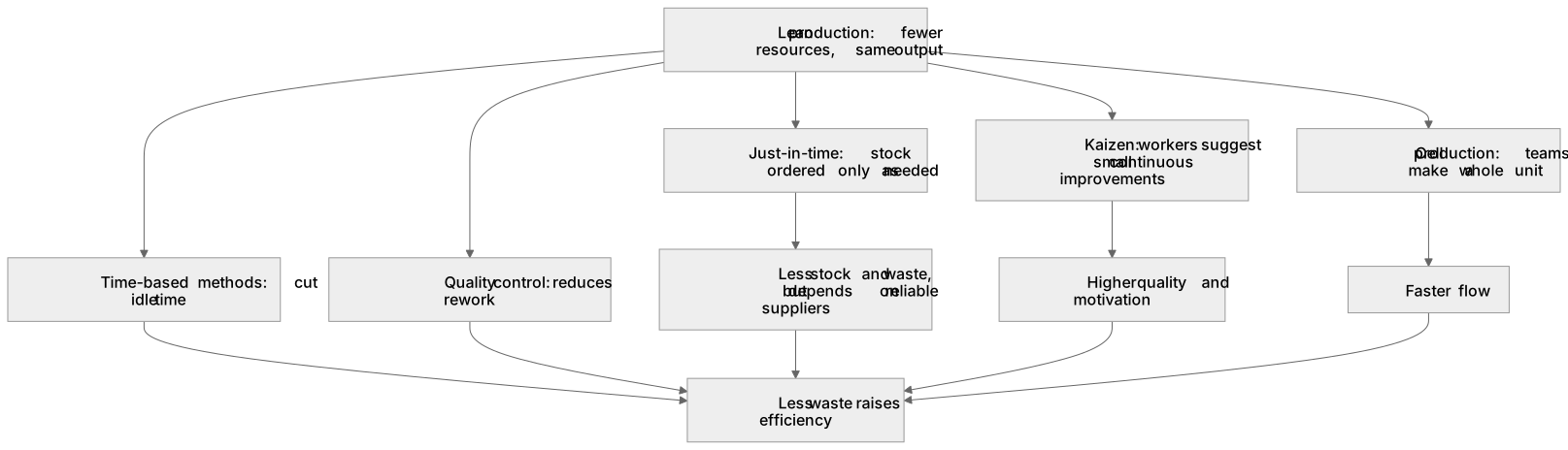
Lean production means using fewer resources to make the same output, so efficiency rises.
Checked against the AQA 8132 specification (opens in a new tab) on .
- Point 6 of 8
- 4 key terms
Study notes
From the checked teaching notes for this specification point.
The idea
Lean production means using fewer resources to make the same output, so efficiency rises. Just-in-time (JIT) orders stock only as needed, cutting storage costs and waste, but it depends on reliable suppliers. Kaizen encourages workers to suggest small continuous improvements, raising quality and motivation. Cell production groups workers into teams making a whole unit, speeding up flow. Time-based methods cut idle time, and quality control reduces rework. Efficiency means output per input, so less waste, less stock or fewer defects all raise it. A bakery using JIT might order flour daily, while a car plant uses cells and kaizen. Lean also has limits: JIT risks stockouts if deliveries fail, and change can meet staff resistance.
What earns the marks
- Define lean production as reducing waste and using fewer resources while maintaining output, so efficiency (output per input) improves.
- Explain just-in-time stock control: materials arrive as needed, lowering storage and holding costs, but requiring dependable suppliers and accurate demand forecasting.
- Explain kaizen: continuous small improvements suggested by workers, which can raise quality, cut waste and increase motivation.
- Explain cell production: teams complete whole units in a sequence, improving flow, teamwork and accountability for quality.
- Explain how lean methods reduce the seven wastes, for example overproduction, waiting, transport, over-processing, inventory, motion and defects.
- Evaluate limitations: JIT can cause production stoppages if deliveries are late, and lean change may face employee resistance or high setup costs.
Common mistakes and how to put them right
Treating lean production as simply cutting staff.
Put it right by explaining it targets waste and inefficiency, not necessarily jobs.
Assuming JIT always saves money.
Put it right by noting it raises risk of stockouts and depends on reliable suppliers.
Confusing lean production with capital-intensive automation.
Put it right by stating lean focuses on waste reduction and process improvement, which may or may not involve machinery.
Exam tips
- Use a named business context and link each lean technique to a specific efficiency gain, such as lower stockholding costs or less rework.
- For evaluation questions, give one benefit and one drawback of lean production before reaching a supported judgement.
- Define key terms briefly at the start of your answer so the examiner can see your understanding before applying it.
Try the lesson
The start of the Production processes: Students should consider how production might be made more efficient by the use of lean production techniques. lesson, made from checked teaching notes for this specification point.
Have a go first
Which of the following is a lean production technique that a business could use to make its production more efficient?
Listen
Lean production means using fewer resources to make the same output, so efficiency rises. Just-in-time (JIT) orders stock only as needed, cutting storage costs and waste, but it depends on reliable suppliers. Kaizen encourages workers to suggest small continuous improvements, raising quality and motivation. Cell production groups workers into teams making a whole unit, speeding up flow. Time-based methods cut idle time, and quality control reduces rework. Efficiency means output per input, so less waste, less stock or fewer defects all raise it. A bakery using JIT might order flour daily, while a car plant uses cells and kaizen. Lean also has limits: JIT risks stockouts if deliveries fail, and change can meet staff resistance. A strong answer earns marks for these points. Define lean production as reducing waste and using fewer resources while maintaining output, so efficiency (output per input) improves. Explain just-in-time stock control: materials arrive as needed, lowering storage and holding costs, but requiring dependable suppliers and accurate demand forecasting. Explain kaizen: continuous small improvements suggested by workers, which can raise quality, cut waste and increase motivation. Explain cell production: teams complete whole units in a sequence, improving flow, teamwork and accountability for quality. A common slip: Treating lean production as simply cutting staff. Instead, explaining it targets waste and inefficiency, not necessarily jobs. Exam tip: Use a named business context and link each lean technique to a specific efficiency gain, such as lower stockholding costs or less rework.
See it
Key words
Say what each word means before you turn the card.
Lean production
Try answering aloud or in your head before turning the card.
Just-in-time (JIT)
Try answering aloud or in your head before turning the card.
Kaizen
Try answering aloud or in your head before turning the card.
Cell production
Try answering aloud or in your head before turning the card.
See every definition
- Lean production
- Using fewer resources to make the same output, targeting waste and inefficiency rather than necessarily cutting jobs.
- Just-in-time (JIT)
- Ordering stock only as needed, which cuts storage costs and waste but depends on reliable suppliers and risks stockouts if deliveries fail.
- Kaizen
- Encouraging workers to suggest small continuous improvements, which can raise quality, cut waste and increase motivation.
- Cell production
- Grouping workers into teams making a whole unit in a sequence, improving flow, teamwork and accountability for quality.
Label the diagram
Some boxes have lost their names. Pick the right name for each number.
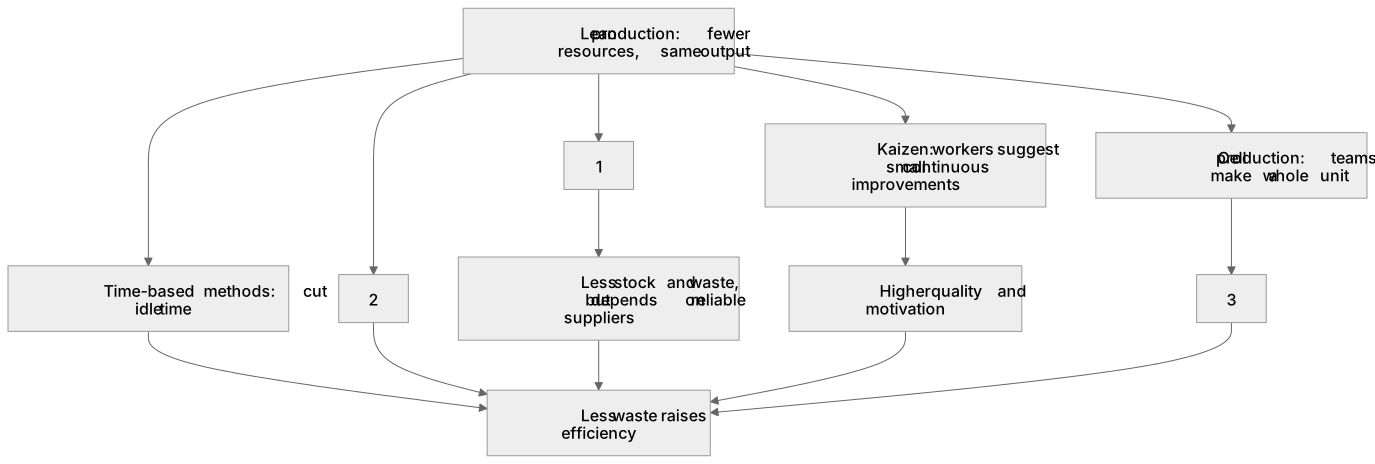
1Box 1
2Box 2
3Box 3
There is more to this lesson
The full lesson goes on to check your understanding and help you earn the marks. Create a free account to carry on, with your progress saved.
A week of Premium from your first lesson · Then the free plan continues · No card, no charge
Test your understanding of Production processes: Students should consider how production might be made more efficient by the use of lean production techniques.
Active recall beats re-reading. Take an instant quiz now to test what you’ve learned and lock it into long-term memory.
A week of Premium from your first lesson · Then the free plan continues · No card, no charge