AQA · GCSE · Business
Course version: 8132 · Version from Sept 2017
Understand the role of objectives in running a business
Full specification wording
Setting business aims and objectives: understand the role of objectives in running a business
Objectives are the specific, measurable targets that a business sets to turn its broader aims into action.
Checked against the AQA 8132 specification (opens in a new tab) on .
- Point 7 of 10
- 4 key terms
Study notes
From the checked teaching notes for this specification point.
The idea
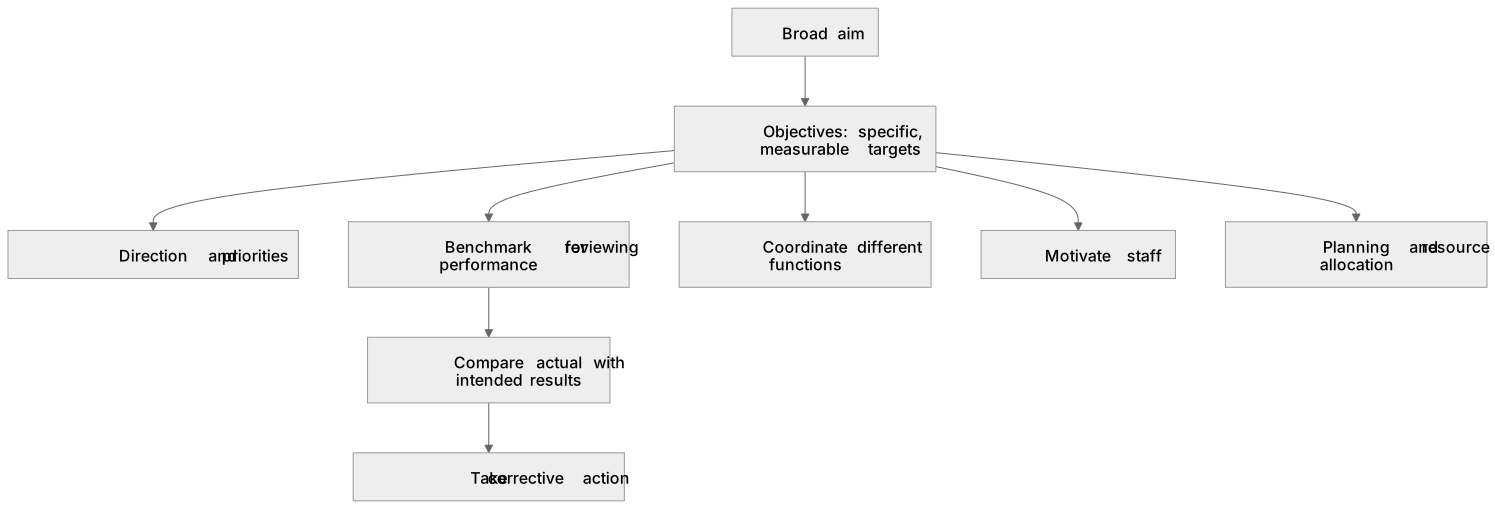
Objectives are the specific, measurable targets that a business sets to turn its broader aims into action. They give direction so that owners, managers and employees know what to prioritise, and they allow progress to be reviewed against clear criteria. For example, a small café might aim to grow, then set an objective to increase weekly sales by 10% over six months. Objectives also coordinate different functions: marketing may focus on customer numbers while operations focuses on speed of service, but both support the same objective. They motivate staff when targets are challenging but achievable, and they provide a basis for measuring success or deciding to change strategy. Without objectives, a business may drift, waste resources or find it hard to judge whether it is performing well.
What earns the marks
- Objectives translate aims into specific, measurable targets that guide day-to-day decisions and priorities.
Common mistakes and how to put them right
Confusing aims with objectives.
Put it right: Define objectives with a measurable outcome and a time frame.
Treating objectives as fixed forever.
Put it right: Explain that objectives are dynamic and may be revised.
Assuming all objectives are financial.
Put it right: Recognise both financial and non-financial objectives.
Exam tips
- Use a named business context to show how an objective guides a real decision, such as a retailer setting a target to reduce customer waiting time.
- When explaining the role of objectives, link each point to a consequence for the business, such as improved focus, motivation or ability to measure success.
- Avoid listing objectives without explaining their purpose; examiners reward analysis of why objectives matter, not just what they are.
Try the lesson
The start of the Setting business aims and objectives: understand the role of objectives in running a business lesson, made from checked teaching notes for this specification point.
Have a go first
What is the main role of objectives in running a business?
Listen
Objectives are the specific, measurable targets that a business sets to turn its broader aims into action. They give direction so that owners, managers and employees know what to prioritise, and they allow progress to be reviewed against clear criteria. For example, a small café might aim to grow, then set an objective to increase weekly sales by 10% over six months. Objectives also coordinate different functions: marketing may focus on customer numbers while operations focuses on speed of service, but both support the same objective. They motivate staff when targets are challenging but achievable, and they provide a basis for measuring success or deciding to change strategy. Without objectives, a business may drift, waste resources or find it hard to judge whether it is performing well. A common slip: Confusing aims with objectives: an aim is a broad intention such as survival or growth, while an objective is a specific, measurable target such as increasing sales by 10% in six months. Instead, define objectives with a measurable outcome and a time frame. Exam tip: Use a named business context to show how an objective guides a real decision, such as a retailer setting a target to reduce customer waiting time.
See it
Key words
Say what each word means before you turn the card.
Purpose and direction
Try answering aloud or in your head before turning the card.
Performance measurement
Try answering aloud or in your head before turning the card.
Coordination of business functions
Try answering aloud or in your head before turning the card.
Motivation and engagement
Try answering aloud or in your head before turning the card.
See every definition
- Purpose and direction
- Objectives give direction so that owners, managers and employees know what to prioritise.
- Performance measurement
- Objectives provide a basis for measuring success or deciding to change strategy, allowing progress to be reviewed against clear criteria.
- Coordination of business functions
- Objectives help coordinate different functions so that effort is focused on shared outcomes, with both supporting the same objective.
- Motivation and engagement
- Objectives motivate staff when targets are challenging but achievable, giving clear targets and a sense of purpose.
Label the diagram
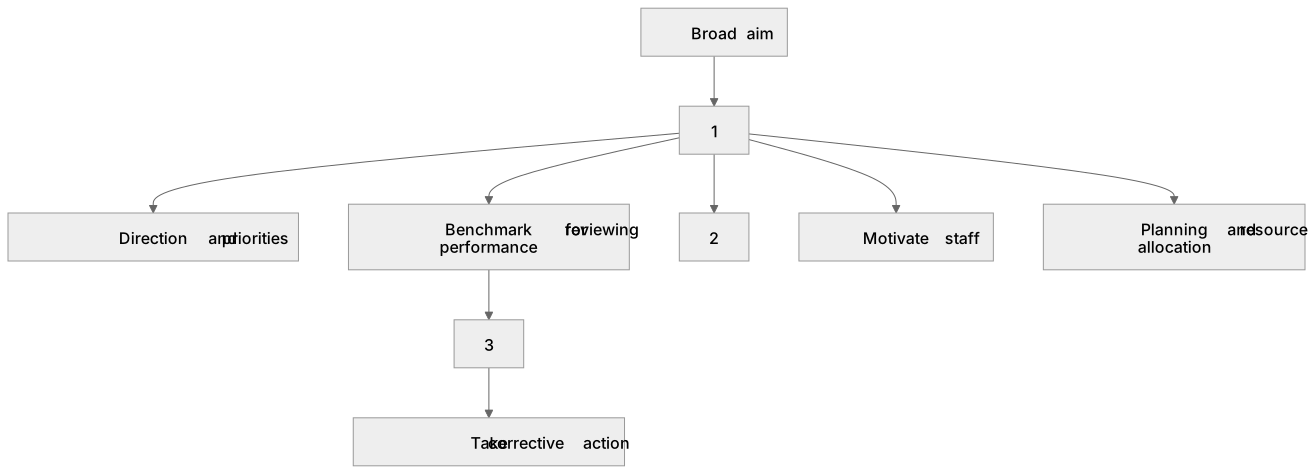
Some boxes have lost their names. Pick the right name for each number.
1Box 1
2Box 2
3Box 3
There is more to this lesson
The full lesson goes on to check your understanding and help you earn the marks. Create a free account to carry on, with your progress saved.
A week of Premium from your first lesson · Then the free plan continues · No card, no charge
Test your understanding of Setting business aims and objectives: understand the role of objectives in running a business
Active recall beats re-reading. Take an instant quiz now to test what you’ve learned and lock it into long-term memory.
A week of Premium from your first lesson · Then the free plan continues · No card, no charge