AQA · GCSE · Business
Course version: 8132 · Version from Sept 2017
Stakeholders: Impact of business activity on stakeholders
Full specification wording
Stakeholders: Impact of business activity on stakeholders
Business activity creates effects that fall unevenly on stakeholders.
Checked against the AQA 8132 specification (opens in a new tab) on .
- Point 3 of 7
- 4 key terms
Study notes
From the checked teaching notes for this specification point.
The idea
Business activity creates effects that fall unevenly on stakeholders. A decision such as relocating a factory may raise profit for shareholders, cut costs for customers, but cause redundancy for employees and disruption for the local community. The impact can be short term, such as a price rise, or long term, such as reputation damage. Assessment rewards chains of reasoning that link the business action to a stakeholder outcome, not just a list of groups.
What earns the marks
- Identifies relevant stakeholder groups such as owners/shareholders, employees, customers, suppliers, local community and government.
- Explains a specific impact on at least one group, for example redundancies reduce employee income and motivation.
- Distinguishes between positive and negative impacts, and between short-term and long-term effects.
- Uses a business example or scenario to show how one action produces different impacts for different groups.
- Reaches a supported judgement about which stakeholder is most affected and why.
Common mistakes and how to put them right
Listing stakeholder groups without explaining any impact.
Put it right: For each group, state one concrete effect and why it happens.
Treating all impacts as negative.
Put it right: Recognise that some groups gain, such as shareholders receiving higher dividends.
Confusing stakeholders with shareholders.
Put it right: Shareholders are one stakeholder group, while employees, customers and the community are others.
Exam tips
- Use the command word to decide depth: 'identify' needs a group, 'explain' needs a because chain, 'analyse' needs effects on several groups.
- Anchor each point to the case study business rather than writing generically about 'a business'.
- Finish with a short judgement that names the most affected stakeholder and gives a reason.
Try the lesson
The start of the Stakeholders: Impact of business activity on stakeholders lesson, made from checked teaching notes for this specification point.
Have a go first
A bakery opens a new shop in a town and hires ten local people. Which stakeholder group gains most directly from the new jobs created?
Listen
Business activity creates effects that fall unevenly on stakeholders. A decision such as relocating a factory may raise profit for shareholders, cut costs for customers, but cause redundancy for employees and disruption for the local community. The impact can be short term, such as a price rise, or long term, such as reputation damage. Assessment rewards chains of reasoning that link the business action to a stakeholder outcome, not just a list of groups. A strong answer earns marks for these points. Identifies relevant stakeholder groups such as owners/shareholders, employees, customers, suppliers, local community and government. Explains a specific impact on at least one group, for example redundancies reduce employee income and motivation. Distinguishes between positive and negative impacts, and between short-term and long-term effects. Uses a business example or scenario to show how one action produces different impacts for different groups. A common slip: Listing stakeholder groups without explaining any impact. Instead, for each group, state one concrete effect and why it happens. Exam tip: Use the command word to decide depth: 'identify' needs a group, 'explain' needs a because chain, 'analyse' needs effects on several groups.
See it
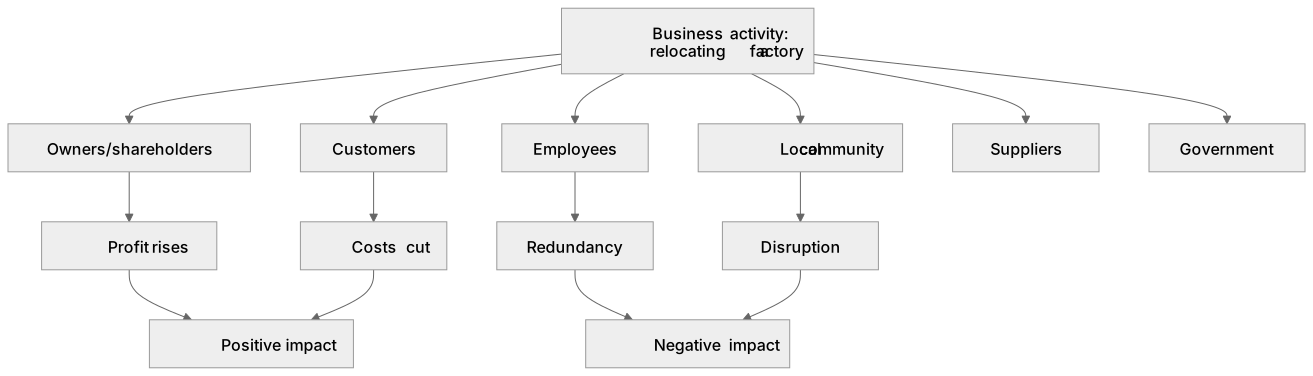
Key words
Say what each word means before you turn the card.
Stakeholder groups and their differing objectives
Try answering aloud or in your head before turning the card.
Positive and negative consequences of business decisions
Try answering aloud or in your head before turning the card.
Short-term versus long-term impact
Try answering aloud or in your head before turning the card.
Stakeholder conflict and trade-offs
Try answering aloud or in your head before turning the card.
See every definition
- Stakeholder groups and their differing objectives
- Groups such as owners/shareholders, employees, customers, suppliers, local community and government, on whom the effects of business activity fall unevenly.
- Positive and negative consequences of business decisions
- A decision can produce gains for some groups, such as higher dividends for shareholders, and losses for others, such as redundancy for employees.
- Short-term versus long-term impact
- An effect may be short term, such as a price rise, or long term, such as reputation damage.
- Stakeholder conflict and trade-offs
- One action produces different impacts for different groups, so a judgement is needed about which stakeholder is most affected and why.
Label the diagram
Some boxes have lost their names. Pick the right name for each number.
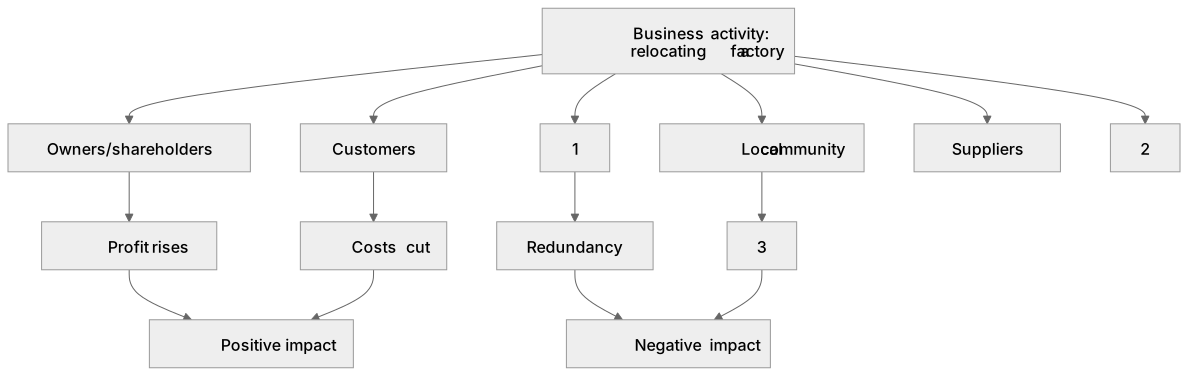
1Box 1
2Box 2
3Box 3
There is more to this lesson
The full lesson goes on to check your understanding and help you earn the marks. Create a free account to carry on, with your progress saved.
A week of Premium from your first lesson · Then the free plan continues · No card, no charge
Test your understanding of Stakeholders: Impact of business activity on stakeholders
Active recall beats re-reading. Take an instant quiz now to test what you’ve learned and lock it into long-term memory.
A week of Premium from your first lesson · Then the free plan continues · No card, no charge