AQA · GCSE · Business
Course version: 8132 · Version from Sept 2017
Consequences of quality issues Students should have an understanding of…
Full specification wording
The concept of quality: Consequences of quality issues Students should have an understanding of customer expectations of quality in terms of production of goods and the provision of services.
Customers expect quality in both goods and services.
Checked against the AQA 8132 specification (opens in a new tab) on .
- Point 1 of 13
- 3 key terms
Study notes
From the checked teaching notes for this specification point.
The idea
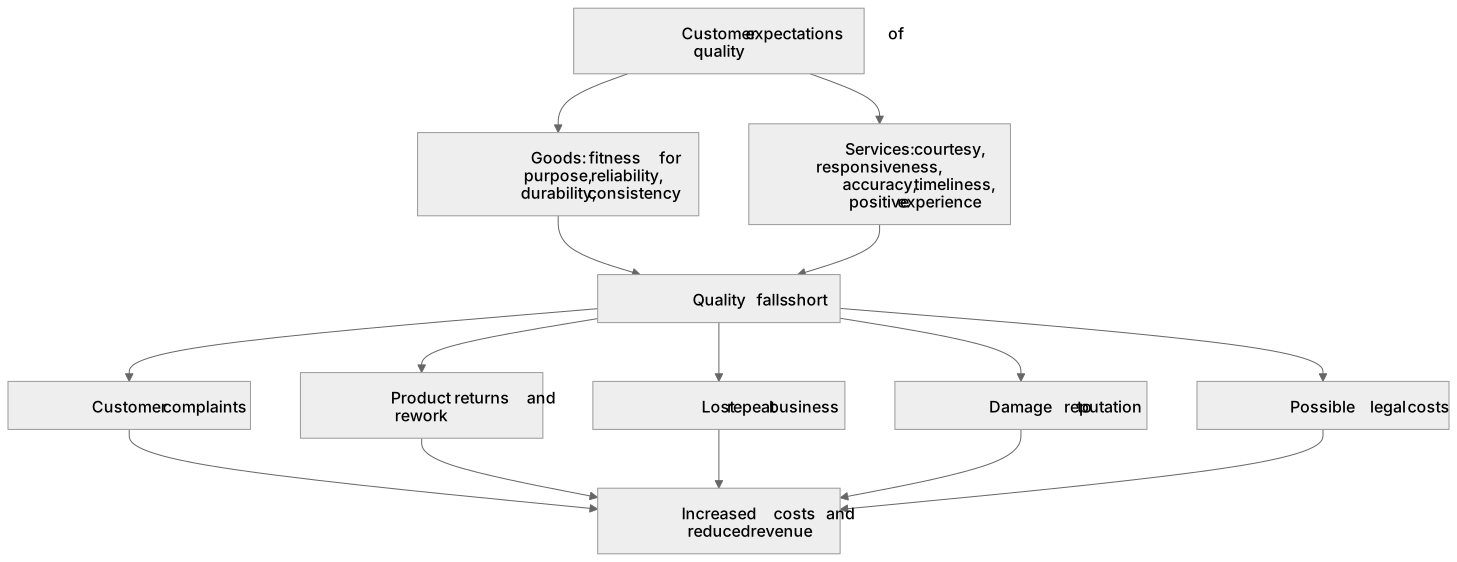
Customers expect quality in both goods and services. For goods, quality means fitness for purpose, reliability, durability and consistency with the specification. For services, it means courtesy, responsiveness, accuracy, timeliness and a positive experience. When quality falls short, consequences include customer complaints, product returns, rework, lost repeat business, damage to reputation and possible legal costs. For example, a hotel with dirty rooms loses bookings and receives poor reviews, while a manufacturer with faulty components faces recalls and compensation claims. Businesses therefore set quality standards, train staff and monitor performance. Understanding these expectations helps students explain why quality matters and how poor quality affects costs, revenue and reputation.
What earns the marks
- Outlines customer expectations of quality for goods: fitness for purpose, reliability, durability and consistency.
- Outlines customer expectations of quality for services: courtesy, responsiveness, accuracy, timeliness and overall experience.
- Explains consequences of poor quality such as complaints, returns, rework, lost customers and reputational damage.
- Links quality issues to increased costs, reduced revenue and possible legal or regulatory consequences.
- Applies quality expectations to a specific business context, distinguishing between goods and services where relevant.
- Evaluates how a business might respond to quality issues, for example through quality control, training or customer feedback.
Common mistakes and how to put them right
Assuming quality only applies to physical products.
Put it right: Service businesses also have measurable quality expectations such as accuracy and timeliness.
Believing higher quality always means higher price.
Put it right: Quality means meeting customer expectations consistently, which can be achieved at different price points.
Overlooking the financial impact of poor quality.
Put it right: Poor quality raises costs through rework, refunds and lost future sales.
Exam tips
- Use the context given in the question to give specific examples of quality expectations rather than generic lists.
- When explaining consequences, follow through from the quality issue to the effect on the business, such as lost revenue or higher costs.
- For evaluation, consider both short-term and long-term consequences, including reputation and repeat custom.
Try the lesson
The start of the The concept of quality: Consequences of quality issues Students should have an understanding of customer expectations of quality in terms of production of goods and the provision of services. lesson, made from checked teaching notes for this specification point.
Have a go first
A hotel receives many complaints that rooms are not cleaned properly and staff are rude to guests. Which consequence is most likely if these quality issues continue?
Listen
Customers expect quality in both goods and services. For goods, quality means fitness for purpose, reliability, durability and consistency with the specification. For services, it means courtesy, responsiveness, accuracy, timeliness and a positive experience. When quality falls short, consequences include customer complaints, product returns, rework, lost repeat business, damage to reputation and possible legal costs. For example, a hotel with dirty rooms loses bookings and receives poor reviews, while a manufacturer with faulty components faces recalls and compensation claims. Businesses therefore set quality standards, train staff and monitor performance. Understanding these expectations helps students explain why quality matters and how poor quality affects costs, revenue and reputation. A strong answer earns marks for these points. Outlines customer expectations of quality for goods: fitness for purpose, reliability, durability and consistency. Outlines customer expectations of quality for services: courtesy, responsiveness, accuracy, timeliness and overall experience. Explains consequences of poor quality such as complaints, returns, rework, lost customers and reputational damage. Links quality issues to increased costs, reduced revenue and possible legal or regulatory consequences. A common slip: Assuming quality only applies to physical products: the error is ignoring service quality. Instead, service businesses also have measurable quality expectations such as accuracy and timeliness. Exam tip: Use the context given in the question to give specific examples of quality expectations rather than generic lists.
See it
Key words
Say what each word means before you turn the card.
Quality
Try answering aloud or in your head before turning the card.
Customer expectations
Try answering aloud or in your head before turning the card.
Business reputation
Try answering aloud or in your head before turning the card.
See every definition
- Quality
- Fitness for purpose, reliability, durability and consistency with the specification for goods, and courtesy, responsiveness, accuracy, timeliness and a positive experience for services.
- Customer expectations
- What customers anticipate in terms of quality in the production of goods and the provision of services.
- Business reputation
- The standing of a business that can be damaged when quality falls short.
Label the diagram
Some boxes have lost their names. Pick the right name for each number.
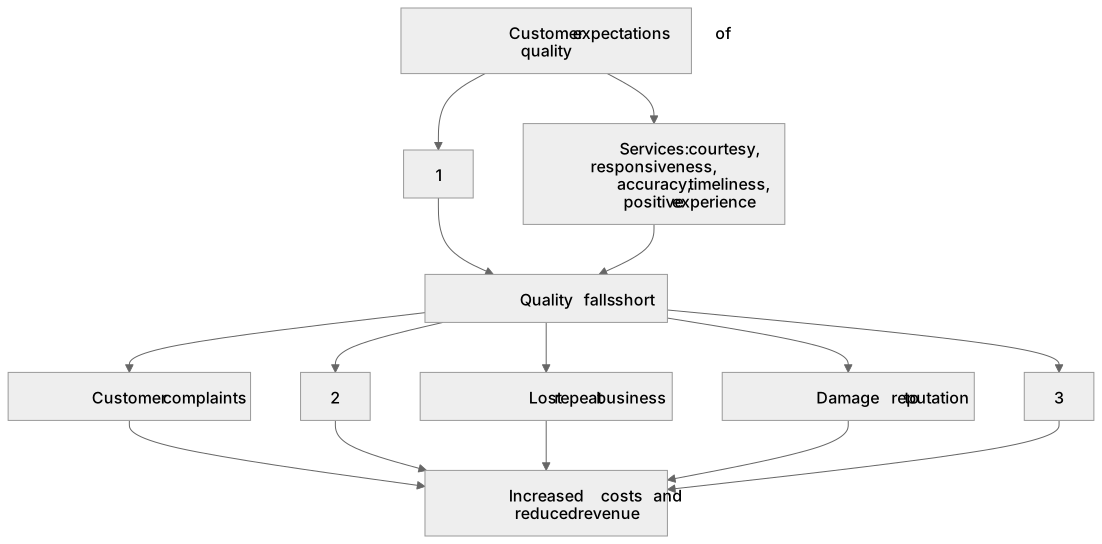
1Box 1
2Box 2
3Box 3
There is more to this lesson
The full lesson goes on to check your understanding and help you earn the marks. Create a free account to carry on, with your progress saved.
A week of Premium from your first lesson · Then the free plan continues · No card, no charge
Test your understanding of The concept of quality: Consequences of quality issues Students should have an understanding of customer expectations of quality in terms of production of goods and the provision of services.
Active recall beats re-reading. Take an instant quiz now to test what you’ve learned and lock it into long-term memory.
A week of Premium from your first lesson · Then the free plan continues · No card, no charge