AQA · GCSE · Business
Course version: 8132 · Version from Sept 2017
The concept of quality: image/reputation
Quality shapes a business's image and reputation: the impression customers, suppliers, employees and investors hold.
Checked against the AQA 8132 specification (opens in a new tab) on .
- Point 8 of 13
Study notes
From the checked teaching notes for this specification point.
The idea
Quality shapes a business's image and reputation: the impression customers, suppliers, employees and investors hold. Consistently meeting or exceeding expectations builds trust, so buyers return and recommend the firm, strengthening brand value and making recruitment and finance easier. Poor quality damages that image quickly: faults, delays and poor service spread through reviews and word of mouth, deterring new customers and unsettling existing ones. Reputation is therefore an asset built over time but lost fast. For example, a bakery selling stale cakes may lose regulars and gain negative online reviews, while a rival with reliable freshness gains repeat trade. Image also affects how stakeholders judge risk, so a strong reputation can support premium pricing and partnerships, whereas a weak one can force discounts and defensive marketing.
What earns the marks
- Explains that image and reputation are the perceptions held by stakeholders such as customers, suppliers, employees and investors, not simply the physical product.
- Links consistently high quality to trust, repeat purchase, positive word of mouth and recommendations, which strengthen the brand.
- Links poor quality to complaints, returns, negative reviews and lost custom, showing how quickly reputation can be damaged.
- Uses a concrete example, such as a bakery with stale cakes losing regulars, to show how quality affects reputation.
- Explains that a strong reputation can make recruitment, finance and supplier relationships easier because stakeholders judge the business as lower risk.
- Explains that a weak reputation may force price discounts or defensive marketing to win back customers.
Common mistakes and how to put them right
Treating image as the same as the product itself.
Put it right by explaining that image is the perception stakeholders form, which quality influences.
Assuming reputation can only improve.
Put it right by noting that one serious quality failure can damage years of goodwill.
Ignoring internal stakeholders; correct by including employees and suppliers, whose confidence also depends on quality.
Exam tips
- Define image and reputation briefly, then apply them to the case business rather than writing generally.
- Use a cause-and-effect chain: quality level leads to customer reaction leads to reputation leads to business consequence.
- Refer to the context, such as the named firm's customers or product, to show application rather than recall alone.
Try the lesson
The start of the The concept of quality: image/reputation lesson, made from checked teaching notes for this specification point.
Have a go first
A bakery consistently sells cakes that customers complain are stale. What is the most likely impact on the bakery's reputation?
Listen
Quality shapes a business's image and reputation: the impression customers, suppliers, employees and investors hold. Consistently meeting or exceeding expectations builds trust, so buyers return and recommend the firm, strengthening brand value and making recruitment and finance easier. Poor quality damages that image quickly: faults, delays and poor service spread through reviews and word of mouth, deterring new customers and unsettling existing ones. Reputation is therefore an asset built over time but lost fast. For example, a bakery selling stale cakes may lose regulars and gain negative online reviews, while a rival with reliable freshness gains repeat trade. Image also affects how stakeholders judge risk, so a strong reputation can support premium pricing and partnerships, whereas a weak one can force discounts and defensive marketing. A strong answer earns marks for these points. Explains that image and reputation are the perceptions held by stakeholders such as customers, suppliers, employees and investors, not simply the physical product. Links consistently high quality to trust, repeat purchase, positive word of mouth and recommendations, which strengthen the brand. Links poor quality to complaints, returns, negative reviews and lost custom, showing how quickly reputation can be damaged. Uses a concrete example, such as a bakery with stale cakes losing regulars, to show how quality affects reputation. A common slip: Treating image as the same as the product itself. Instead, explaining that image is the perception stakeholders form, which quality influences. Exam tip: Define image and reputation briefly, then apply them to the case business rather than writing generally.
See it
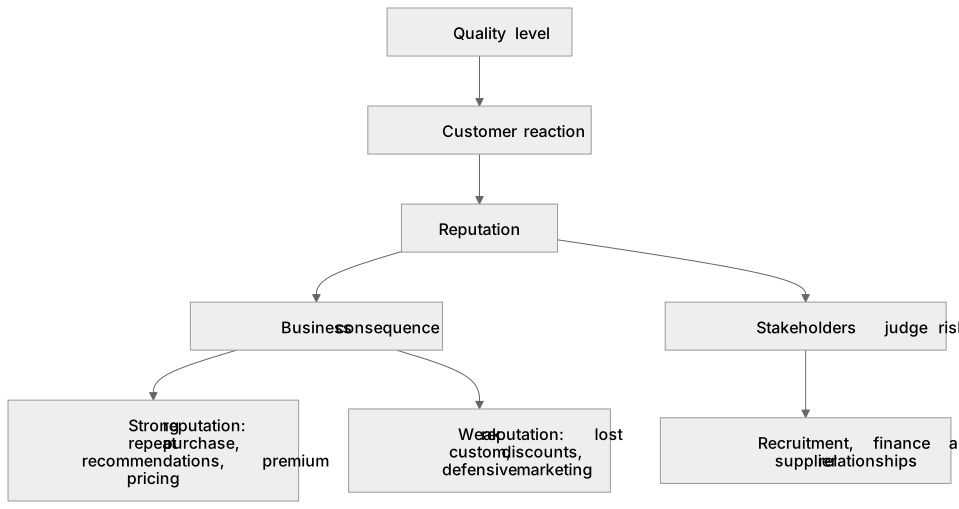
Label the diagram
Some boxes have lost their names. Pick the right name for each number.
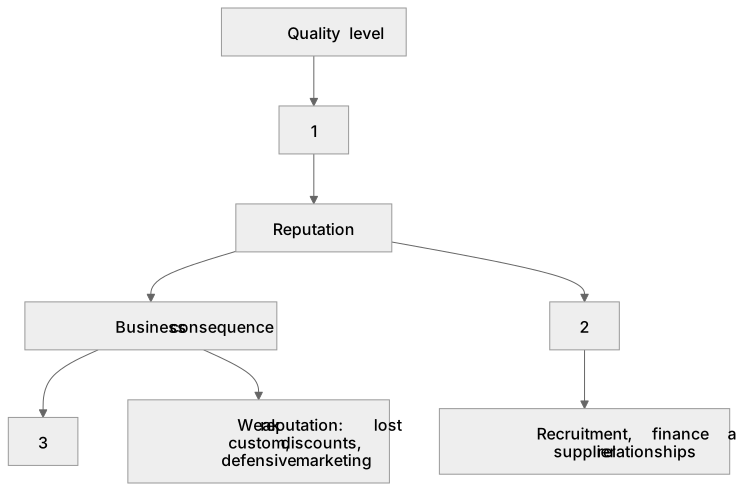
1Box 1
2Box 2
3Box 3
There is more to this lesson
The full lesson goes on to check your understanding and help you earn the marks. Create a free account to carry on, with your progress saved.
A week of Premium from your first lesson · Then the free plan continues · No card, no charge
Test your understanding of The concept of quality: image/reputation
Active recall beats re-reading. Take an instant quiz now to test what you’ve learned and lock it into long-term memory.
A week of Premium from your first lesson · Then the free plan continues · No card, no charge