AQA · GCSE · Business
Course version: 8132 · Version from Sept 2017
Methods of maintaining consistent quality: Total quality management (TQM)
Full specification wording
The concept of quality: Methods of maintaining consistent quality: Total quality management (TQM)
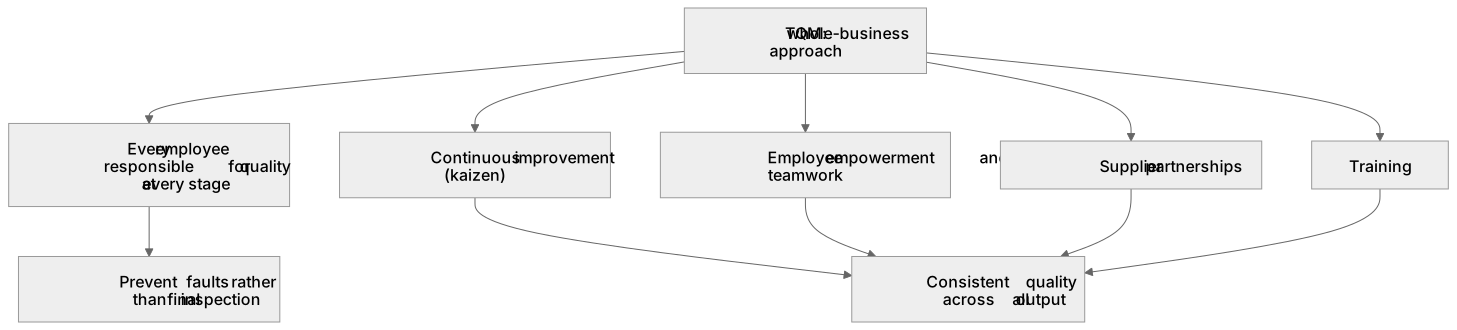
Total quality management (TQM) is a whole-business approach in which every employee takes responsibility for quality at every stage, rather than relying on a final inspection.
Checked against the AQA 8132 specification (opens in a new tab) on .
- Point 3 of 13
- 4 key terms
Study notes
From the checked teaching notes for this specification point.
The idea
Total quality management (TQM) is a whole-business approach in which every employee takes responsibility for quality at every stage, rather than relying on a final inspection. It aims to prevent faults rather than find them afterwards, so it maintains consistent quality across all output. Key features include a culture of continuous improvement, often called kaizen, where small incremental gains are made all the time; employee empowerment and teamwork so workers can halt production or suggest fixes; supplier partnerships that require reliable incoming materials; and training so staff have the skills to meet standards. For example, a car plant where any worker can stop the line when a fault appears prevents defective vehicles reaching customers. TQM can raise customer satisfaction and cut waste, but it needs strong leadership, time and investment, and benefits may take months to appear.
What earns the marks
- Definition: TQM is a whole-business approach where every employee is responsible for quality at every stage, preventing faults rather than inspecting them out at the end.
- Continuous improvement (kaizen): small, ongoing improvements are made by teams rather than one-off large changes.
- Employee involvement: empowerment, teamwork and training allow workers to spot problems, suggest improvements and take responsibility for their own output.
- Supplier partnerships: TQM depends on reliable suppliers providing consistent quality materials and components, often through long-term relationships.
- Benefits: fewer defects, less waste and rework, higher customer satisfaction, stronger reputation and potentially lower long-run costs.
- Limitations: TQM requires strong leadership, significant training and time investment, may meet employee resistance, and benefits can take months to appear.
Common mistakes and how to put them right
Describing TQM as simply more inspections at the end of production.
Put it right: TQM prevents faults throughout the process and reduces reliance on final inspection.
Claiming TQM guarantees zero defects immediately.
Put it right: It is a long-term approach needing training, leadership and continuous effort before results show.
Ignoring the role of suppliers.
Put it right: Inconsistent incoming materials undermine TQM even when internal staff work well.
Exam tips
- Contrast TQM with traditional quality control by explaining that TQM involves everyone and prevents faults, while quality control checks finished output.
- Support each benefit or limitation with a short business example, such as a factory where workers can stop the line to fix a fault.
- For evaluation questions, weigh benefits against costs and time, then reach a supported judgement rather than listing points only.
Try the lesson
The start of the The concept of quality: Methods of maintaining consistent quality: Total quality management (TQM) lesson, made from checked teaching notes for this specification point.
Have a go first
What is the main aim of total quality management (TQM) in a business?
Listen
Total quality management (TQM) is a whole-business approach in which every employee takes responsibility for quality at every stage, rather than relying on a final inspection. It aims to prevent faults rather than find them afterwards, so it maintains consistent quality across all output. Key features include a culture of continuous improvement, often called kaizen, where small incremental gains are made all the time; employee empowerment and teamwork so workers can halt production or suggest fixes; supplier partnerships that require reliable incoming materials; and training so staff have the skills to meet standards. For example, a car plant where any worker can stop the line when a fault appears prevents defective vehicles reaching customers. TQM can raise customer satisfaction and cut waste, but it needs strong leadership, time and investment, and benefits may take months to appear. A strong answer earns marks for these points. Definition: TQM is a whole-business approach where every employee is responsible for quality at every stage, preventing faults rather than inspecting them out at the end. Continuous improvement (kaizen): small, ongoing improvements are made by teams rather than one-off large changes. Employee involvement: empowerment, teamwork and training allow workers to spot problems, suggest improvements and take responsibility for their own output. Supplier partnerships: TQM depends on reliable suppliers providing consistent quality materials and components, often through long-term relationships. Exam tip: Contrast TQM with traditional quality control by explaining that TQM involves everyone and prevents faults, while quality control checks finished output.
See it
Key words
Say what each word means before you turn the card.
Whole-business quality culture
Try answering aloud or in your head before turning the card.
Continuous improvement
Try answering aloud or in your head before turning the card.
Employee empowerment and training
Try answering aloud or in your head before turning the card.
Supplier relationships and consistency
Try answering aloud or in your head before turning the card.
See every definition
- Whole-business quality culture
- An approach in which every employee takes responsibility for quality at every stage, rather than relying on a final inspection.
- Continuous improvement
- A culture, often called kaizen, where small incremental gains are made all the time.
- Employee empowerment and training
- Workers are enabled to halt production or suggest fixes, and are given the skills to meet standards.
- Supplier relationships and consistency
- Supplier partnerships that require reliable incoming materials, often through long-term relationships.
Label the diagram
Some boxes have lost their names. Pick the right name for each number.
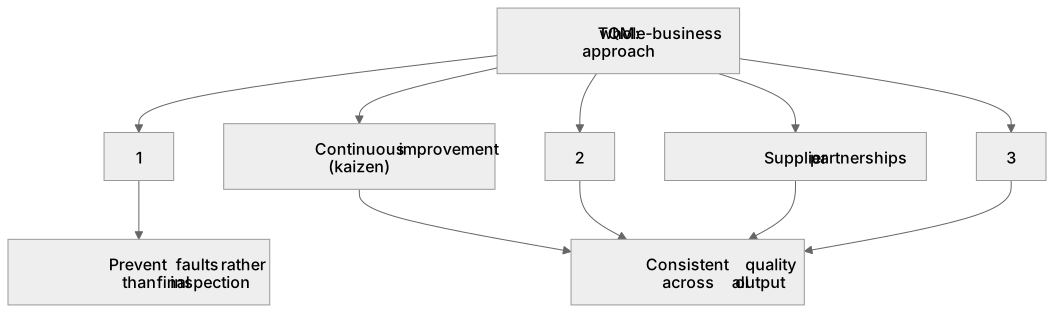
1Box 1
2Box 2
3Box 3
There is more to this lesson
The full lesson goes on to check your understanding and help you earn the marks. Create a free account to carry on, with your progress saved.
A week of Premium from your first lesson · Then the free plan continues · No card, no charge
Test your understanding of The concept of quality: Methods of maintaining consistent quality: Total quality management (TQM)
Active recall beats re-reading. Take an instant quiz now to test what you’ve learned and lock it into long-term memory.
A week of Premium from your first lesson · Then the free plan continues · No card, no charge