AQA · GCSE · Business
Course version: 8132 · Version from Sept 2017
How fluctuating interest rates can affect businesses that rely on…
Full specification wording
The economic climate on businesses: how fluctuating interest rates can affect businesses that rely on overdrafts and loans for finance
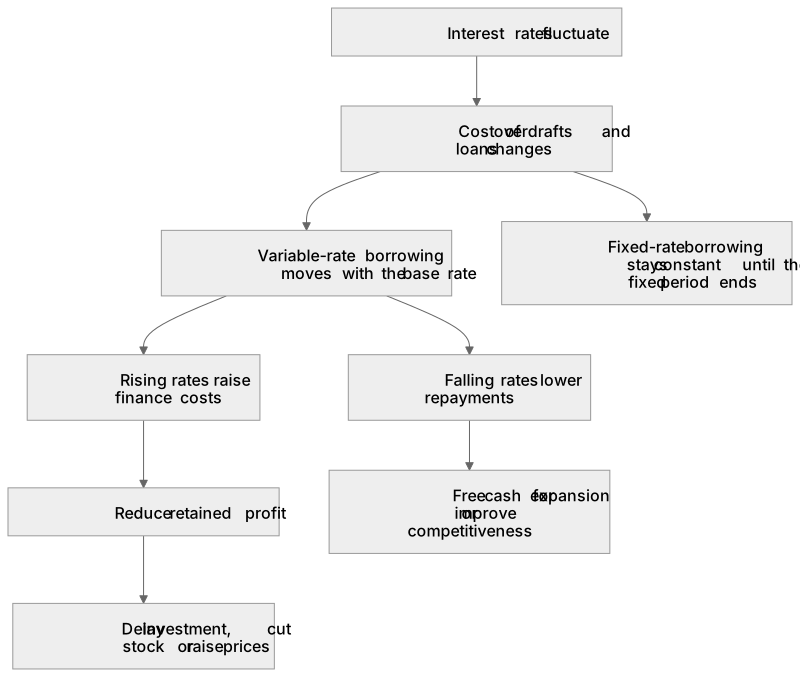
Interest rates are the price of borrowed money, so when they fluctuate, the cost of overdrafts and loans changes.
Checked against the AQA 8132 specification (opens in a new tab) on .
- Point 2 of 8
- 4 key terms
Study notes
From the checked teaching notes for this specification point.
The idea
Interest rates are the price of borrowed money, so when they fluctuate, the cost of overdrafts and loans changes. A business using a £50,000 overdraft at 6% pays £3,000 interest a year; at 9% it pays £4,500, so £1,500 less profit. Variable-rate loans move with the base rate, while fixed-rate loans stay constant until the fixed period ends. Rising rates therefore raise finance costs, reduce retained profit and may force a firm to delay investment, cut stock or raise prices. Falling rates lower repayments, freeing cash for expansion or improving competitiveness. The effect depends on how much debt a business carries and whether rates are fixed or variable.
What earns the marks
- Define interest as the cost of borrowing and identify overdrafts and loans as external finance sources.
- Explain that a rise in interest rates increases interest payments on variable-rate overdrafts and loans, reducing profit.
- Explain that a fall in interest rates reduces interest payments, improving cash flow and retained profit.
- Distinguish between fixed-rate and variable-rate borrowing and explain why fixed rates delay the impact.
- Apply the effect to business decisions such as investment, pricing, stock levels or expansion.
- Use a numerical example to show how a change in the rate changes the annual interest cost.
Common mistakes and how to put them right
Treating interest as a one-off fee rather than a percentage charged over time.
Put it right by calculating annual interest as rate multiplied by the amount borrowed.
Assuming all loans are affected immediately.
Put it right by noting that fixed-rate loans stay unchanged until the fixed period ends.
Confusing interest rates with exchange rates.
Put it right by linking interest rates to the cost of borrowing and exchange rates to currency conversion.
Exam tips
- Use the formula interest = rate × amount borrowed to produce a quick numerical comparison.
- Link each rate change to a specific business consequence such as lower profit, higher prices or postponed investment.
- State whether the borrowing is fixed or variable before judging the impact on the business.
Try the lesson
The start of the The economic climate on businesses: how fluctuating interest rates can affect businesses that rely on overdrafts and loans for finance lesson, made from checked teaching notes for this specification point.
Have a go first
A business has an overdraft on which it pays interest. If interest rates rise, what happens to the interest payments the business makes on that overdraft?
Listen
Interest rates are the price of borrowed money, so when they fluctuate, the cost of overdrafts and loans changes. A business using a £50,000 overdraft at 6% pays £3,000 interest a year; at 9% it pays £4,500, so £1,500 less profit. Variable-rate loans move with the base rate, while fixed-rate loans stay constant until the fixed period ends. Rising rates therefore raise finance costs, reduce retained profit and may force a firm to delay investment, cut stock or raise prices. Falling rates lower repayments, freeing cash for expansion or improving competitiveness. The effect depends on how much debt a business carries and whether rates are fixed or variable. A strong answer earns marks for these points. Define interest as the cost of borrowing and identify overdrafts and loans as external finance sources. Explain that a rise in interest rates increases interest payments on variable-rate overdrafts and loans, reducing profit. Explain that a fall in interest rates reduces interest payments, improving cash flow and retained profit. Distinguish between fixed-rate and variable-rate borrowing and explain why fixed rates delay the impact. A common slip: Treating interest as a one-off fee rather than a percentage charged over time. Instead, calculating annual interest as rate multiplied by the amount borrowed. Exam tip: Use the formula interest = rate × amount borrowed to produce a quick numerical comparison.
See it
Key words
Say what each word means before you turn the card.
Cost of finance
Try answering aloud or in your head before turning the card.
Cash flow and profit
Try answering aloud or in your head before turning the card.
Business investment decisions
Try answering aloud or in your head before turning the card.
Fixed versus variable borrowing
Try answering aloud or in your head before turning the card.
See every definition
- Cost of finance
- Interest rates are the price of borrowed money, so when they fluctuate, the cost of overdrafts and loans changes.
- Cash flow and profit
- Falling rates lower repayments, freeing cash for expansion or improving competitiveness, while rising rates reduce retained profit.
- Business investment decisions
- Rising rates may force a firm to delay investment, cut stock or raise prices, while falling rates free cash for expansion.
- Fixed versus variable borrowing
- Variable-rate loans move with the base rate, while fixed-rate loans stay constant until the fixed period ends.
Label the diagram
Some boxes have lost their names. Pick the right name for each number.
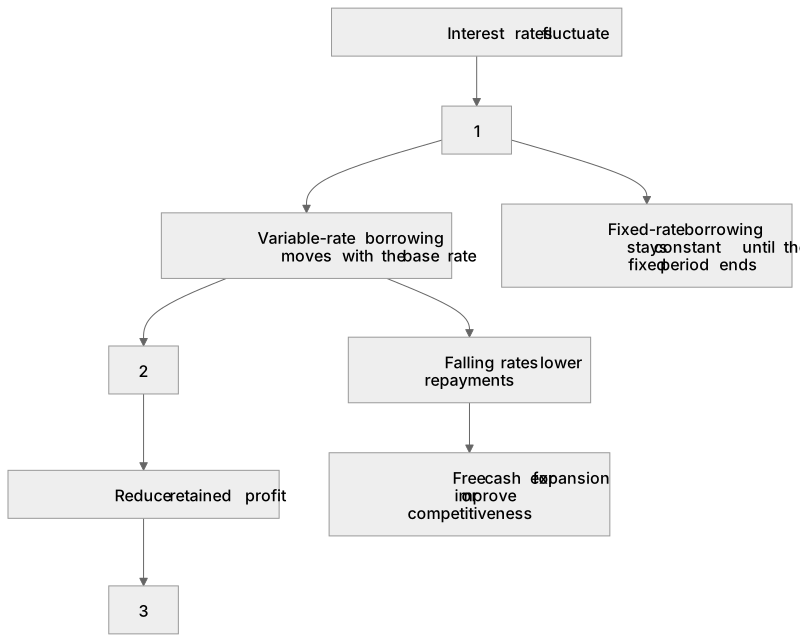
1Box 1
2Box 2
3Box 3
There is more to this lesson
The full lesson goes on to check your understanding and help you earn the marks. Create a free account to carry on, with your progress saved.
A week of Premium from your first lesson · Then the free plan continues · No card, no charge
Test your understanding of The economic climate on businesses: how fluctuating interest rates can affect businesses that rely on overdrafts and loans for finance
Active recall beats re-reading. Take an instant quiz now to test what you’ve learned and lock it into long-term memory.
A week of Premium from your first lesson · Then the free plan continues · No card, no charge