AQA · GCSE · Business
Course version: 8132 · Version from Sept 2017
Price, product, promotion and place (4Ps): advertising
Full specification wording
The elements of the marketing mix: price, product, promotion and place (4Ps): advertising
Advertising is paid, non-personal promotion that informs or persuades customers about a product.
Checked against the AQA 8132 specification (opens in a new tab) on .
- Point 32 of 80
- 4 key terms
Study notes
From the checked teaching notes for this specification point.
The idea
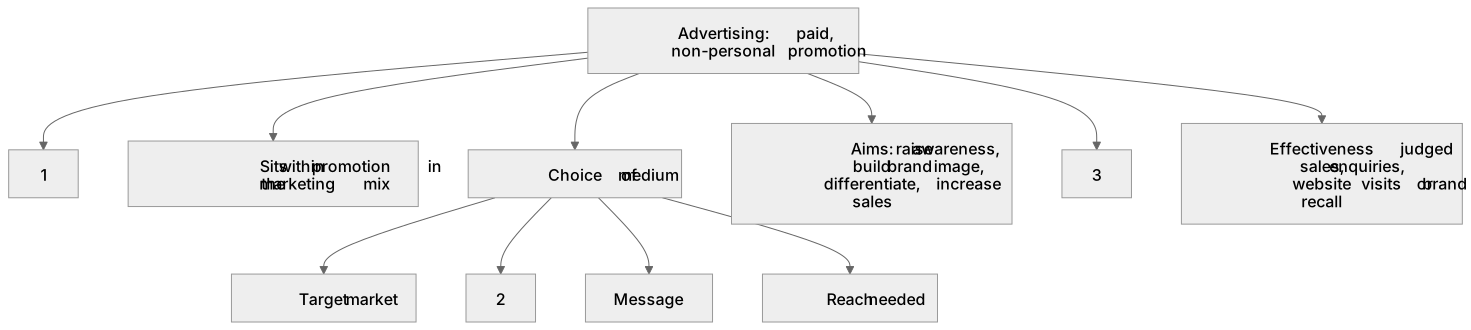
Advertising is paid, non-personal promotion that informs or persuades customers about a product. It sits within the promotion element of the marketing mix. Businesses choose media such as television, radio, newspapers, magazines, billboards, cinema, online display, social media and search-engine advertising. The choice depends on the target market, budget, message and reach needed. Advertising aims to raise awareness, build a brand image, differentiate from rivals and increase sales. It can be informative, persuasive or reminder-based. Costs vary: a national TV campaign is expensive but reaches millions, while social media can be cheaper and more precisely targeted. Effectiveness is judged by sales, enquiries, website visits or brand recall. Poor advertising wastes money and may annoy customers.
What earns the marks
- Defines advertising as paid, non-personal communication used to inform or persuade customers.
- Identifies at least two advertising media, such as television, social media, billboards or newspapers.
- Explains how the choice of medium depends on the target market, budget and desired reach.
- Gives a purpose of advertising, such as increasing awareness, building brand image or boosting sales.
- Analyses a benefit and a drawback, such as wide reach versus high cost or wasted exposure.
- Judges whether a particular advertising method is suitable for a given business and target market.
Common mistakes and how to put them right
Confusing advertising with other promotion methods such as sales promotions or personal selling.
Put it right: Advertising is paid, non-personal communication to a mass audience.
Assuming all advertising is expensive.
Put it right: Low-cost options such as social media or local leaflets may suit small businesses.
Ignoring the target market when choosing a medium.
Put it right: The medium must be where the intended customers actually spend their time.
Exam tips
- Name the specific advertising medium and link it to the target market, for example online video for teenagers.
- Use the context of the business in the case study rather than writing about advertising in general.
- For evaluation, compare the cost of the advertising with the expected increase in sales or awareness.
Try the lesson
The start of the The elements of the marketing mix: price, product, promotion and place (4Ps): advertising lesson, made from checked teaching notes for this specification point.
Have a go first
Advertising is one part of the marketing mix. Which element of the marketing mix does advertising belong to?
Listen
Advertising is paid, non-personal promotion that informs or persuades customers about a product. It sits within the promotion element of the marketing mix. Businesses choose media such as television, radio, newspapers, magazines, billboards, cinema, online display, social media and search-engine advertising. The choice depends on the target market, budget, message and reach needed. Advertising aims to raise awareness, build a brand image, differentiate from rivals and increase sales. It can be informative, persuasive or reminder-based. Costs vary: a national TV campaign is expensive but reaches millions, while social media can be cheaper and more precisely targeted. Effectiveness is judged by sales, enquiries, website visits or brand recall. Poor advertising wastes money and may annoy customers. A strong answer earns marks for these points. Defines advertising as paid, non-personal communication used to inform or persuade customers. Identifies at least two advertising media, such as television, social media, billboards or newspapers. Explains how the choice of medium depends on the target market, budget and desired reach. Gives a purpose of advertising, such as increasing awareness, building brand image or boosting sales. A common slip: Confusing advertising with other promotion methods such as sales promotions or personal selling. Instead, advertising is paid, non-personal communication to a mass audience. Exam tip: Name the specific advertising medium and link it to the target market, for example online video for teenagers.
See it

Key words
Say what each word means before you turn the card.
Advertising
Try answering aloud or in your head before turning the card.
Promotion mix
Try answering aloud or in your head before turning the card.
Target market and media choice
Try answering aloud or in your head before turning the card.
Cost effectiveness
Try answering aloud or in your head before turning the card.
See every definition
- Advertising
- Paid, non-personal promotion that informs or persuades customers about a product, sitting within the promotion element of the marketing mix.
- Promotion mix
- The promotion element of the marketing mix, within which advertising sits alongside other promotion methods.
- Target market and media choice
- The choice of advertising medium depends on the target market, budget, message and reach needed.
- Cost effectiveness
- Effectiveness is judged by sales, enquiries, website visits or brand recall, and poor advertising wastes money and may annoy customers.
Label the diagram
Some boxes have lost their names. Pick the right name for each number.
1Box 1
2Box 2
3Box 3
There is more to this lesson
The full lesson goes on to check your understanding and help you earn the marks. Create a free account to carry on, with your progress saved.
A week of Premium from your first lesson · Then the free plan continues · No card, no charge
Test your understanding of The elements of the marketing mix: price, product, promotion and place (4Ps): advertising
Active recall beats re-reading. Take an instant quiz now to test what you’ve learned and lock it into long-term memory.
A week of Premium from your first lesson · Then the free plan continues · No card, no charge