AQA · GCSE · Business
Course version: 8132 · Version from Sept 2017
Price, product, promotion and place (4Ps): competitions.
Full specification wording
The elements of the marketing mix: price, product, promotion and place (4Ps): competitions.
Competitions are a promotional tactic where customers enter for a chance to win a prize, often by purchasing a product, sharing details or creating content.
Checked against the AQA 8132 specification (opens in a new tab) on .
- Point 52 of 80
- 4 key terms
Study notes
From the checked teaching notes for this specification point.
The idea
Competitions are a promotional tactic where customers enter for a chance to win a prize, often by purchasing a product, sharing details or creating content. They sit within the promotion element of the marketing mix. For example, a soft drinks brand might run a competition to win a holiday, with entry via a code on the bottle. This can raise awareness, increase engagement and generate customer data. Competitions can be low-cost relative to mass advertising and can create social media buzz. However, they may attract entrants who are only interested in the prize, not the product, and they require clear terms and legal compliance. When analysing, consider whether the competition builds long-term brand loyalty or just short-term attention.
What earns the marks
- Defines competitions as a promotional method where customers enter for a chance to win a prize.
- Links competitions to the promotion element of the marketing mix and to awareness or engagement objectives.
- Explains how competitions can increase brand awareness, customer engagement or data collection.
- Analyses the cost-effectiveness of competitions compared with other promotional methods.
- Evaluates the risk of attracting prize-focused entrants rather than genuine customers.
Common mistakes and how to put them right
Confusing competitions with coupons.
Put it right: Competitions offer a chance to win a prize, while coupons give a guaranteed discount.
Ignoring legal and ethical requirements.
Put it right: Competitions must comply with advertising and data protection rules, and terms should be clear.
Assuming all entrants become customers.
Put it right: Many may enter only for the prize, so the business should measure conversion or repeat purchase.
Exam tips
- When analysing, link the competition to a specific promotional objective such as increasing social media followers or collecting email addresses.
- Use a real or hypothetical example to show how a competition can generate engagement, for instance a photo contest with a hashtag.
- In evaluation, consider whether the competition attracts the target market and whether the prize cost is justified by the promotional benefit.
Try the lesson
The start of the The elements of the marketing mix: price, product, promotion and place (4Ps): competitions. lesson, made from checked teaching notes for this specification point.
Have a go first
Which element of the marketing mix is a business using when it runs a competition for customers to win a prize?
Listen
Competitions are a promotional tactic where customers enter for a chance to win a prize, often by purchasing a product, sharing details or creating content. They sit within the promotion element of the marketing mix. For example, a soft drinks brand might run a competition to win a holiday, with entry via a code on the bottle. This can raise awareness, increase engagement and generate customer data. Competitions can be low-cost relative to mass advertising and can create social media buzz. However, they may attract entrants who are only interested in the prize, not the product, and they require clear terms and legal compliance. When analysing, consider whether the competition builds long-term brand loyalty or just short-term attention. A strong answer earns marks for these points. Defines competitions as a promotional method where customers enter for a chance to win a prize. Links competitions to the promotion element of the marketing mix and to awareness or engagement objectives. Explains how competitions can increase brand awareness, customer engagement or data collection. Analyses the cost-effectiveness of competitions compared with other promotional methods. A common slip: Confusing competitions with coupons. Instead, competitions offer a chance to win a prize, while coupons give a guaranteed discount. Exam tip: When analysing, link the competition to a specific promotional objective such as increasing social media followers or collecting email addresses.
See it

Key words
Say what each word means before you turn the card.
Promotion
Try answering aloud or in your head before turning the card.
Brand awareness
Try answering aloud or in your head before turning the card.
Customer engagement
Try answering aloud or in your head before turning the card.
Legal compliance
Try answering aloud or in your head before turning the card.
See every definition
- Promotion
- One of the elements of the marketing mix, within which competitions sit as a promotional tactic.
- Brand awareness
- Something a competition can raise, alongside increasing engagement and generating customer data.
- Customer engagement
- Something a competition can increase, alongside raising awareness and generating customer data.
- Legal compliance
- Something competitions require, along with clear terms, as they must comply with advertising and data protection rules.
Label the diagram
Some boxes have lost their names. Pick the right name for each number.
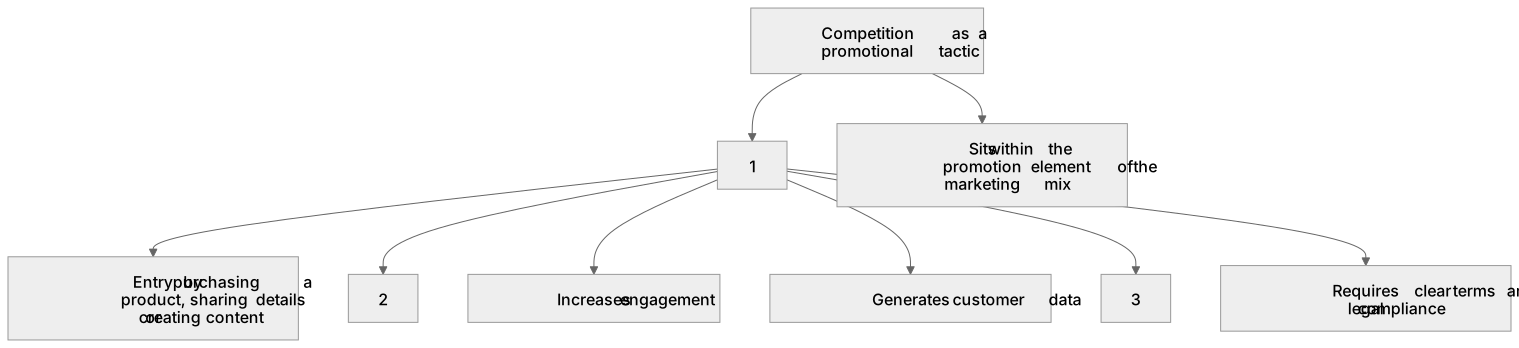
1Box 1
2Box 2
3Box 3
There is more to this lesson
The full lesson goes on to check your understanding and help you earn the marks. Create a free account to carry on, with your progress saved.
A week of Premium from your first lesson · Then the free plan continues · No card, no charge
Test your understanding of The elements of the marketing mix: price, product, promotion and place (4Ps): competitions.
Active recall beats re-reading. Take an instant quiz now to test what you’ve learned and lock it into long-term memory.
A week of Premium from your first lesson · Then the free plan continues · No card, no charge