AQA · GCSE · Business
Course version: 8132 · Version from Sept 2017
Price, product, promotion and place (4Ps): competitive pricing
Full specification wording
The elements of the marketing mix: price, product, promotion and place (4Ps): competitive pricing
Competitive pricing means setting a price close to, or slightly below, the prices charged by rival businesses for similar products.
Checked against the AQA 8132 specification (opens in a new tab) on .
- Point 5 of 80
- 2 key terms
Study notes
From the checked teaching notes for this specification point.
The idea
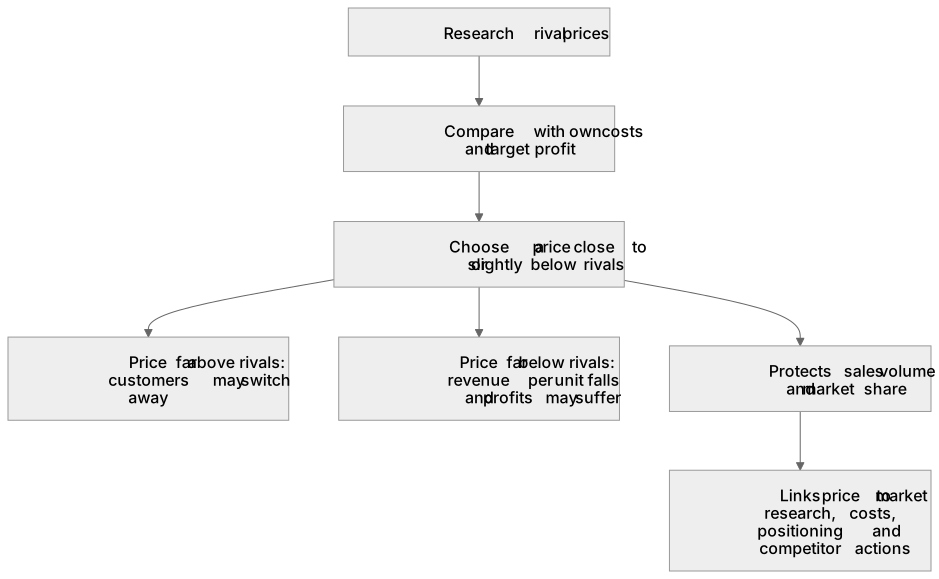
Competitive pricing means setting a price close to, or slightly below, the prices charged by rival businesses for similar products. It sits within the price element of the marketing mix (the 4Ps) and is most useful in markets where customers can easily compare offers, such as soft drinks, budget airlines or mobile phone contracts. A business first researches rival prices, then chooses a price that protects its sales volume while still covering costs and earning a target profit. If it prices far above rivals, customers may switch away; if it prices far below, revenue per unit falls and profits may suffer. Competitive pricing therefore links price decisions to market research, costs, positioning and the actions of competitors.
What earns the marks
- Defines competitive pricing as setting a price in line with, or slightly below, the prices of rival businesses selling similar products.
- Explains that it is used in competitive markets where customers compare prices easily, so demand is sensitive to small price differences.
- Shows the method: research competitor prices, compare them with the firm's own costs and target profit, then choose a suitable price.
- Analyses the benefit of protecting or increasing sales volume and market share by remaining attractive to price-conscious customers.
- Analyses the drawback that a low price reduces the profit margin per unit, so total profit may fall unless sales volume rises enough.
- Links competitive pricing to the wider marketing mix, for example matching a mid-market product image or supporting it with promotion.
- Applies the concept to a given business context, using the data or scenario provided rather than writing generally.
Common mistakes and how to put them right
Treating competitive pricing as always the cheapest price in the market.
Put it right: It means pricing close to rivals, not necessarily being the lowest.
Confusing competitive pricing with price skimming or penetration pricing.
Put it right: Skimming starts high for new or unique products, while penetration starts very low to win market share quickly.
Ignoring costs and assuming any price below rivals is safe.
Put it right: The chosen price must still cover costs and allow a realistic profit margin.
Writing about competition in general without mentioning price.
Put it right: Keep the answer focused on the pricing decision and its effect on sales and profit.
Exam tips
- Define the term briefly, then apply it to the business in the case study rather than leaving the definition abstract.
- Use the data given, such as rival prices or the firm's costs, to justify the price you recommend.
- Develop the chain of reasoning: price change leads to effect on demand, then effect on revenue, then effect on profit.
- When evaluating, weigh the benefit of higher sales against the risk of a lower profit margin per unit.
Try the lesson
The start of the The elements of the marketing mix: price, product, promotion and place (4Ps): competitive pricing lesson, made from checked teaching notes for this specification point.
Have a go first
A small bakery checks the prices charged by other bakeries nearby and then sets its own prices at a similar level. Which pricing method is the bakery using?
Listen
Competitive pricing means setting a price close to, or slightly below, the prices charged by rival businesses for similar products. It sits within the price element of the marketing mix (the 4Ps) and is most useful in markets where customers can easily compare offers, such as soft drinks, budget airlines or mobile phone contracts. A business first researches rival prices, then chooses a price that protects its sales volume while still covering costs and earning a target profit. If it prices far above rivals, customers may switch away; if it prices far below, revenue per unit falls and profits may suffer. Competitive pricing therefore links price decisions to market research, costs, positioning and the actions of competitors. A strong answer earns marks for these points. Defines competitive pricing as setting a price in line with, or slightly below, the prices of rival businesses selling similar products. Explains that it is used in competitive markets where customers compare prices easily, so demand is sensitive to small price differences. Shows the method: research competitor prices, compare them with the firm's own costs and target profit, then choose a suitable price. Analyses the benefit of protecting or increasing sales volume and market share by remaining attractive to price-conscious customers. A common slip: Treating competitive pricing as always the cheapest price in the market. Instead, it means pricing close to rivals, not necessarily being the lowest. Exam tip: Define the term briefly, then apply it to the business in the case study rather than leaving the definition abstract.
See it
Key words
Say what each word means before you turn the card.
Competitive pricing
Try answering aloud or in your head before turning the card.
Marketing mix
Try answering aloud or in your head before turning the card.
See every definition
- Competitive pricing
- Setting a price close to, or slightly below, the prices charged by rival businesses for similar products.
- Marketing mix
- The mix whose price element competitive pricing sits within, made up of price, product, promotion and place (the 4Ps).
Label the diagram
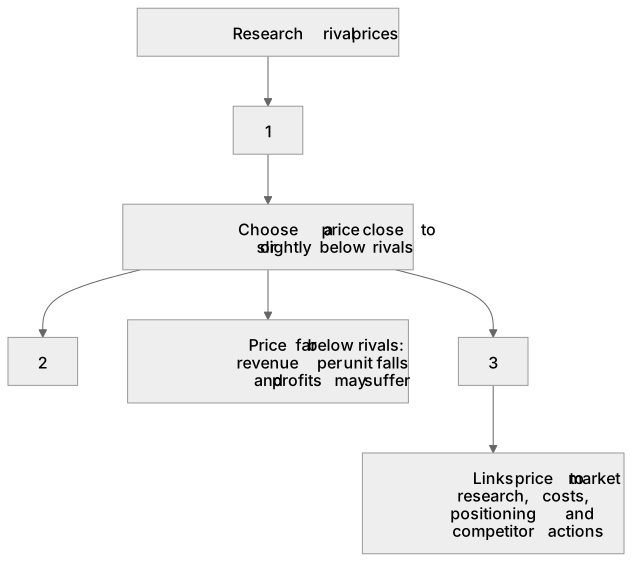
Some boxes have lost their names. Pick the right name for each number.
1Box 1
2Box 2
3Box 3
There is more to this lesson
The full lesson goes on to check your understanding and help you earn the marks. Create a free account to carry on, with your progress saved.
A week of Premium from your first lesson · Then the free plan continues · No card, no charge
Test your understanding of The elements of the marketing mix: price, product, promotion and place (4Ps): competitive pricing
Active recall beats re-reading. Take an instant quiz now to test what you’ve learned and lock it into long-term memory.
A week of Premium from your first lesson · Then the free plan continues · No card, no charge