AQA · GCSE · Business
Course version: 8132 · Version from Sept 2017
Price, product, promotion and place (4Ps): competitor actions
Full specification wording
The elements of the marketing mix: price, product, promotion and place (4Ps): competitor actions
Competitor actions are the decisions and moves made by rival businesses that affect a firm's marketing mix.
Checked against the AQA 8132 specification (opens in a new tab) on .
- Point 59 of 80
- 3 key terms
Study notes
From the checked teaching notes for this specification point.
The idea
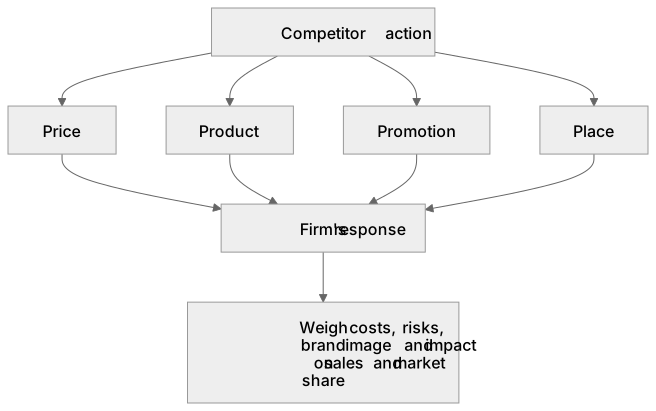
Competitor actions are the decisions and moves made by rival businesses that affect a firm's marketing mix. A competitor may cut price, launch a new product, run a promotion or change distribution, forcing a response. For example, if a rival cuts price by 10%, a firm may lower price, add value, or emphasise quality. Assessment requires applying competitor actions to a given business context and justifying a recommended response.
What earns the marks
- Defines competitor actions as the marketing decisions and strategies of rival businesses that can affect demand for a firm's own products.
- Explains how a competitor's price change can force a firm to reconsider its own pricing strategy, such as matching, undercutting or maintaining a premium price.
- Analyses how a competitor's new product launch or product improvement can require a firm to adapt its product portfolio, features or quality.
- Explains how competitor promotional activity, such as a major advertising campaign or special offer, can influence a firm's promotion mix and promotional budget.
- Analyses how a competitor changing its place strategy, for example opening new outlets or moving online, can affect a firm's distribution choices.
- Evaluates the most appropriate response to competitor actions by weighing costs, risks, brand image and likely impact on sales and market share.
Common mistakes and how to put them right
Treating competitor actions as only price cuts.
Put it right: Competitor actions can relate to any of the 4Ps, including product, promotion and place.
Assuming a firm must always match a competitor's action.
Put it right: A firm may choose to differentiate, ignore the action or target a different segment if that better fits its objectives.
Exam tips
- Use the case study to identify the specific competitor action before recommending a response.
- Link each response to at least one element of the marketing mix to show understanding of the 4Ps.
- When evaluating, compare at least two possible responses and justify which is best for the business in context.
Try the lesson
The start of the The elements of the marketing mix: price, product, promotion and place (4Ps): competitor actions lesson, made from checked teaching notes for this specification point.
Have a go first
A small bakery charges £2 for a loaf of bread. A rival bakery opens nearby and starts selling a similar loaf for £1.50. Which competitor action is the rival bakery taking?
Listen
Competitor actions are the decisions and moves made by rival businesses that affect a firm's marketing mix. A competitor may cut price, launch a new product, run a promotion or change distribution, forcing a response. For example, if a rival cuts price by 10%, a firm may lower price, add value, or emphasise quality. Assessment requires applying competitor actions to a given business context and justifying a recommended response. A strong answer earns marks for these points. Defines competitor actions as the marketing decisions and strategies of rival businesses that can affect demand for a firm's own products. Explains how a competitor's price change can force a firm to reconsider its own pricing strategy, such as matching, undercutting or maintaining a premium price. Analyses how a competitor's new product launch or product improvement can require a firm to adapt its product portfolio, features or quality. Explains how competitor promotional activity, such as a major advertising campaign or special offer, can influence a firm's promotion mix and promotional budget. A common slip: Treating competitor actions as only price cuts. Instead, competitor actions can relate to any of the 4Ps, including product, promotion and place. Exam tip: Use the case study to identify the specific competitor action before recommending a response.
See it
Key words
Say what each word means before you turn the card.
Competitor actions
Try answering aloud or in your head before turning the card.
Marketing mix
Try answering aloud or in your head before turning the card.
Business objectives
Try answering aloud or in your head before turning the card.
See every definition
- Competitor actions
- The marketing decisions and strategies of rival businesses that can affect demand for a firm's own products.
- Marketing mix
- The 4Ps of price, product, promotion and place, each of which a competitor's actions can influence.
- Business objectives
- The aims a firm considers, alongside costs and market position, when evaluating an appropriate response to competitor actions.
Label the diagram
Some boxes have lost their names. Pick the right name for each number.
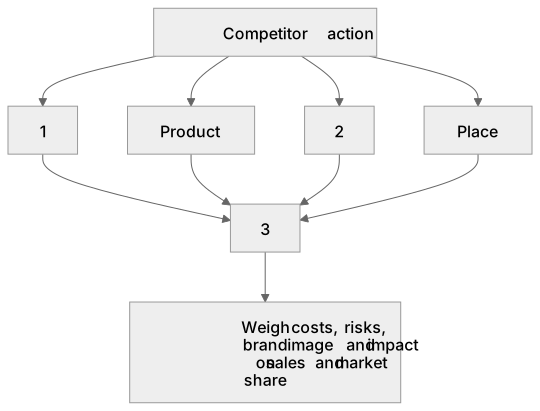
1Box 1
2Box 2
3Box 3
There is more to this lesson
The full lesson goes on to check your understanding and help you earn the marks. Create a free account to carry on, with your progress saved.
A week of Premium from your first lesson · Then the free plan continues · No card, no charge
Test your understanding of The elements of the marketing mix: price, product, promotion and place (4Ps): competitor actions
Active recall beats re-reading. Take an instant quiz now to test what you’ve learned and lock it into long-term memory.
A week of Premium from your first lesson · Then the free plan continues · No card, no charge