AQA · GCSE · Business
Course version: 8132 · Version from Sept 2017
Price, product, promotion and place (4Ps): costs
Full specification wording
The elements of the marketing mix: price, product, promotion and place (4Ps): costs
Costs are the amounts a business spends to produce and sell its goods or services, and they set the floor below which a price cannot normally be sustained in the long run.
Checked against the AQA 8132 specification (opens in a new tab) on .
- Point 10 of 80
- 4 key terms
Study notes
From the checked teaching notes for this specification point.
The idea
Costs are the amounts a business spends to produce and sell its goods or services, and they set the floor below which a price cannot normally be sustained in the long run. Fixed costs, such as rent and insurance, do not change with output, while variable costs, such as raw materials and packaging, rise as output increases. Total costs are fixed costs plus variable costs, and average cost is total cost divided by output. When pricing, a business must at least cover its costs to avoid a loss, and cost-plus pricing adds a percentage mark-up to the unit cost. As output grows, fixed costs are spread over more units, so average cost tends to fall, which can allow a lower price or a higher margin.
What earns the marks
- Defines costs as the amounts spent on producing and selling goods or services, distinguishing them from price and revenue.
- Classifies costs as fixed, which do not vary with output, and variable, which do vary with output, giving a relevant example of each.
- Calculates total cost as fixed costs plus variable costs, and average cost as total cost divided by output, using correct units.
- Explains that costs set a minimum price because a business must cover them to avoid making a loss in the long run.
- Links cost-plus pricing to unit cost, showing that a mark-up is added to the cost of producing one unit to set the selling price.
- Explains how growth and higher output spread fixed costs over more units, reducing average cost and widening pricing options.
Common mistakes and how to put them right
Treating fixed costs as costs that never change at all.
Put it right: They do not change with output, though they can change over time, for example a rent review.
Adding a mark-up to total cost rather than unit cost when applying cost-plus pricing.
Put it right: Divide total cost by output first, then add the percentage mark-up.
Confusing cost with price.
Put it right: State that cost is what the business pays and price is what the customer pays.
Assuming lower average cost automatically means lower price.
Put it right: Explain that the business may keep the price and take a higher margin instead.
Exam tips
- Show your working for cost calculations, including the formula used, so method marks can be awarded even if the final figure is wrong.
- Use the case figures rather than generic numbers, and keep units consistent, for example pounds per unit.
- When discussing pricing, state explicitly whether the proposed price covers cost and what that means for profit or loss.
- Link cost changes to the business context, for example explaining how bulk buying lowers variable cost per unit and affects the price floor.
Try the lesson
The start of the The elements of the marketing mix: price, product, promotion and place (4Ps): costs lesson, made from checked teaching notes for this specification point.
Have a go first
Which of the following best describes the costs of a business?
Listen
Costs are the amounts a business spends to produce and sell its goods or services, and they set the floor below which a price cannot normally be sustained in the long run. Fixed costs, such as rent and insurance, do not change with output, while variable costs, such as raw materials and packaging, rise as output increases. Total costs are fixed costs plus variable costs, and average cost is total cost divided by output. When pricing, a business must at least cover its costs to avoid a loss, and cost-plus pricing adds a percentage mark-up to the unit cost. As output grows, fixed costs are spread over more units, so average cost tends to fall, which can allow a lower price or a higher margin. A strong answer earns marks for these points. Defines costs as the amounts spent on producing and selling goods or services, distinguishing them from price and revenue. Classifies costs as fixed, which do not vary with output, and variable, which do vary with output, giving a relevant example of each. Calculates total cost as fixed costs plus variable costs, and average cost as total cost divided by output, using correct units. Explains that costs set a minimum price because a business must cover them to avoid making a loss in the long run. A common slip: Treating fixed costs as costs that never change at all. Instead, they do not change with output, though they can change over time, for example a rent review. Exam tip: Show your working for cost calculations, including the formula used, so method marks can be awarded even if the final figure is wrong.
See it
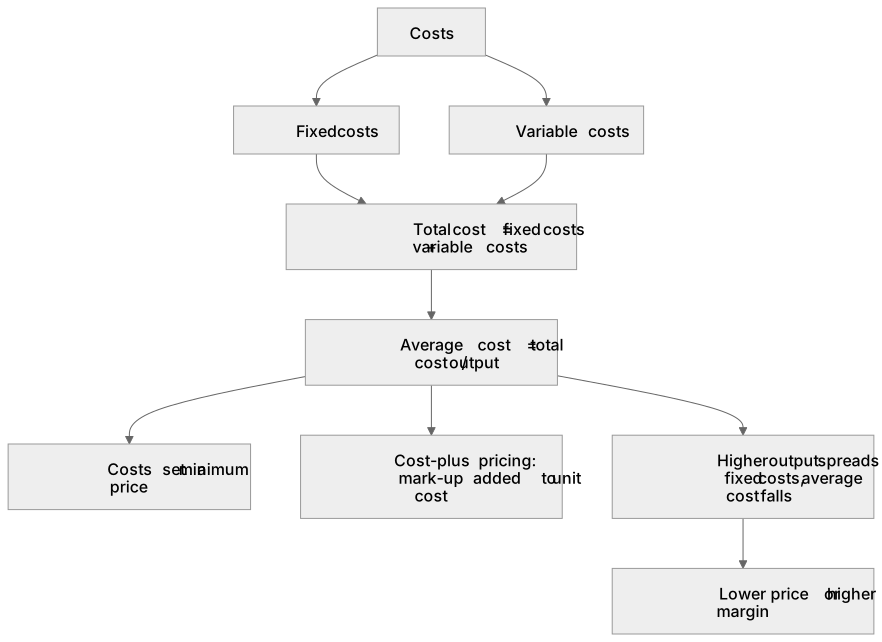
Key words
Say what each word means before you turn the card.
Costs
Try answering aloud or in your head before turning the card.
Fixed and variable costs
Try answering aloud or in your head before turning the card.
Total cost and average cost calculations
Try answering aloud or in your head before turning the card.
Cost-plus pricing and the effect of growth on average cost
Try answering aloud or in your head before turning the card.
See every definition
- Costs
- The amounts a business spends to produce and sell its goods or services.
- Fixed and variable costs
- Fixed costs do not change with output, while variable costs rise as output increases.
- Total cost and average cost calculations
- Total costs are fixed costs plus variable costs, and average cost is total cost divided by output.
- Cost-plus pricing and the effect of growth on average cost
- Cost-plus pricing adds a percentage mark-up to the unit cost, and as output grows fixed costs are spread over more units so average cost tends to fall.
Label the diagram
Some boxes have lost their names. Pick the right name for each number.
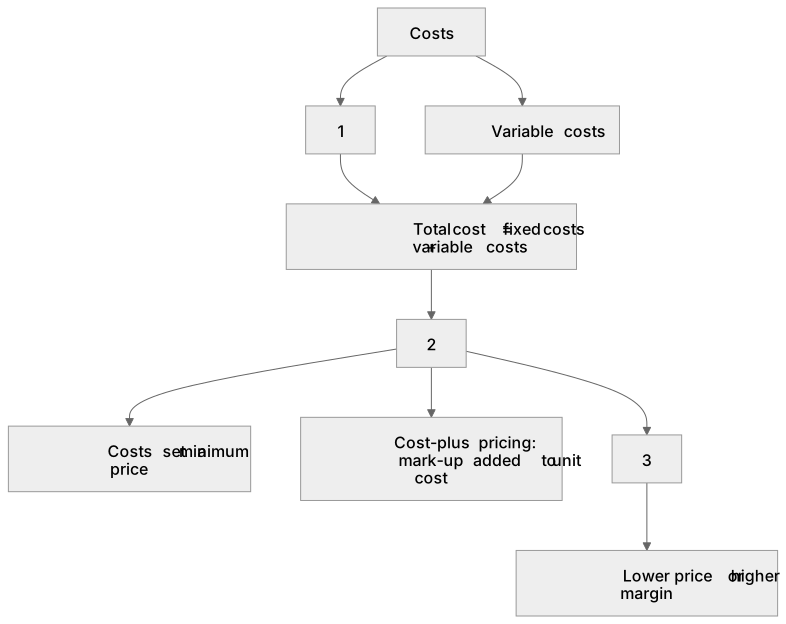
1Box 1
2Box 2
3Box 3
There is more to this lesson
The full lesson goes on to check your understanding and help you earn the marks. Create a free account to carry on, with your progress saved.
A week of Premium from your first lesson · Then the free plan continues · No card, no charge
Test your understanding of The elements of the marketing mix: price, product, promotion and place (4Ps): costs
Active recall beats re-reading. Take an instant quiz now to test what you’ve learned and lock it into long-term memory.
A week of Premium from your first lesson · Then the free plan continues · No card, no charge