AQA · GCSE · Business
Course version: 8132 · Version from Sept 2017
Price, product, promotion and place (4Ps): growth
Full specification wording
The elements of the marketing mix: price, product, promotion and place (4Ps): growth
Growth is the product life cycle stage where sales rise, often quickly, after launch.
Checked against the AQA 8132 specification (opens in a new tab) on .
- Point 25 of 80
- 4 key terms
Study notes
From the checked teaching notes for this specification point.
The idea
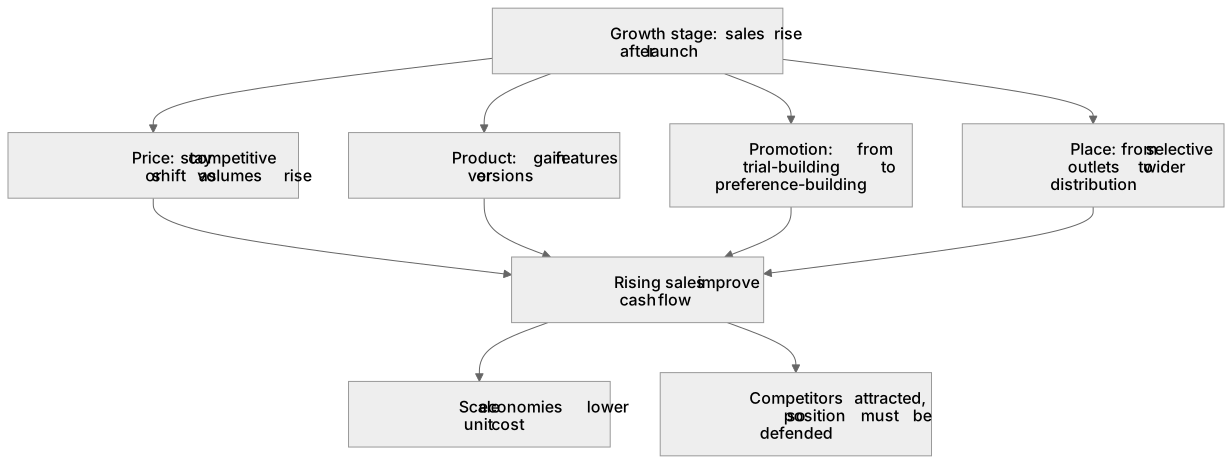
Growth is the product life cycle stage where sales rise, often quickly, after launch. Demand is being established, so the business works to build awareness and repeat purchase. In the 4Ps, price may stay competitive or shift as volumes rise; the product may gain features or versions; promotion moves from trial-building to preference-building; place expands from selective outlets to wider distribution. Growth matters because rising sales can improve cash flow and allow scale economies, lowering unit cost. It also attracts competitors, so the business must defend its position. A student shows understanding by linking each 4P decision to evidence of rising demand and explaining the likely effect on sales, costs or competitiveness.
What earns the marks
- Defines growth as the life cycle stage following launch in which sales increase, often rapidly, as customer awareness and demand build.
- Explains that during growth the product may be developed or extended, for example new sizes or features, to widen appeal and sustain momentum.
- Links pricing decisions in growth to objectives such as maintaining competitiveness, increasing volume or improving margin as costs per unit fall.
- Explains how promotion shifts from creating initial awareness and trial towards building preference, loyalty and repeat purchase.
- Explains how place or distribution can widen during growth, moving from limited outlets to broader availability to reach more customers.
- Analyses consequences of growth, such as higher revenue, improved cash flow, scale economies and the attraction of new competitors.
Common mistakes and how to put them right
Treating growth as simply any increase in profit.
Put it right: Growth refers to rising sales or demand in the life cycle, and profit depends on costs as well as revenue.
Assuming price must always rise during growth.
Put it right: Price may be held, lowered or raised depending on objectives, competition and elasticity.
Confusing growth with maturity.
Put it right: Growth is the phase of rising sales before sales peak, whereas maturity is when sales level off at their highest sustained level.
Exam tips
- Anchor each 4P point to the growth stage explicitly, for example by stating why wider distribution suits rising demand rather than describing distribution generally.
- Use the case study context to justify decisions, naming the product, market or competitor pressure instead of writing generic marketing theory.
- When asked to analyse or evaluate, develop a chain of reasoning from the 4P decision to a consequence such as sales volume, unit cost or competitive position.
Try the lesson
The start of the The elements of the marketing mix: price, product, promotion and place (4Ps): growth lesson, made from checked teaching notes for this specification point.
Have a go first
A product is in the growth stage of its product life cycle. Which statement best describes sales at this stage?
Listen
Growth is the product life cycle stage where sales rise, often quickly, after launch. Demand is being established, so the business works to build awareness and repeat purchase. In the 4Ps, price may stay competitive or shift as volumes rise; the product may gain features or versions; promotion moves from trial-building to preference-building; place expands from selective outlets to wider distribution. Growth matters because rising sales can improve cash flow and allow scale economies, lowering unit cost. It also attracts competitors, so the business must defend its position. A student shows understanding by linking each 4P decision to evidence of rising demand and explaining the likely effect on sales, costs or competitiveness. A strong answer earns marks for these points. Defines growth as the life cycle stage following launch in which sales increase, often rapidly, as customer awareness and demand build. Explains that during growth the product may be developed or extended, for example new sizes or features, to widen appeal and sustain momentum. Links pricing decisions in growth to objectives such as maintaining competitiveness, increasing volume or improving margin as costs per unit fall. Explains how promotion shifts from creating initial awareness and trial towards building preference, loyalty and repeat purchase. A common slip: Treating growth as simply any increase in profit. Instead, growth refers to rising sales or demand in the life cycle, and profit depends on costs as well as revenue. Exam tip: Anchor each 4P point to the growth stage explicitly, for example by stating why wider distribution suits rising demand rather than describing distribution generally.
See it
Key words
Say what each word means before you turn the card.
Product life cycle stages
Try answering aloud or in your head before turning the card.
Marketing mix decisions
Try answering aloud or in your head before turning the card.
Rising demand and sales growth
Try answering aloud or in your head before turning the card.
Competitive response and scale economies
Try answering aloud or in your head before turning the card.
See every definition
- Product life cycle stages
- Growth is the stage following launch in which sales increase, often rapidly, as customer awareness and demand build.
- Marketing mix decisions
- In growth, price may stay competitive or shift as volumes rise, the product may gain features or versions, promotion moves from trial-building to preference-building, and place expands to wider distribution.
- Rising demand and sales growth
- Demand is being established, so the business works to build awareness and repeat purchase as sales rise.
- Competitive response and scale economies
- Rising sales can improve cash flow and allow scale economies, lowering unit cost, but growth also attracts competitors, so the business must defend its position.
Label the diagram
Some boxes have lost their names. Pick the right name for each number.
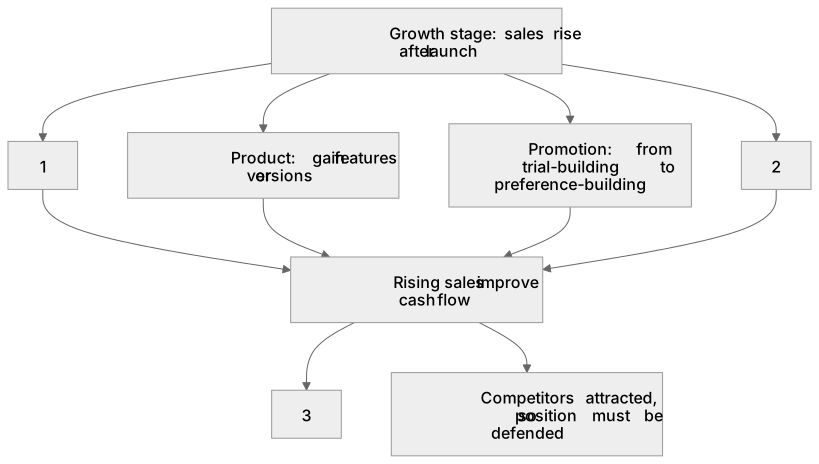
1Box 1
2Box 2
3Box 3
There is more to this lesson
The full lesson goes on to check your understanding and help you earn the marks. Create a free account to carry on, with your progress saved.
A week of Premium from your first lesson · Then the free plan continues · No card, no charge
Test your understanding of The elements of the marketing mix: price, product, promotion and place (4Ps): growth
Active recall beats re-reading. Take an instant quiz now to test what you’ve learned and lock it into long-term memory.
A week of Premium from your first lesson · Then the free plan continues · No card, no charge