AQA · GCSE · Business
Course version: 8132 · Version from Sept 2017
Price, product, promotion and place (4Ps): samples
Full specification wording
The elements of the marketing mix: price, product, promotion and place (4Ps): samples
A sample is a small amount or trial-sized portion of a product given or sold cheaply to potential customers so they can try it before buying the full-size version.
Checked against the AQA 8132 specification (opens in a new tab) on .
- Point 50 of 80
- 4 key terms
Study notes
From the checked teaching notes for this specification point.
The idea
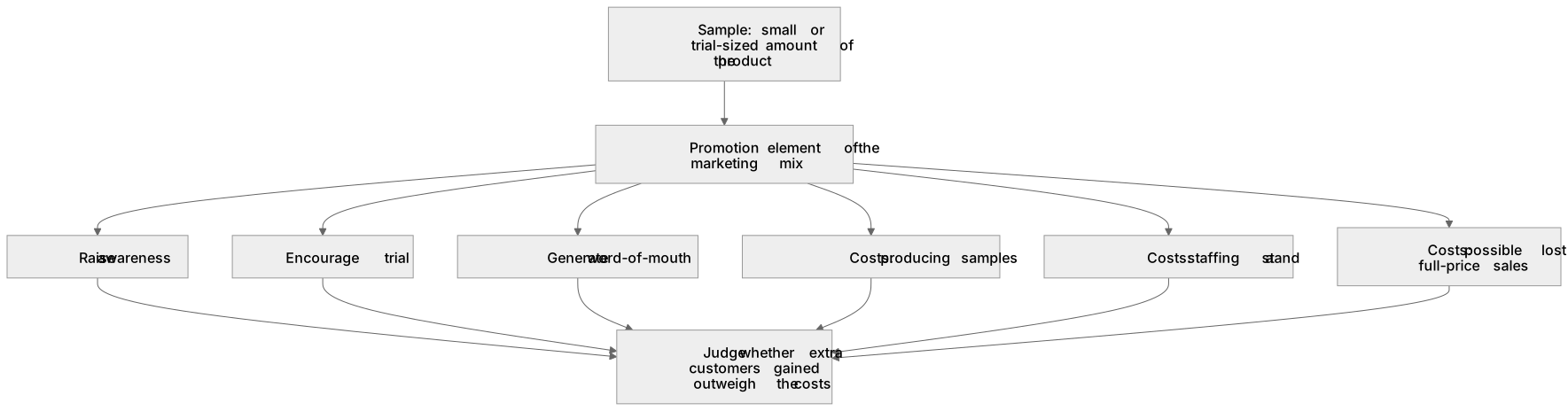
A sample is a small amount or trial-sized portion of a product given or sold cheaply to potential customers so they can try it before buying the full-size version. Sampling belongs to the promotion element of the marketing mix and is especially useful for new or improved products, food and drink, cosmetics and subscription services, where the customer needs to experience the product before committing. For example, a supermarket may hand out free tasters of a new snack, or a streaming service may offer a free trial month. Sampling can raise awareness, encourage trial and generate word-of-mouth, but it carries costs such as producing the samples, staffing a stand and any lost full-price sales. A business must judge whether the extra customers gained outweigh those costs.
What earns the marks
- Defines a sample as a small or trial-sized amount of a product given to customers so they can try it.
- Identifies sampling as part of the promotion element of the marketing mix.
- Explains that sampling is used to raise awareness, encourage trial and generate word-of-mouth for new or improved products.
- Analyses the costs of sampling, including producing samples, staffing and possible lost full-price sales.
- Applies sampling to a named business or product and links it to the target market.
- Evaluates whether sampling is suitable for a particular product compared with other promotional methods.
Common mistakes and how to put them right
Confusing a sample with a free gift.
Put it right by explaining that a sample is a small trial amount of the product itself, while a free gift is an extra item given with a purchase.
Assuming sampling always leads to repeat purchase.
Put it right by noting that some customers take the sample without buying the full product.
Ignoring the costs of sampling.
Put it right by including production, distribution and staffing costs in the analysis.
Exam tips
- State what the sample is and which product it promotes before explaining the intended effect.
- Link sampling to a specific stage, such as launching a new product or entering a new market.
- For evaluation, weigh the cost of the samples against the expected increase in sales and reach a clear conclusion.
Try the lesson
The start of the The elements of the marketing mix: price, product, promotion and place (4Ps): samples lesson, made from checked teaching notes for this specification point.
Have a go first
Which element of the marketing mix is a free sample of perfume given to shoppers in a store?
Listen
A sample is a small amount or trial-sized portion of a product given or sold cheaply to potential customers so they can try it before buying the full-size version. Sampling belongs to the promotion element of the marketing mix and is especially useful for new or improved products, food and drink, cosmetics and subscription services, where the customer needs to experience the product before committing. For example, a supermarket may hand out free tasters of a new snack, or a streaming service may offer a free trial month. Sampling can raise awareness, encourage trial and generate word-of-mouth, but it carries costs such as producing the samples, staffing a stand and any lost full-price sales. A business must judge whether the extra customers gained outweigh those costs. A strong answer earns marks for these points. Defines a sample as a small or trial-sized amount of a product given to customers so they can try it. Identifies sampling as part of the promotion element of the marketing mix. Explains that sampling is used to raise awareness, encourage trial and generate word-of-mouth for new or improved products. Analyses the costs of sampling, including producing samples, staffing and possible lost full-price sales. A common slip: Confusing a sample with a free gift. Instead, explaining that a sample is a small trial amount of the product itself, while a free gift is an extra item given with a purchase. Exam tip: State what the sample is and which product it promotes before explaining the intended effect.
See it
Key words
Say what each word means before you turn the card.
Promotion within the marketing mix
Try answering aloud or in your head before turning the card.
Encouraging product trial
Try answering aloud or in your head before turning the card.
New product launch
Try answering aloud or in your head before turning the card.
Costs and benefits of promotion
Try answering aloud or in your head before turning the card.
See every definition
- Promotion within the marketing mix
- One of the elements of the marketing mix, to which sampling belongs, used to raise awareness and encourage trial.
- Encouraging product trial
- Getting potential customers to experience a product, which sampling does by giving a small or trial-sized amount so they can try it before buying the full-size version.
- New product launch
- A stage at which sampling is especially useful, along with improved products, food and drink, cosmetics and subscription services.
- Costs and benefits of promotion
- Sampling can raise awareness, encourage trial and generate word-of-mouth, but carries costs such as producing the samples, staffing a stand and any lost full-price sales.
Label the diagram
Some boxes have lost their names. Pick the right name for each number.
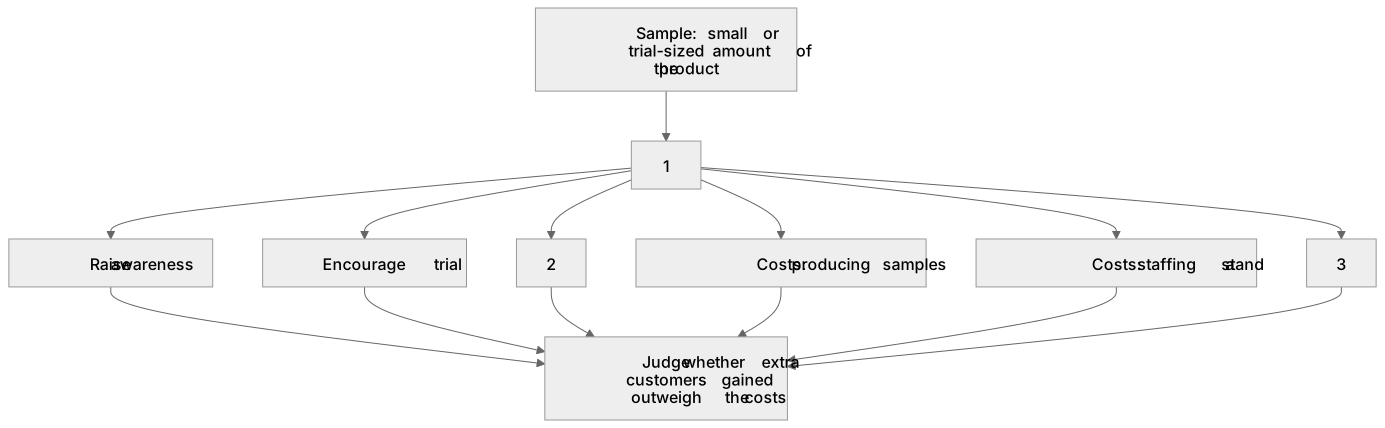
1Box 1
2Box 2
3Box 3
There is more to this lesson
The full lesson goes on to check your understanding and help you earn the marks. Create a free account to carry on, with your progress saved.
A week of Premium from your first lesson · Then the free plan continues · No card, no charge
Test your understanding of The elements of the marketing mix: price, product, promotion and place (4Ps): samples
Active recall beats re-reading. Take an instant quiz now to test what you’ve learned and lock it into long-term memory.
A week of Premium from your first lesson · Then the free plan continues · No card, no charge