AQA · GCSE · Business
Course version: 8132 · Version from Sept 2017
Price, product, promotion and place (4Ps): Students should be able to…
Full specification wording
The elements of the marketing mix: price, product, promotion and place (4Ps): Students should be able to evaluate the effectiveness of extension strategies and when they would be suitable.
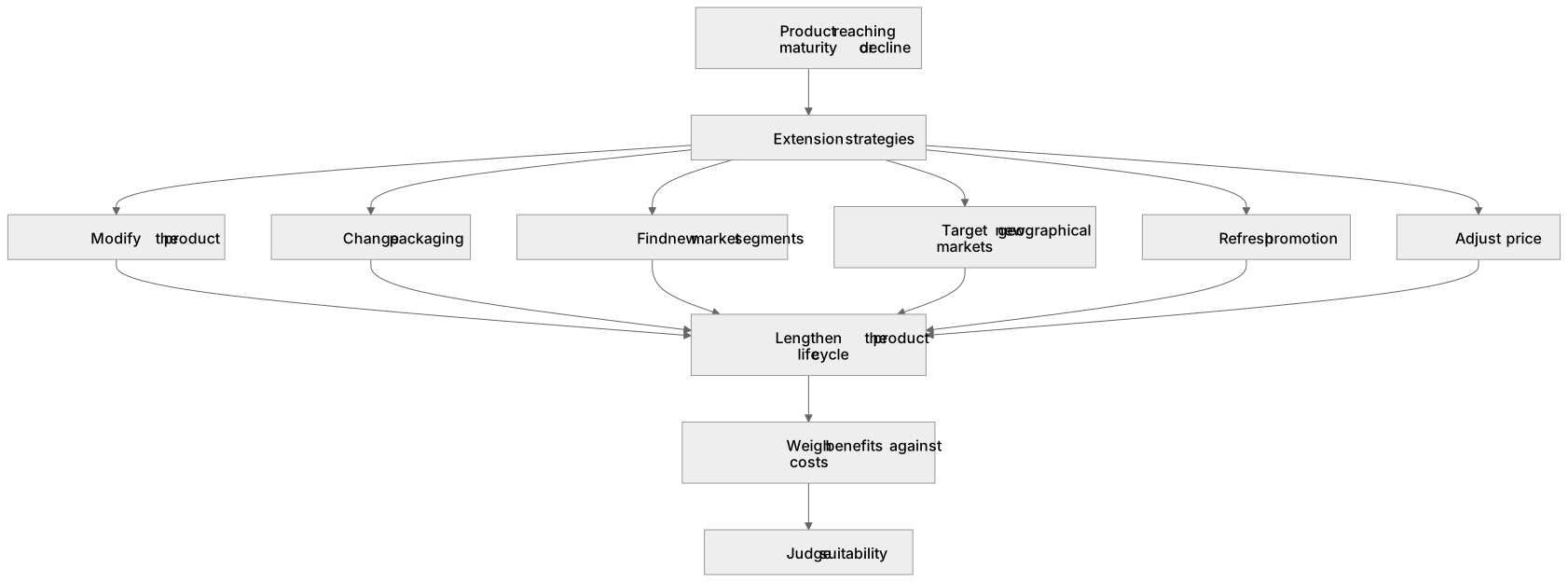
Extension strategies aim to lengthen the life cycle of a product that is reaching maturity or decline.
Checked against the AQA 8132 specification (opens in a new tab) on .
- Point 34 of 80
- 4 key terms
Study notes
From the checked teaching notes for this specification point.
The idea
Extension strategies aim to lengthen the life cycle of a product that is reaching maturity or decline. Common approaches include modifying the product, changing packaging, finding new market segments, targeting new geographical markets, refreshing promotion or adjusting price. Effectiveness depends on whether the strategy generates enough extra sales and contribution to justify its cost, and whether it fits the brand and the target market. For example, a soft drink brand might launch a sugar-free version to attract health-conscious consumers, extending maturity sales. Suitability varies: extension may work when the brand is strong and demand still exists, but it can fail if the product is obsolete, if competitors have moved on or if the spend merely delays an inevitable decline.
What earns the marks
- Identifies extension strategies such as product modification, new packaging, new market segments, new geographical markets, promotional refresh and price changes.
- Explains how an extension strategy can lengthen the product life cycle by sustaining or increasing sales during maturity or decline.
- Assesses effectiveness by comparing the extra revenue and contribution generated with the cost of implementing the strategy.
- Evaluates suitability in context, considering the strength of the brand, the nature of demand, competitor activity and the product's stage in its life cycle.
- Reaches a supported judgement on whether extension is worthwhile or whether the business should instead let the product decline or replace it.
Common mistakes and how to put them right
Confusing extension strategies with launching a brand-new product.
Put it right: Extension strategies modify or reposition an existing product to prolong its life cycle.
Assuming any extension strategy will succeed.
Put it right: Evaluate costs, demand and competition, and to recognise that some products cannot be revived.
Describing an extension strategy without linking it to the product life cycle.
Put it right: Explain how the strategy affects sales at the maturity or decline stage.
Exam tips
- Use a specific product example, such as a breakfast cereal adding a new flavour or a car manufacturer updating a model, to show how extension works in practice.
- Structure the evaluation by weighing benefits against drawbacks and then stating a clear, justified conclusion about suitability.
- Refer to the business context given in the case, including its objectives, target market and competitors, rather than giving generic advice.
Try the lesson
The start of the The elements of the marketing mix: price, product, promotion and place (4Ps): Students should be able to evaluate the effectiveness of extension strategies and when they would be suitable. lesson, made from checked teaching notes for this specification point.
Have a go first
Which of the following is an example of an extension strategy for a product?
Listen
Extension strategies aim to lengthen the life cycle of a product that is reaching maturity or decline. Common approaches include modifying the product, changing packaging, finding new market segments, targeting new geographical markets, refreshing promotion or adjusting price. Effectiveness depends on whether the strategy generates enough extra sales and contribution to justify its cost, and whether it fits the brand and the target market. For example, a soft drink brand might launch a sugar-free version to attract health-conscious consumers, extending maturity sales. Suitability varies: extension may work when the brand is strong and demand still exists, but it can fail if the product is obsolete, if competitors have moved on or if the spend merely delays an inevitable decline. A strong answer earns marks for these points. Identifies extension strategies such as product modification, new packaging, new market segments, new geographical markets, promotional refresh and price changes. Explains how an extension strategy can lengthen the product life cycle by sustaining or increasing sales during maturity or decline. Assesses effectiveness by comparing the extra revenue and contribution generated with the cost of implementing the strategy. Evaluates suitability in context, considering the strength of the brand, the nature of demand, competitor activity and the product's stage in its life cycle. A common slip: Confusing extension strategies with launching a brand-new product. Instead, extension strategies modify or reposition an existing product to prolong its life cycle. Exam tip: Use a specific product example, such as a breakfast cereal adding a new flavour or a car manufacturer updating a model, to show how extension works in practice.
See it
Key words
Say what each word means before you turn the card.
Extension strategies
Try answering aloud or in your head before turning the card.
Product life cycle
Try answering aloud or in your head before turning the card.
Costs versus benefits of marketing decisions
Try answering aloud or in your head before turning the card.
Brand and market positioning
Try answering aloud or in your head before turning the card.
See every definition
- Extension strategies
- Approaches that aim to lengthen the life cycle of a product that is reaching maturity or decline.
- Product life cycle
- The stages a product passes through, including maturity and decline, during which sales can be sustained or increased by an extension strategy.
- Costs versus benefits of marketing decisions
- Weighing the extra revenue and contribution generated by a strategy against the cost of implementing it.
- Brand and market positioning
- Whether a strategy fits the brand and the target market, which affects its effectiveness.
Label the diagram
Some boxes have lost their names. Pick the right name for each number.
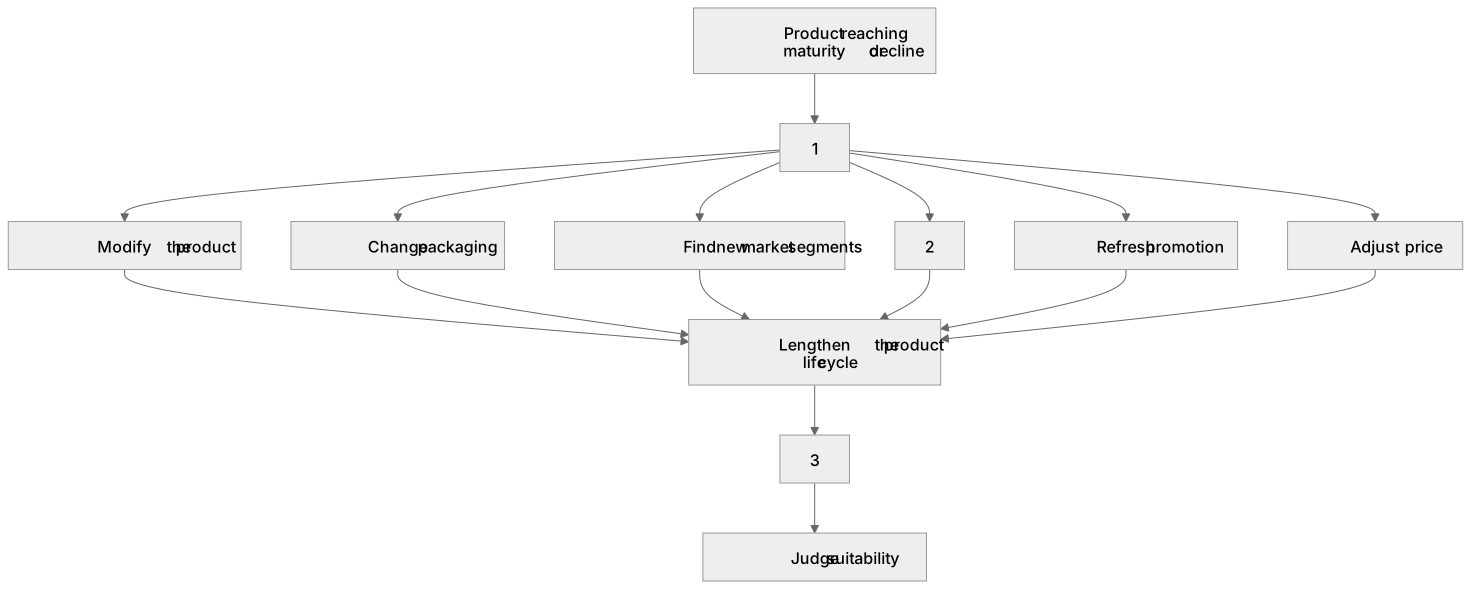
1Box 1
2Box 2
3Box 3
There is more to this lesson
The full lesson goes on to check your understanding and help you earn the marks. Create a free account to carry on, with your progress saved.
A week of Premium from your first lesson · Then the free plan continues · No card, no charge
Test your understanding of The elements of the marketing mix: price, product, promotion and place (4Ps): Students should be able to evaluate the effectiveness of extension strategies and when they would be suitable.
Active recall beats re-reading. Take an instant quiz now to test what you’ve learned and lock it into long-term memory.
A week of Premium from your first lesson · Then the free plan continues · No card, no charge