AQA · GCSE · Business
Course version: 8132 · Version from Sept 2017
Price, product, promotion and place (4Ps): Students should be able to…
Full specification wording
The elements of the marketing mix: price, product, promotion and place (4Ps): Students should be able to identify and explain the four categories of the Boston Box.
The Boston Box, also called the Boston Matrix, sorts a firm's products using two axes: market growth rate and relative market share.
Checked against the AQA 8132 specification (opens in a new tab) on .
- Point 36 of 80
- 4 key terms
Study notes
From the checked teaching notes for this specification point.
The idea
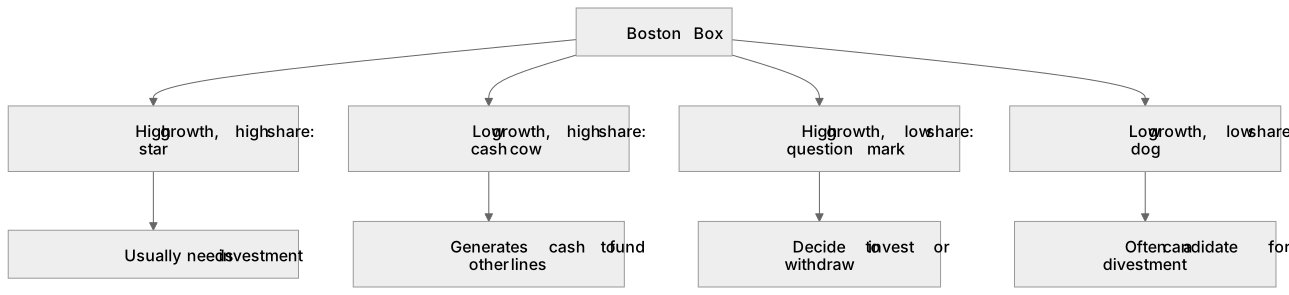
The Boston Box, also called the Boston Matrix, sorts a firm's products using two axes: market growth rate and relative market share. High growth with high share gives a star, which usually needs investment to keep pace but can become a future cash cow. Low growth with high share gives a cash cow, a mature product generating steady cash that can fund other lines. High growth with low share gives a question mark, where the business must decide whether to invest to build share or withdraw. Low growth with low share gives a dog, often a candidate for divestment, though it may still contribute.
For example: A phone maker might treat its newest flagship as a star and an older budget model as a cash cow.
What earns the marks
- Identify the two axes of the Boston Box as market growth rate and relative market share.
- Define a star as a product in a high-growth market with high relative market share, typically requiring investment to sustain position.
- Define a cash cow as a product in a low-growth market with high relative market share, generating cash that can fund other products.
- Define a question mark as a product in a high-growth market with low relative market share, requiring a decision to invest or withdraw.
- Define a dog as a product in a low-growth market with low relative market share, often considered for divestment.
- Explain the link between categories and strategy, such as investing in stars, harvesting cash cows, building or dropping question marks, and divesting dogs.
Common mistakes and how to put them right
Mixing up the axes, for example placing a cash cow in a high-growth market.
Put it right by remembering that cash cows sit in low-growth markets with high share.
Describing a question mark as a certain failure.
Put it right by explaining it is uncertain and may become a star if the business invests successfully.
Calling a dog a product with no value at all.
Put it right by noting it may still generate some cash or support the brand, so divestment is a judgement.
Exam tips
- Learn a quick grid: high growth and high share is a star, low growth and high share is a cash cow, high growth and low share is a question mark, low growth and low share is a dog.
- When explaining a category, always state both the growth rate and the market share position to show precise understanding.
- Apply each category to a product from a named business to demonstrate identification and explanation together.
Try the lesson
The start of the The elements of the marketing mix: price, product, promotion and place (4Ps): Students should be able to identify and explain the four categories of the Boston Box. lesson, made from checked teaching notes for this specification point.
Have a go first
Which of the following is one of the four categories of the Boston Matrix?
Listen
The Boston Box, also called the Boston Matrix, sorts a firm's products using two axes: market growth rate and relative market share. High growth with high share gives a star, which usually needs investment to keep pace but can become a future cash cow. Low growth with high share gives a cash cow, a mature product generating steady cash that can fund other lines. High growth with low share gives a question mark, where the business must decide whether to invest to build share or withdraw. Low growth with low share gives a dog, often a candidate for divestment, though it may still contribute. For example, a phone maker might treat its newest flagship as a star and an older budget model as a cash cow. A strong answer earns marks for these points. Identify the two axes of the Boston Box as market growth rate and relative market share. Define a star as a product in a high-growth market with high relative market share, typically requiring investment to sustain position. Define a cash cow as a product in a low-growth market with high relative market share, generating cash that can fund other products. Define a question mark as a product in a high-growth market with low relative market share, requiring a decision to invest or withdraw. A common slip: Mixing up the axes, for example placing a cash cow in a high-growth market. Instead, remembering that cash cows sit in low-growth markets with high share. Exam tip: Learn a quick grid: high growth and high share is a star, low growth and high share is a cash cow, high growth and low share is a question mark, low growth and low share is a dog.
See it
Key words
Say what each word means before you turn the card.
Market growth rate
Try answering aloud or in your head before turning the card.
Relative market share
Try answering aloud or in your head before turning the card.
Star
Try answering aloud or in your head before turning the card.
Cash cow
Try answering aloud or in your head before turning the card.
See every definition
- Market growth rate
- One of the two axes used to sort a firm's products in the Boston Box, alongside relative market share.
- Relative market share
- One of the two axes used to sort a firm's products in the Boston Box, alongside market growth rate.
- Star
- A product in a high-growth market with high relative market share, which usually needs investment to keep pace but can become a future cash cow.
- Cash cow
- A mature product in a low-growth market with high relative market share that generates steady cash which can fund other lines.
Label the diagram
Some boxes have lost their names. Pick the right name for each number.
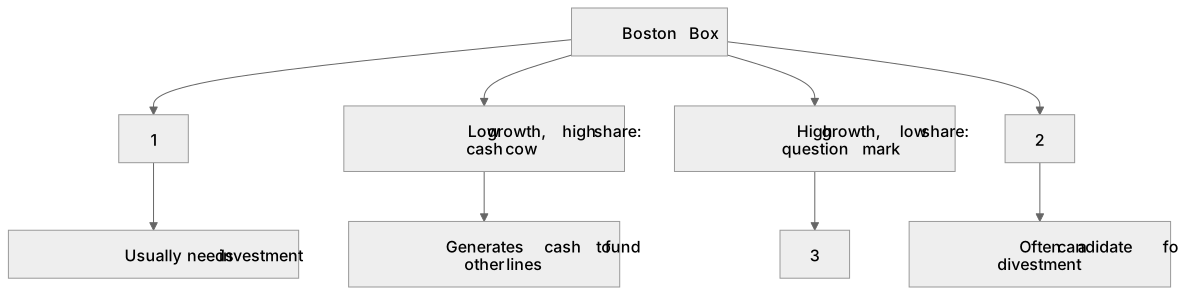
1Box 1
2Box 2
3Box 3
There is more to this lesson
The full lesson goes on to check your understanding and help you earn the marks. Create a free account to carry on, with your progress saved.
A week of Premium from your first lesson · Then the free plan continues · No card, no charge
Test your understanding of The elements of the marketing mix: price, product, promotion and place (4Ps): Students should be able to identify and explain the four categories of the Boston Box.
Active recall beats re-reading. Take an instant quiz now to test what you’ve learned and lock it into long-term memory.
A week of Premium from your first lesson · Then the free plan continues · No card, no charge