AQA · GCSE · Business
Course version: 8132 · Version from Sept 2017
The purpose and methods of market research: competition
Competition refers to rival businesses offering similar products to the same customers.
Checked against the AQA 8132 specification (opens in a new tab) on .
- Point 5 of 19
- 4 key terms
Study notes
From the checked teaching notes for this specification point.
The idea
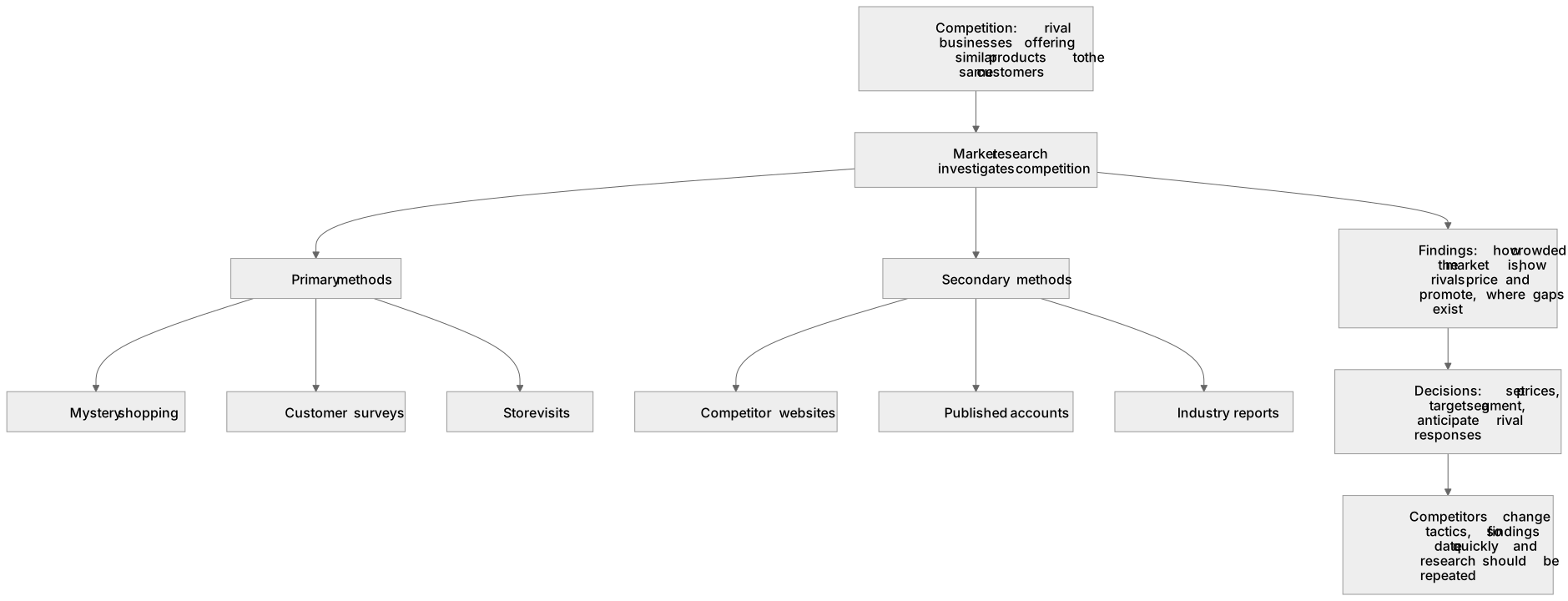
Competition refers to rival businesses offering similar products to the same customers. Market research investigates competition so a business can judge how crowded a market is, how rivals price and promote, and where gaps exist. Primary methods include mystery shopping, customer surveys and store visits; secondary methods include competitor websites, published accounts and industry reports. For example, a café opening near three existing cafés might research their prices, menus and opening hours, then differentiate through longer hours or a niche product range. Understanding competition helps a business set prices, target a segment and anticipate rival responses. It also reveals that competitors change their tactics, so research findings date quickly and should be repeated.
What earns the marks
- Defines competition as rival businesses offering similar products to the same group of customers.
- Explains that market research is used to identify competitors, their prices, products and promotional methods.
- Distinguishes primary research methods such as mystery shopping from secondary methods such as competitor websites and published accounts.
- Applies competition research to a context, for example comparing local rivals' prices and opening hours before choosing a position.
- Recognises that competitor behaviour changes over time, so research must be repeated and findings treated as a snapshot.
Common mistakes and how to put them right
Assuming competition only means other businesses selling an identical product.
Put it right: Rivals may offer substitutes that meet the same customer need.
Believing one round of research is enough.
Put it right: Competitors adjust prices and promotions, so research needs updating.
Confusing competitor research with copying.
Put it right: The purpose is to identify gaps and differentiate, not to imitate.
Exam tips
- Name specific competitors or rival products from the case where possible to show application rather than generic description.
- Link each research finding to a decision, such as setting a price or choosing a unique selling point.
- For evaluation, consider whether the cost of detailed competitor research is justified by the benefit of a stronger market position.
Try the lesson
The start of the The purpose and methods of market research: competition lesson, made from checked teaching notes for this specification point.
Have a go first
A new sandwich shop uses market research to investigate three established sandwich shops on the same high street. What is the main purpose of researching these competitors?
Listen
Competition refers to rival businesses offering similar products to the same customers. Market research investigates competition so a business can judge how crowded a market is, how rivals price and promote, and where gaps exist. Primary methods include mystery shopping, customer surveys and store visits; secondary methods include competitor websites, published accounts and industry reports. For example, a café opening near three existing cafés might research their prices, menus and opening hours, then differentiate through longer hours or a niche product range. Understanding competition helps a business set prices, target a segment and anticipate rival responses. It also reveals that competitors change their tactics, so research findings date quickly and should be repeated. A strong answer earns marks for these points. Defines competition as rival businesses offering similar products to the same group of customers. Explains that market research is used to identify competitors, their prices, products and promotional methods. Distinguishes primary research methods such as mystery shopping from secondary methods such as competitor websites and published accounts. Applies competition research to a context, for example comparing local rivals' prices and opening hours before choosing a position. A common slip: Assuming competition only means other businesses selling an identical product. Instead, rivals may offer substitutes that meet the same customer need. Exam tip: Name specific competitors or rival products from the case where possible to show application rather than generic description.
See it
Key words
Say what each word means before you turn the card.
Competition
Try answering aloud or in your head before turning the card.
Primary research methods
Try answering aloud or in your head before turning the card.
Secondary research methods
Try answering aloud or in your head before turning the card.
Differentiation
Try answering aloud or in your head before turning the card.
See every definition
- Competition
- Rival businesses offering similar products to the same customers.
- Primary research methods
- Methods such as mystery shopping, customer surveys and store visits used to investigate competition.
- Secondary research methods
- Methods such as competitor websites, published accounts and industry reports used to investigate competition.
- Differentiation
- Identifying gaps and differentiating rather than imitating rivals, for example through longer hours or a niche product range.
Label the diagram
Some boxes have lost their names. Pick the right name for each number.
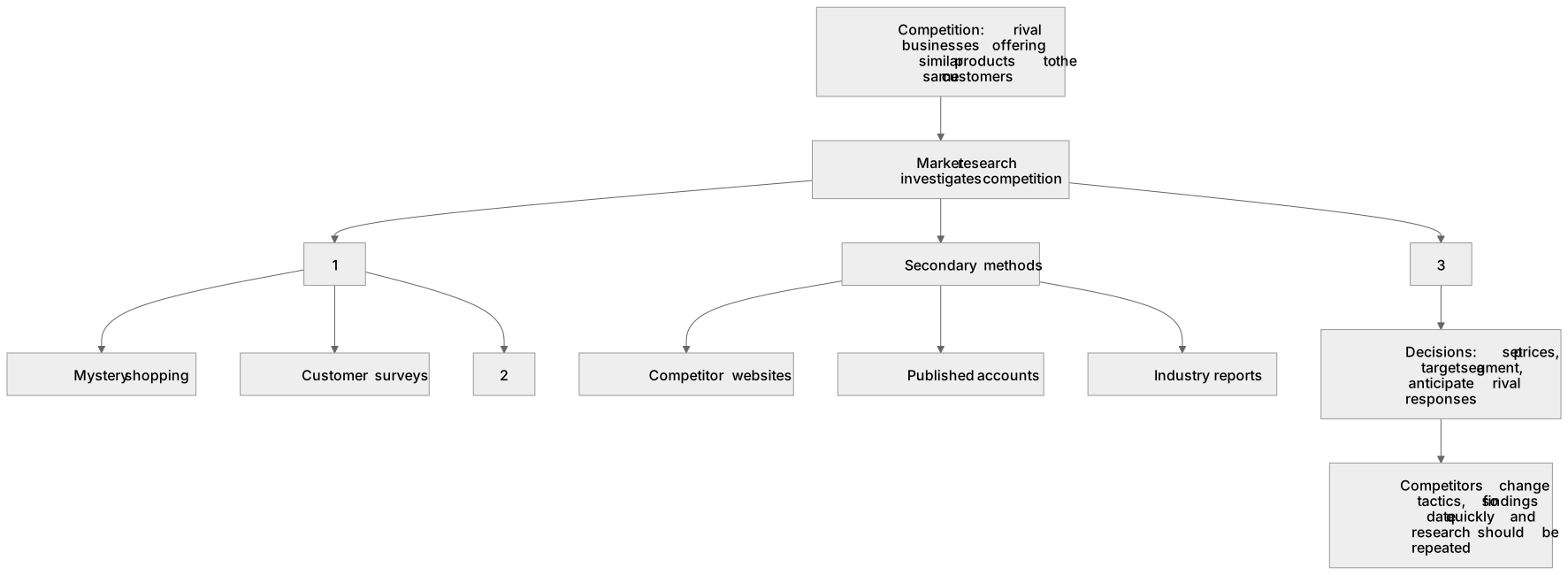
1Box 1
2Box 2
3Box 3
There is more to this lesson
The full lesson goes on to check your understanding and help you earn the marks. Create a free account to carry on, with your progress saved.
A week of Premium from your first lesson · Then the free plan continues · No card, no charge
Test your understanding of The purpose and methods of market research: competition
Active recall beats re-reading. Take an instant quiz now to test what you’ve learned and lock it into long-term memory.
A week of Premium from your first lesson · Then the free plan continues · No card, no charge