AQA · GCSE · Business
Course version: 8132 · Version from Sept 2017
Students should identify the benefits and drawbacks for various market…
Full specification wording
The purpose and methods of market research: Students should identify the benefits and drawbacks for various market research techniques and select the best method for a given business.
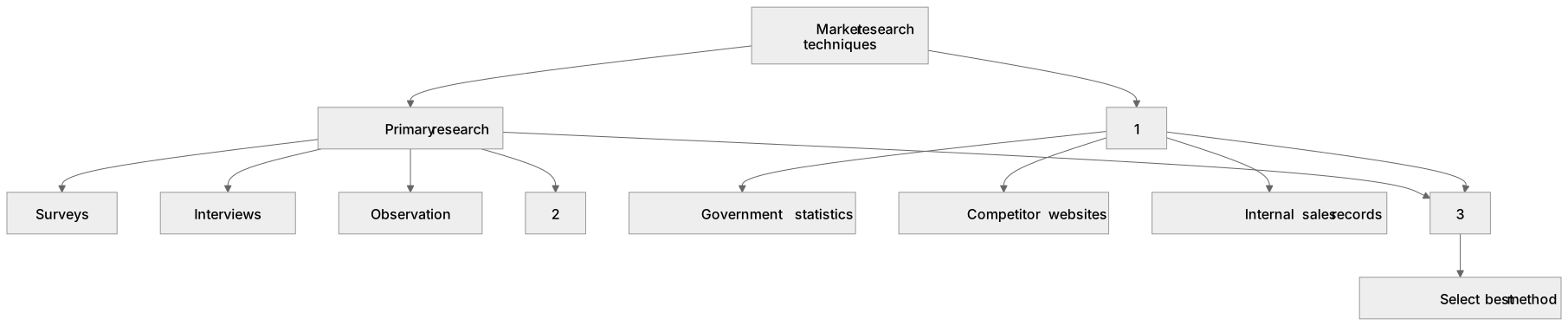
Market research techniques include primary methods, such as surveys, interviews, observation and trials, and secondary methods, such as government statistics, competitor websites and internal…
Checked against the AQA 8132 specification (opens in a new tab) on .
- Point 15 of 19
- 4 key terms
Study notes
From the checked teaching notes for this specification point.
The idea
Market research techniques include primary methods, such as surveys, interviews, observation and trials, and secondary methods, such as government statistics, competitor websites and internal sales records. Each technique has benefits and drawbacks. Primary research is gathered first-hand, so it can be tailored to the business, but it is often slow and costly. Secondary research is usually quicker and cheaper, but it may be outdated or not quite fit the business's needs. Quantitative data from large samples is easy to compare, while qualitative data gives richer reasons but is harder to summarise. To select the best method, a business weighs cost, time, reliability, sample size and fit with its aims.
For example: A small cafe testing a new menu might use short customer interviews, while a national chain might analyse loyalty-card data.
What earns the marks
- Identifies benefits and drawbacks of named techniques, such as the tailored nature of primary research or the low cost of secondary research.
- Distinguishes primary from secondary research and quantitative from qualitative data using correct terms.
- Explains how factors such as cost, time, reliability, sample size and relevance affect the choice of technique.
- Applies at least two techniques to the given business and compares them directly.
- Selects one method as best for the business and justifies the choice with a developed reason.
- Recognises that the best method depends on the business context rather than being fixed for all businesses.
Common mistakes and how to put them right
Listing techniques without benefits or drawbacks.
Put it right: The error is naming surveys or interviews and stopping, and the correction is to state an advantage and a disadvantage for each technique discussed.
Treating primary research as always better.
Put it right: The error is ignoring cost and time, and the correction is to weigh benefits against drawbacks for the specific business.
Choosing a method without context.
Put it right: The error is picking a technique that does not suit the business's customers or budget, and the correction is to match the method to the target market and resources.
Exam tips
- Use connectives such as because, therefore and however to turn a listed point into a developed benefit or drawback.
- For selection questions, name the chosen method clearly and give a reason linked to the business in the case material.
- Compare at least two techniques before judging, so the recommendation is supported rather than asserted.
Try the lesson
The start of the The purpose and methods of market research: Students should identify the benefits and drawbacks for various market research techniques and select the best method for a given business. lesson, made from checked teaching notes for this specification point.
Have a go first
Which of the following is a benefit of using a written questionnaire to carry out market research?
Listen
Market research techniques include primary methods, such as surveys, interviews, observation and trials, and secondary methods, such as government statistics, competitor websites and internal sales records. Each technique has benefits and drawbacks. Primary research is gathered first-hand, so it can be tailored to the business, but it is often slow and costly. Secondary research is usually quicker and cheaper, but it may be outdated or not quite fit the business's needs. Quantitative data from large samples is easy to compare, while qualitative data gives richer reasons but is harder to summarise. To select the best method, a business weighs cost, time, reliability, sample size and fit with its aims. For example, a small cafe testing a new menu might use short customer interviews, while a national chain might analyse loyalty-card data. A strong answer earns marks for these points. Identifies benefits and drawbacks of named techniques, such as the tailored nature of primary research or the low cost of secondary research. Distinguishes primary from secondary research and quantitative from qualitative data using correct terms. Explains how factors such as cost, time, reliability, sample size and relevance affect the choice of technique. Applies at least two techniques to the given business and compares them directly. Exam tip: Use connectives such as because, therefore and however to turn a listed point into a developed benefit or drawback.
See it

Key words
Say what each word means before you turn the card.
Primary research
Try answering aloud or in your head before turning the card.
Secondary research
Try answering aloud or in your head before turning the card.
Quantitative data
Try answering aloud or in your head before turning the card.
Qualitative data
Try answering aloud or in your head before turning the card.
See every definition
- Primary research
- Research gathered first-hand, so it can be tailored to the business, but it is often slow and costly.
- Secondary research
- Research that is usually quicker and cheaper, but it may be outdated or not quite fit the business's needs.
- Quantitative data
- Data from large samples that is easy to compare.
- Qualitative data
- Data that gives richer reasons but is harder to summarise.
Label the diagram
Some boxes have lost their names. Pick the right name for each number.
1Box 1
2Box 2
3Box 3
There is more to this lesson
The full lesson goes on to check your understanding and help you earn the marks. Create a free account to carry on, with your progress saved.
A week of Premium from your first lesson · Then the free plan continues · No card, no charge
Test your understanding of The purpose and methods of market research: Students should identify the benefits and drawbacks for various market research techniques and select the best method for a given business.
Active recall beats re-reading. Take an instant quiz now to test what you’ve learned and lock it into long-term memory.
A week of Premium from your first lesson · Then the free plan continues · No card, no charge