AQA · GCSE · Business
Course version: 8132 · Version from Sept 2017
The purpose and nature of businesses: Purpose of business
A business exists to satisfy customer needs and wants by providing goods or services, while also creating value for its owners and stakeholders.
Checked against the AQA 8132 specification (opens in a new tab) on .
- Point 1 of 14
- 4 key terms
Study notes
From the checked teaching notes for this specification point.
The idea
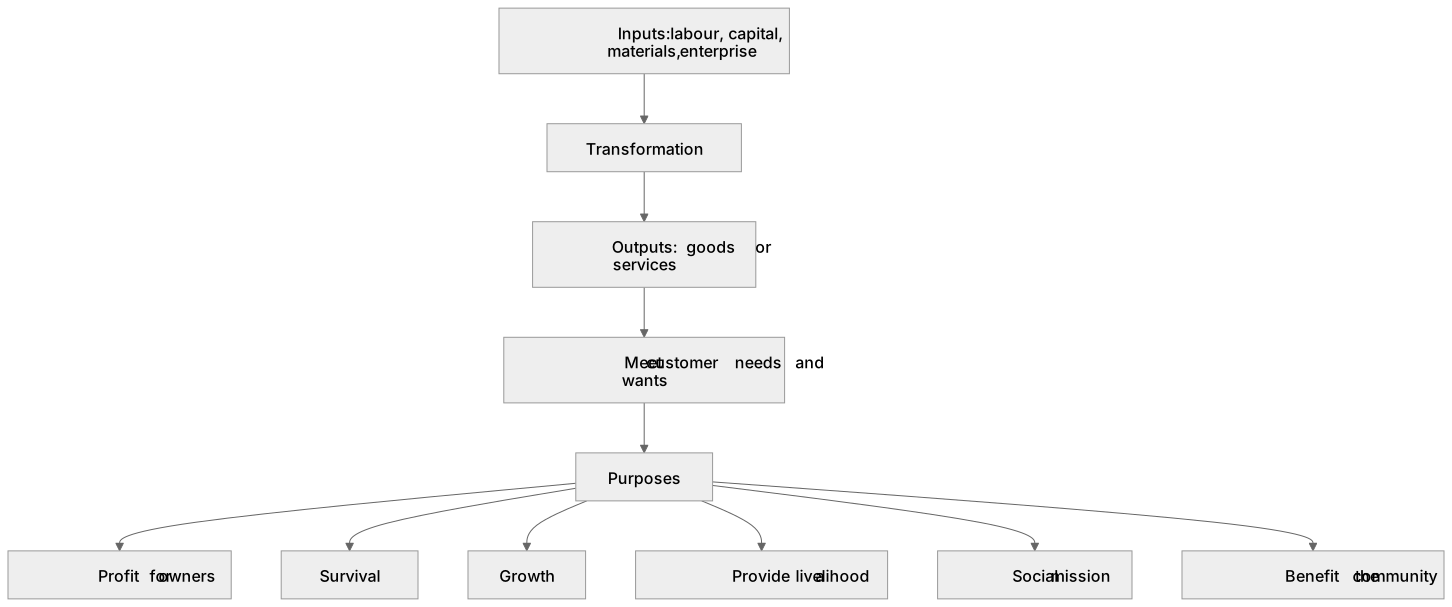
A business exists to satisfy customer needs and wants by providing goods or services, while also creating value for its owners and stakeholders. The core purpose is to combine inputs—such as labour, capital, materials and enterprise—to produce outputs that customers are willing to buy. This can generate profit for owners, but profit is not the only purpose: businesses may also aim to survive, grow, provide a livelihood, serve a social mission, or benefit the community. For example, a sole trader bakery uses ingredients and labour to make bread, sells it to local customers, and uses the revenue to cover costs, pay herself and reinvest. Understanding purpose helps explain why businesses set objectives, make decisions and measure success in different ways.
What earns the marks
- Defines purpose as the fundamental reason a business exists, such as meeting customer needs and wants.
- Explains that businesses transform inputs into goods or services that customers value.
- Identifies profit as a key purpose for many private-sector businesses, while recognising other purposes such as survival, growth, social mission or providing a livelihood.
- Uses a relevant example to show how purpose influences business decisions, such as a bakery choosing to reinvest profit to grow.
- Explains that purpose can differ between organisations, for example a charity prioritising social aims over profit.
Common mistakes and how to put them right
Stating that all businesses exist only to maximise profit.
Put it right: Many businesses also pursue survival, growth, social or community purposes.
Confusing purpose with a specific objective, such as 'to increase sales by 10%'.
Put it right: Purpose is the overall reason for existing, while objectives are measurable targets that support it.
Describing inputs and outputs without linking them to customer needs.
Put it right: Explain that the purpose is to create value by satisfying customer needs and wants.
Exam tips
- Use the phrase 'meet customer needs and wants' when defining purpose, then add one other purpose to show range.
- Apply your answer to a named business or type of business to make the explanation concrete.
- If asked to explain, develop each point with a consequence, such as how purpose affects whether profit is reinvested or taken as income.
Try the lesson
The start of the The purpose and nature of businesses: Purpose of business lesson, made from checked teaching notes for this specification point.
Have a go first
Which of the following best describes the main purpose of a business?
Listen
A business exists to satisfy customer needs and wants by providing goods or services, while also creating value for its owners and stakeholders. The core purpose is to combine inputs—such as labour, capital, materials and enterprise—to produce outputs that customers are willing to buy. This can generate profit for owners, but profit is not the only purpose: businesses may also aim to survive, grow, provide a livelihood, serve a social mission, or benefit the community. For example, a sole trader bakery uses ingredients and labour to make bread, sells it to local customers, and uses the revenue to cover costs, pay herself and reinvest. Understanding purpose helps explain why businesses set objectives, make decisions and measure success in different ways. A strong answer earns marks for these points. Defines purpose as the fundamental reason a business exists, such as meeting customer needs and wants. Explains that businesses transform inputs into goods or services that customers value. Identifies profit as a key purpose for many private-sector businesses, while recognising other purposes such as survival, growth, social mission or providing a livelihood. Uses a relevant example to show how purpose influences business decisions, such as a bakery choosing to reinvest profit to grow. A common slip: Stating that all businesses exist only to maximise profit. Instead, many businesses also pursue survival, growth, social or community purposes. Exam tip: Use the phrase 'meet customer needs and wants' when defining purpose, then add one other purpose to show range.
See it
Watch it explained
What is the one idea the video explains? Say it in a sentence.
Read the described scene instead
Every business exists for a reason. Its purpose is the fundamental reason it exists. A business aims to satisfy customer needs and wants by providing goods or services. At the same time, it can create value for its owners and for stakeholders. So purpose is broader than simply making money; it explains why the business operates and what it is trying to achieve. Businesses transform inputs into outputs. Inputs include labour, capital, materials and enterprise. The purpose is to combine these inputs to produce goods or services that customers are willing to buy. That transformation adds value by meeting customer needs. If customers value the output, the business can generate profit for its owners. But profit is only one possible purpose, not the only one. A sole trader bakery shows this in practice. The bakery uses ingredients and labour to make bread. It sells the bread to local customers. The revenue from those sales must cover costs. It can then pay the owner and reinvest some profit. Each step links back to the business purpose: meeting customer needs while sustaining the business and its owner. Now apply this to a choice. Suppose the bakery's purpose includes growth. The owner must decide whether to take all profit as income or reinvest some. Reinvesting can support growth, while taking income provides the owner with a livelihood. Neither choice is automatically wrong. The right decision depends on the business's purpose and priorities. Pause and consider how purpose shapes that choice. A common mistake is to state that all businesses exist only to maximise profit. Many also pursue survival, growth, a social mission or community benefit. Another mistake is confusing purpose with a specific objective, such as increasing sales by ten percent. Purpose is the overall reason for existing. Objectives are measurable targets that support that purpose. Keep the two ideas distinct. To recap: a business purpose is to satisfy customer needs and wants by transforming inputs into valued goods or services. Profit and financial sustainability can be important, but businesses may also aim to survive, grow, provide a livelihood, or serve a social or community purpose. Understanding purpose helps explain objectives, decisions and how success is measured. Not every organisation prioritises profit above all else.
Key words
Say what each word means before you turn the card.
Customer needs and wants
Try answering aloud or in your head before turning the card.
Adding value through transformation
Try answering aloud or in your head before turning the card.
Profit and financial sustainability
Try answering aloud or in your head before turning the card.
Stakeholder and social purposes
Try answering aloud or in your head before turning the card.
See every definition
- Customer needs and wants
- What a business exists to satisfy by providing goods or services, creating value for its owners and stakeholders.
- Adding value through transformation
- Combining inputs such as labour, capital, materials and enterprise to produce outputs that customers are willing to buy.
- Profit and financial sustainability
- A key purpose for many private-sector businesses, generating profit for owners, though not the only purpose.
- Stakeholder and social purposes
- Purposes other than profit, such as survival, growth, providing a livelihood, serving a social mission or benefiting the community.
Label the diagram
Some boxes have lost their names. Pick the right name for each number.
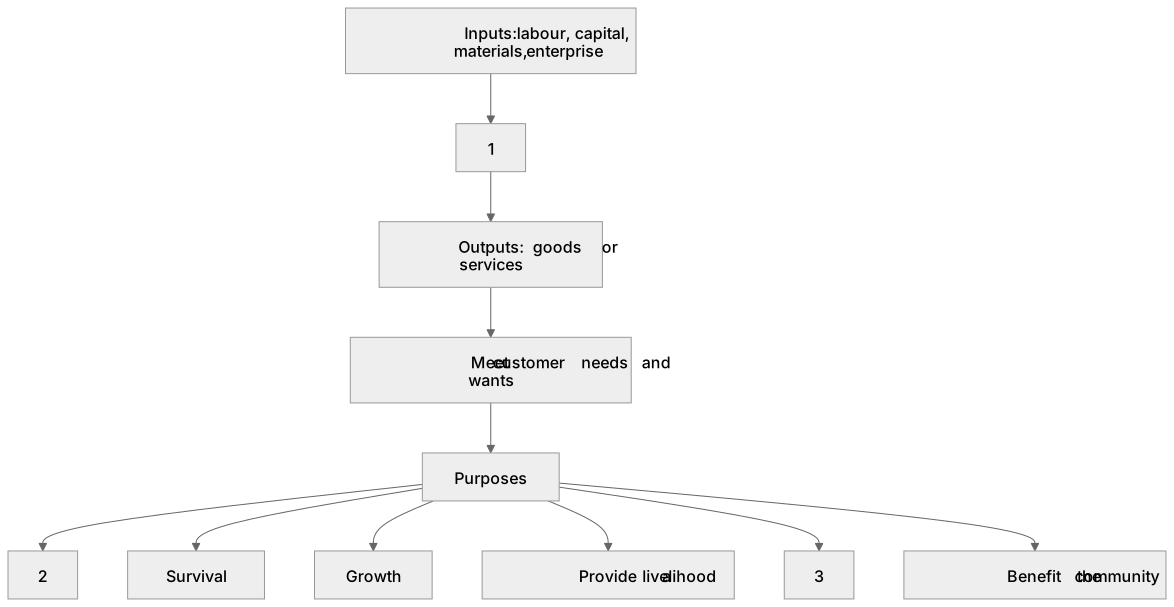
1Box 1
2Box 2
3Box 3
There is more to this lesson
The full lesson goes on to check your understanding and help you earn the marks. Create a free account to carry on, with your progress saved.
A week of Premium from your first lesson · Then the free plan continues · No card, no charge
Test your understanding of The purpose and nature of businesses: Purpose of business
Active recall beats re-reading. Take an instant quiz now to test what you’ve learned and lock it into long-term memory.
A week of Premium from your first lesson · Then the free plan continues · No card, no charge