AQA · GCSE · Business
Course version: 8132 · Version from Sept 2017
Understand that businesses face a constantly changing business environment…
Full specification wording
The purpose and nature of businesses: understand that businesses face a constantly changing business environment due to changes in technology, economic situation, legislation and environmental expectations.
The business environment is the external setting in which a business operates, and it never stands still.
Checked against the AQA 8132 specification (opens in a new tab) on .
- Point 14 of 14
- 4 key terms
Study notes
From the checked teaching notes for this specification point.
The idea
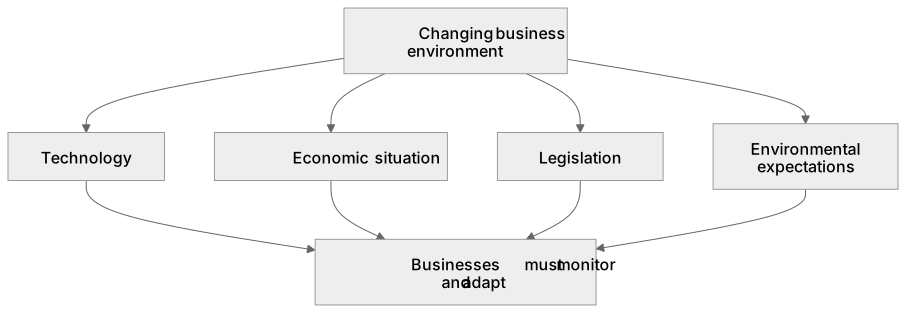
The business environment is the external setting in which a business operates, and it never stands still. Technology changes how goods are made, marketed and sold, so firms that ignore new software, machinery or online selling can lose competitiveness. The economic situation covers factors such as growth, interest rates, inflation and unemployment; a downturn can reduce demand, while low interest rates can make borrowing cheaper. Legislation means new laws and regulations, for example on minimum wage, health and safety or data protection, which raise compliance costs but also protect workers and customers. Environmental expectations concern pressure from customers, government and society to reduce waste, cut carbon emissions and use sustainable materials. Because these forces shift constantly, businesses must monitor them and adapt their products, costs and operations to survive.
What earns the marks
- Defines the business environment as the external conditions and forces affecting a business.
- Explains technological change with examples such as automation, e-commerce or digital communication.
- Explains economic change with examples such as recession, interest rates, inflation or unemployment.
- Explains legislative change with examples such as minimum wage, health and safety or data protection law.
- Explains environmental expectations with examples such as reducing waste, emissions or using sustainable materials.
- Explains that because change is constant, businesses must monitor and adapt to remain competitive.
Common mistakes and how to put them right
Describing only one factor, such as technology, and ignoring the other three.
Put it right: Cover technology, economic situation, legislation and environmental expectations.
Treating legislation as always a cost with no benefit.
Put it right: Laws can also protect workers, customers and the business's reputation.
Assuming environmental expectations are optional.
Put it right: They can affect costs, demand and legal compliance.
Exam tips
- Use the case study to name the specific change and then state its effect on the business.
- Structure answers around the four named factors to ensure full coverage.
- Explain the consequence for the business, such as higher costs or falling demand, not just the change itself.
Try the lesson
The start of the The purpose and nature of businesses: understand that businesses face a constantly changing business environment due to changes in technology, economic situation, legislation and environmental expectations. lesson, made from checked teaching notes for this specification point.
Have a go first
Which of the following is an external factor that causes a constantly changing business environment?
Listen
The business environment is the external setting in which a business operates, and it never stands still. Technology changes how goods are made, marketed and sold, so firms that ignore new software, machinery or online selling can lose competitiveness. The economic situation covers factors such as growth, interest rates, inflation and unemployment; a downturn can reduce demand, while low interest rates can make borrowing cheaper. Legislation means new laws and regulations, for example on minimum wage, health and safety or data protection, which raise compliance costs but also protect workers and customers. Environmental expectations concern pressure from customers, government and society to reduce waste, cut carbon emissions and use sustainable materials. Because these forces shift constantly, businesses must monitor them and adapt their products, costs and operations to survive. A strong answer earns marks for these points. Defines the business environment as the external conditions and forces affecting a business. Explains technological change with examples such as automation, e-commerce or digital communication. Explains economic change with examples such as recession, interest rates, inflation or unemployment. Explains legislative change with examples such as minimum wage, health and safety or data protection law. A common slip: Describing only one factor, such as technology, and ignoring the other three. Instead, cover technology, economic situation, legislation and environmental expectations. Exam tip: Use the case study to name the specific change and then state its effect on the business.
See it
Key words
Say what each word means before you turn the card.
External environment
Try answering aloud or in your head before turning the card.
Adaptation and change
Try answering aloud or in your head before turning the card.
Technology
Try answering aloud or in your head before turning the card.
Legislation and sustainability
Try answering aloud or in your head before turning the card.
See every definition
- External environment
- The external setting in which a business operates, made up of conditions and forces that affect it and never stand still.
- Adaptation and change
- Because forces shift constantly, businesses must monitor them and adapt their products, costs and operations to survive.
- Technology
- Changes how goods are made, marketed and sold, so firms that ignore new software, machinery or online selling can lose competitiveness.
- Legislation and sustainability
- New laws and regulations raise compliance costs but also protect workers and customers, while environmental expectations concern pressure to reduce waste, cut carbon emissions and use sustainable materials.
Label the diagram
Some boxes have lost their names. Pick the right name for each number.
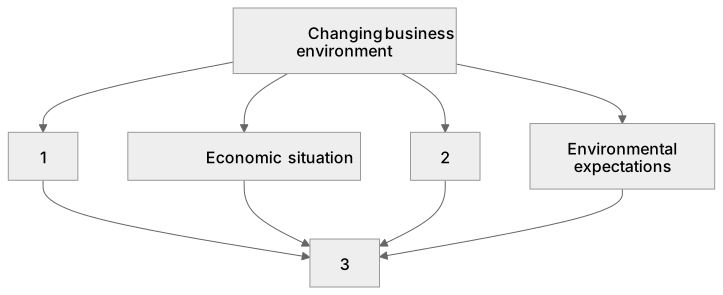
1Box 1
2Box 2
3Box 3
There is more to this lesson
The full lesson goes on to check your understanding and help you earn the marks. Create a free account to carry on, with your progress saved.
A week of Premium from your first lesson · Then the free plan continues · No card, no charge
Test your understanding of The purpose and nature of businesses: understand that businesses face a constantly changing business environment due to changes in technology, economic situation, legislation and environmental expectations.
Active recall beats re-reading. Take an instant quiz now to test what you’ve learned and lock it into long-term memory.
A week of Premium from your first lesson · Then the free plan continues · No card, no charge