AQA · GCSE · Business
Course version: 8132 · Version from Sept 2017
The role of procurement: Just in time (JIT)
Just in time (JIT) is a stock management method in which materials and components are ordered so they arrive just as they are needed for production or sale, rather than being held in a warehouse.
Checked against the AQA 8132 specification (opens in a new tab) on .
- Point 3 of 21
- 4 key terms
Study notes
From the checked teaching notes for this specification point.
The idea
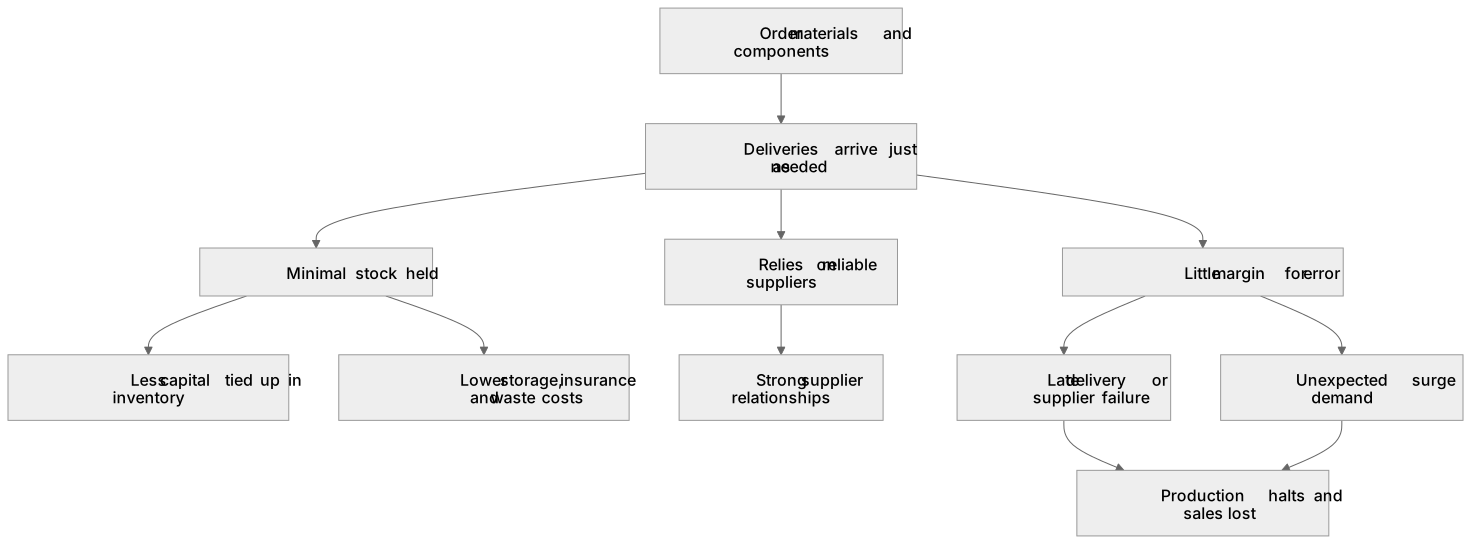
Just in time (JIT) is a stock management method in which materials and components are ordered so they arrive just as they are needed for production or sale, rather than being held in a warehouse. It links closely to procurement because the business must build strong relationships with reliable suppliers who can deliver quickly and consistently. Holding minimal stock reduces the capital tied up in inventory and cuts storage, insurance and waste costs, since goods are less likely to be damaged or become obsolete. However, JIT leaves little margin for error: a late delivery, supplier failure or unexpected surge in demand can halt production and lose sales. It therefore suits businesses with dependable suppliers and predictable demand.
What earns the marks
- States that JIT means stock arrives just as it is needed, so minimal stock is held.
- Explains the link to procurement: reliable suppliers and good supplier relationships are essential for JIT to work.
- Explains a cost benefit, such as less capital tied up in stock or lower storage, insurance and waste costs.
- Explains a risk, such as production stopping, lost sales or customer dissatisfaction if deliveries fail or demand rises.
- Applies JIT to a business context, judging whether its suppliers and demand pattern make the method suitable.
Common mistakes and how to put them right
Confusing JIT with just in case stockholding, where buffer stock is deliberately kept.
Put it right by stressing that JIT holds minimal stock and relies on timed deliveries.
Assuming JIT always cuts costs.
Put it right by noting that frequent small deliveries can raise ordering and transport costs and that failure risks are serious.
Treating JIT as only a production technique.
Put it right by linking it to procurement and supplier relationships, as the specification does.
Exam tips
- Learn a short definition plus one benefit and one risk so you can answer definition and analysis questions quickly.
- When a case is given, name the business's actual suppliers or products to show application rather than generic theory.
- For longer answers, structure your response as benefit, risk, then judgement so nothing important is missed.
Try the lesson
The start of the The role of procurement: Just in time (JIT) lesson, made from checked teaching notes for this specification point.
Have a go first
Which description best explains just in time (JIT) stock management?
Listen
Just in time (JIT) is a stock management method in which materials and components are ordered so they arrive just as they are needed for production or sale, rather than being held in a warehouse. It links closely to procurement because the business must build strong relationships with reliable suppliers who can deliver quickly and consistently. Holding minimal stock reduces the capital tied up in inventory and cuts storage, insurance and waste costs, since goods are less likely to be damaged or become obsolete. However, JIT leaves little margin for error: a late delivery, supplier failure or unexpected surge in demand can halt production and lose sales. It therefore suits businesses with dependable suppliers and predictable demand. A strong answer earns marks for these points. States that JIT means stock arrives just as it is needed, so minimal stock is held. Explains the link to procurement: reliable suppliers and good supplier relationships are essential for JIT to work. Explains a cost benefit, such as less capital tied up in stock or lower storage, insurance and waste costs. Explains a risk, such as production stopping, lost sales or customer dissatisfaction if deliveries fail or demand rises. A common slip: Confusing JIT with just in case stockholding, where buffer stock is deliberately kept. Instead, stressing that JIT holds minimal stock and relies on timed deliveries. Exam tip: Learn a short definition plus one benefit and one risk so you can answer definition and analysis questions quickly.
See it
Key words
Say what each word means before you turn the card.
Just in time (JIT)
Try answering aloud or in your head before turning the card.
Procurement and supplier relationships
Try answering aloud or in your head before turning the card.
Cost control and working capital
Try answering aloud or in your head before turning the card.
Operational risk and business resilience
Try answering aloud or in your head before turning the card.
See every definition
- Just in time (JIT)
- A stock management method in which materials and components are ordered so they arrive just as they are needed for production or sale, rather than being held in a warehouse.
- Procurement and supplier relationships
- The link to procurement means the business must build strong relationships with reliable suppliers who can deliver quickly and consistently.
- Cost control and working capital
- Holding minimal stock reduces the capital tied up in inventory and cuts storage, insurance and waste costs.
- Operational risk and business resilience
- A late delivery, supplier failure or unexpected surge in demand can halt production and lose sales, so it suits businesses with dependable suppliers and predictable demand.
Label the diagram
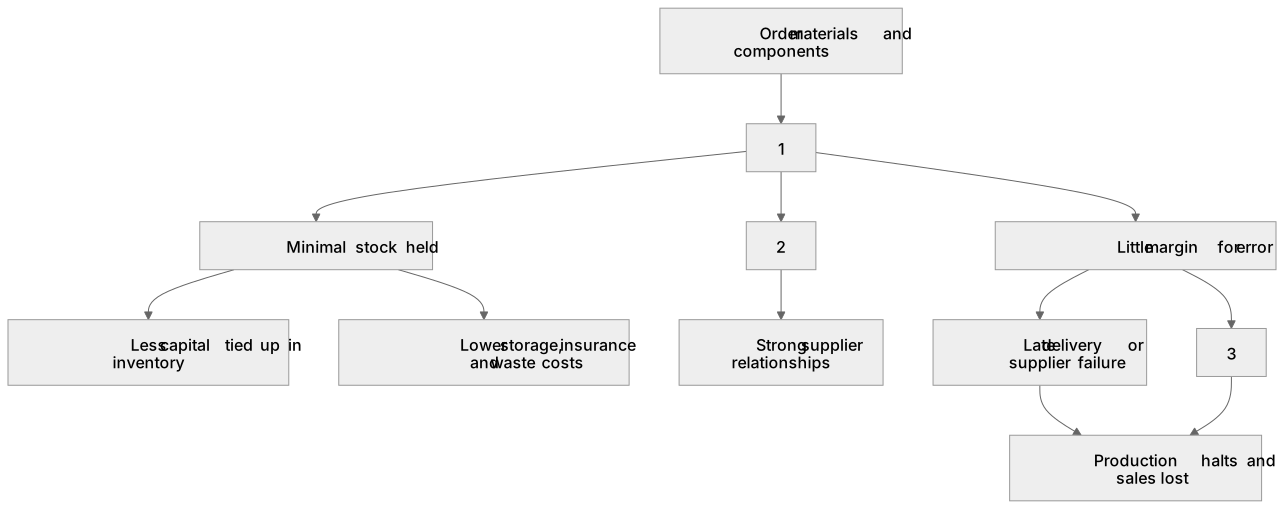
Some boxes have lost their names. Pick the right name for each number.
1Box 1
2Box 2
3Box 3
There is more to this lesson
The full lesson goes on to check your understanding and help you earn the marks. Create a free account to carry on, with your progress saved.
A week of Premium from your first lesson · Then the free plan continues · No card, no charge
Test your understanding of The role of procurement: Just in time (JIT)
Active recall beats re-reading. Take an instant quiz now to test what you’ve learned and lock it into long-term memory.
A week of Premium from your first lesson · Then the free plan continues · No card, no charge