AQA · GCSE · Business
Course version: 8132 · Version from Sept 2017
The role of procurement: Managing stock:
Managing stock means controlling the quantity, timing and cost of raw materials, components and finished goods held by a business.
Checked against the AQA 8132 specification (opens in a new tab) on .
- Point 1 of 21
- 3 key terms
Study notes
From the checked teaching notes for this specification point.
The idea
Managing stock means controlling the quantity, timing and cost of raw materials, components and finished goods held by a business. It involves deciding how much to order, when to reorder and how to store items, often using stock control methods such as just in time (JIT) or buffer stock. Effective stock management balances the risk of stockouts, which can halt production or lose sales, against the cost of holding too much stock, including storage, insurance, spoilage and tied-up working capital. Businesses may use stock control charts, reorder levels and lead times to manage this. The procurement function is central because it sources stock, negotiates with suppliers and monitors quality and delivery, directly affecting production efficiency, customer service and profitability.
What earns the marks
- Explains that managing stock involves controlling the amount and timing of materials, components and finished goods held by a business.
- Analyses the costs of holding stock, such as storage, insurance, security, deterioration and opportunity cost of working capital.
- Analyses the risks of poor stock management, such as stockouts stopping production, delayed customer orders, lost sales and damaged reputation.
- Explains stock control techniques such as reorder levels, lead times, buffer stock and stock control charts, and how they help avoid stockouts or excess stock.
- Links stock management to procurement: sourcing reliable suppliers, negotiating prices and delivery terms, and monitoring quality.
- Applies stock management to a context, for example a supermarket balancing fresh food availability against waste, or a manufacturer holding components for assembly.
Common mistakes and how to put them right
Thinking that more stock is always safer.
Put it right: Excess stock raises storage and working capital costs and can become obsolete.
Confusing managing stock with just in time.
Put it right: JIT is one approach to stock management, while managing stock is the broader activity.
Ignoring the link to procurement.
Put it right: Procurement decisions about suppliers, prices and delivery directly affect stock levels and reliability.
Forgetting that stock includes raw materials, work in progress and finished goods.
Put it right: Recognise all three types when analysing stock management.
Exam tips
- Use the context to decide whether the main issue is stockout risk or excess stock cost, and build your answer around that trade-off.
- When discussing procurement, refer to specific actions such as negotiating lead times, agreeing delivery schedules or checking quality.
- For higher marks, evaluate by weighing the costs and benefits of a particular stock management approach for the business in the case study.
- Include numerical examples where possible, such as calculating reorder level from lead time and usage, to show understanding.
Try the lesson
The start of the The role of procurement: Managing stock: lesson, made from checked teaching notes for this specification point.
Have a go first
In the procurement function, what does managing stock involve?
Listen
Managing stock means controlling the quantity, timing and cost of raw materials, components and finished goods held by a business. It involves deciding how much to order, when to reorder and how to store items, often using stock control methods such as just in time (JIT) or buffer stock. Effective stock management balances the risk of stockouts, which can halt production or lose sales, against the cost of holding too much stock, including storage, insurance, spoilage and tied-up working capital. Businesses may use stock control charts, reorder levels and lead times to manage this. The procurement function is central because it sources stock, negotiates with suppliers and monitors quality and delivery, directly affecting production efficiency, customer service and profitability. A strong answer earns marks for these points. Explains that managing stock involves controlling the amount and timing of materials, components and finished goods held by a business. Analyses the costs of holding stock, such as storage, insurance, security, deterioration and opportunity cost of working capital. Analyses the risks of poor stock management, such as stockouts stopping production, delayed customer orders, lost sales and damaged reputation. Explains stock control techniques such as reorder levels, lead times, buffer stock and stock control charts, and how they help avoid stockouts or excess stock. A common slip: Thinking that more stock is always safer. Instead, excess stock raises storage and working capital costs and can become obsolete. Exam tip: Use the context to decide whether the main issue is stockout risk or excess stock cost, and build your answer around that trade-off.
See it
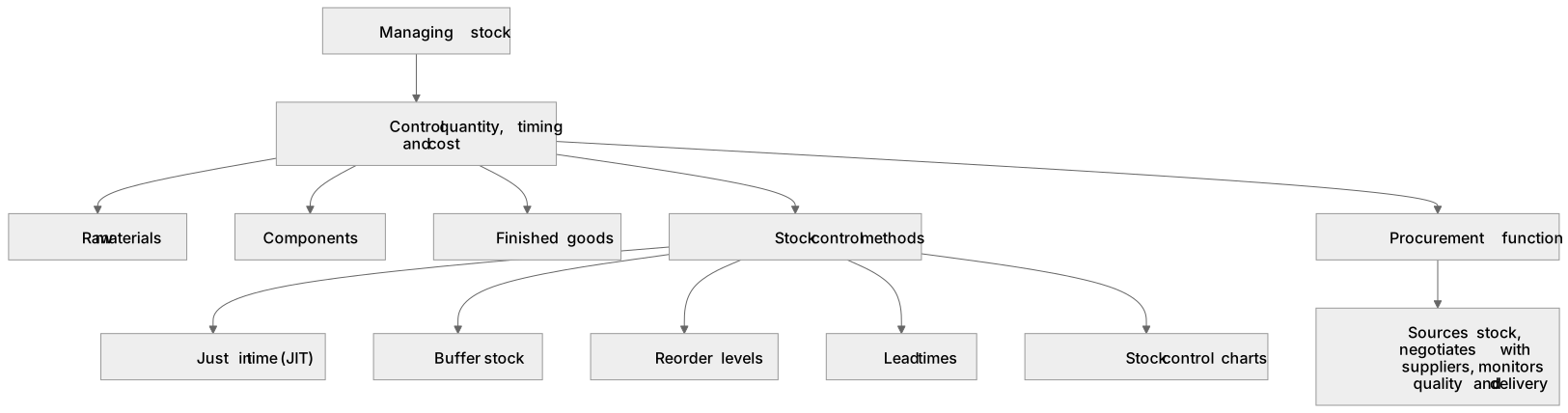
Key words
Say what each word means before you turn the card.
Managing stock
Try answering aloud or in your head before turning the card.
Stockouts
Try answering aloud or in your head before turning the card.
Lead times
Try answering aloud or in your head before turning the card.
See every definition
- Managing stock
- Controlling the quantity, timing and cost of raw materials, components and finished goods held by a business.
- Stockouts
- A risk that can halt production or lose sales when stock is not available.
- Lead times
- Used with reorder levels and stock control charts to help manage stock.
Label the diagram
Some boxes have lost their names. Pick the right name for each number.
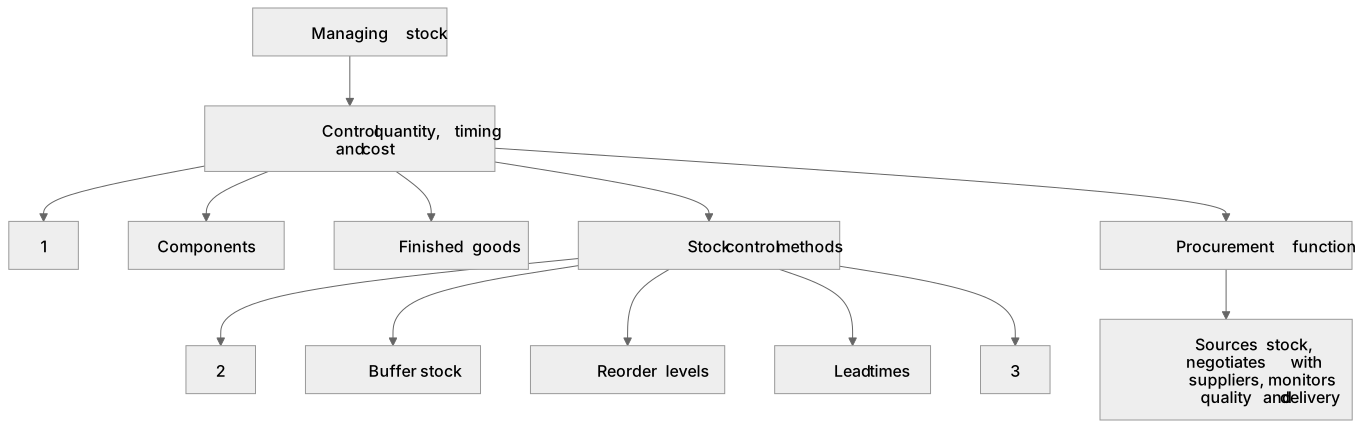
1Box 1
2Box 2
3Box 3
There is more to this lesson
The full lesson goes on to check your understanding and help you earn the marks. Create a free account to carry on, with your progress saved.
A week of Premium from your first lesson · Then the free plan continues · No card, no charge
Test your understanding of The role of procurement: Managing stock:
Active recall beats re-reading. Take an instant quiz now to test what you’ve learned and lock it into long-term memory.
A week of Premium from your first lesson · Then the free plan continues · No card, no charge