Pearson Edexcel · A-Level · Business
Global industries and companies (multinational corporations)
This topic explores the massive power and influence of Multinational Corporations (MNCs) in the modern global economy. You will learn why these business giants exist, how they impact both local communities and national economies, and the complex ethical dilemmas they create for stakeholders.
- 6 min read
- 3 worked examples
- 5 practice questions
- 6 key terms
Study Notes
Overview
Multinational Corporations (MNCs) are the titans of the global economy. Companies like Apple, Amazon, Nike, and Toyota are so large that their annual revenues exceed the Gross Domestic Product (GDP) of many entire nations. In your GCSE Business exam, examiners expect you to understand not just what an MNC is, but why they operate across borders and the profound impacts they have on the countries they enter.
This topic is highly examinable because it touches on several core business concepts: stakeholder conflict, ethics, globalisation, and government intervention. You will need to evaluate whether the benefits of MNCs (such as job creation and investment) outweigh the drawbacks (such as environmental damage and exploitation of cheap labour).
Listen to the Topic Podcast

Why do MNCs exist?
Businesses do not expand internationally by accident; they do so to gain competitive advantages. Examiners expect you to know the four main reasons MNCs locate operations overseas. You can remember these using the acronym CMAR:
- Costs: The primary driver is often reducing production costs, particularly labour. Manufacturing a garment in Bangladesh or Vietnam costs a fraction of manufacturing it in the UK or USA due to lower minimum wages and different living standards.
- Markets: Expanding into fast-growing economies (like India, China, or Brazil) allows MNCs to reach millions of new consumers, increasing sales revenue and market share.
- Avoiding Trade Barriers: By setting up production facilities inside a country or trade bloc (like the EU), MNCs can avoid tariffs (taxes on imports) and quotas (limits on imports).
- Resources: Some MNCs must locate where natural resources are found. Oil companies, mining firms, and agricultural businesses operate globally to access raw materials.
The Impact of MNCs
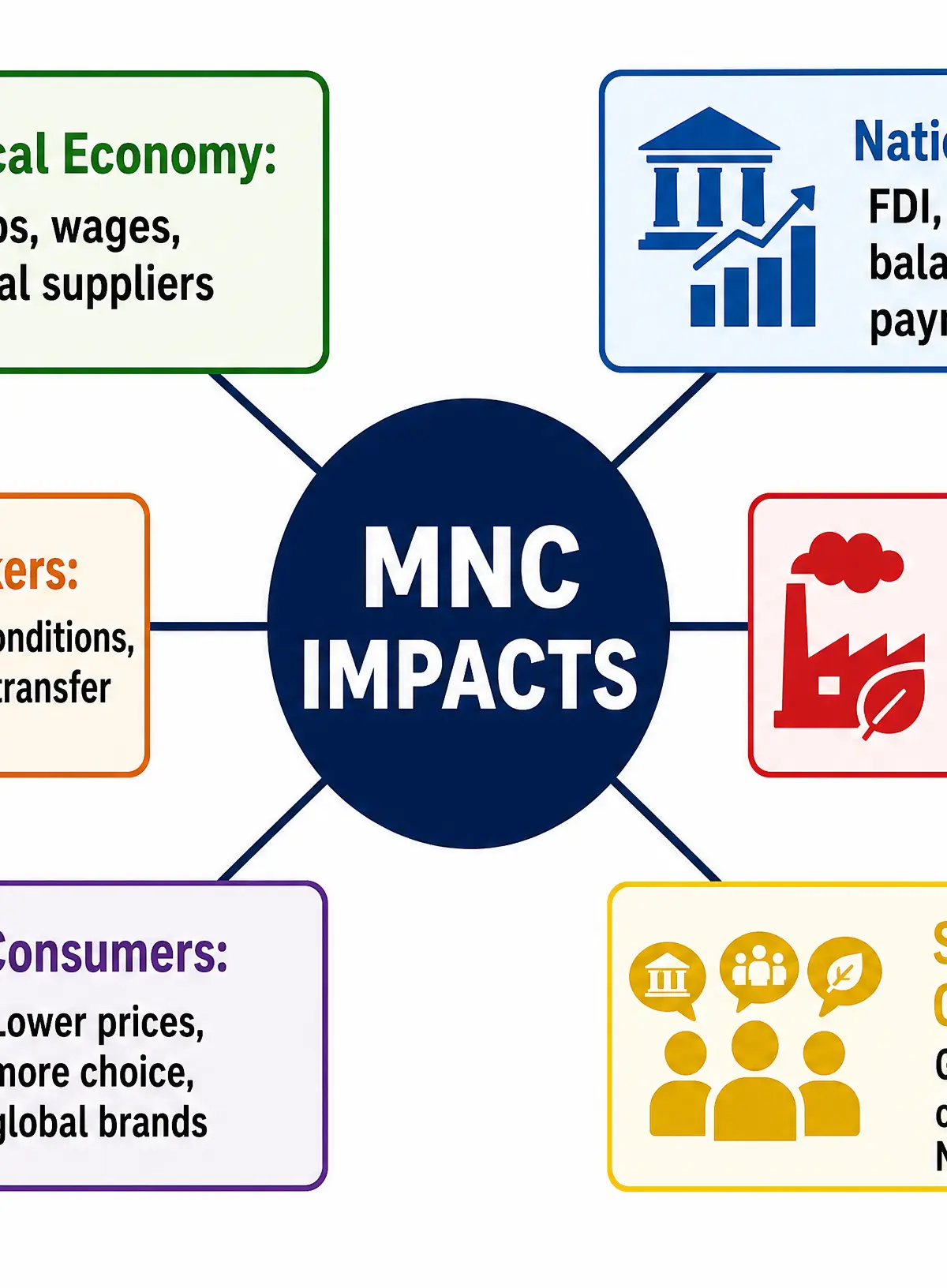
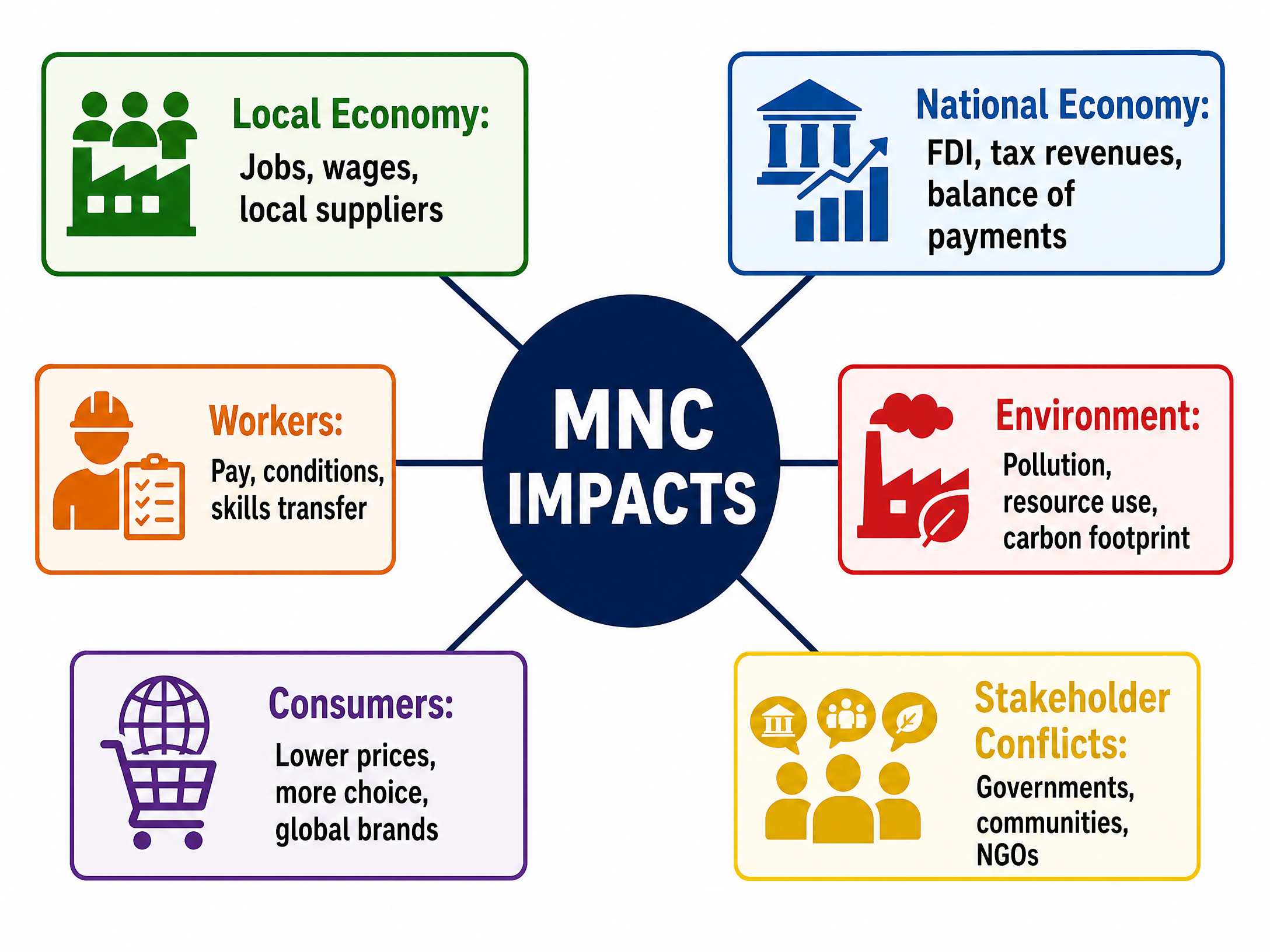
When an MNC enters a new country (often referred to as the 'host country'), it creates a ripple effect across both the local and national economy. Exam questions frequently ask you to analyse these impacts.
Impact on the Local Economy
Positive Impacts:
- Job Creation: MNCs often build large factories or offices, directly employing thousands of local workers.
- Higher Wages: In developing nations, MNCs typically pay wages that are higher than the local average, improving living standards.
- Skills Transfer: Local workers receive training in modern manufacturing or management techniques, improving the local skill base.
- Local Suppliers: The MNC will buy materials and services from local businesses, creating a 'multiplier effect' that boosts the whole local economy.
Negative Impacts:
- Exploitation: While wages may be higher than the local average, they are often extremely low by Western standards, and working conditions can be poor or unsafe.
- Local Businesses Close: Small local firms may be unable to compete with the massive scale, marketing budgets, and low prices of the MNC, leading to bankruptcies.
- Environmental Damage: Factories may cause local air and water pollution, or deplete local resources like water.
Impact on the National Economy
Positive Impacts:
- Foreign Direct Investment (FDI): When an MNC builds a factory, it brings foreign capital into the country, boosting the national GDP.
- Tax Revenue: The host government can collect corporation tax on the MNC's profits, which can be spent on public services like schools and hospitals.
- Balance of Payments: If the MNC exports the goods it produces in the host country, it improves that country's balance of trade.
Negative Impacts:
- Repatriation of Profits: The majority of the profits made by the MNC are usually sent back ('repatriated') to the home country, rather than being reinvested in the host country.
- Transfer Pricing: MNCs often use complex accounting methods to shift profits to countries with very low tax rates, meaning the host government receives very little tax revenue.
- Influence over Government: Because MNCs bring so much investment, they can sometimes bully governments into lowering environmental standards or employment rights by threatening to leave.
Stakeholder Conflicts and Ethics
The operations of MNCs frequently lead to stakeholder conflicts. A stakeholder is anyone with an interest in the business.
For example, Shareholders want maximum profits, which might mean paying the lowest possible wages in a developing country. However, Workers want fair pay and safe conditions, and Pressure Groups want ethical behaviour.
Ethical considerations are a massive part of this topic. Examiners will expect you to discuss issues such as:
- Child Labour: The use of underage workers in supply chains.
- Working Conditions: Long hours, unsafe factories, and lack of union rights (e.g., the Rana Plaza disaster).
- Environmental Impact: Deforestation, carbon emissions, and toxic waste dumping.
- Misleading Marketing: Selling products in developing countries without proper safety warnings (e.g., the historical controversy over infant formula in developing nations).
Methods of Controlling MNCs
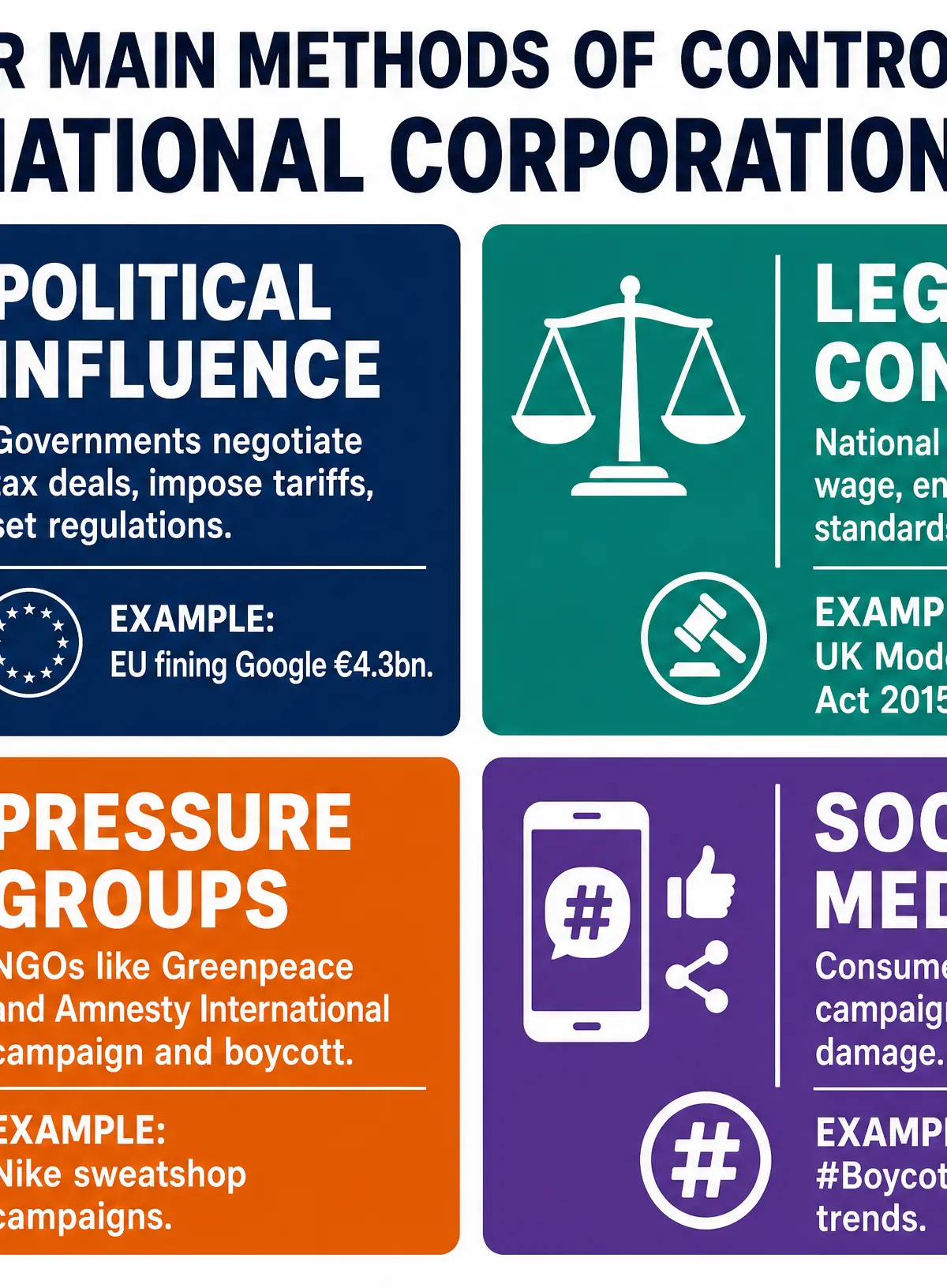
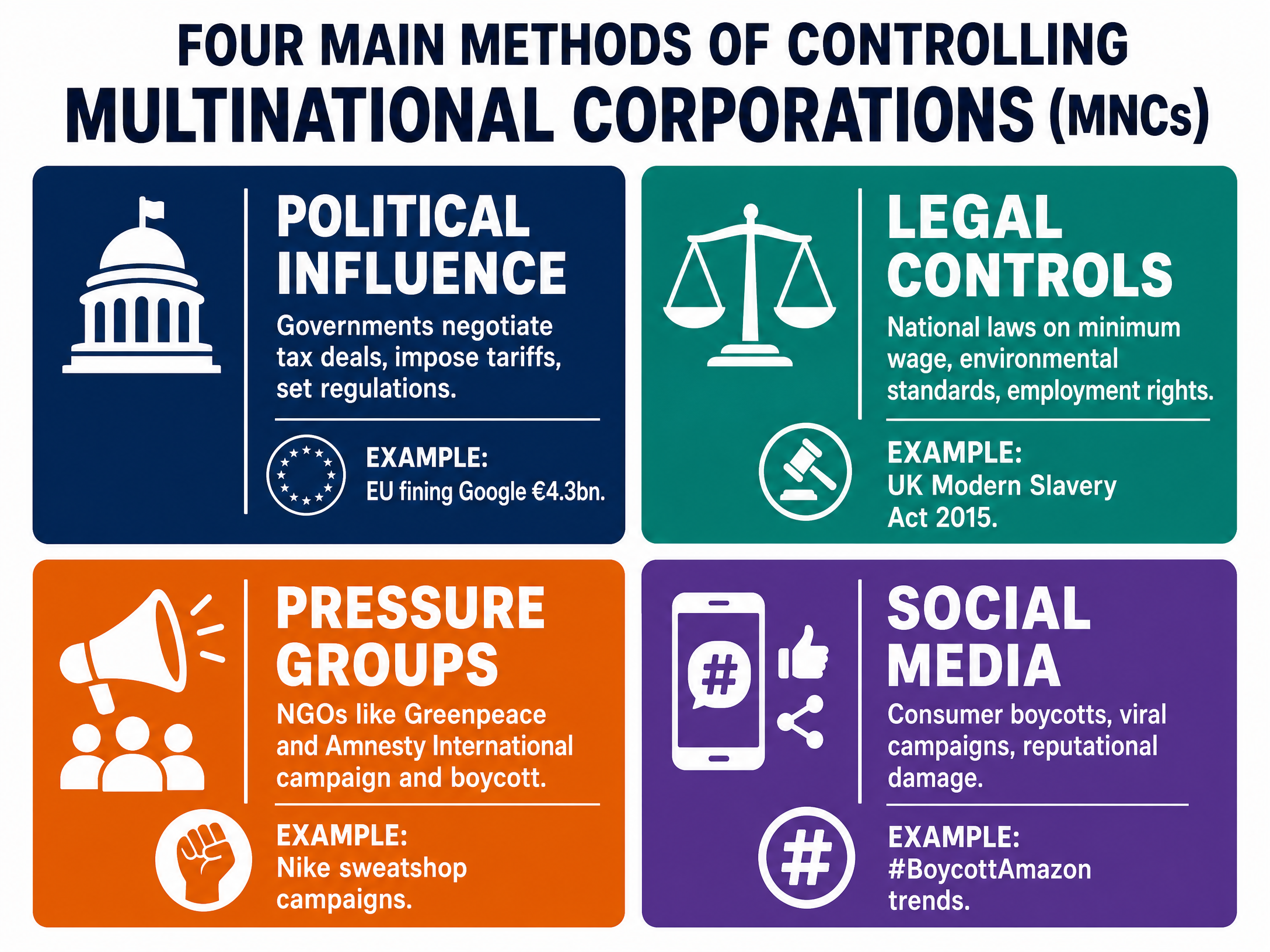
Because MNCs are so powerful, controlling them is difficult. However, there are four main methods:
- Political Influence: Governments can negotiate with MNCs, or groups of countries (like the EU) can act together to fine MNCs for anti-competitive behaviour.
- Legal Controls: National governments pass laws on minimum wages, environmental standards, and consumer protection that the MNC must follow.
- Pressure Groups: Organisations like Greenpeace or Amnesty International can campaign against unethical MNCs, organising boycotts and raising public awareness.
- Social Media: Viral campaigns can rapidly damage an MNC's global reputation, forcing them to change their behaviour to protect their brand image.
Visual Resources
2 diagrams and illustrations
Interactive Diagrams
1 interactive diagram to visualise key concepts
Conceptual Flow Outline
Flowchart showing the relationship and impacts between an MNC and a host country.
Worked Examples
3 worked examples — open one to explore the question and available guidance.
Practice Questions
Test your understanding — click to reveal model answers
State two reasons why a business might want to become a Multinational Corporation. (2 marks)
Hint: Think of the CMAR acronym.
Explain how the use of transfer pricing by an MNC can cause conflict with the host country's government. (4 marks)
Hint: Define transfer pricing, then explain what the government loses as a result.
Analyse how pressure groups can influence the behaviour of Multinational Corporations. (6 marks)
Hint: Think about what pressure groups actually do (campaigns, boycotts) and how this affects the MNC's profits or reputation.
Explain the difference between Foreign Direct Investment (FDI) and international trade. (3 marks)
Hint: Focus on physical assets vs. moving goods.
Discuss the ethical issues an MNC must consider when managing its global supply chain. (9 marks)
Hint: You need to cover multiple ethical issues (e.g., pay, conditions, environment) and evaluate why the MNC might struggle to balance these with making a profit.