Pearson Edexcel · A-Level · Business
Meeting customer needs
Meeting customer needs is the foundational principle of any successful business. In this guide, you will master the essential concepts of markets, research, and segmentation, equipping you with the precise terminology examiners reward to secure top marks.
- 7 min read
- 3 worked examples
- 5 practice questions
- 6 key terms
Study Notes

Overview
Every business exists to satisfy the needs and wants of its customers. This topic forms the core of GCSE Business because without understanding customers, a business cannot survive, let alone thrive. Examiners expect candidates to not only describe concepts like market research and segmentation but to evaluate their effectiveness in real-world scenarios. A key differentiator between average and top-tier candidates is the precise use of terminology—such as distinguishing between market size and market share, or risk and uncertainty.
Understanding Markets
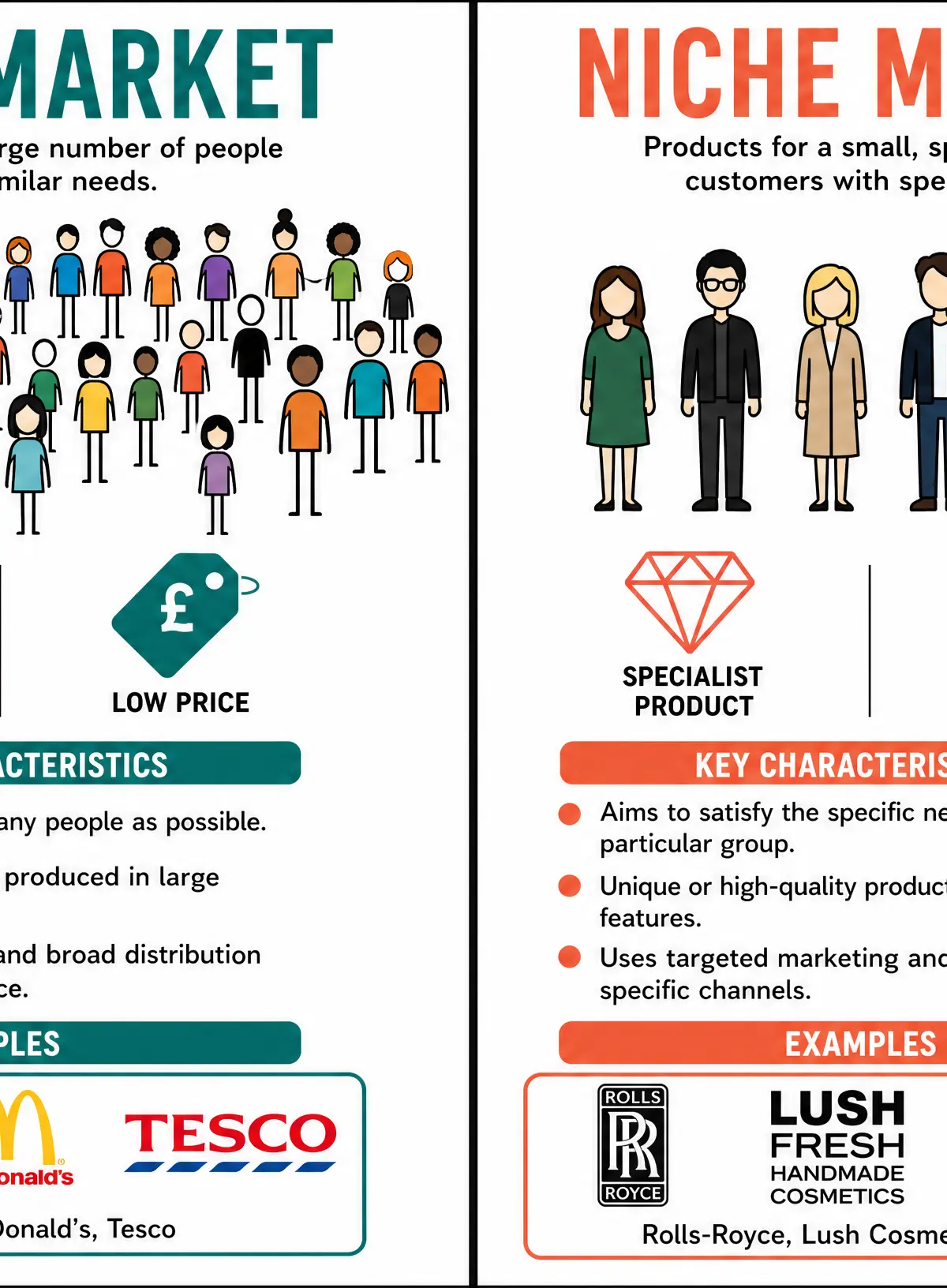
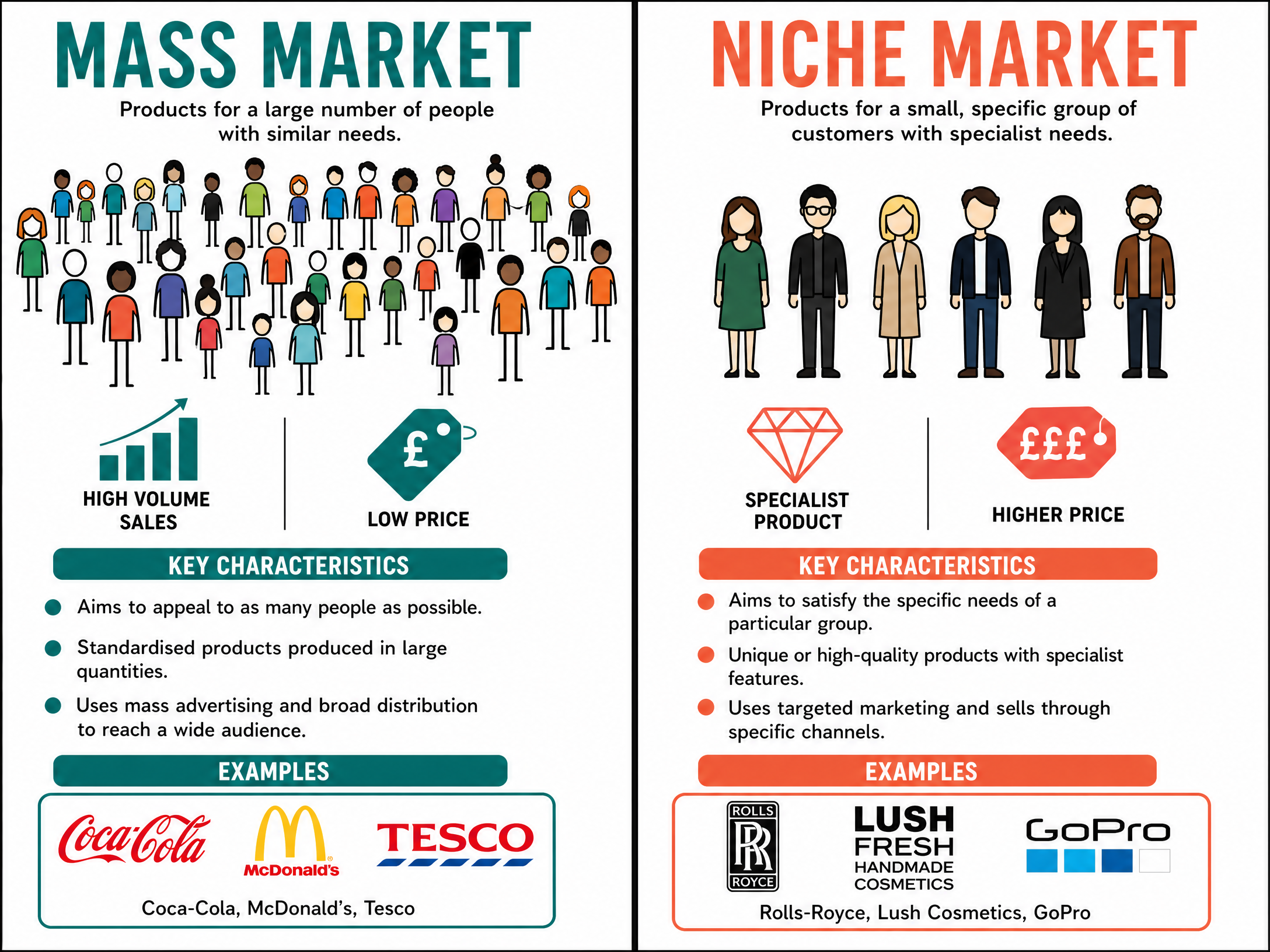
A market is any place where buyers and sellers come together to exchange goods and services. Businesses operate in either mass or niche markets, and understanding the distinction is crucial.
Mass Markets
Definition: A market where a business sells the same product to a very large number of customers.
Key Characteristics:
- Standardised products produced in large quantities.
- Aims to appeal to as many people as possible.
- Uses mass media for advertising.
Exam Focus: Mass markets offer economies of scale (lower cost per unit) and high sales volume, but suffer from intense competition and lower profit margins.
Niche Markets
Definition: A small, specific segment of a larger market with specialist needs.
Key Characteristics:
- Highly specialised products.
- Targets a very specific customer profile.
- Often charges premium prices.
Exam Focus: Niche markets face less direct competition and benefit from loyal customers, but have lower overall sales volumes and are vulnerable to sudden changes in consumer tastes.
Market Size vs Market Share
Examiners frequently test the distinction between these two concepts.
- Market Size: The total value or volume of sales in a given market (e.g., the UK fast-food market is worth £15 billion).
- Market Share: The proportion of total market sales held by one specific business, expressed as a percentage.
Formula: (Business Sales ÷ Total Market Sales) × 100 = Market Share %
Risk vs Uncertainty
Another common area of confusion for candidates is the difference between risk and uncertainty.
- Risk: A situation where the outcome is unknown, but the probability can be estimated (e.g., a 20% chance a new product will fail).
- Uncertainty: A situation where the outcome cannot be predicted at all, and no probability can be assigned (e.g., the impact of a sudden global pandemic).
Business Orientation
Businesses approach their markets in two fundamentally different ways:
Product Orientation
The business focuses primarily on the design, quality, and performance of the product itself, assuming that a superior product will naturally attract customers. This approach is common in high-tech industries.
Market Orientation
The business starts by identifying what the customer wants through extensive market research, and then designs products to meet those specific needs. This is the most common approach in highly competitive modern markets.
Market Research
To become market-oriented, a business must conduct market research. Examiners expect you to evaluate the methods used.
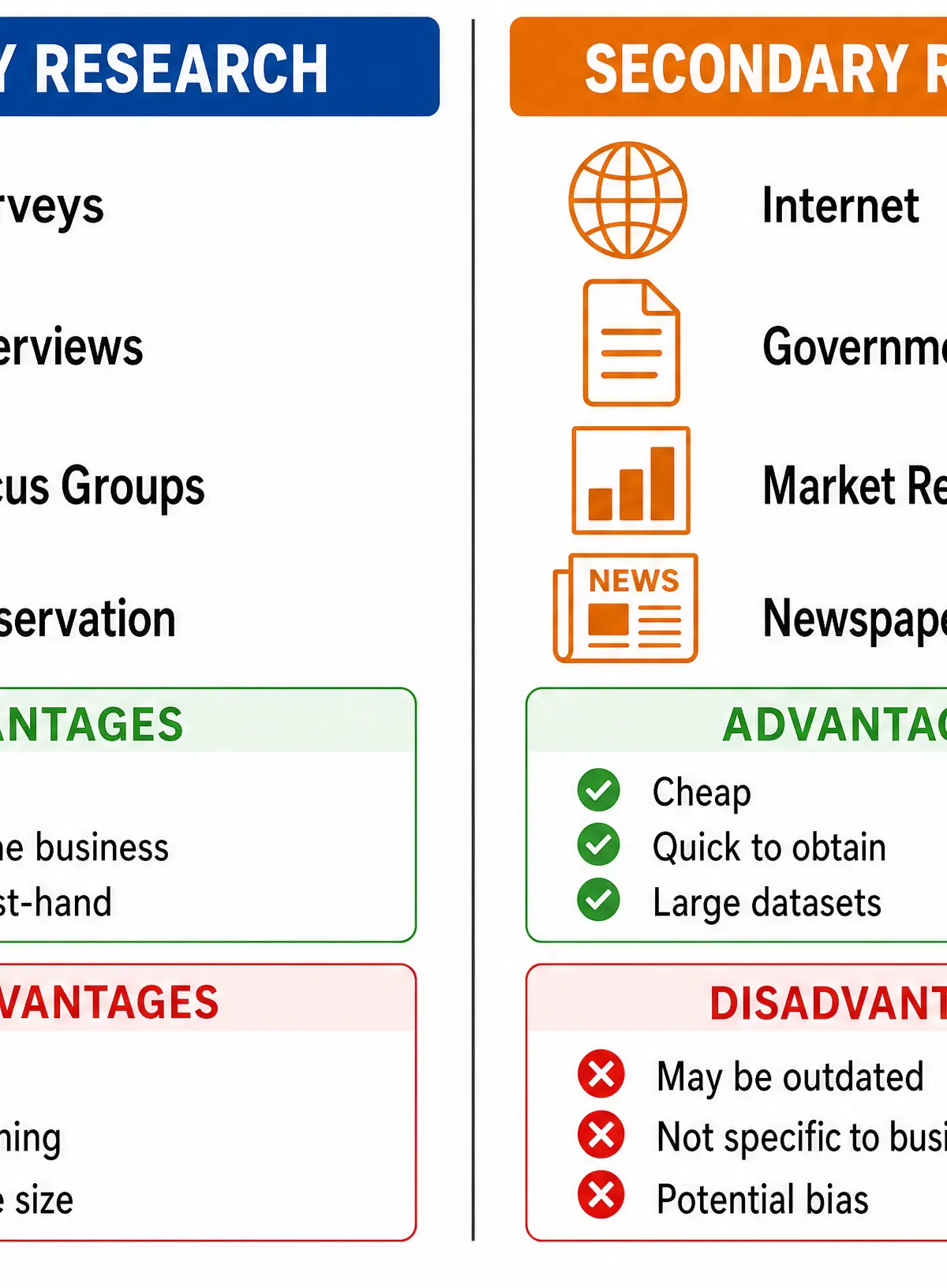
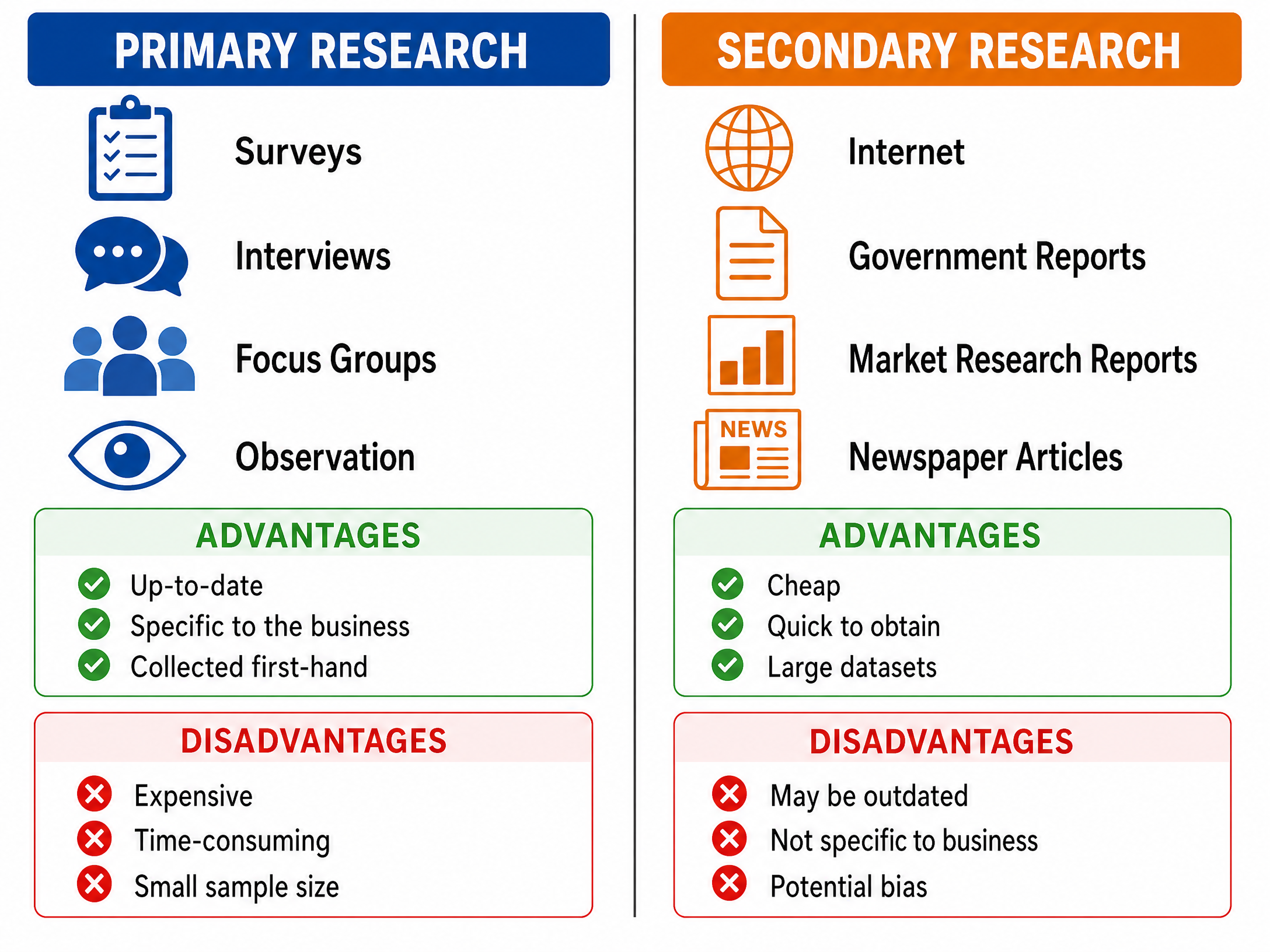
Primary (Field) Research
Data collected first-hand, specifically for the purpose of the business.
- Methods: Surveys, interviews, focus groups, observation.
- Advantages: Up-to-date, highly specific to the business's exact needs, competitors cannot access it.
- Disadvantages: Expensive, time-consuming, and prone to bias if the sample size is too small.
Secondary (Desk) Research
Data that already exists and was collected by someone else for another purpose.
- Methods: Government statistics, internet research, trade journals, Mintel reports.
- Advantages: Cheap (often free), quick to obtain, often covers very large datasets.
- Disadvantages: May be outdated, not specific to the business, and potentially biased.
The Role of ICT
Information and Communication Technology (ICT) has revolutionised research. Online surveys are cheap and reach global audiences instantly. Social media analytics allow real-time tracking of customer sentiment. Big data analysis helps spot hidden trends in consumer behaviour.
Market Segmentation
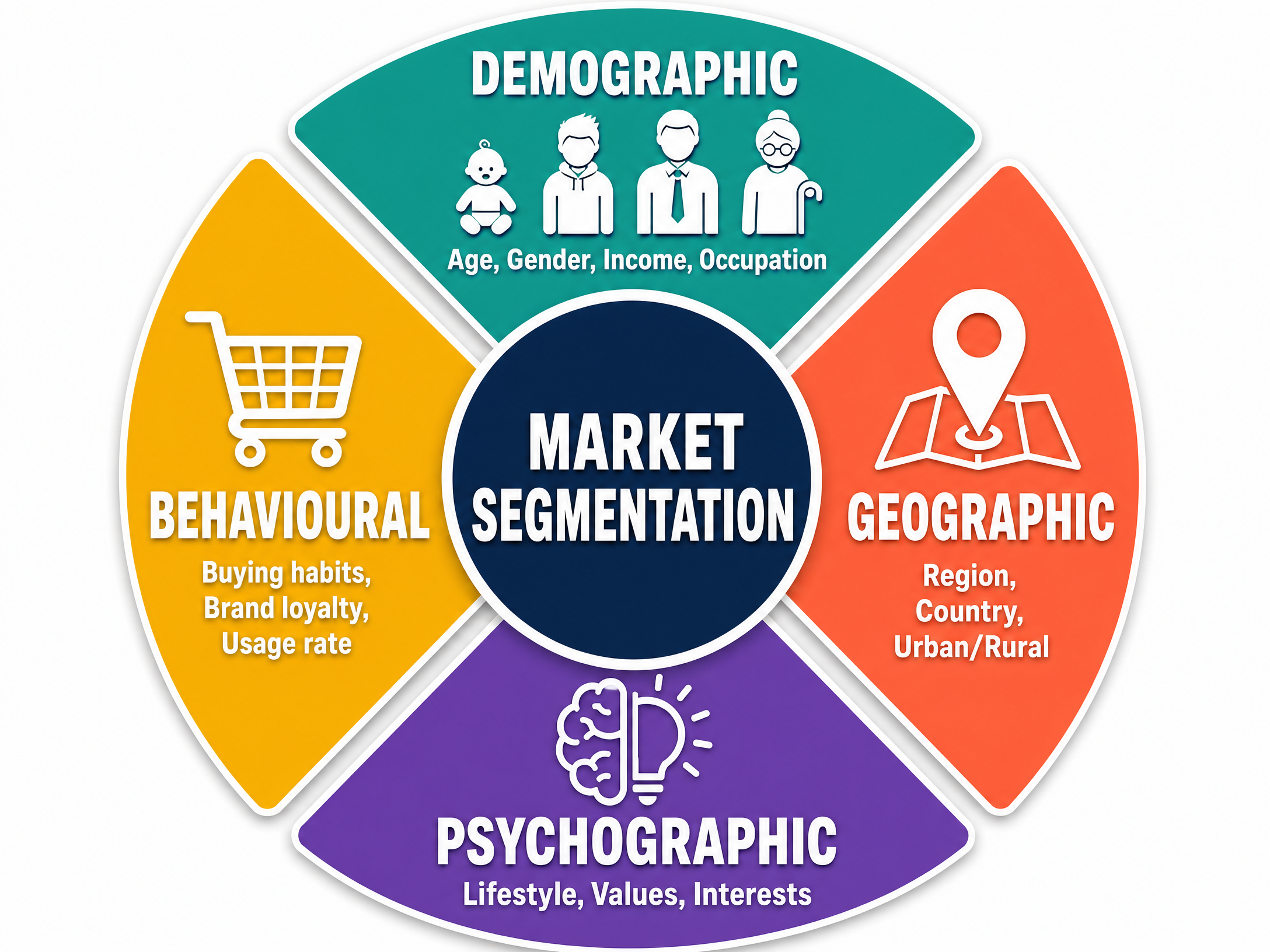
Segmentation is the process of dividing a target market into smaller, distinct groups of consumers who share similar characteristics or needs.
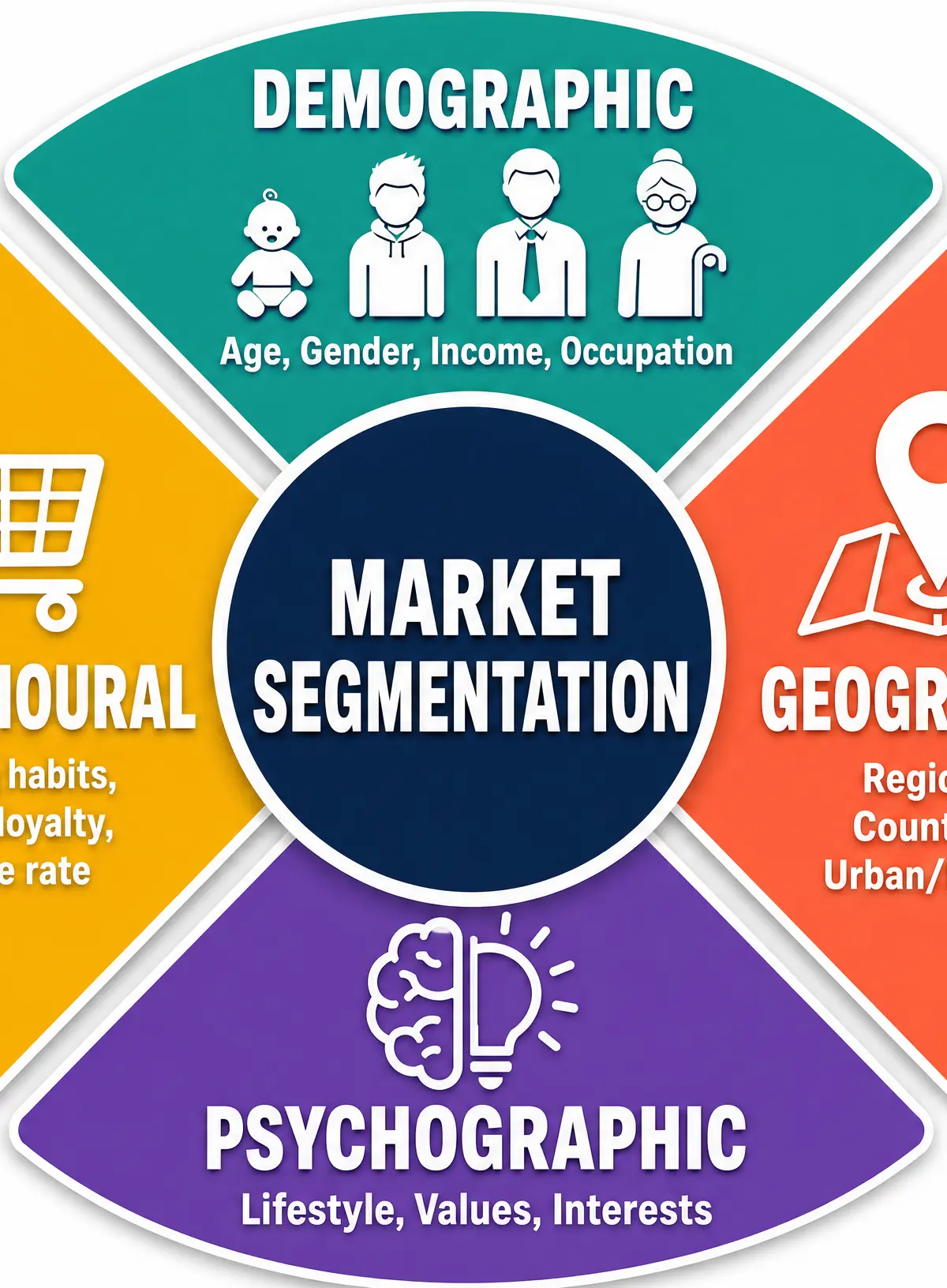
The Four Methods of Segmentation
- Demographic: Age, gender, income, occupation, social class.
- Geographic: Region, country, urban vs rural.
- Psychographic: Lifestyle, values, personality, interests.
- Behavioural: Buying habits, brand loyalty, usage rate.
Exam Focus: Segmentation allows a business to target its marketing more effectively, avoiding wasted advertising spend and creating products that precisely match customer desires.
Market Mapping
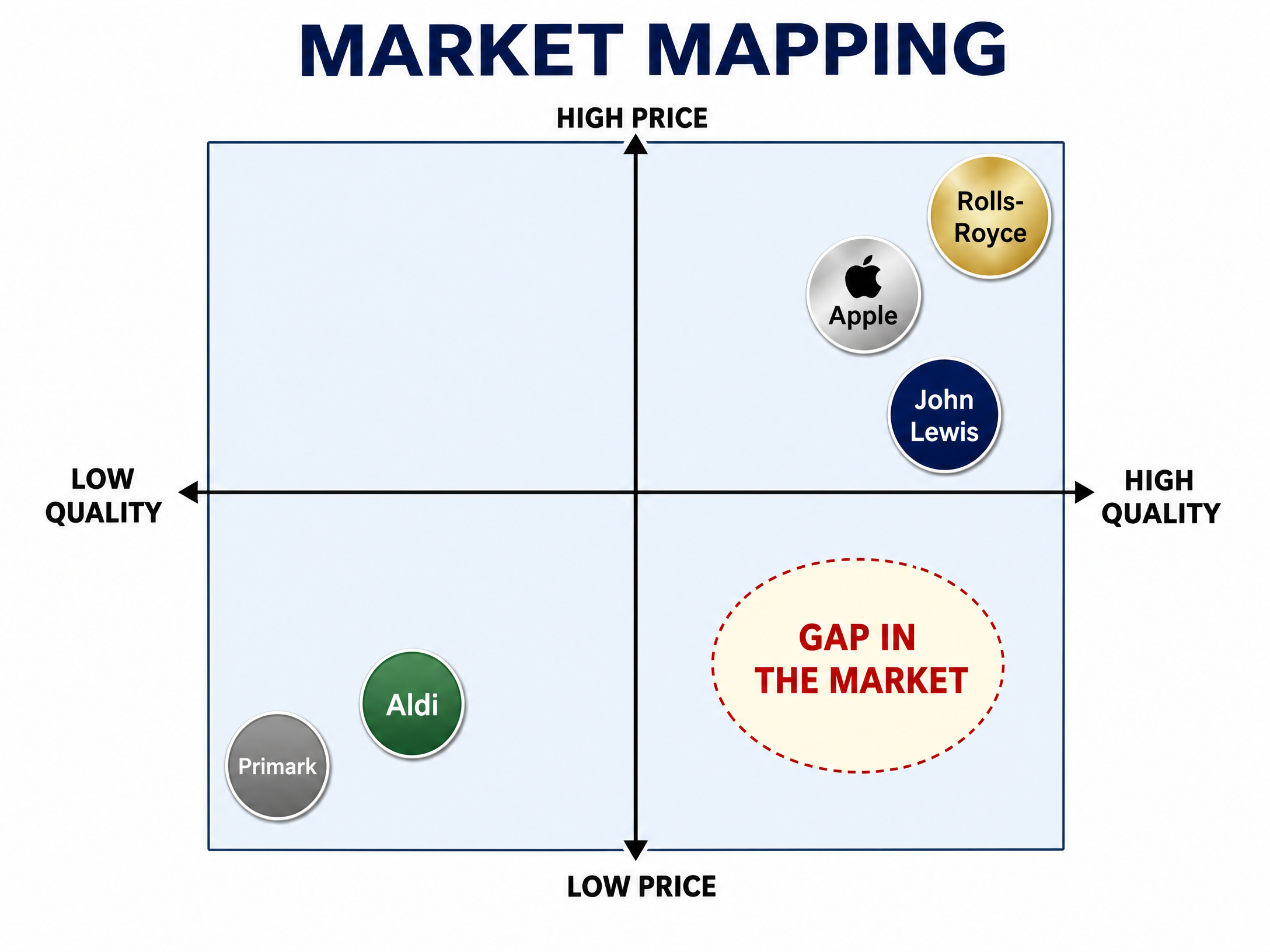
A market map (or perceptual map) is a diagram used to position and compare products in a market based on two key variables (usually price and quality).
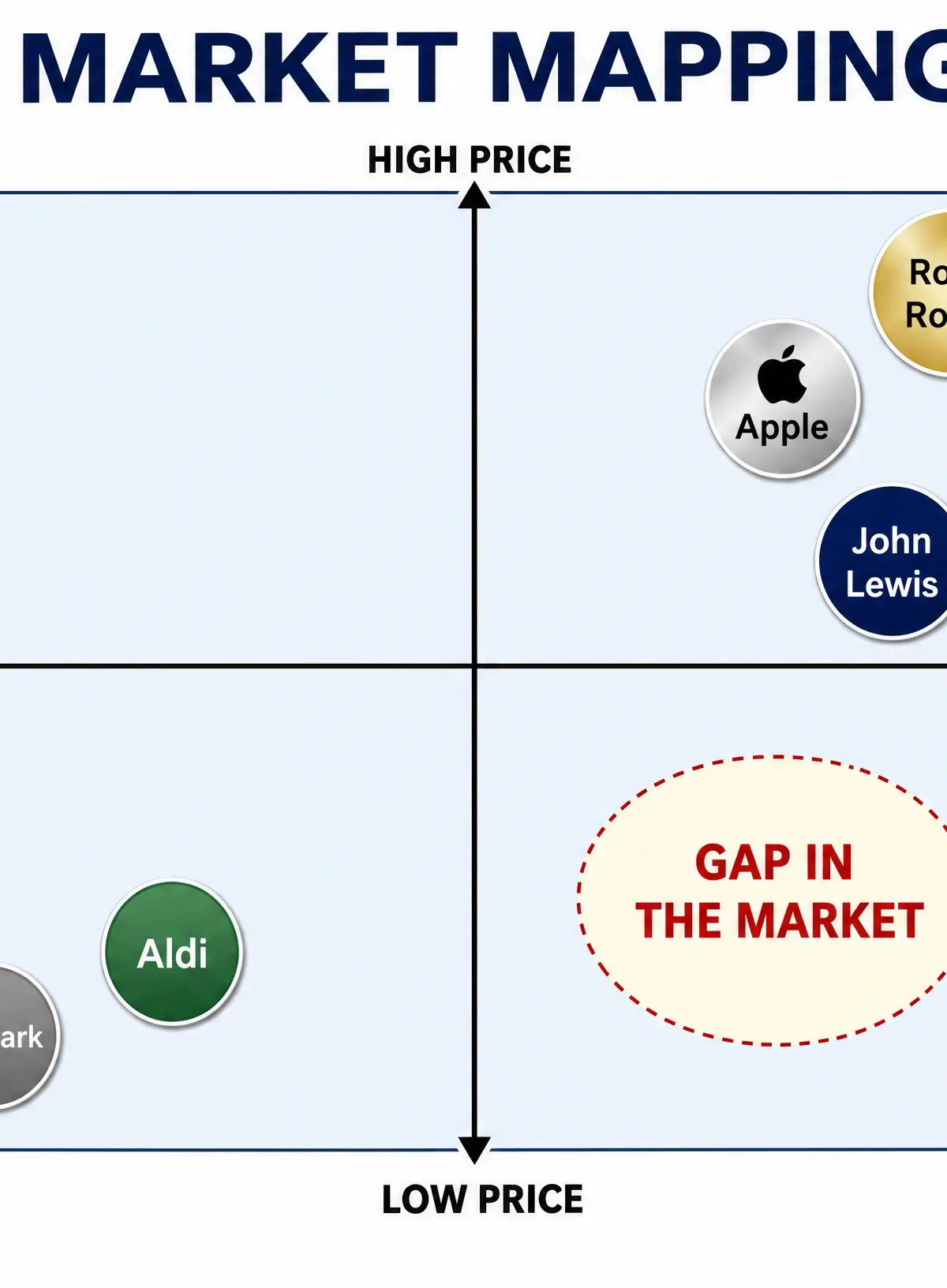
Exam Focus: The primary purpose of a market map is to identify a gap in the market—an area where customer needs are not currently being met by existing competitors. This helps a business decide where to position a new product.
Product Differentiation and Adding Value
To survive in a competitive market, a business must stand out.
- Product Differentiation: Making a product distinct from competitors in the eyes of the customer. This can be achieved through unique design, superior quality, distinctive branding, or exceptional customer service.
- Adding Value: The process of increasing the perceived worth of a product above the cost of its raw materials. This allows the business to charge a premium price. Value can be added through strong branding, convenience, high-quality packaging, or unique features.
Audio Revision
Listen to our comprehensive 4-minute revision podcast covering all the core concepts, common mistakes, and a quick-fire recall quiz to test your knowledge.

Worked Examples
3 worked examples — open one to explore the question and available guidance.
Practice Questions
Test your understanding — click to reveal model answers
State two methods of primary market research. (2 marks)
Hint: Think of methods where the business collects the data themselves, first-hand.
Explain one way a business could segment the market for a new range of sports shoes. (3 marks)
Hint: Name a segmentation method, apply it to sports shoes, and explain the benefit.
A small independent coffee shop is deciding whether to use primary or secondary market research to find out what new flavours of coffee its customers want. Recommend which method they should use. Justify your answer. (9 marks)
Hint: Consider the budget of a small independent shop, but also the specific nature of the data they need.
Explain the difference between risk and uncertainty in a business context. (4 marks)
Hint: Focus on whether the outcome can be predicted or measured.
Explain how a business can use a market map to identify a gap in the market. (3 marks)
Hint: Think about what the axes represent and where competitors are placed.