Pearson Edexcel · A-Level · Business
Theme 1: Marketing and people
Theme 1 introduces the fundamental concepts of how businesses interact with their markets and manage their people. Understanding these principles is crucial for exam success, as they form the foundation for analyzing business behaviour, evaluating strategies, and making justified recommendations in context.
- 7 min read
- 3 worked examples
- 5 practice questions
- 6 key terms
Study Notes

Overview
Theme 1: Marketing and People is a cornerstone of the GCSE Business specification. It explores the dual challenges every business faces: identifying and satisfying customer needs profitably, and managing the human resources required to deliver those products or services. Examiners expect candidates to not only understand these theories but to apply them to specific business contexts, evaluating which strategies are most appropriate given a firm's objectives, size, and competitive environment. Mastery of this theme is essential, as its concepts frequently appear in high-mark evaluation questions across all papers.
Listen to the comprehensive revision podcast for this theme here:

1. Marketing
1.1 The Market
Mass vs Niche MarketsBusinesses must decide whether to target a mass market (a large, unsegmented market with a standardized product, e.g., standard toothpaste) or a niche market (a smaller, specialized segment with specific needs, e.g., organic, fluoride-free toothpaste).
- Mass Market: High sales volume, economies of scale, intense competition, lower profit margins.
- Niche Market: Less competition, ability to charge premium prices, loyal customer base, vulnerable to market changes.
Market Size vs Market Share
- Market Size: The total volume or value of sales within a specific market.
- Market Share: The proportion of total market sales held by one business. Calculated as:
(Business Sales / Total Market Sales) × 100.
1.2 Market Research
Businesses gather data to understand customer needs, reduce risk, and inform decision-making.
- Primary Research: Collecting new, first-hand data (e.g., surveys, focus groups, observation). It is specific and up-to-date but expensive and time-consuming.
- Secondary Research: Using existing data (e.g., government statistics, competitor websites, market reports). It is quick and cheap but may be outdated or lack specific relevance.
- Quantitative Data: Numerical data that can be analyzed statistically.
- Qualitative Data: Descriptive data concerning opinions, motivations, and feelings.
1.3 Elasticity
Understanding how demand responds to changes in price and income is critical for setting strategy.
- Price Elasticity of Demand (PED): Measures the responsiveness of demand to a change in price.
PED = % Change in Quantity Demanded / % Change in Price.- Price Elastic: PED > 1. Demand is highly responsive to price changes (e.g., luxury goods, products with many substitutes). Lowering price increases total revenue.
- Price Inelastic: PED < 1. Demand is unresponsive to price changes (e.g., necessities, addictive goods). Raising price increases total revenue.
- Income Elasticity of Demand (YED): Measures how demand responds to changes in consumer income.
- Normal Goods: Positive YED. Demand rises as income rises.
- Inferior Goods: Negative YED. Demand falls as income rises (e.g., budget supermarket own-brands).
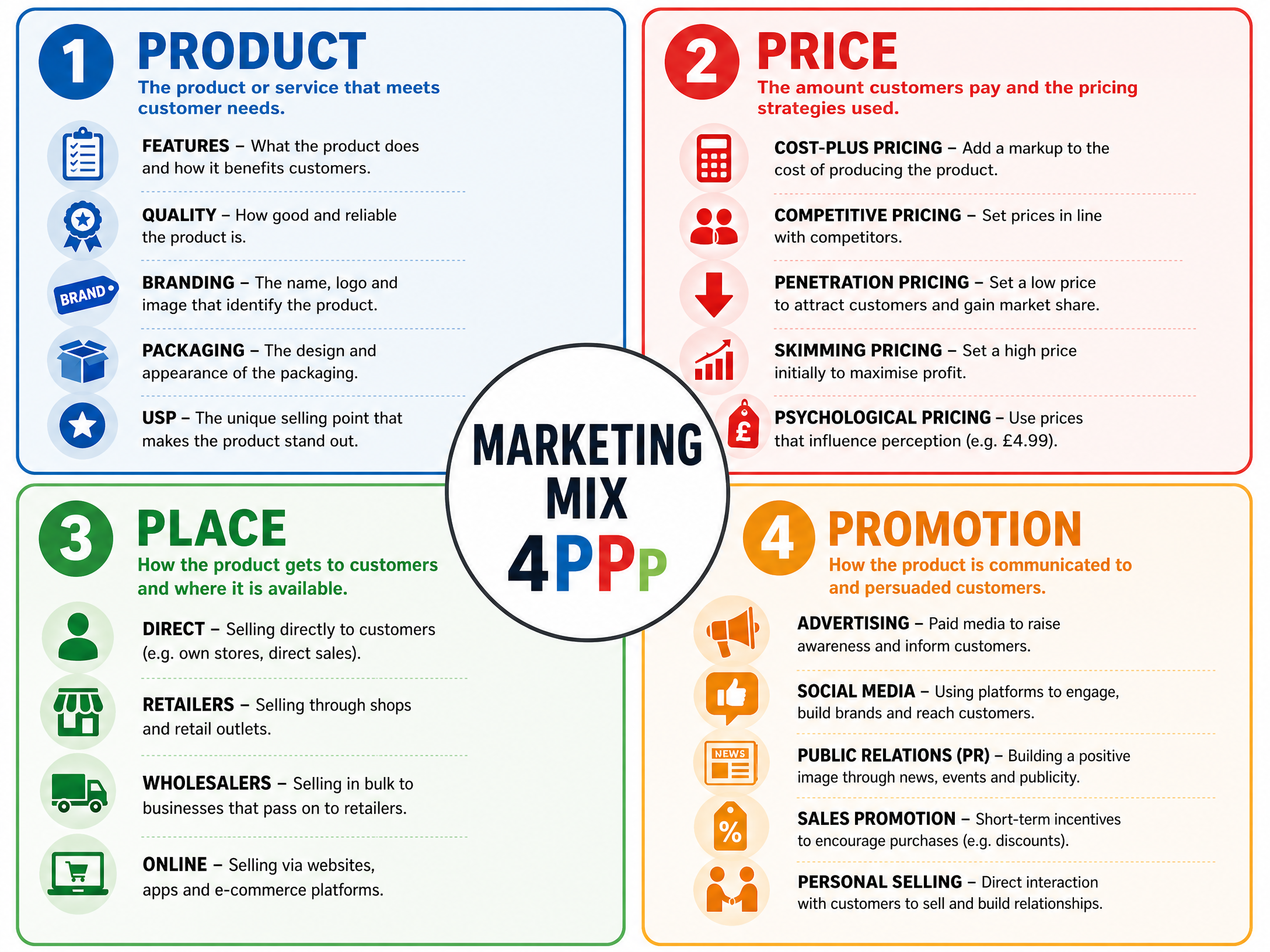
1.4 The Marketing Mix (The 4Ps)
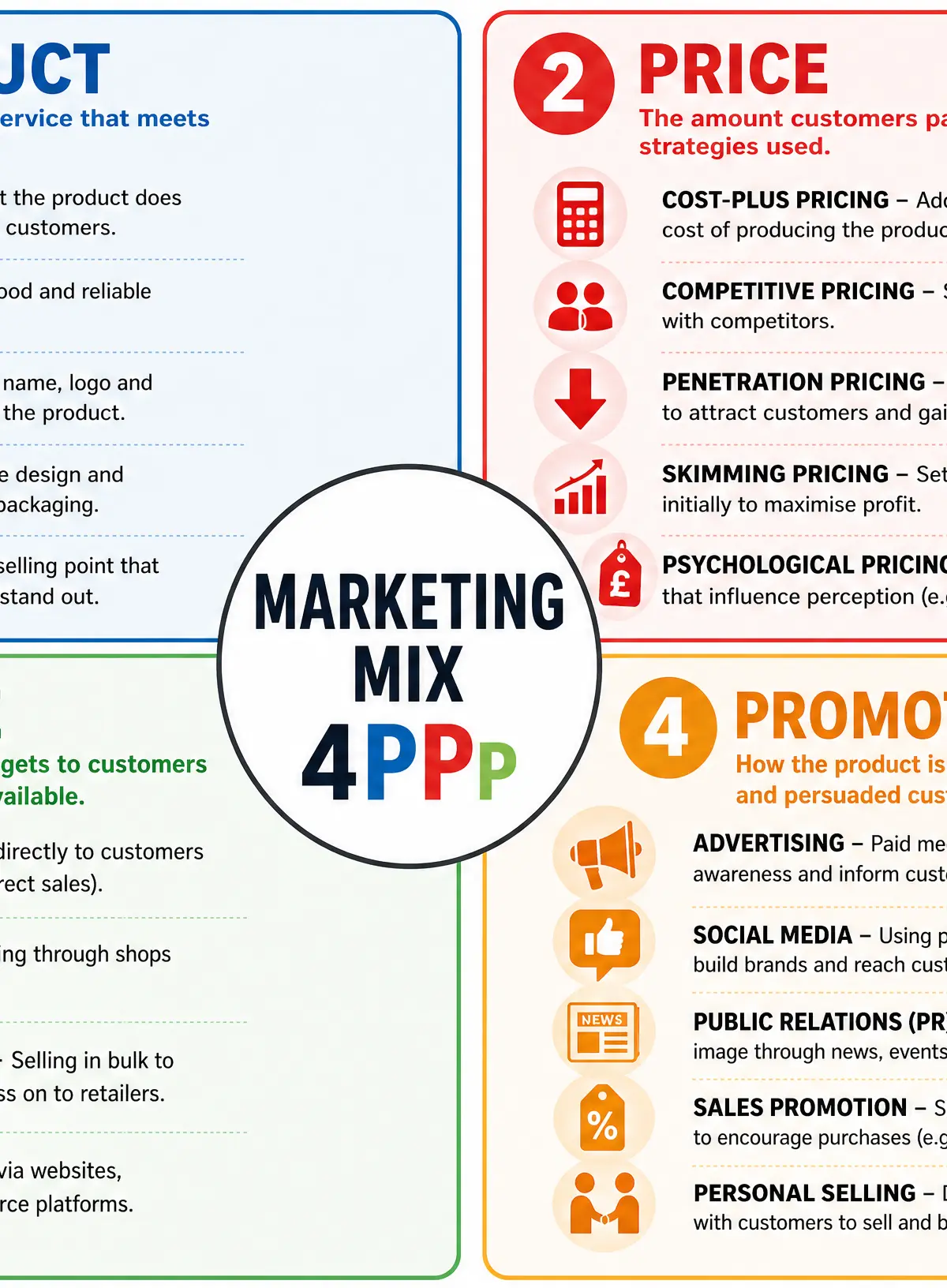
The combination of elements a business uses to successfully market its product.
- Product: The good or service offered. Key concepts include the Design Mix (Function, Aesthetics, Cost) and the Unique Selling Point (USP).
- Price: The amount charged. Strategies include Cost-plus, Competitive, Penetration, Price Skimming, and Psychological pricing.
- Place: How the product reaches the consumer (distribution channels). This includes direct selling, retailers, wholesalers, and e-commerce.
- Promotion: How the business communicates with the market. Includes advertising, sales promotion, public relations (PR), and personal selling.
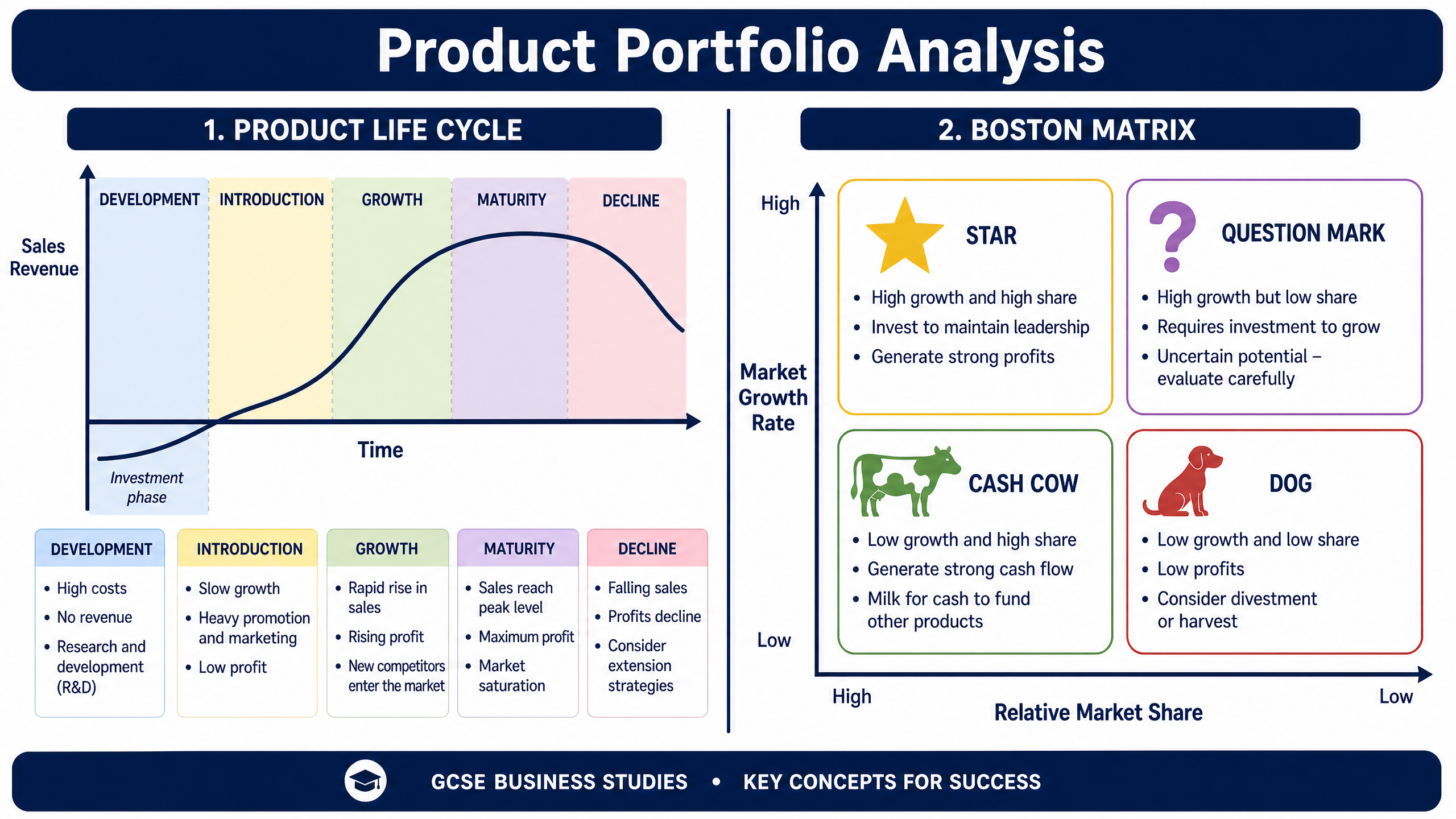
1.5 Product Portfolio Analysis
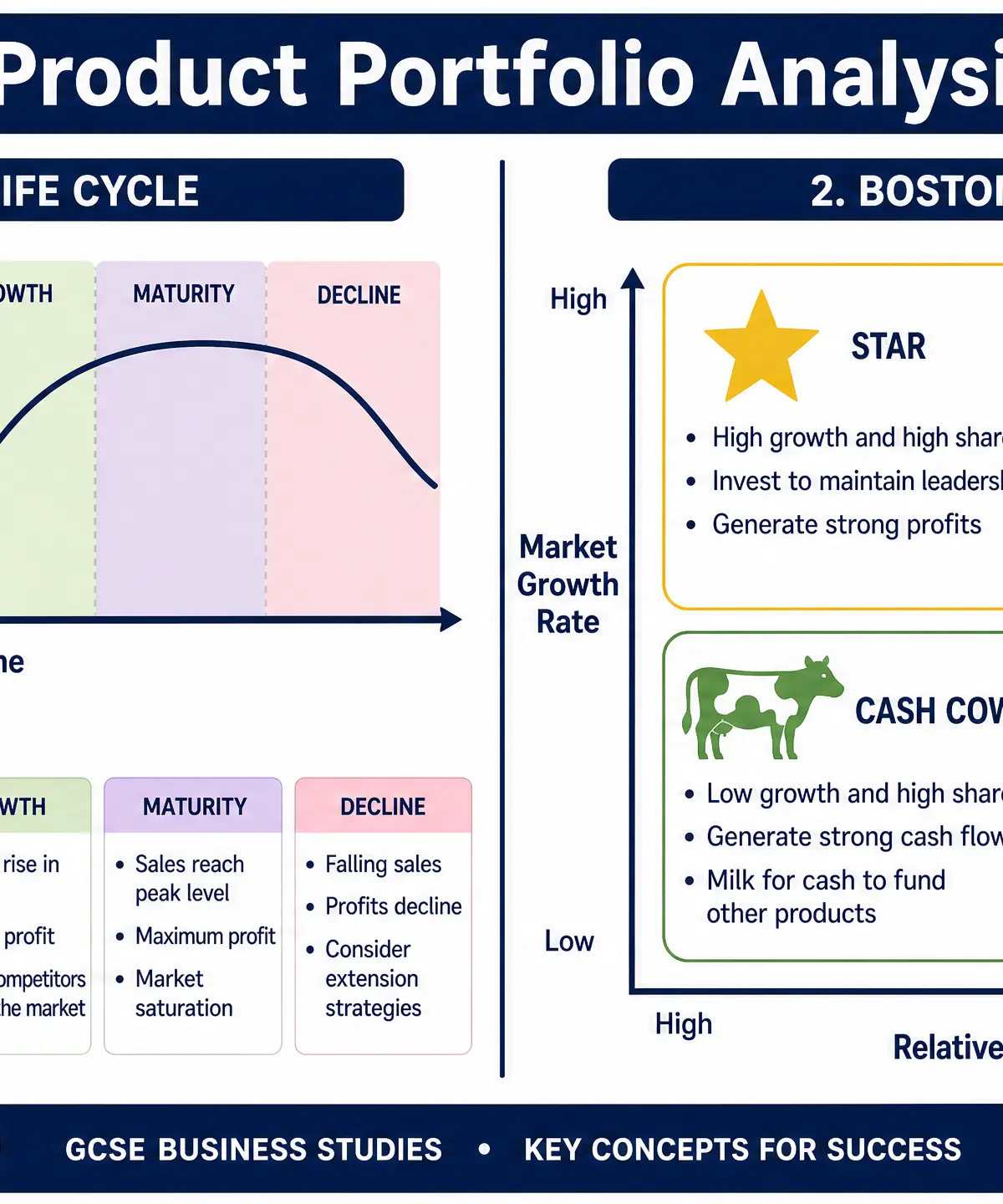
Businesses use models to manage their range of products.
- The Product Life Cycle: Tracks a product's sales over time through Development, Introduction, Growth, Maturity, and Decline. Extension strategies can prolong the maturity phase.
- The Boston Matrix: Categorizes products based on Market Share and Market Growth Rate into Stars, Cash Cows, Question Marks, and Dogs, guiding investment decisions.
2. People
2.1 Recruitment and Training
- Internal Recruitment: Filling vacancies from within the existing workforce. It is cheaper, faster, and motivating, but limits new ideas and creates another vacancy.
- External Recruitment: Hiring from outside the business. Brings fresh perspectives and skills but is expensive and time-consuming.
- Training: Essential for productivity and motivation. Includes Induction (for new starters), On-the-job (learning while working), and Off-the-job (learning away from the workplace).
2.2 Organisational Structures
- Tall Structure: Many layers of hierarchy, narrow span of control. Offers clear progression paths but communication can be slow.
- Flat Structure: Few layers of hierarchy, wide span of control. Encourages delegation and faster communication but managers may be overwhelmed.
- Centralised vs Decentralised: Centralised structures keep decision-making at the top; decentralised structures delegate authority lower down the chain.
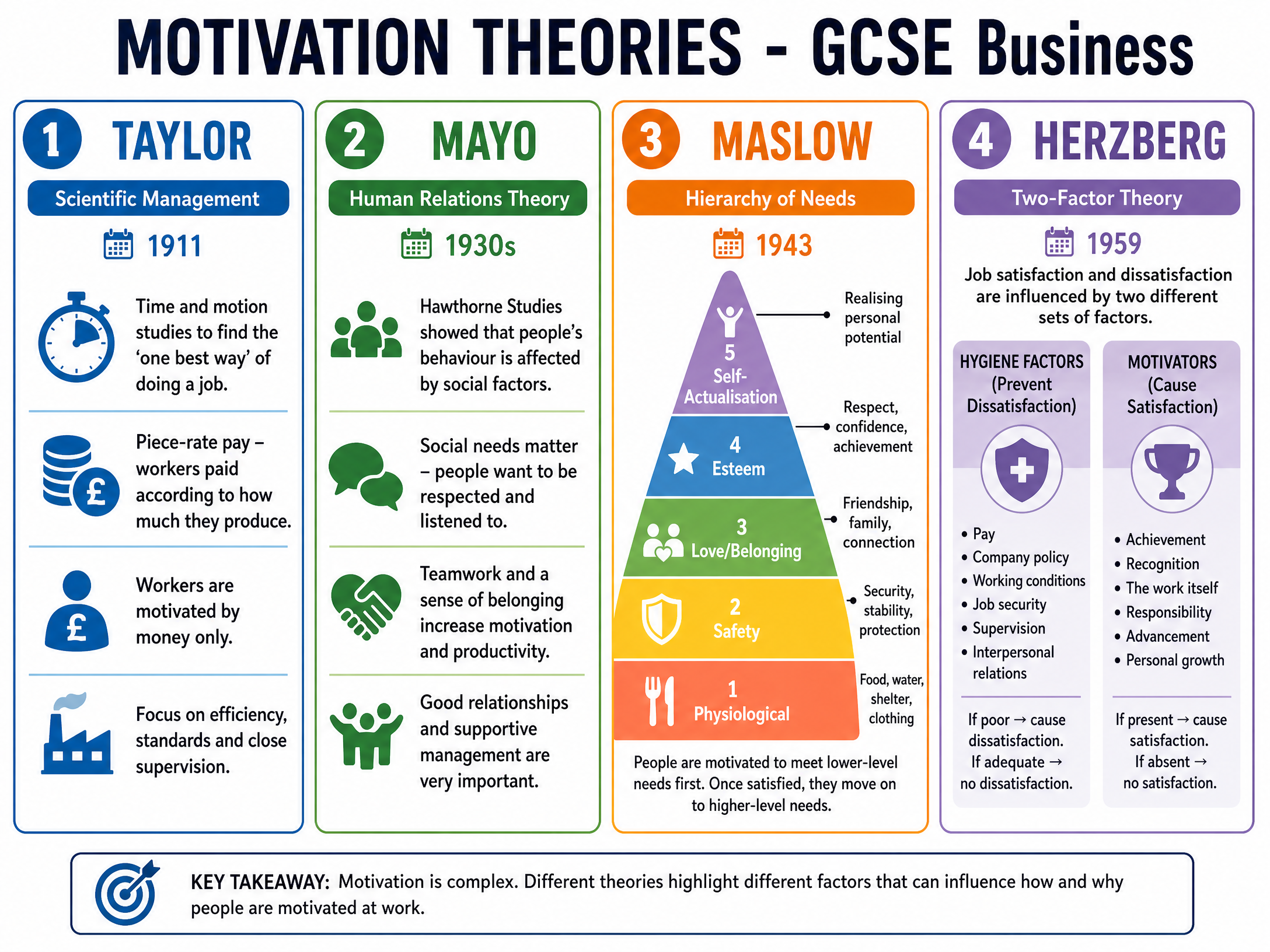
2.3 Motivation Theories
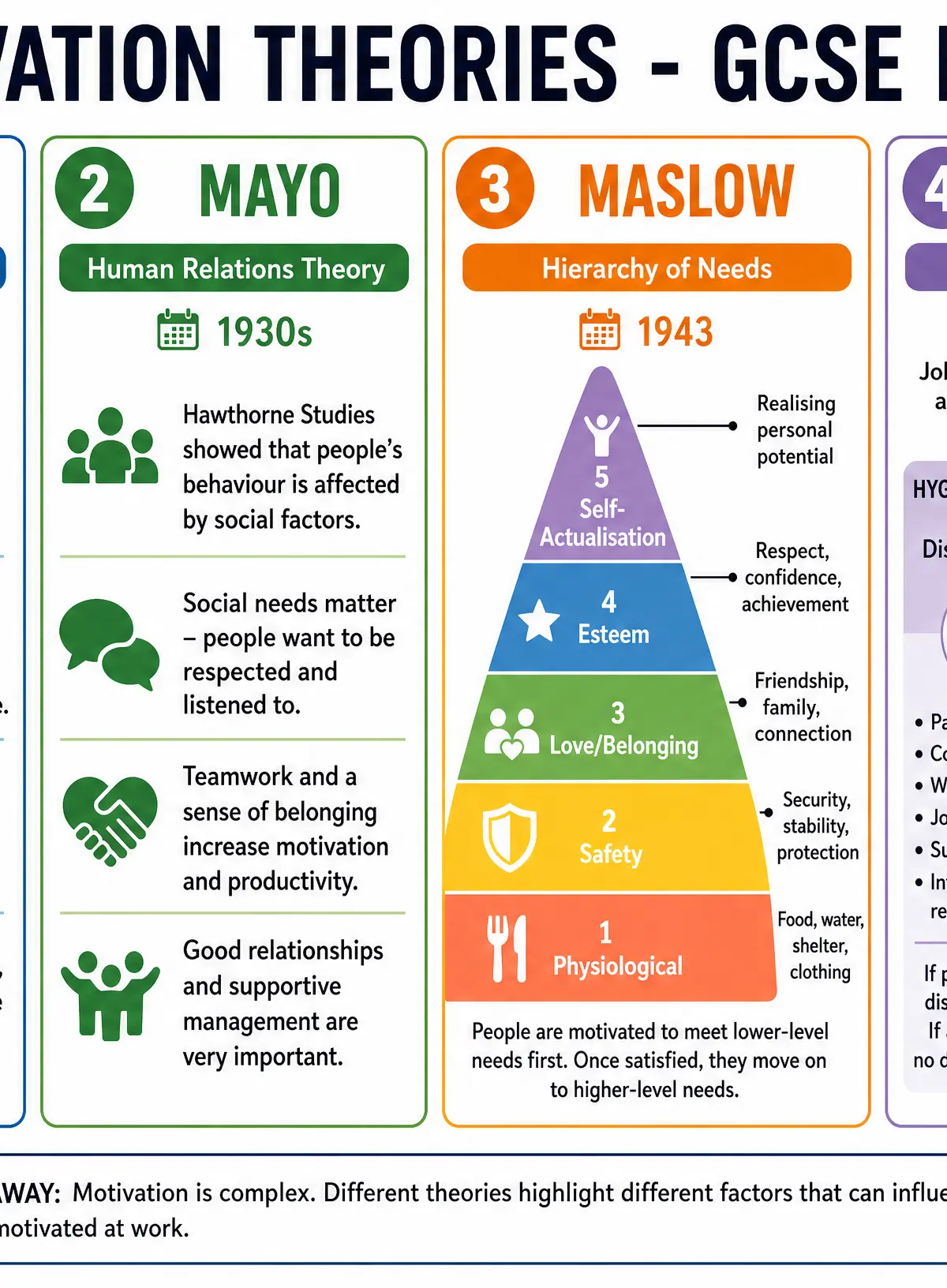
Examiners frequently ask candidates to apply these theories to workplace scenarios to recommend how a business should improve productivity or retention.
- F.W. Taylor (Scientific Management): Workers are motivated primarily by money. Advocated piece-rate pay and close supervision.
- Elton Mayo (Human Relations): Workers are motivated by social needs, teamwork, and feeling valued by management (the Hawthorne effect).
- Abraham Maslow (Hierarchy of Needs): Five levels of needs (Physiological, Safety, Social, Esteem, Self-Actualisation). Lower needs must be met before higher needs motivate.
- Frederick Herzberg (Two-Factor Theory): 'Hygiene factors' (e.g., pay, conditions) prevent dissatisfaction but do not motivate. 'Motivators' (e.g., achievement, recognition) actively increase job satisfaction.
2.4 Leadership and Management Styles
- Autocratic: The leader makes all decisions. Useful in crises or with unskilled workers, but can demotivate staff.
- Democratic: The leader consults the team before making decisions. Increases motivation and utilizes team skills, but decision-making is slower.
- Laissez-Faire: The leader gives the team broad objectives and leaves them to decide how to achieve them. Effective with highly skilled, creative teams, but can lead to a lack of direction.
Visual Resources
3 diagrams and illustrations
Interactive Diagrams
1 interactive diagram to visualise key concepts
Conceptual Flow Outline
The Recruitment Process
Worked Examples
3 worked examples — open one to explore the question and available guidance.
Practice Questions
Test your understanding — click to reveal model answers
A local independent coffee shop wants to increase its sales. Recommend whether they should use primary or secondary market research to help them achieve this. (9 marks)
Hint: Consider the budget of a small independent shop and the specific, local nature of their target market.
Explain one impact on a business of having a tall organisational structure. (3 marks)
Hint: Think about the number of layers and how that affects communication or promotion opportunities.
A manufacturer of luxury sports cars is considering its pricing strategy. Explain why demand for its cars is likely to be price elastic. (3 marks)
Hint: Consider the nature of a luxury product and the availability of alternatives.
State two benefits of on-the-job training. (2 marks)
Hint: Think about cost and relevance to the specific workplace.
Analyse the impact on employee motivation if a factory replaces piece-rate pay with a fixed monthly salary. (6 marks)
Hint: Use motivation theories (Taylor vs. Herzberg) to build your analysis.