Pearson Edexcel · A-Level · Business
Theme 3: Business decisions and strategy
Theme 3 is the engine room of GCSE Business. It explores how businesses make critical strategic decisions, respond to external pressures, and pursue growth to secure their long-term survival and success.
- 6 min read
- 3 worked examples
- 5 practice questions
- 6 key terms
Study Notes
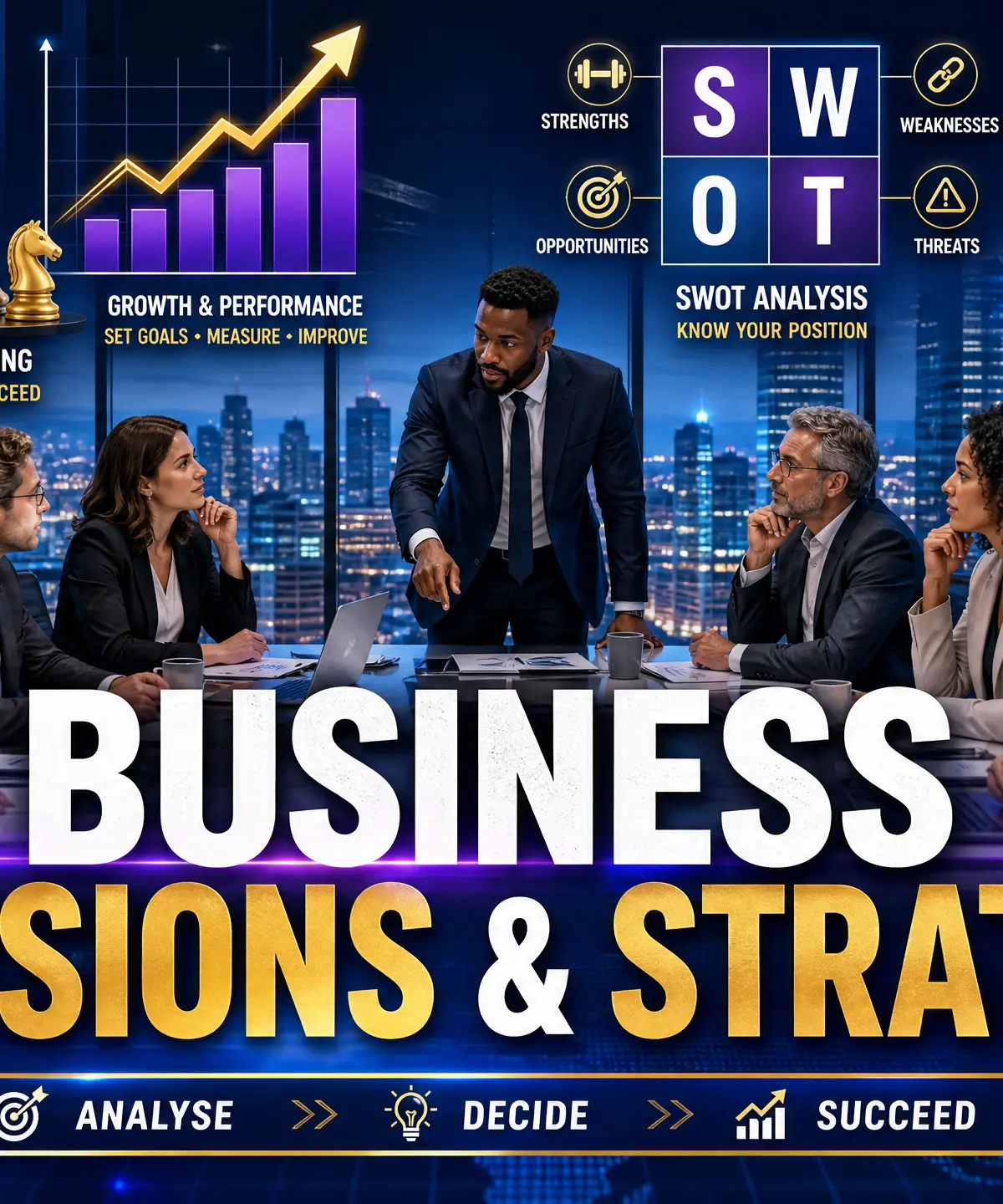
Overview
Theme 3: Business Decisions and Strategy is a high-value topic that separates top-tier candidates from the rest. Examiners love this section because it tests your ability to think analytically, evaluate strategic options, and apply your knowledge to real-world business scenarios.
This study guide covers the fundamental frameworks businesses use to grow, analyze their competitive environment, and respond to external factors outside their control. You'll master the Ansoff Matrix, SWOT Analysis, Porter's Five Forces, and PESTLE analysis. More importantly, you'll learn how to write like a senior examiner—moving beyond simple definitions to develop chains of reasoning that demonstrate exactly why a decision matters for a specific business.
Listen to the companion podcast to consolidate your learning:

1. Business Objectives and Decision Making
Strategic vs. Tactical Decisions
Businesses must make decisions to achieve their aims.
- Strategic Decisions: Long-term, high-risk, and usually made by senior management (e.g., expanding into a new international market).
- Tactical Decisions: Short-term, lower-risk, day-to-day decisions made by middle management (e.g., launching a temporary price promotion).
Changing Objectives
Examiners award marks when candidates recognize that business objectives are not static. A start-up's primary objective is almost always survival. As the business becomes established, objectives shift toward profit maximization, growth, or increasing market share. In times of economic recession, even a large business may revert its primary objective back to survival.
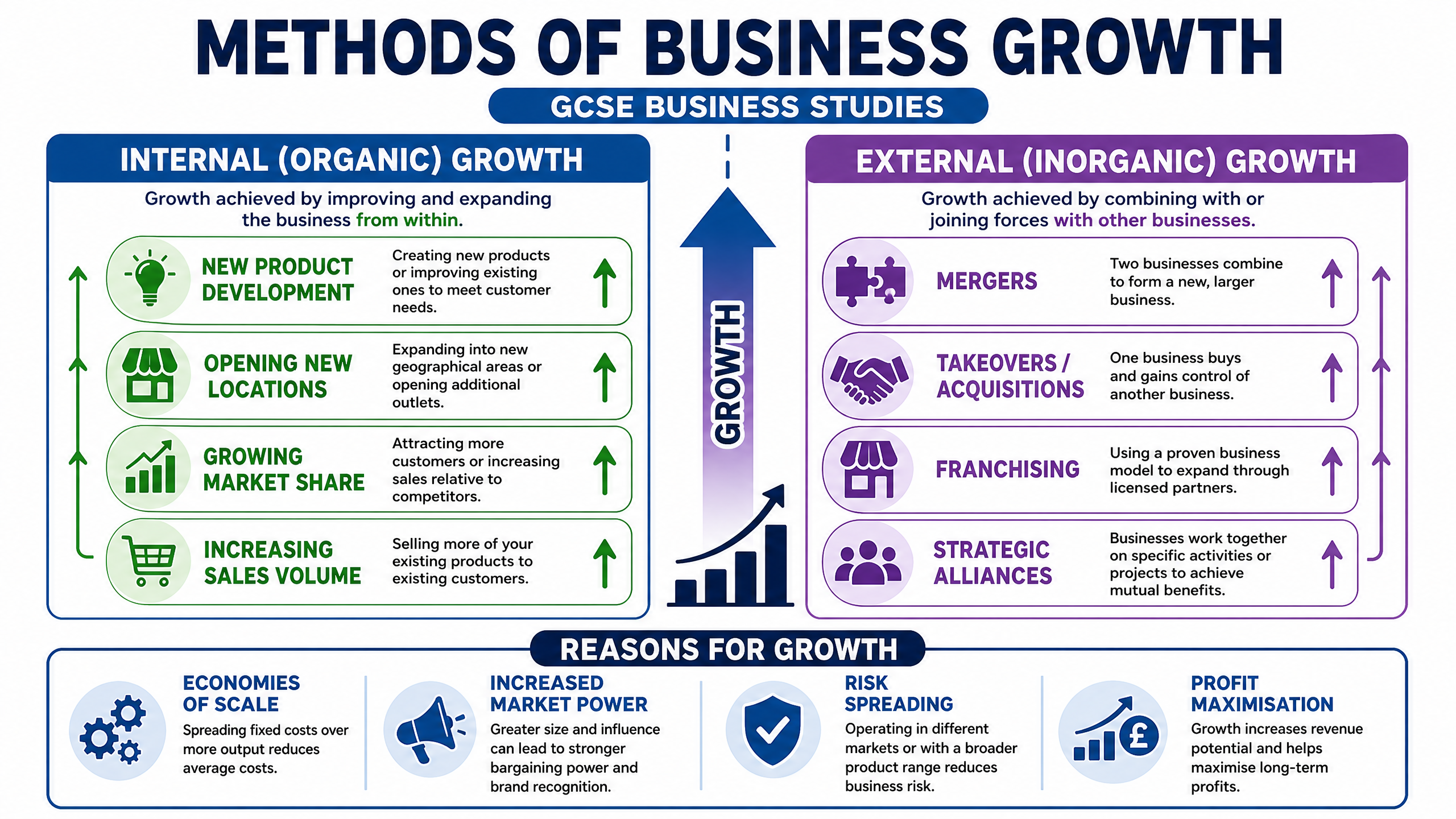
2. Business Growth
Businesses grow to achieve economies of scale, increase market power, spread risk, and maximize profits.
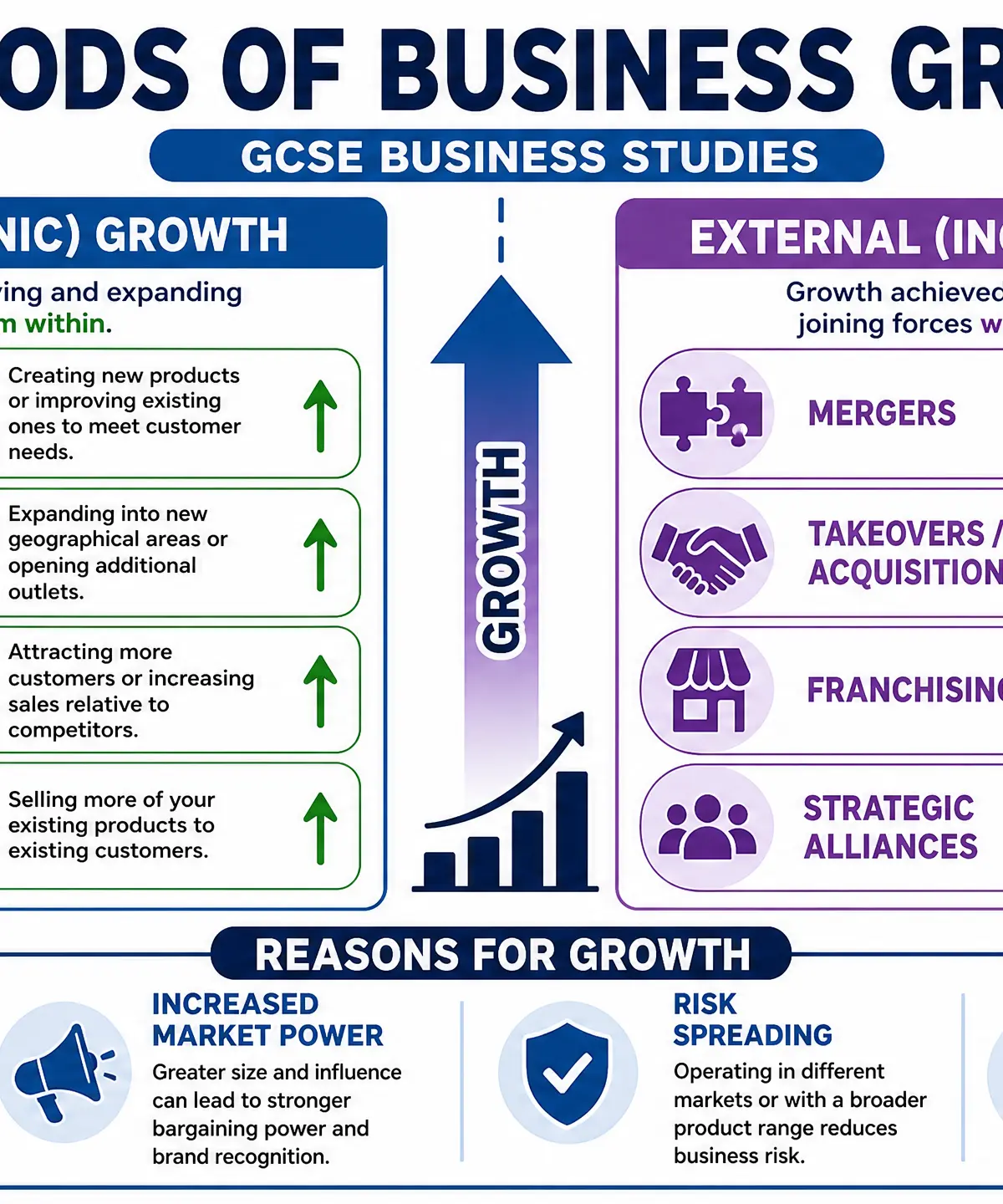
Internal (Organic) Growth
Growing from within using the business's own resources. Methods include:
- New Product Development: Launching new items to attract more sales.
- Opening New Locations: Expanding the physical footprint.
- Increasing Production Capacity: Investing in new machinery.
Examiner Note: Internal growth is generally slower but lower risk, as the owners retain full control and the business culture remains intact.
External (Inorganic) Growth
Growing by combining with other businesses. Methods include:
- Merger: Two businesses agree to join together to form a new, larger enterprise.
- Takeover (Acquisition): One business buys a controlling interest in another (can be hostile or friendly).
- Franchising: Selling the rights to use the business name and model to independent operators.
- Strategic Alliance: Two businesses working together on a specific project without fully merging.
Examiner Note: External growth is rapid but high risk. A common evaluation point is the risk of a "culture clash" when two different workforces are forced together.
Economies and Diseconomies of Scale
As a business grows, its average cost per unit falls (Economies of Scale). Types include:
- Purchasing: Buying in bulk for lower unit prices.
- Technical: Affording highly efficient, specialized machinery.
- Managerial: Hiring specialist managers to improve efficiency.
- Financial: Borrowing money at lower interest rates.
However, if a business grows too large, average costs can rise (Diseconomies of Scale) due to poor communication, lack of coordination, and demotivated workers who feel like "just a number."
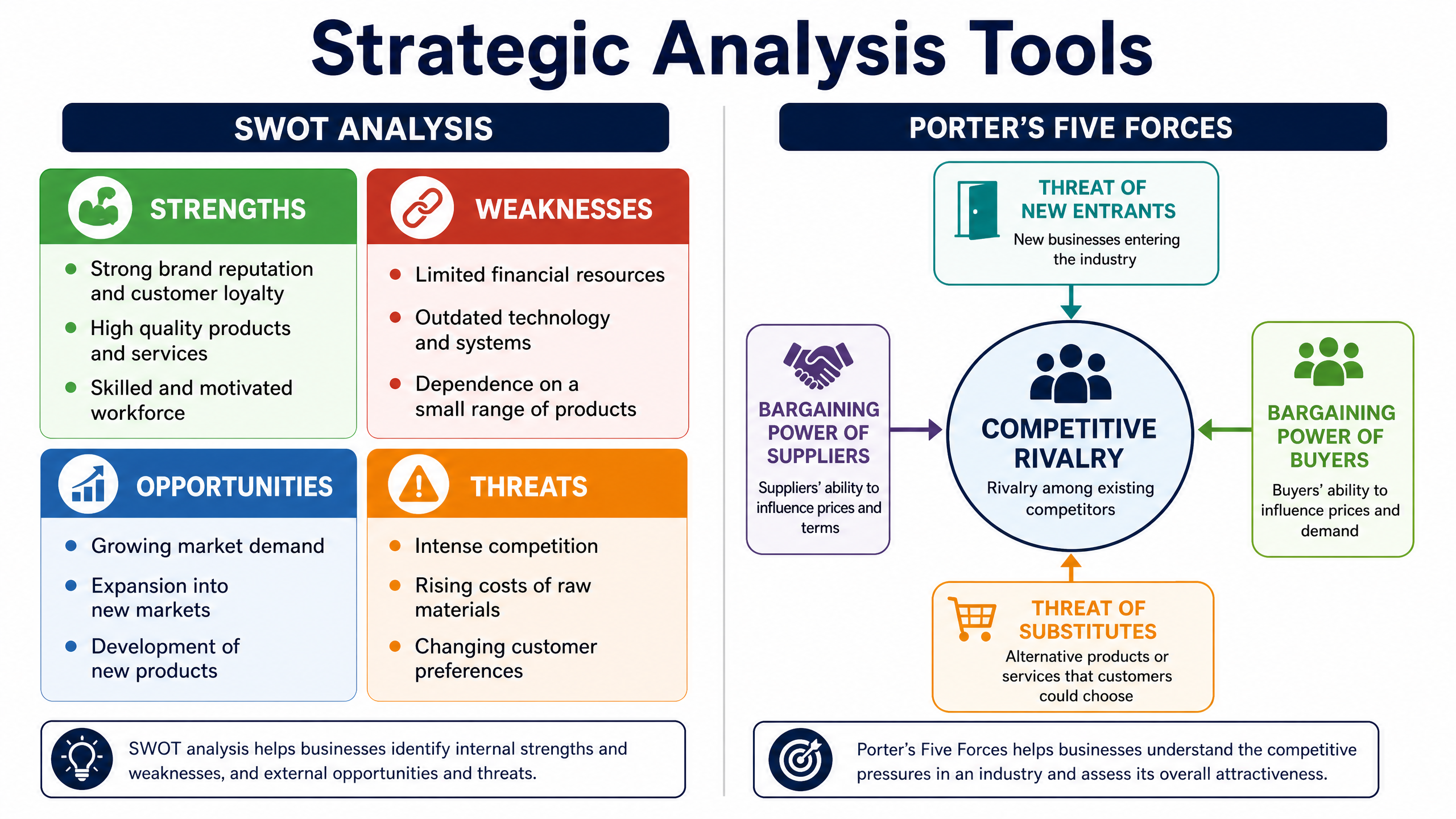
3. Strategic Analysis Tools
To make good decisions, businesses must analyze their current position and their market.
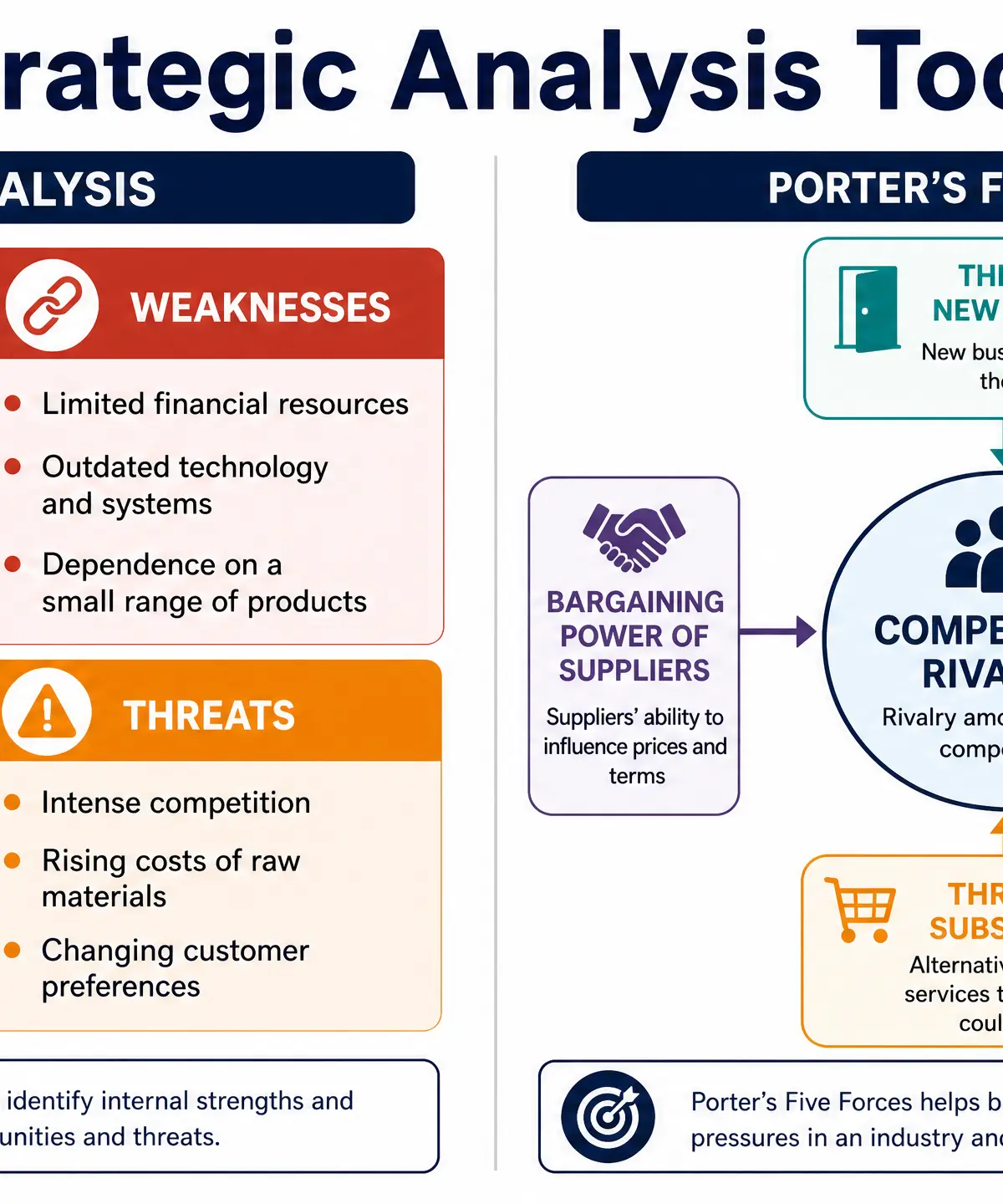
SWOT Analysis
- Strengths (Internal): What the business does well (e.g., strong brand loyalty).
- Weaknesses (Internal): Areas needing improvement (e.g., outdated technology).
- Opportunities (External): Favorable external factors (e.g., a growing market trend).
- Threats (External): Unfavorable external factors (e.g., a new competitor entering the market).
Porter's Five Forces
Assesses the competitive intensity and attractiveness of an industry:
- Competitive Rivalry: How intense is the competition?
- Threat of New Entrants: How easy is it for new firms to enter the market?
- Bargaining Power of Suppliers: Can suppliers dictate high prices?
- Bargaining Power of Buyers: Can customers demand lower prices?
- Threat of Substitutes: Are there alternative products customers could switch to?
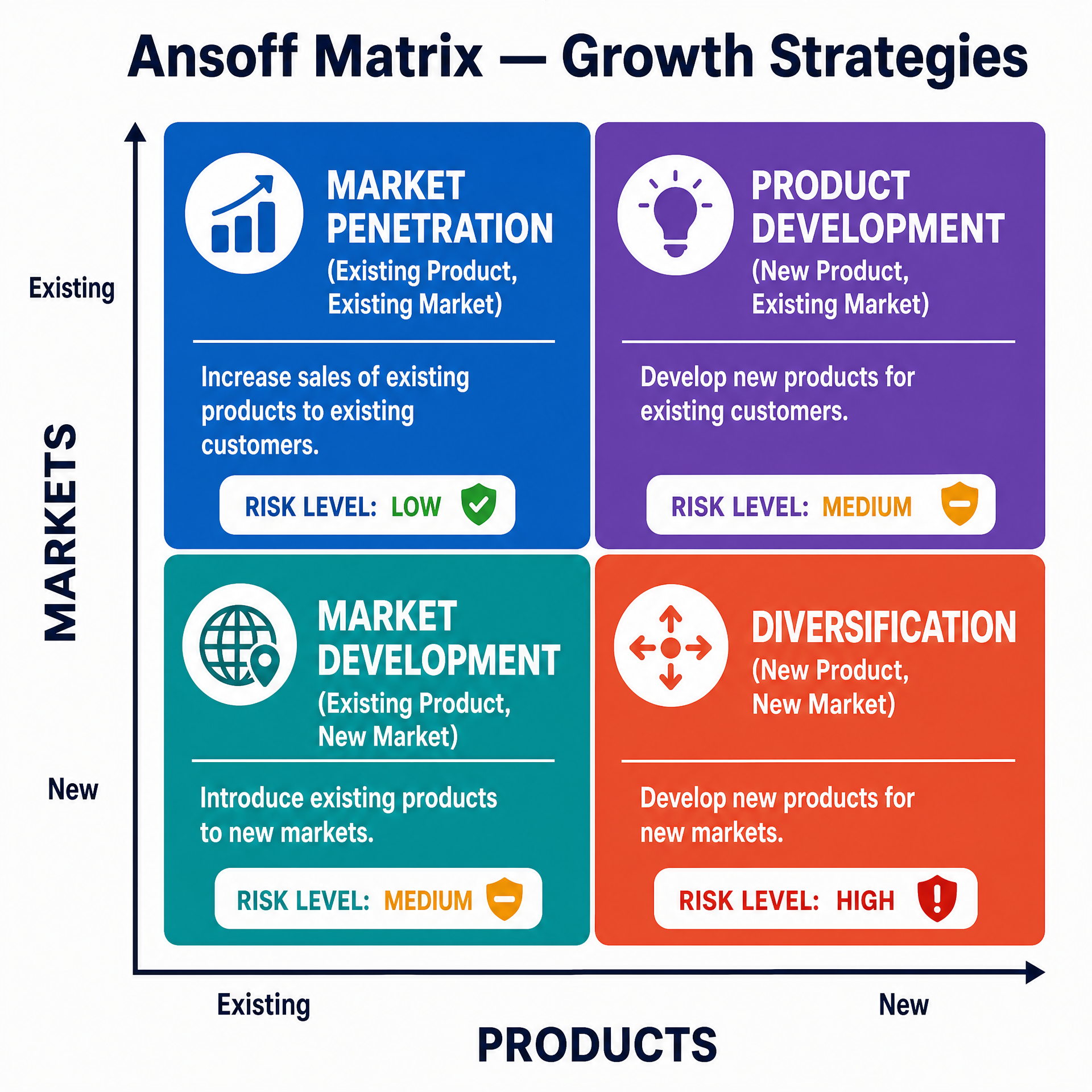
4. Growth Strategies: The Ansoff Matrix
The Ansoff Matrix helps businesses decide their product and market growth strategy based on risk.
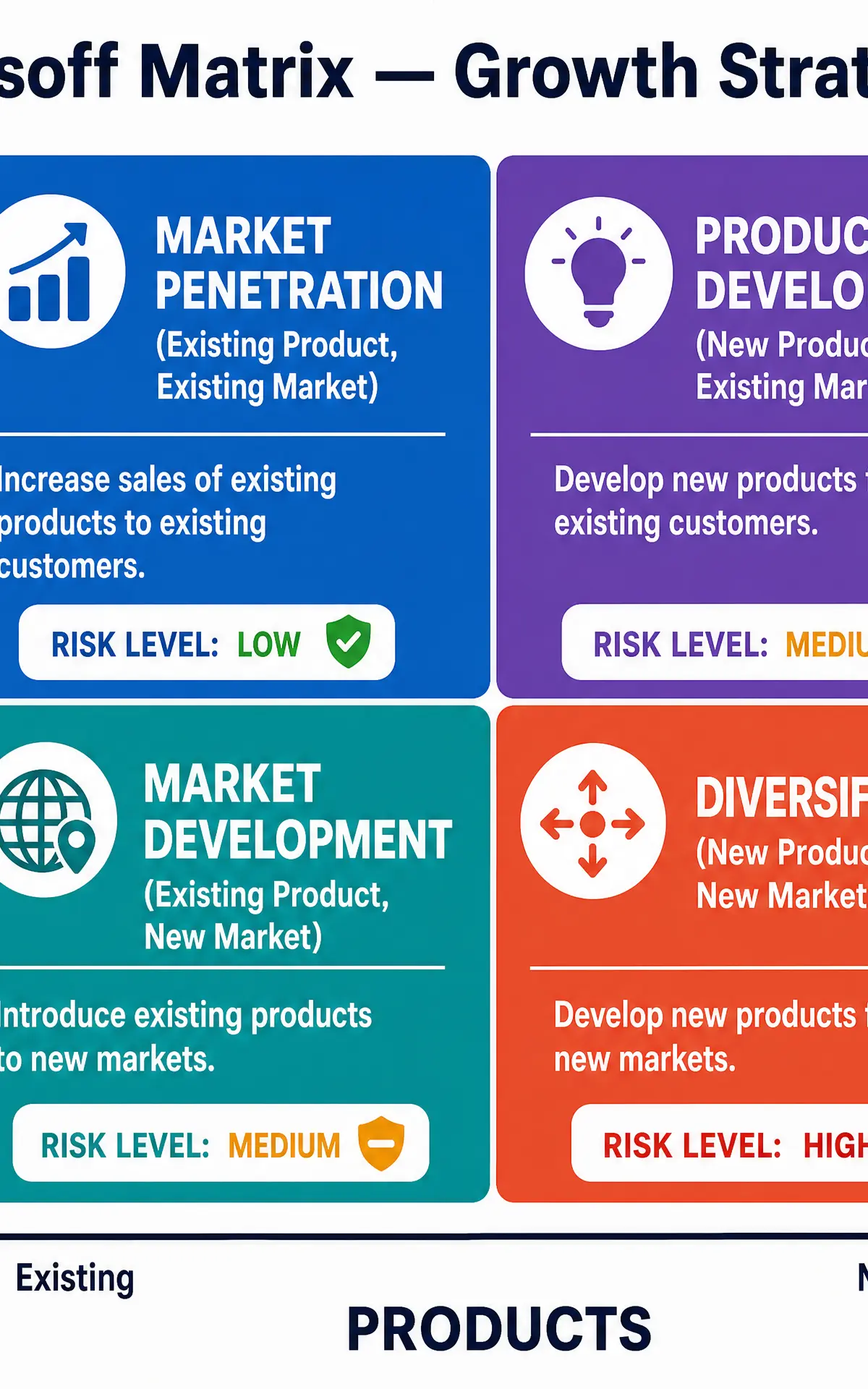
- Market Penetration (Low Risk): Selling existing products to existing markets (e.g., a loyalty scheme to encourage more frequent visits).
- Product Development (Medium Risk): Selling new products to existing markets (e.g., Apple launching the Apple Watch to its existing iPhone user base).
- Market Development (Medium Risk): Selling existing products to new markets (e.g., opening stores in a new country).
- Diversification (High Risk): Selling new products to new markets (e.g., a clothing retailer launching a chain of coffee shops).
5. The External Environment (PESTLE)
Businesses do not operate in a vacuum. They must respond to external factors (PESTLE):
- Political: Government policies, trade tariffs, political stability.
- Economic: Interest rates, inflation, exchange rates, economic growth/recession.
- Social: Demographic changes, lifestyle trends, ethical consumerism.
- Technological: Automation, e-commerce, artificial intelligence.
- Legal: Minimum wage laws, health and safety regulations, consumer rights.
- Environmental: Climate change pressures, sustainability, waste disposal regulations.
Examiner Tip: Never just list a PESTLE factor. Always explain the impact. For example, "An increase in the legal minimum wage will increase the business's operating costs, which may force them to raise prices, potentially reducing demand if the product is price elastic."
Visual Resources
3 diagrams and illustrations
Interactive Diagrams
1 interactive diagram to visualise key concepts
Conceptual Flow Outline
Methods of Business Growth
Worked Examples
3 worked examples — open one to explore the question and available guidance.
Practice Questions
Test your understanding — click to reveal model answers
State two external factors in a PESTLE analysis. (2 marks)
Hint: Think of the acronym PESTLE.
Explain one reason why a business might choose to grow through franchising. (4 marks)
Hint: Think about who provides the capital (money) when a franchise is opened.
Analyze the impact of a significant increase in the legal minimum wage on a supermarket chain. (6 marks)
Hint: Supermarkets employ many low-skilled workers. How will this affect costs, and what will the supermarket have to do in response?
Evaluate whether product development is a better strategy than market development for a successful mobile phone manufacturer looking to increase sales. (12 marks)
Hint: Use the Ansoff Matrix. Compare the risks of selling new products to current loyal customers vs selling current phones to new countries.
Explain one source of diseconomies of scale that a rapidly growing business might experience. (4 marks)
Hint: Think about what happens to communication when a company goes from 50 employees to 5,000 employees.