Pearson Edexcel · GCSE · Business
Topic 1.2 Spotting a business opportunity
Mastering 'Spotting a Business Opportunity' is the foundation of GCSE Business. This topic explores how successful entrepreneurs identify customer needs, conduct market research, and find profitable gaps in the market before their competitors do.
- 5 min read
- 3 worked examples
- 5 practice questions
- 6 key terms
Study Notes

Overview
Topic 1.2 focuses on the very first steps an entrepreneur must take before launching a product or service. Examiners expect candidates to understand that businesses don't just guess what to sell; they systematically identify customer needs and use market research to reduce the risk of failure. This topic is heavily tested in both short-answer recall questions and longer evaluation essays where you must weigh the costs and benefits of different research methods in specific contexts.
Listen to the comprehensive audio guide for this topic here:

Customer Needs
Every successful business starts by fulfilling a customer need. If a product doesn't solve a problem or satisfy a desire, it won't sell.
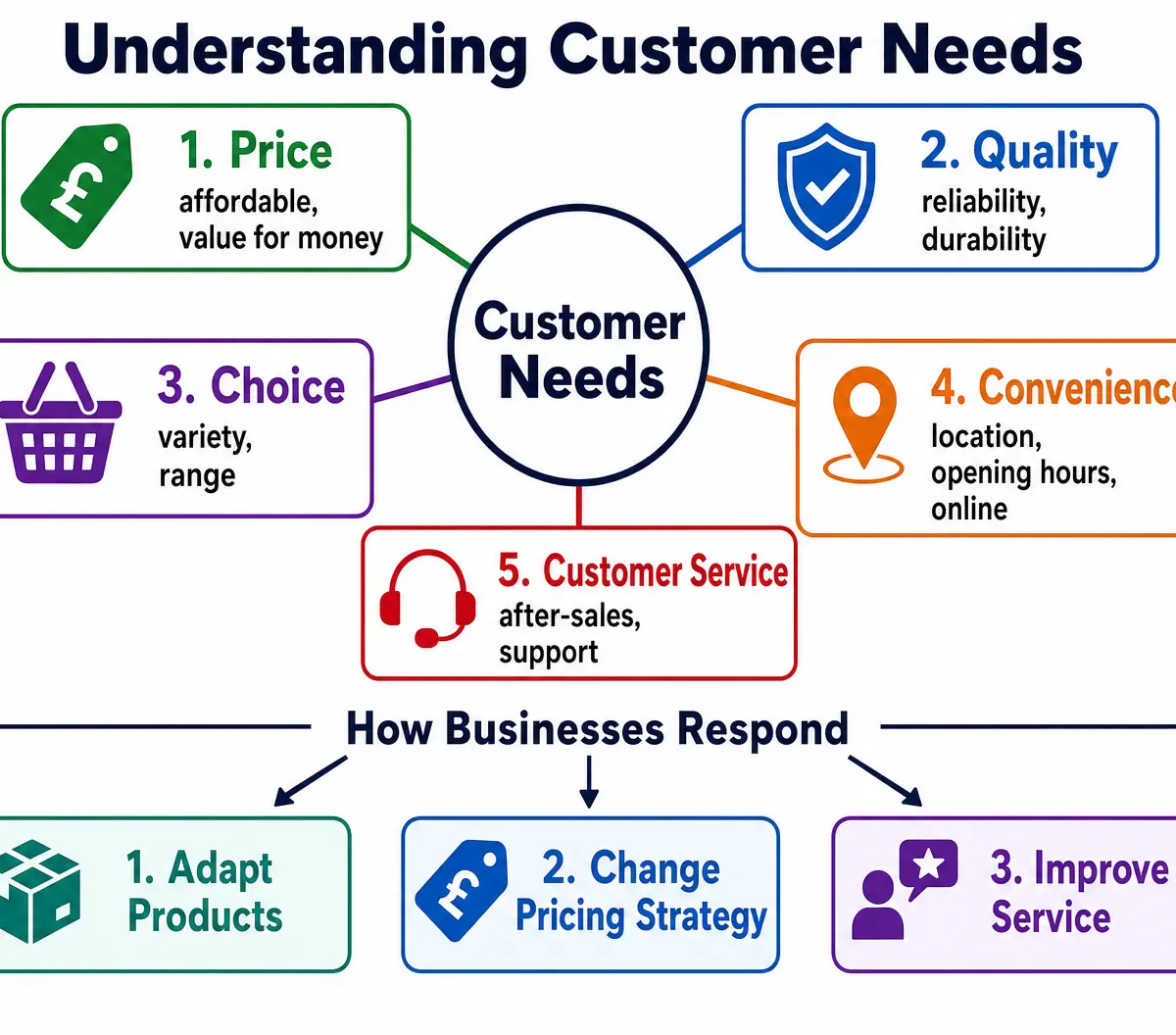
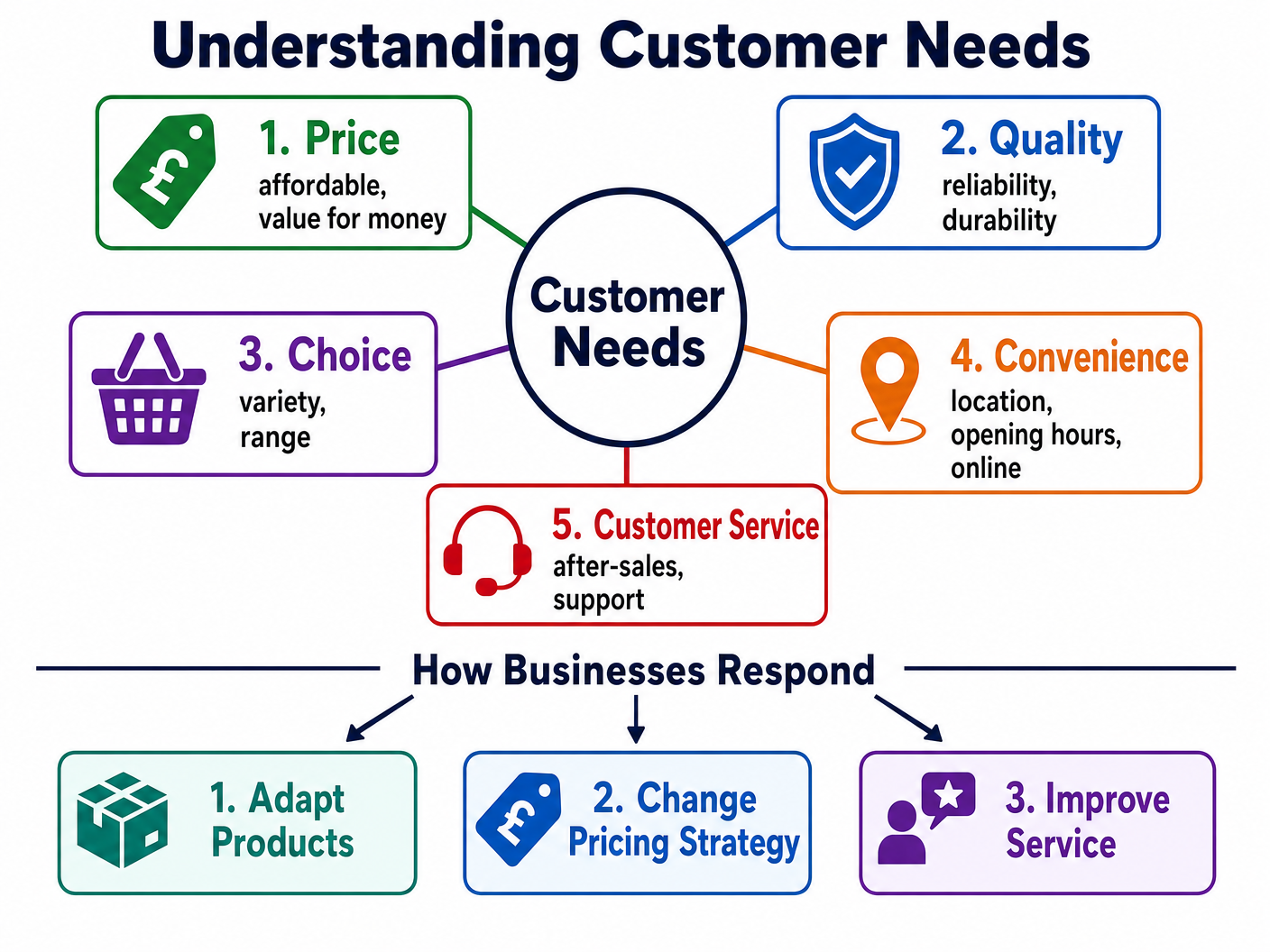
Examiners focus on five key customer needs:
- Price: Customers want value for money. This doesn't always mean 'cheap' — it means the price matches the perceived quality.
- Quality: The product must be reliable, durable, and fit for purpose.
- Choice: Customers appreciate variety, allowing them to select exactly what they want.
- Convenience: How easy is it to buy? This includes location, opening hours, and online availability.
- Customer Service: Pre-sale advice, after-sales support, and how complaints are handled.
Exam Focus: You must be able to link a specific need to a business decision. For example, if a scenario mentions a busy train station, the primary customer need is convenience (speed), not necessarily choice.
Market Research
Market research is the process of gathering, analysing, and interpreting information about a market. Its primary purpose is to reduce risk and inform decision-making.
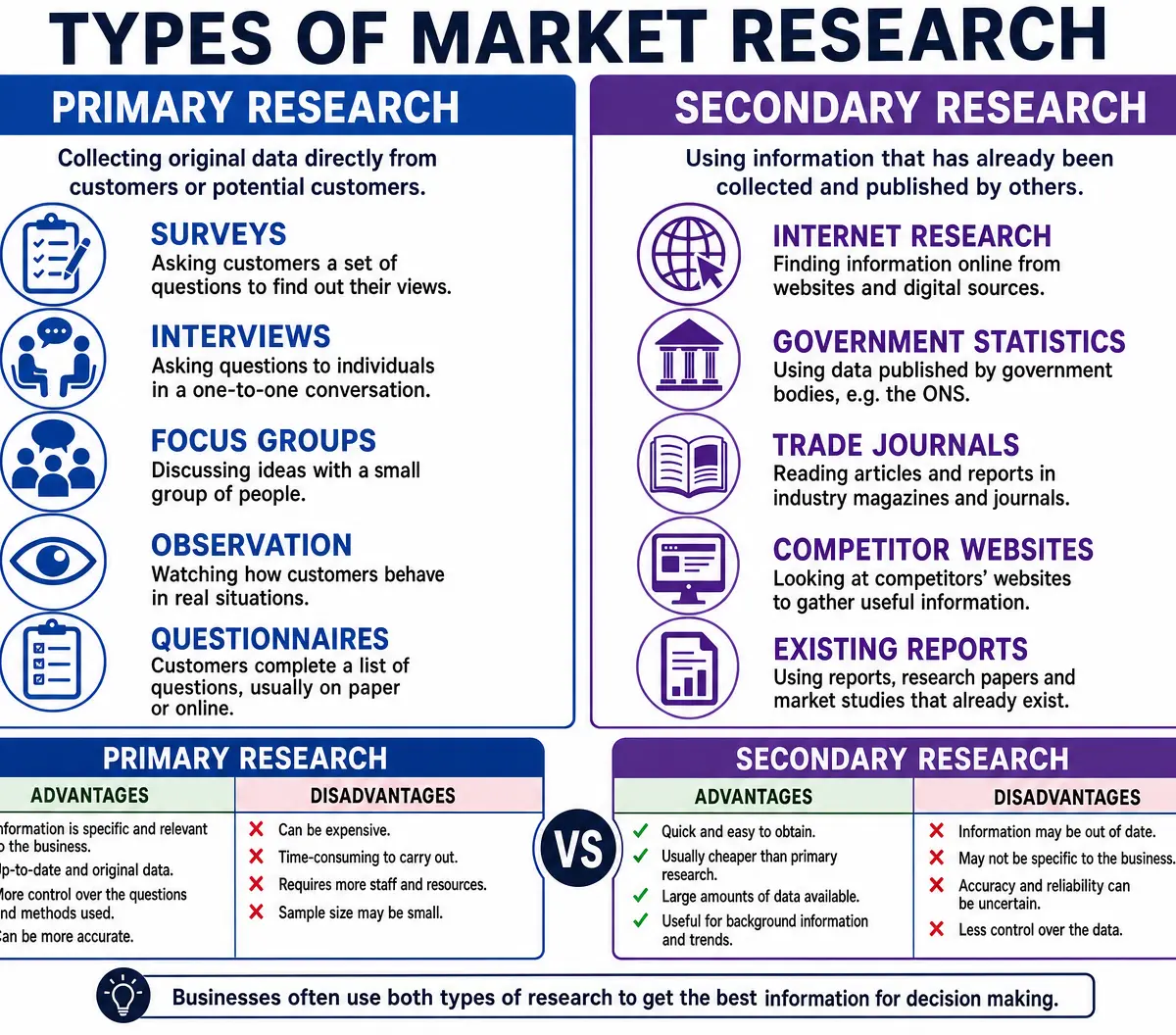
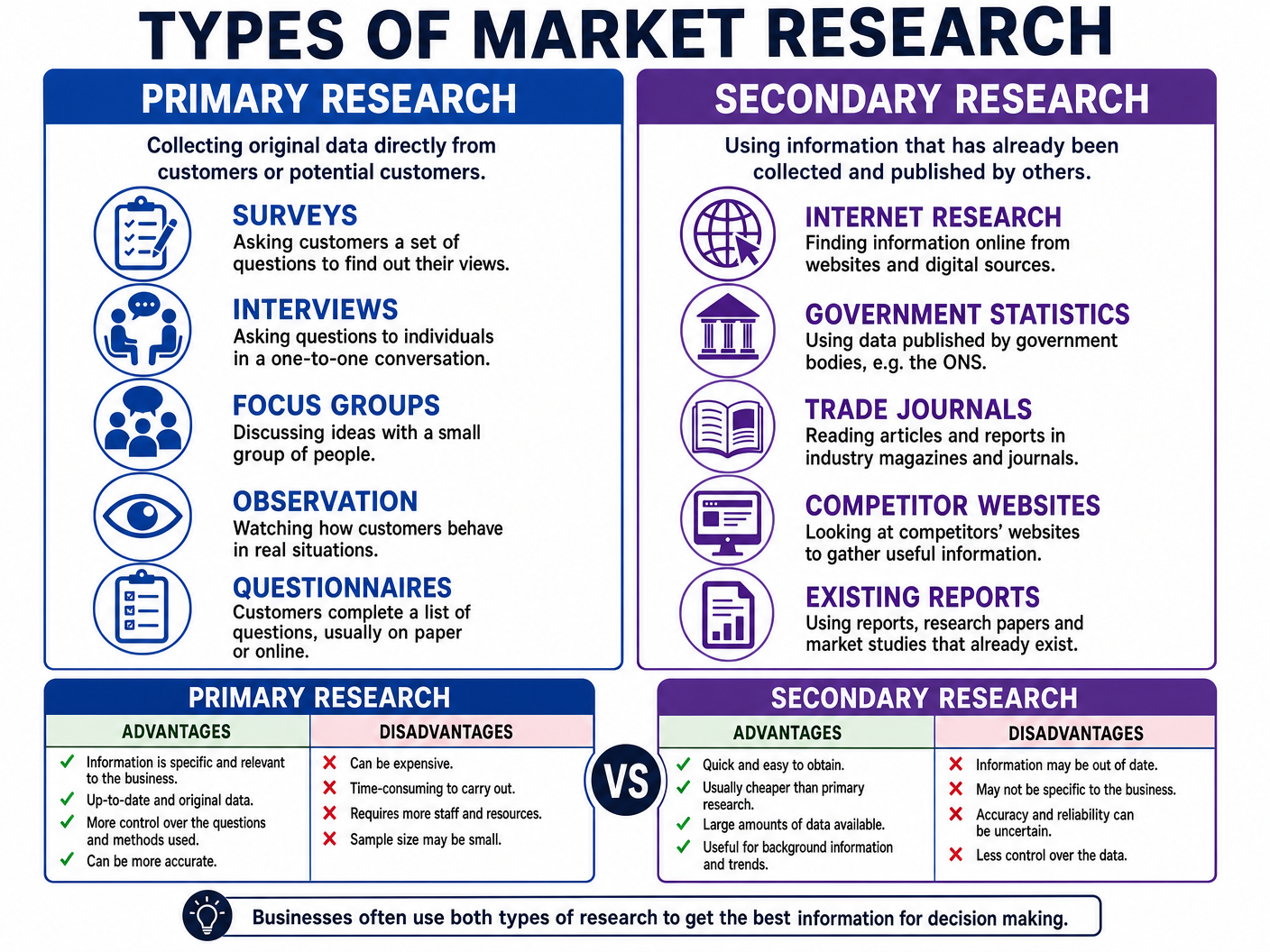
Primary Research (Field Research)
Gathering new, original data directly from potential customers.
- Methods: Surveys, questionnaires, focus groups, interviews, observation.
- Advantages: Data is up-to-date, specific to the exact needs of the business, and competitors don't have access to it.
- Disadvantages: Expensive, time-consuming, and results may be inaccurate if the sample size is too small.
Secondary Research (Desk Research)
Analysing data that already exists and was collected by someone else.
- Methods: Internet research, government statistics (e.g., ONS), trade journals, competitor websites, existing market reports.
- Advantages: Usually cheaper (often free), much quicker to obtain, and can provide a broad overview of the whole market.
- Disadvantages: May be out of date, might not be specific enough to the business's exact product, and is available to competitors.
Quantitative vs Qualitative Data
- Quantitative: Numerical data that can be measured and analysed statistically (e.g., '65% of people prefer the red packaging'). Useful for spotting trends.
- Qualitative: Descriptive data based on opinions, feelings, and attitudes (e.g., 'Customers felt the red packaging looked too aggressive'). Useful for understanding why customers behave as they do.
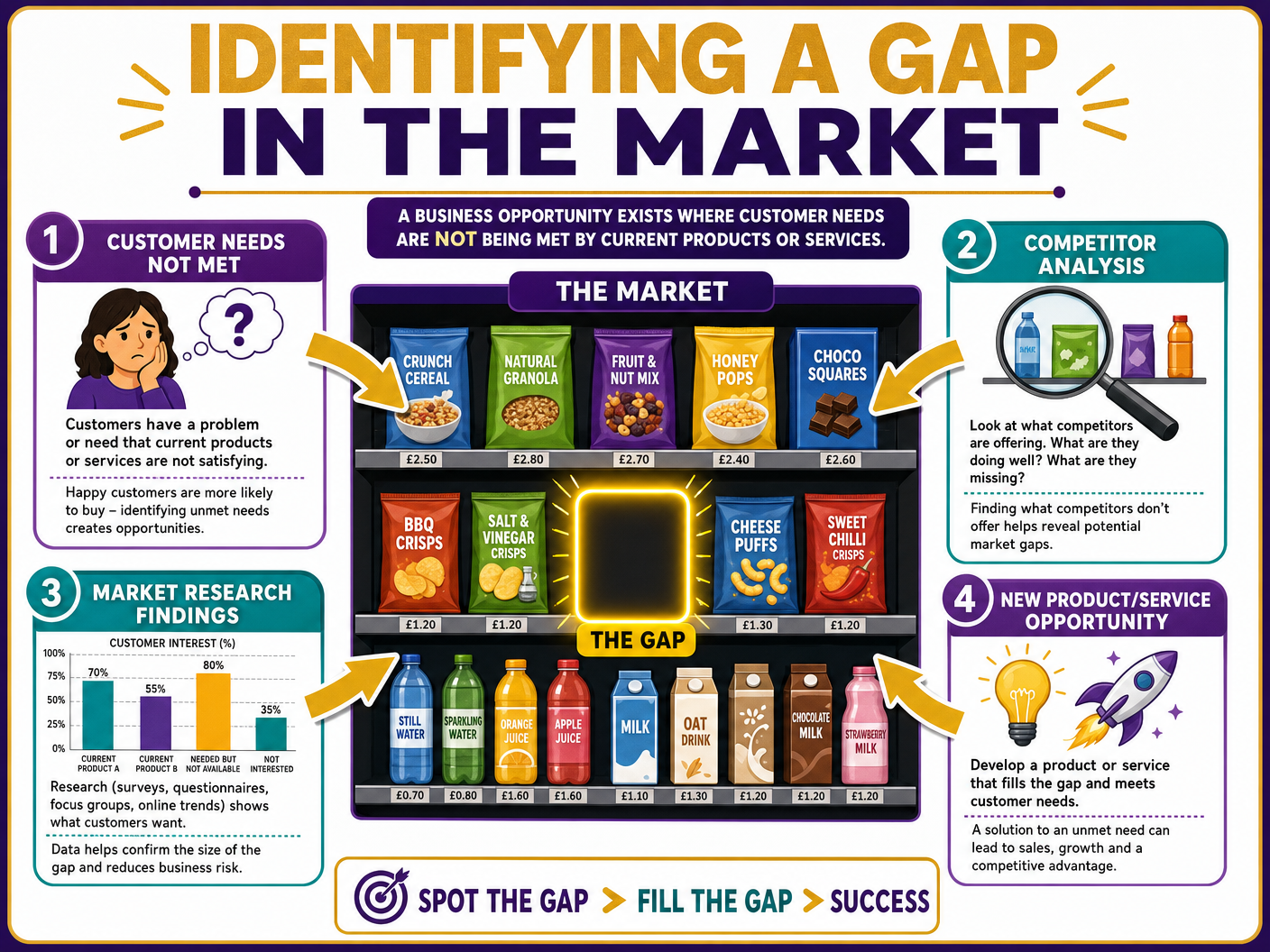
Identifying a Gap in the Market
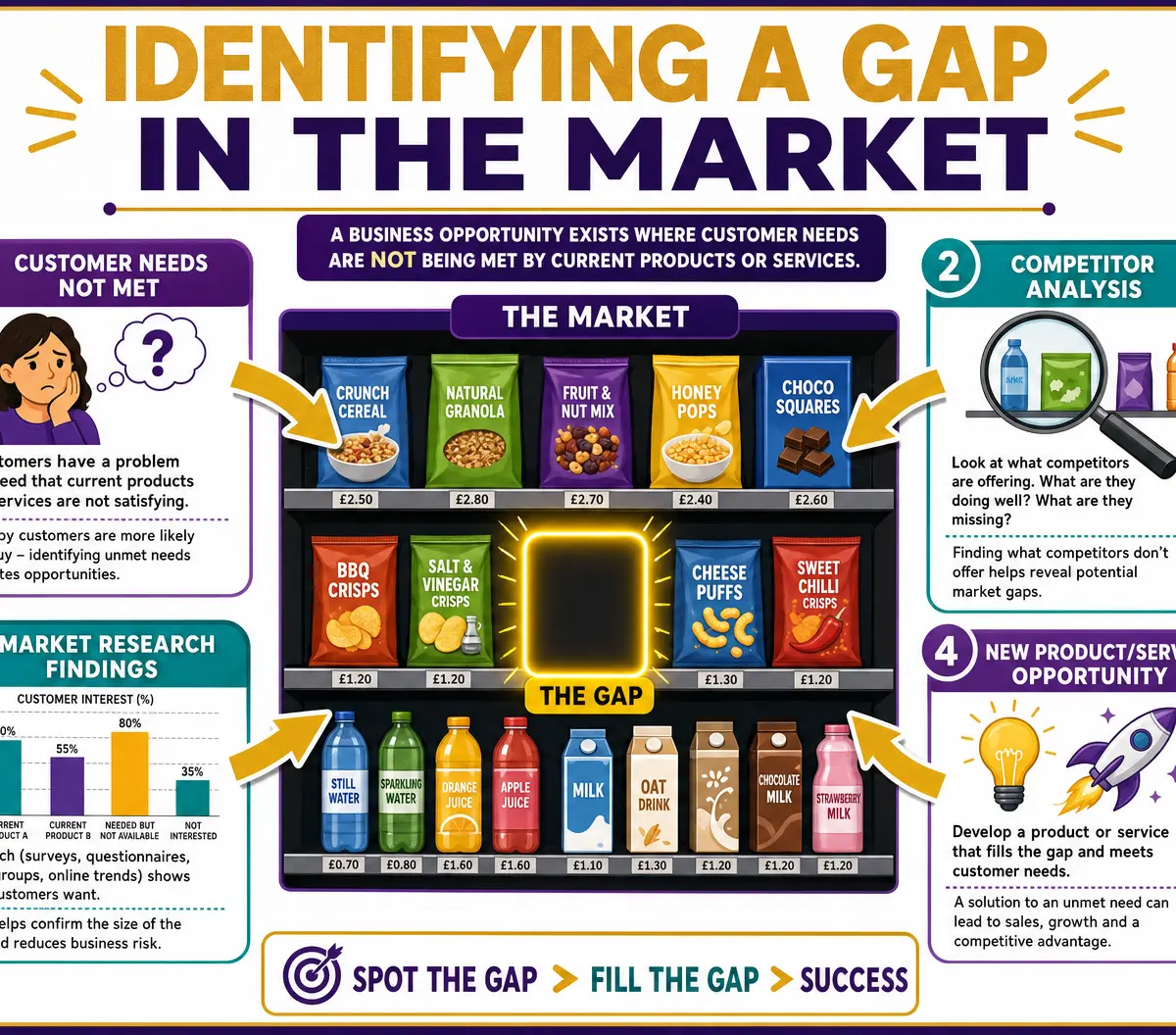
A 'gap in the market' occurs when a customer need is not currently being met by existing businesses. Finding this gap is how entrepreneurs create new opportunities.
Businesses identify gaps by:
- Spotting a completely new, unfulfilled need.
- Improving an existing product (making it cheaper, faster, or better quality).
- Targeting a specific market segment that competitors are ignoring.
Market Segmentation
Market segmentation involves dividing a broad target market into smaller, more defined groups of consumers who share similar characteristics or needs.
Common ways to segment a market:
- Demographics: Age, gender, income, occupation.
- Location: Region, urban vs rural.
- Lifestyle: Hobbies, interests, values.
Why segment? It allows a business to tailor its marketing mix (Product, Price, Place, Promotion) specifically to that group, increasing the chances of sales and reducing wasted marketing spend.
Visual Resources
3 diagrams and illustrations
Interactive Diagrams
1 interactive diagram to visualise key concepts
Conceptual Flow Outline
The process of spotting and developing a business opportunity.
Worked Examples
3 worked examples — open one to explore the question and available guidance.
Practice Questions
Test your understanding — click to reveal model answers
State two methods of primary market research. (2 marks)
Hint: Think of methods where the business collects the data themselves directly from customers.
Explain one reason why a business might choose to segment its market. (3 marks)
Hint: Make a point, explain how segmentation changes what the business does, and state the final benefit to the business.
A small independent bakery wants to find out why its afternoon sales have dropped. Explain whether they should use quantitative or qualitative research to find out why. (3 marks)
Hint: Look at the specific word 'why' in the question. Which type of data answers 'why'?
Discuss the benefits to a new clothing brand of identifying a gap in the market before launching. (6 marks)
Hint: You need to explain at least two developed benefits. Think about competition and meeting customer needs.
A mobile phone manufacturer is planning to launch a new device aimed at elderly users. Evaluate the most appropriate methods of market research for this business. (9 marks)
Hint: Consider the specific target market (elderly users) and the size of the business (manufacturer). Weigh up primary vs secondary.