Pearson Edexcel · GCSE · Business
Topic 2.5 Making human resource decisions
Master Topic 2.5: Making Human Resource Decisions. This guide breaks down the core concepts of recruitment, training, motivation, and organisational structure, providing the exact terminology and analytical skills examiners reward.
- 4 min read
- 3 worked examples
- 5 practice questions
- 6 key terms
Study Notes

Overview
Topic 2.5 Making Human Resource Decisions is a fundamental pillar of GCSE Business Studies. It explores how businesses attract, train, motivate, and organise their most valuable asset: their people. Examiners frequently use this topic to test your ability to apply theory to real-world business contexts. You will be expected to evaluate the trade-offs between different recruitment methods, training types, and organisational structures, and to understand how theories from Maslow and Herzberg apply to employee motivation. Strong answers in this section always link HR decisions back to business costs, productivity, and overall success.

Key Concepts & Processes
Recruitment and Selection
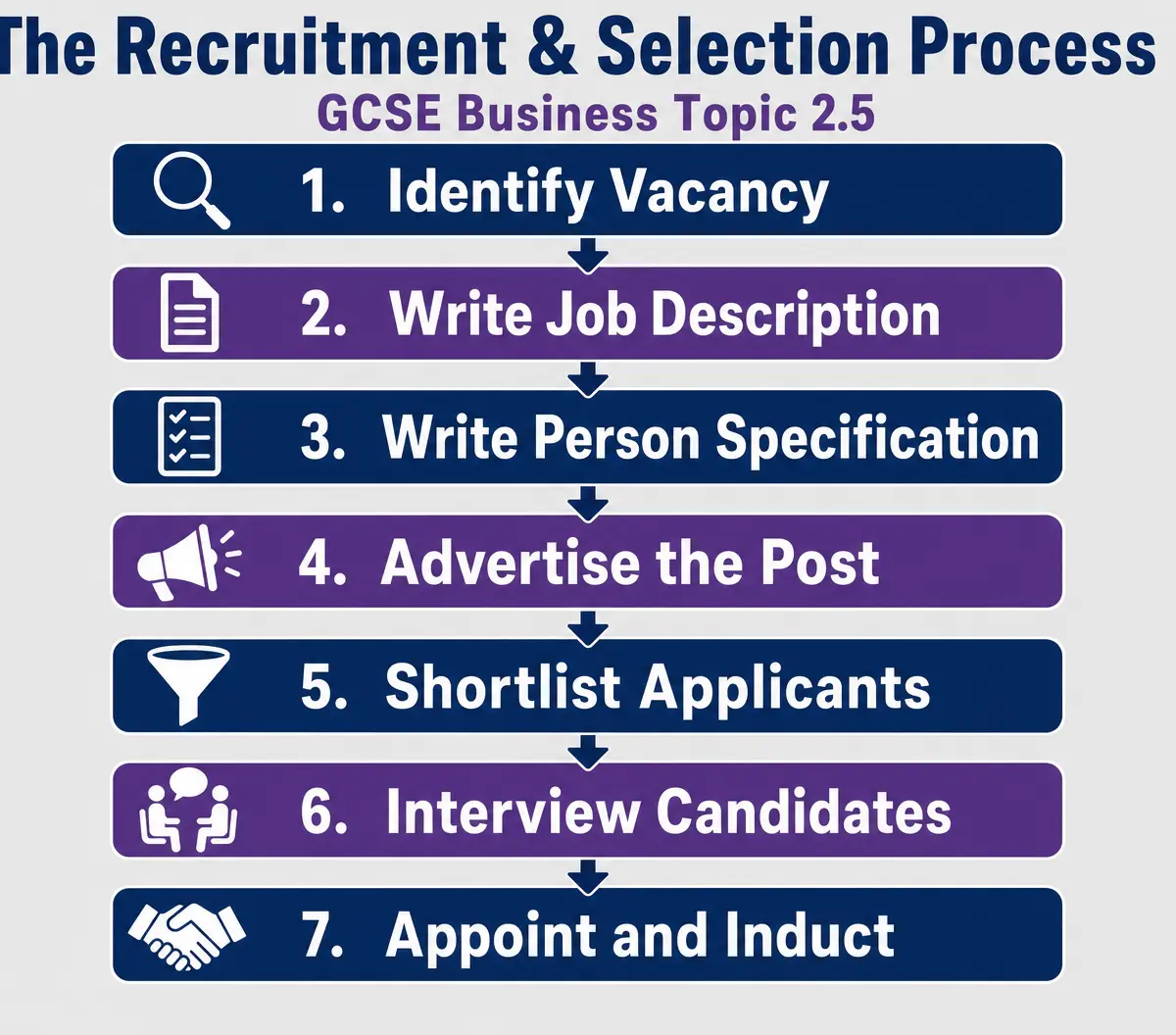
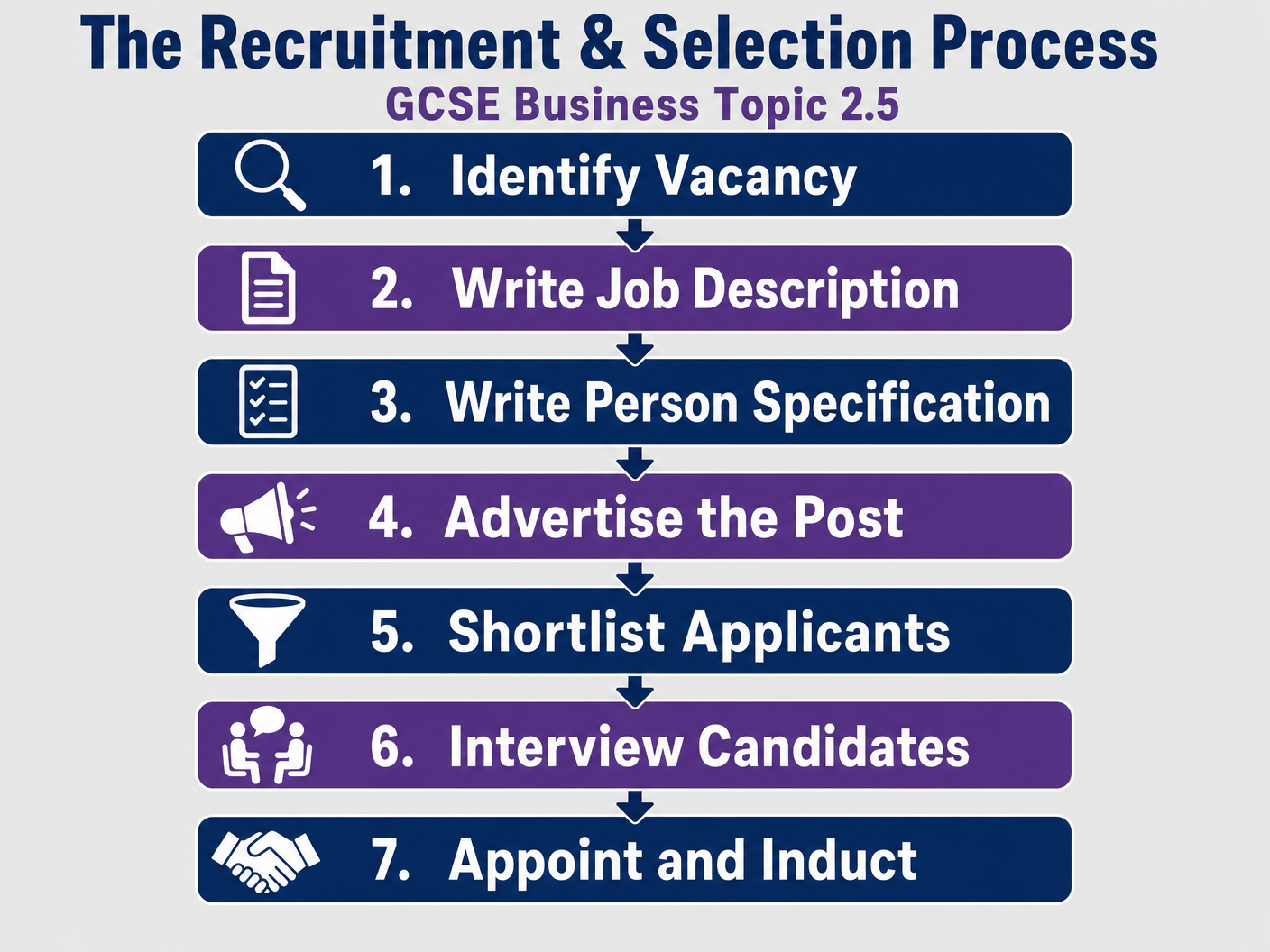
The Process: Identifying a vacancy → Job Description → Person Specification → Advertising → Shortlisting → Interviewing → Appointment.
Job Description vs Person Specification: A job description outlines the duties and responsibilities of the role. A person specification outlines the qualifications, skills, and experience the ideal candidate must have.
Internal vs External Recruitment: Internal recruitment (promoting from within) is cheaper and faster, and acts as a motivator. External recruitment brings in new ideas and a wider pool of candidates, but is more expensive and time-consuming.
Training and Development
Induction Training: Given to new employees to familiarise them with the business, health and safety, and their role. It helps them settle in quickly and reduces early mistakes.
On-the-job Training: Training that takes place while doing the job, often through shadowing or mentoring. It is cost-effective and highly relevant, but the trainer's bad habits might be passed on.
Off-the-job Training: Training that takes place away from the workplace, such as at a college or specialist training centre. It provides high-quality, specialist skills but is more expensive and takes the employee away from their daily tasks.
Motivation Theories
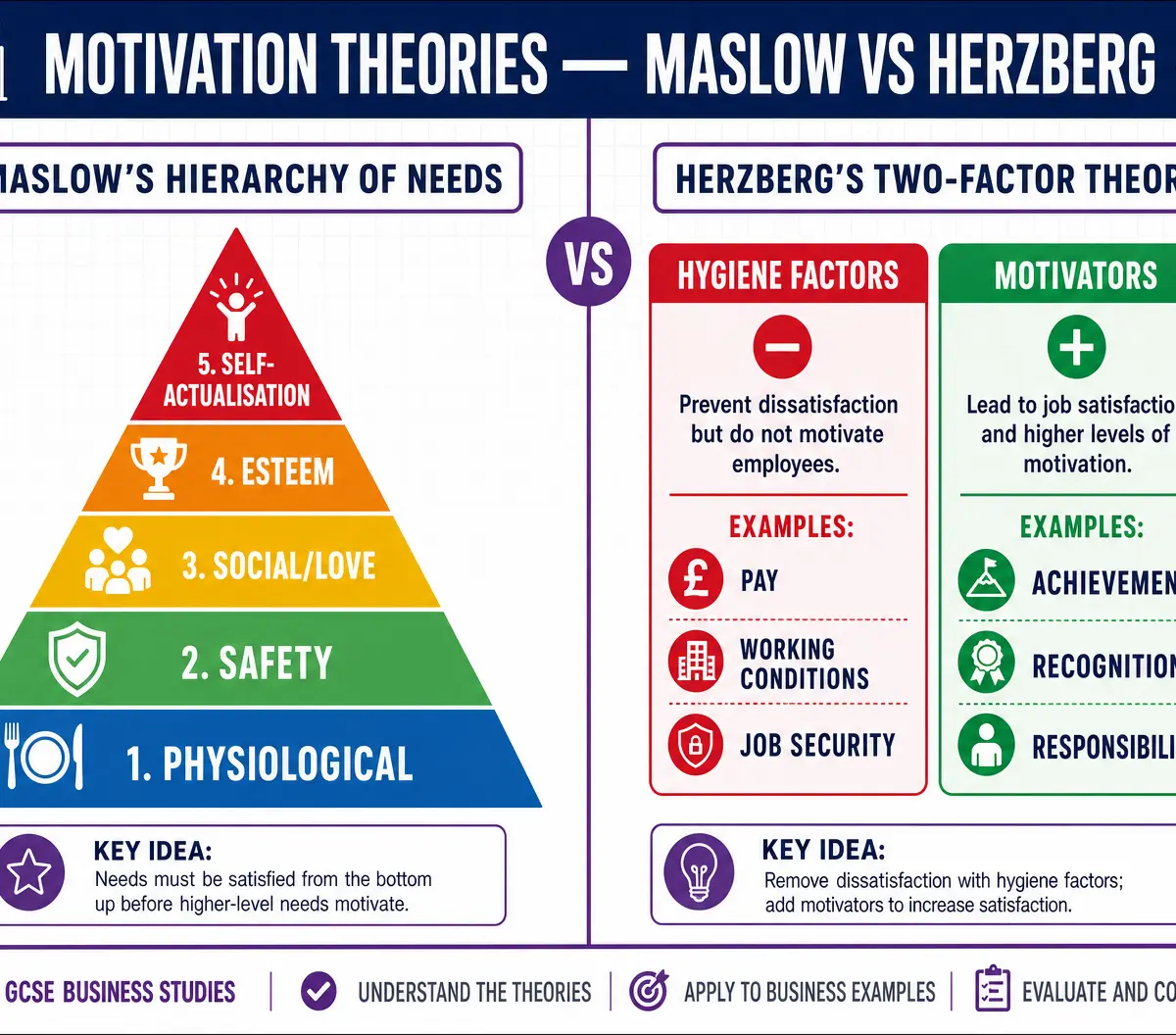
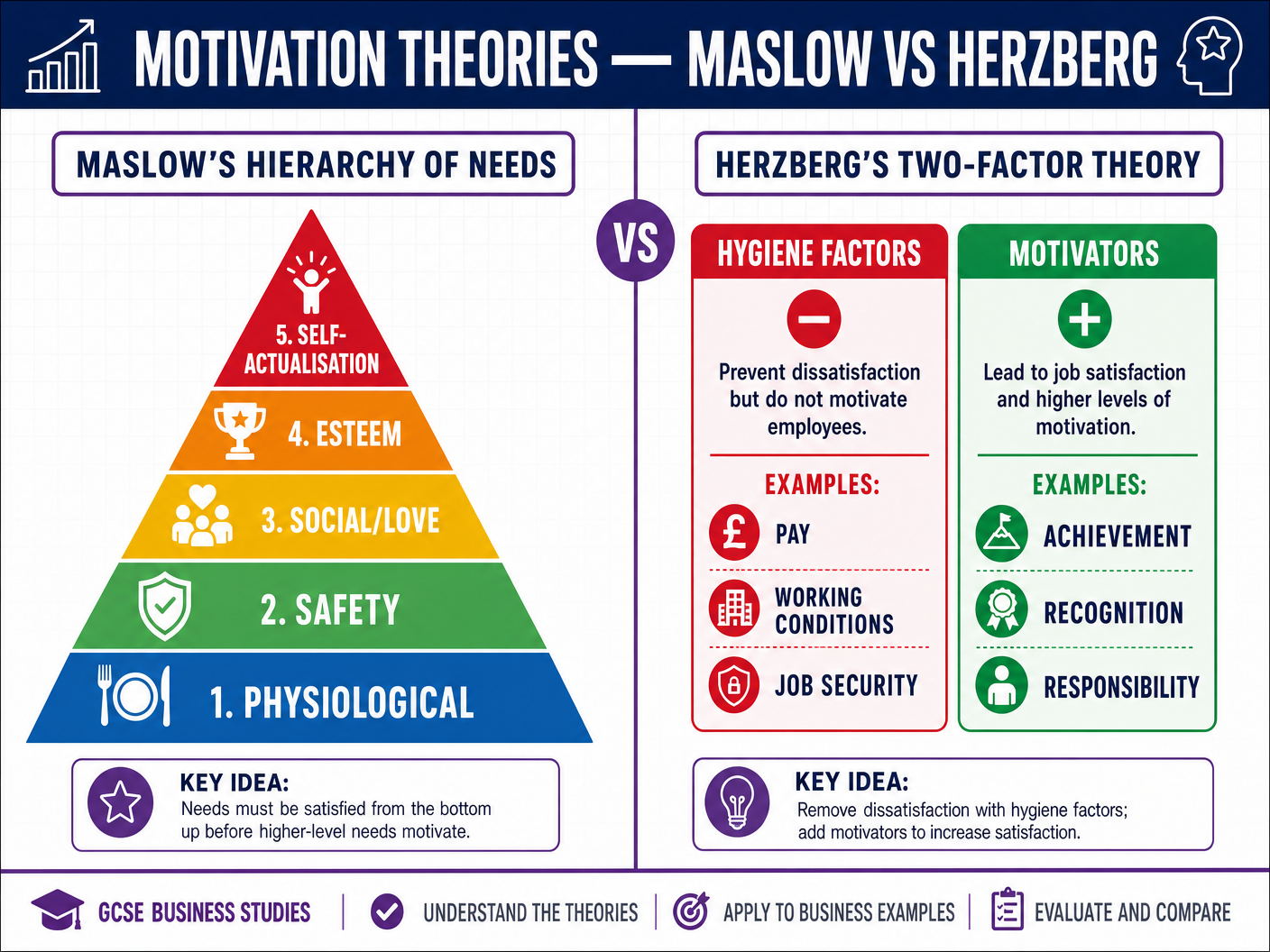
Maslow's Hierarchy of Needs: A pyramid of needs (Physiological, Safety, Social, Esteem, Self-Actualisation). Lower-level needs must be met before higher-level needs can act as motivators.
Herzberg's Two-Factor Theory: Differentiates between 'Hygiene Factors' (e.g., pay, conditions) which prevent dissatisfaction but don't motivate, and 'Motivators' (e.g., achievement, recognition) which actually drive employees to work harder.
Organisational Structures
Hierarchical vs Flat: Hierarchical structures have many levels of management and narrow spans of control (clear progression but slow communication). Flat structures have few levels and wide spans of control (faster communication and more delegation, but managers can be overworked).
Centralisation vs Decentralisation: Centralised businesses keep decision-making at the top level (consistent, but slow to react to local markets). Decentralised businesses delegate decision-making to lower levels or branches (responsive to local needs, motivating for staff, but risks inconsistency).
Visual Resources
2 diagrams and illustrations
Interactive Diagrams
1 interactive diagram to visualise key concepts
Conceptual Flow Outline
The Recruitment and Selection Process
Worked Examples
3 worked examples — open one to explore the question and available guidance.
Practice Questions
Test your understanding — click to reveal model answers
State two methods of external recruitment. (2 marks)
Hint: Think about where you would look if you were trying to find a job at a new company.
Explain one benefit to a business of having a wide span of control. (3 marks)
Hint: A wide span of control means fewer managers are needed.
A retail clothing chain wants to improve customer service. Evaluate whether they should use on-the-job or off-the-job training for their sales assistants. (9 marks)
Hint: Consider the cost, the location, and the specific skills needed for retail.
Explain how a business could use Herzberg's Two-Factor theory to improve employee motivation. (6 marks)
Hint: Remember to distinguish between hygiene factors and motivators.
Analyse the impact on a business of having high staff turnover. (6 marks)
Hint: Staff turnover is the rate at which employees leave a workforce and are replaced.