OCR · GCSE · Business
Course version: J204 · Version from Sept 2019
Business aims and objectives
Master the fundamental aims and objectives of a business, from start-up survival to long-term profit and growth. Learn why objectives change over a business's lifecycle and how examiners test your understanding of SMART targets.
- 4 min read
- 3 worked examples
- 5 practice questions
- 6 key terms
Check what you remember
Read the wording for your board, then hide it and explain Aim in your own words. Rough notes are fine. This is a self-check, with no mark or grade.
Reference: OCR
A long-term, general goal that sets the overall direction for a business.
Study Notes
Overview
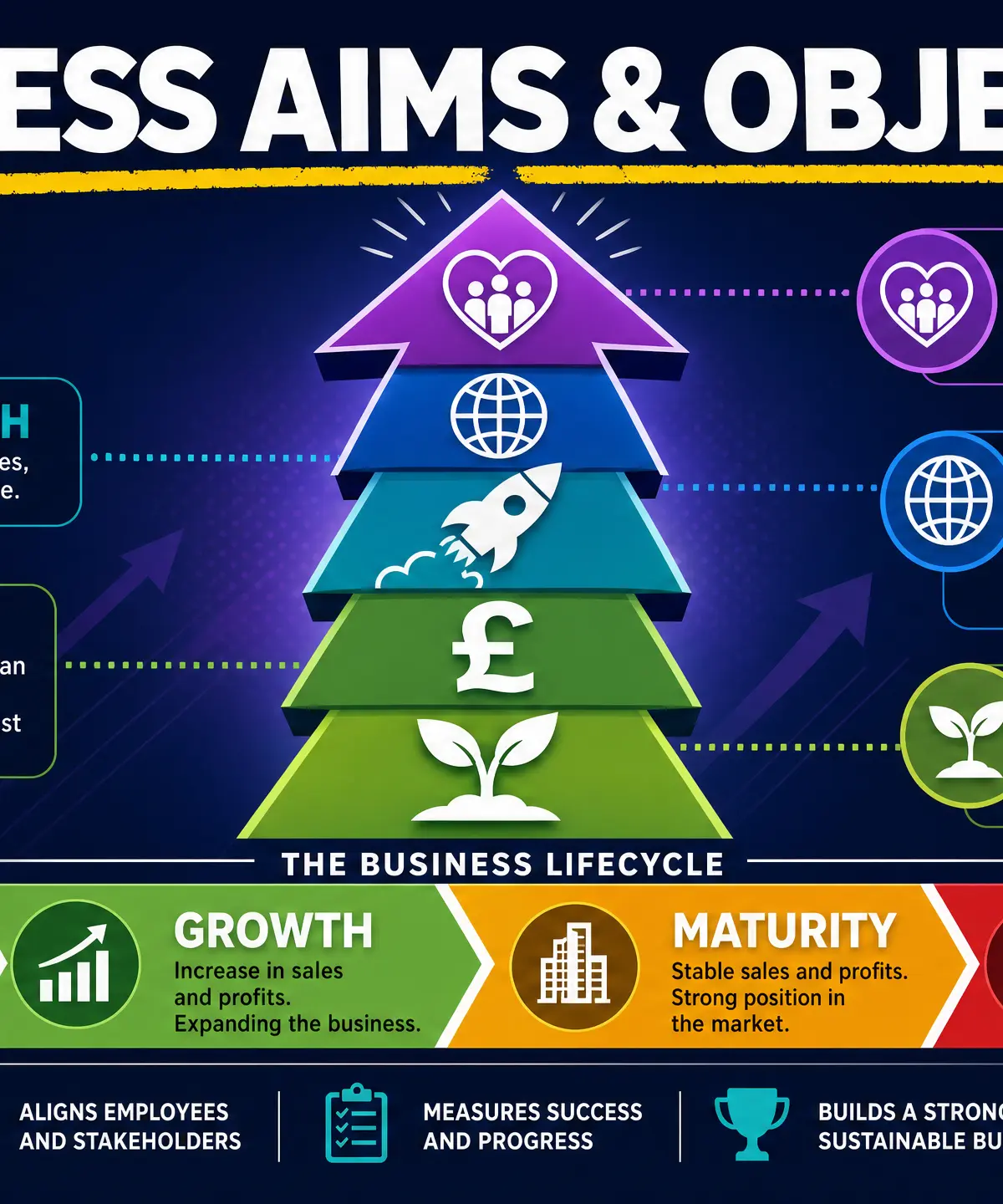
This study guide covers the foundational topic of Business Aims and Objectives. It explores the core reasons why businesses exist—such as profit, survival, growth, market share, and providing a service—and how these goals evolve over time. Examiners frequently test candidates on their ability to distinguish between long-term aims and short-term SMART objectives. Furthermore, you will be expected to apply these concepts to different business contexts, demonstrating an understanding of how a start-up's priorities differ from those of an established multinational corporation.
The Difference Between Aims and Objectives
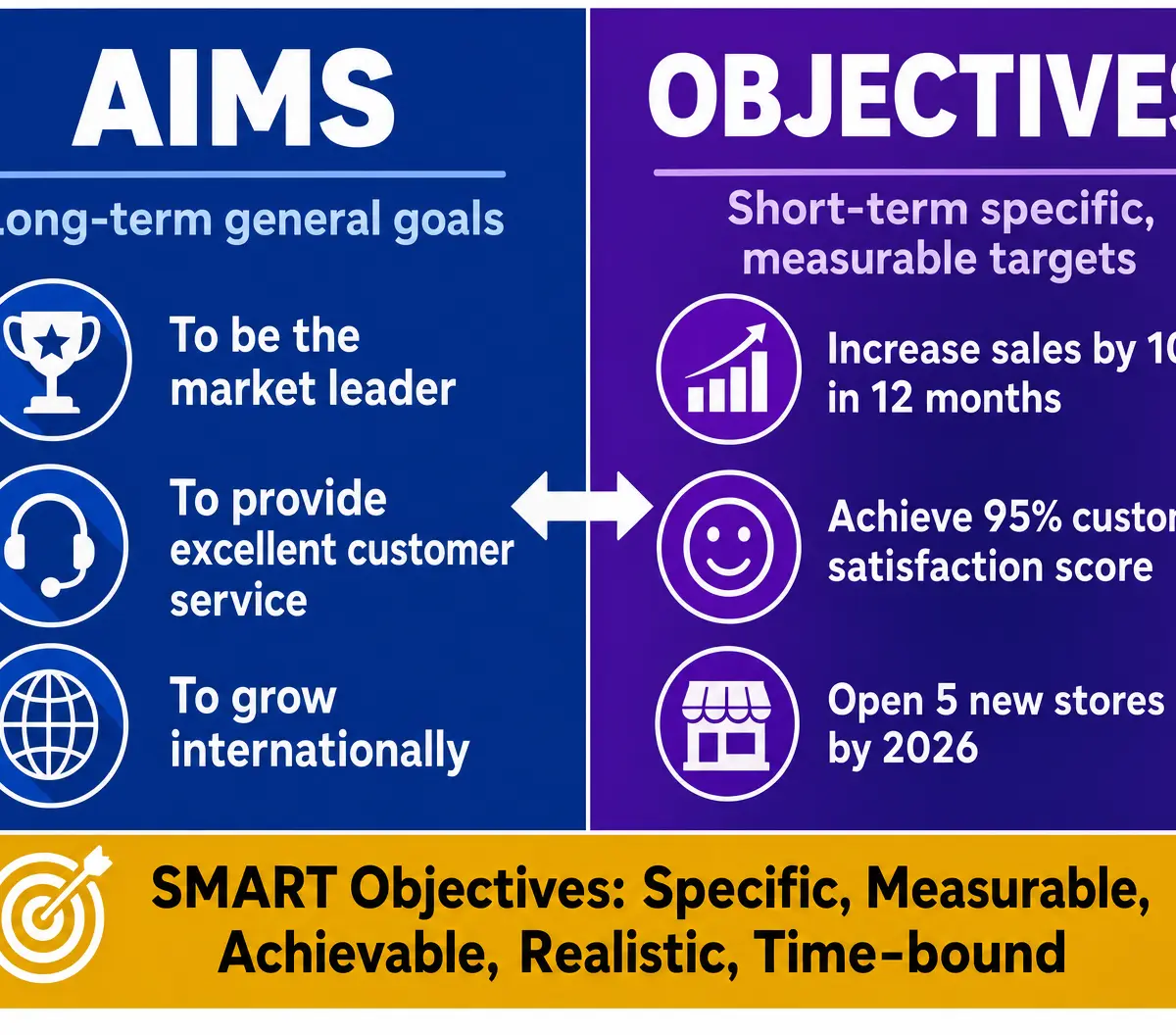
Aims
An aim is a broad, long-term goal that sets the overall direction of a business. It provides a vision for the future but lacks specific details on how to achieve it. For example, an aim might be 'to become the most sustainable coffee shop chain in the UK.'
Objectives
Objectives are short-term, specific, and measurable targets that act as stepping stones to achieve the overall aim. They provide clear focus for managers and employees. A good objective follows the SMART criteria: Specific, Measurable, Achievable, Realistic, and Time-bound. An example objective would be 'to reduce packaging waste by 20% within the next 12 months.'
Core Business Objectives
Survival
Survival is the primary objective for most start-up businesses or those facing difficult economic conditions, such as a recession or intense new competition. The focus is purely on generating enough revenue to cover fixed and variable costs, ensuring the business can continue trading.
Profit
Profit is the financial reward for taking the risk of running a business (Total Revenue minus Total Costs). For many private sector businesses, particularly established ones, profit maximisation is the ultimate objective. It provides funds for reinvestment and rewards shareholders with dividends.
Growth
Growth involves expanding the business, which can be achieved internally (organic growth) by opening new stores or externally (inorganic growth) through mergers and takeovers. Growth can lead to economies of scale, increased market power, and a stronger brand presence.
Market Share
Market share is the percentage of total sales in a specific market that is controlled by a single business. Increasing market share is a common objective because it often indicates that a business is outperforming its competitors and becoming a dominant force in the industry.
Providing a Service (Social Objectives)
Not all businesses prioritise profit. Charities, social enterprises, and public sector organisations focus on providing a service or achieving social and ethical objectives. For example, a local cooperative might aim to provide affordable organic food to the community rather than maximising profit.
Changing Objectives and the Business Lifecycle
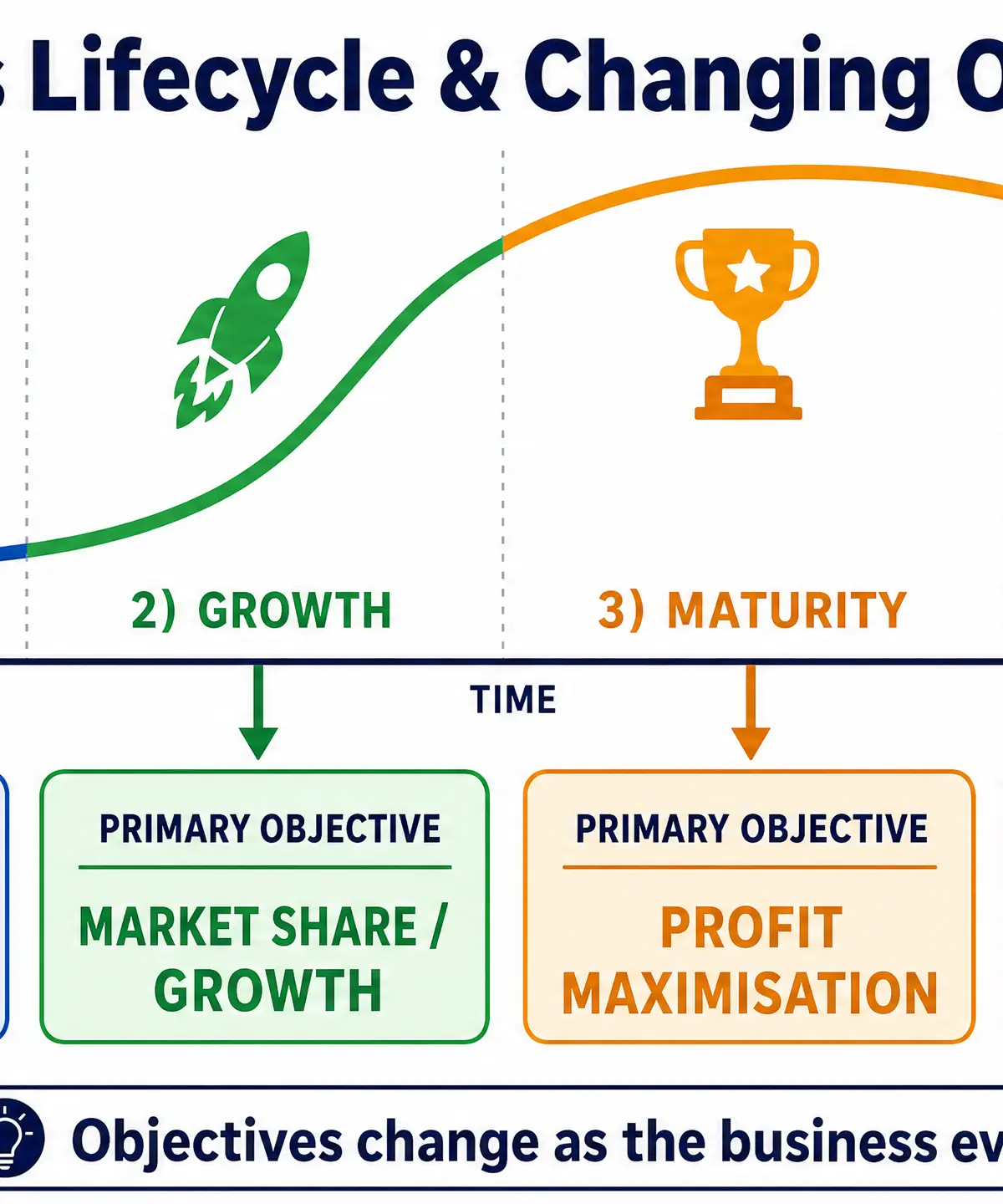
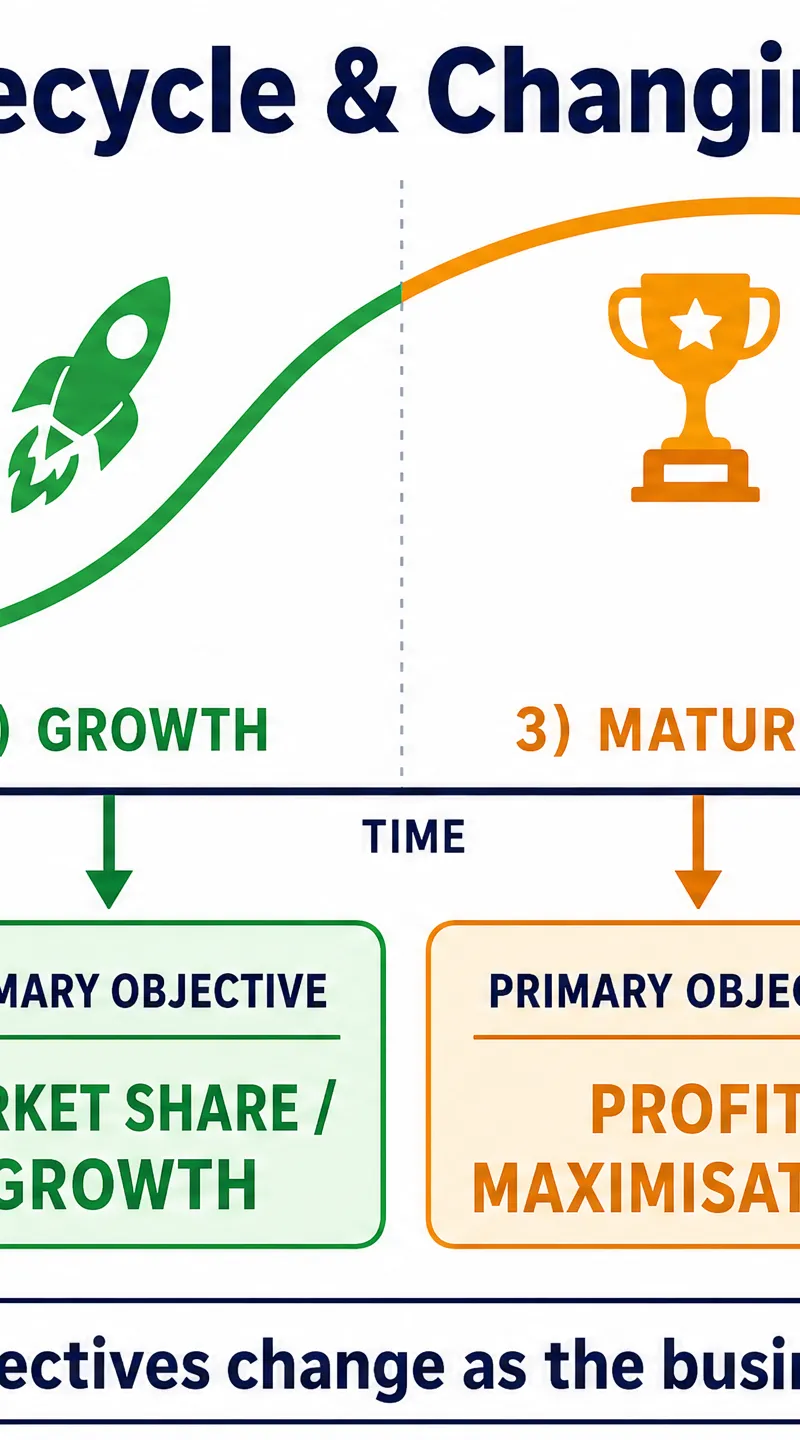
Business objectives are dynamic; they change as the business evolves. In the start-up phase, survival is the dominant objective as the business establishes its customer base. During the growth phase, the focus shifts to increasing market share and expanding operations. In the maturity phase, when the business is established, profit maximisation becomes the priority. Finally, if a business enters a decline phase, it may revert to survival or focus on diversification to find new revenue streams.
Audio Revision
Listen to our comprehensive revision podcast to reinforce your understanding of this topic:
Visual Resources
2 diagrams and illustrations
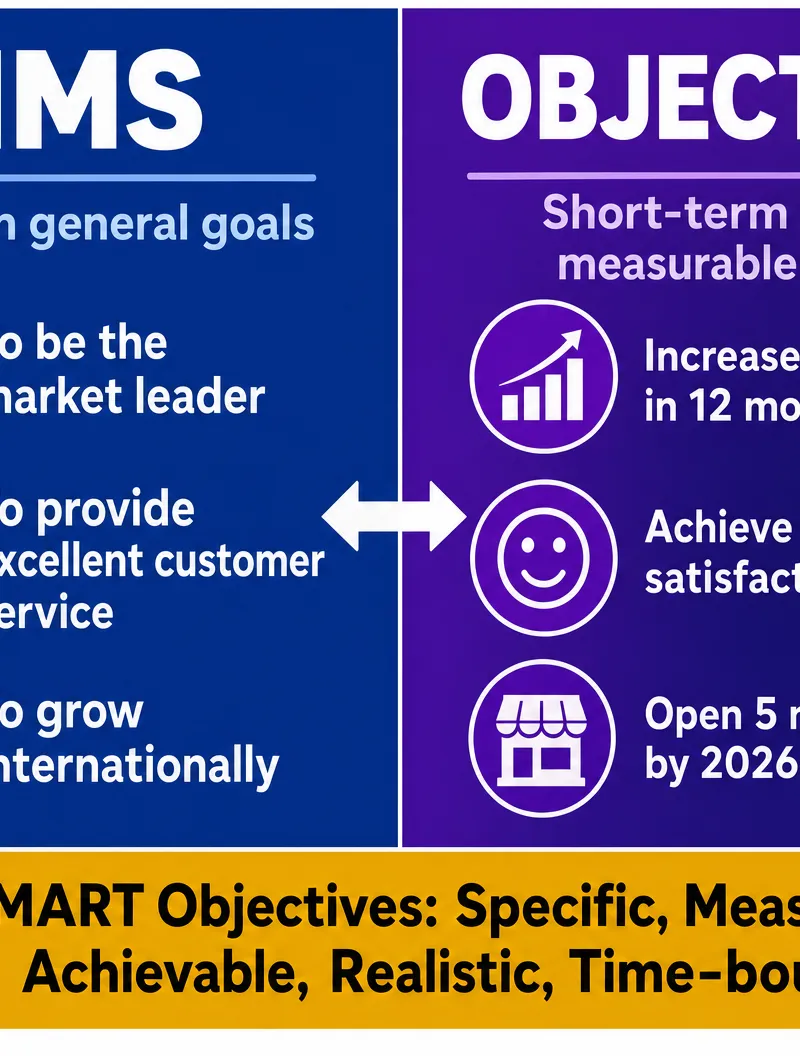
Interactive Diagrams
1 interactive diagram to visualise key concepts
Conceptual Flow Outline
How Aims relate to Objectives
Worked Examples
3 worked examples — open one to explore the question and available guidance.
Practice Questions
Try the question, then reveal an answer plan or example response
State two features of a SMART objective. (2 marks)
Hint: Think of the acronym SMART.
Explain how the objective of a charity differs from that of a private limited company. (4 marks)
Hint: Contrast social goals with financial goals.
A local independent coffee shop has just opened. Explain why survival is likely to be its main objective. (3 marks)
Hint: Think about the challenges a new business faces with costs and customers.
Analyse the benefits to a business of setting SMART objectives. (6 marks)
Hint: How do SMART objectives help managers and employees?
Evaluate whether increasing market share is the most effective way for a large supermarket to increase its profits. (9 marks)
Hint: Consider the benefits of market share, but also the costs of achieving it.
Exam technique
How to turn what you know into marks
How to approach the question
Always read the context carefully. If a business name or scenario is given, you MUST refer to it in your answer to gain application marks.
How to structure your answer
- Analyse questions
- Develop a chain of reasoning showing causes and effects. Use connectives like 'this leads to' or 'as a result'.
- Explain questions
- Make a point, give a reason, and explain the business consequence (Point, Evidence, Explain).
- Evaluate questions
- Provide arguments for, arguments against, and a justified conclusion based on the context.
Timing
Approximately 1 minute per mark, plus planning time for longer 9 or 12 mark questions.
Common pitfalls
- Confusing aims with objectives.
- Failing to apply the answer to the specific business context provided in the question.
- Writing 'to make money' instead of using the precise term 'profit' or 'revenue'.
- Assuming all businesses only care about profit, ignoring social enterprises or start-ups.
What the command words want
- Analyse
- Examine in detail, showing causes, effects, and connections.
- Explain
- Give a reason and develop it with a consequence.
- Evaluate
- Make a judgement based on a balanced argument of both sides.
- State/Identify
- Provide a simple, factual answer without explanation.
Watch or listen (optional)
Test your understanding of Business aims and objectives
Active recall beats re-reading. Take an instant quiz now to test what you’ve learned and lock it into long-term memory.
A week of Premium from your first lesson · Then the free plan continues · No card, no charge