OCR · GCSE · Business
Course version: J204 · Version from Sept 2019
Business growth
Business Growth explores how and why enterprises expand, a fundamental topic across all GCSE Business specifications. Mastering the distinction between organic and external growth, and the nuances of integration, is essential for securing high marks in extended response questions.
- 4 min read
- 3 worked examples
- 5 practice questions
- 6 key terms
Check what you remember
Read the wording for your board, then hide it and explain Organic Growth in your own words. Rough notes are fine. This is a self-check, with no mark or grade.
Reference: OCR
Expansion from within a business, using its own resources.
Study Notes
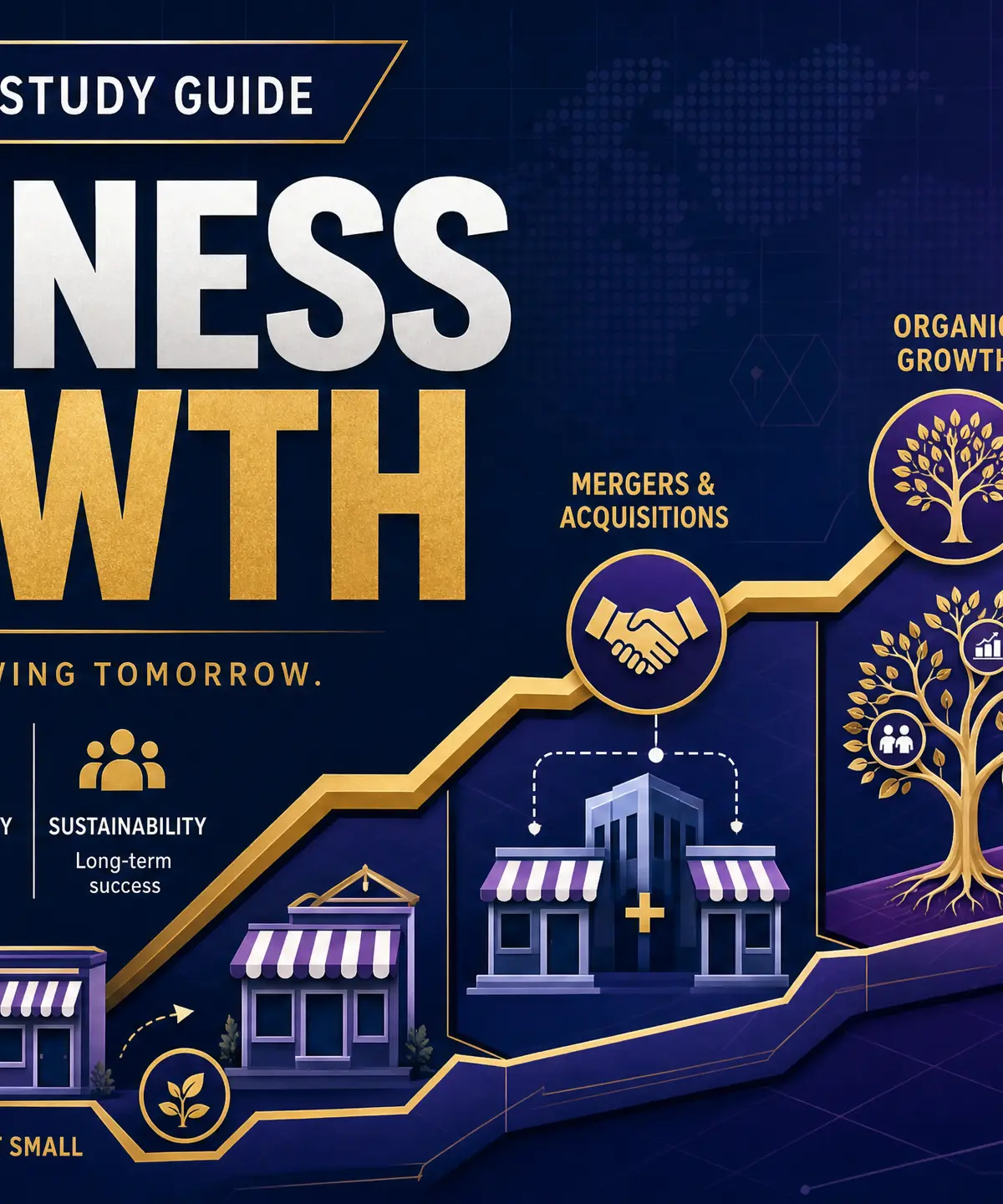
Overview
This study guide covers the critical topic of Business Growth, a staple of GCSE Business examinations. Examiners consistently test candidates' ability to distinguish between organic (internal) and external growth methods, and to evaluate the relative merits of each. Understanding how businesses expand—whether through increasing output, launching new products, or undertaking complex mergers and takeovers—is vital. Candidates must not only identify these methods but also analyse their impacts on stakeholders, market share, and profitability. High-scoring responses will confidently apply these concepts to specific business scenarios provided in the exam.
Listen to the Podcast
Key Concepts & Methods
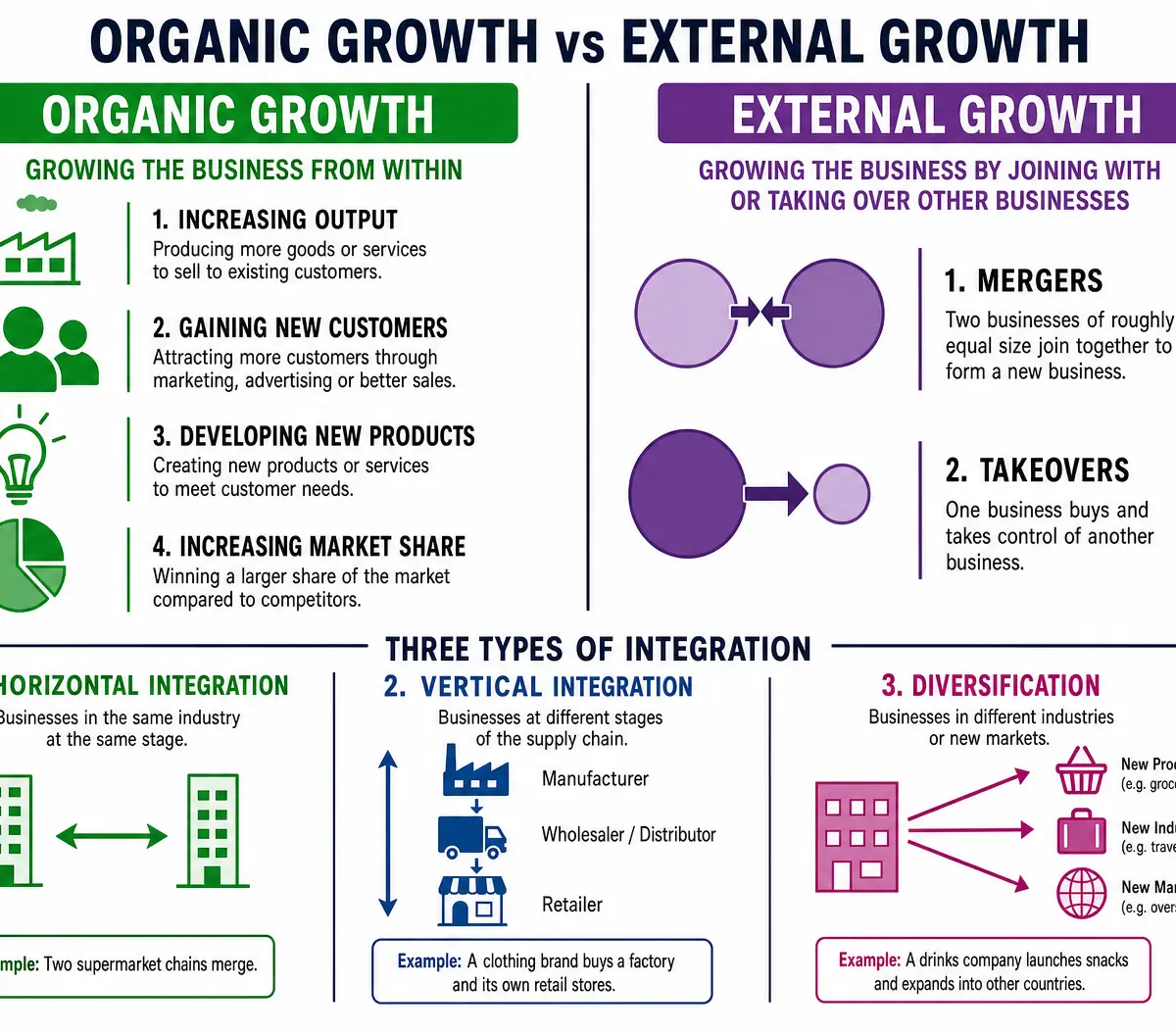
Organic Growth
Definition: Expansion from within the business using its own resources.
Methods:
- Increasing Output: Producing more goods or services to meet existing demand. Examiner Tip: Link this to economies of scale.
- Gaining New Customers: Expanding the customer base through marketing or entering new geographical areas.
- Developing New Products: Innovating to meet changing consumer needs (e.g., Apple launching new iPhone models).
- Increasing Market Share: Capturing a larger percentage of total market sales from competitors.
Why it matters: Organic growth is typically slower but carries less risk than external growth. Examiners often look for candidates to balance this low risk against the potential for missed opportunities in fast-moving markets.
External Growth
Definition: Expansion achieved by joining with or taking over another business.
Key Forms:
- Mergers: Two businesses of roughly equal size mutually agree to form a new, combined enterprise.
- Takeovers (Acquisitions): One business buys a controlling interest (over 50% of shares) in another, which can be hostile or friendly.
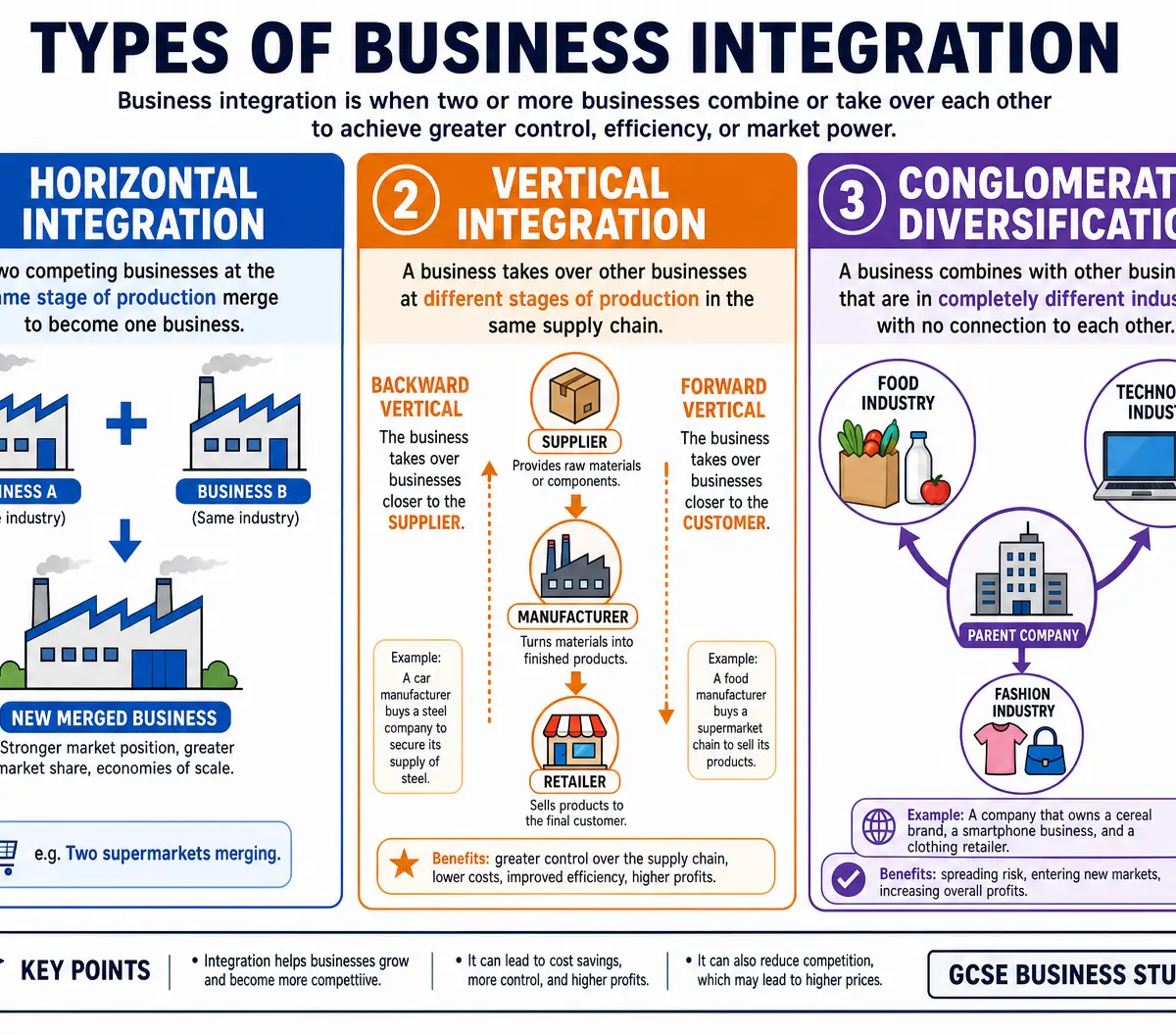
Types of Integration:
- Horizontal Integration: Joining with a business at the same stage of production in the same industry (e.g., two supermarkets merging).
- Vertical Integration: Joining with a business at a different stage of the supply chain. This can be backward (buying a supplier) or forward (buying a retailer).
- Diversification (Conglomerate): Joining with a business in a completely unrelated industry to spread risk.
Second-Order Concepts
Causation
Why do businesses seek growth? Key drivers include the pursuit of higher profits, achieving economies of scale (reducing average unit costs), increasing market power to influence pricing, and spreading risk across different markets or products.
Consequence
Growth impacts various stakeholders differently. Shareholders may see increased dividends, but employees might face redundancy during a merger (rationalisation). Consumers might benefit from lower prices due to economies of scale, or suffer from higher prices if a monopoly forms.
Significance
Understanding growth strategies allows candidates to evaluate business decisions in the real world. Examiners reward answers that recognise growth is not always positive—diseconomies of scale (communication and coordination issues) can occur if a business grows too large, too quickly.
Visual Resources
2 diagrams and illustrations
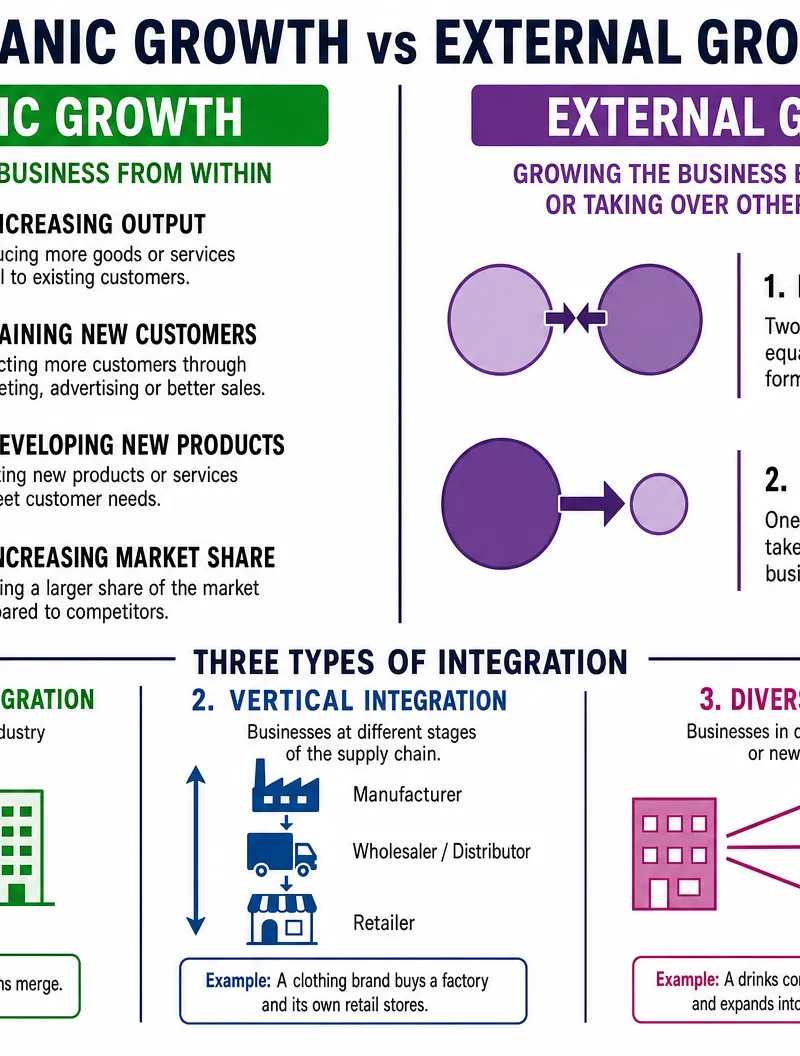
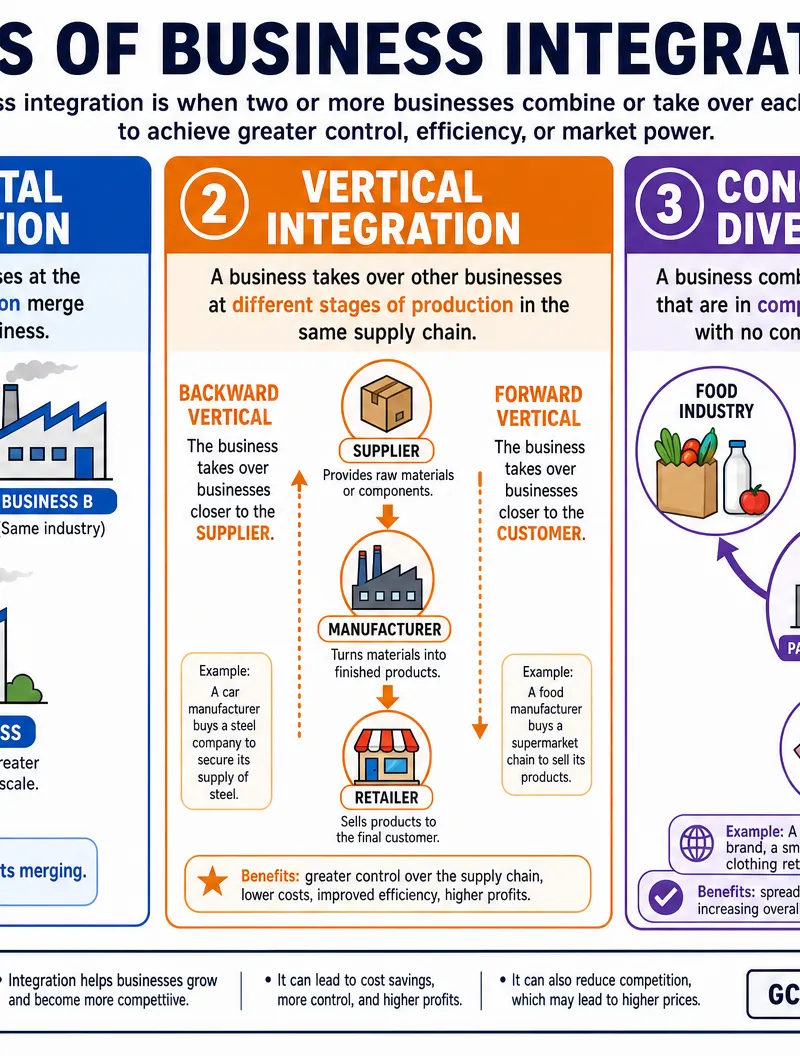
Interactive Diagrams
1 interactive diagram to visualise key concepts
Conceptual Flow Outline
Overview of Business Growth Strategies
Worked Examples
3 worked examples — open one to explore the question and available guidance.
Practice Questions
Try the question, then reveal an answer plan or example response
Explain one reason why a business might choose organic growth over external growth. (3 marks)
Hint: Think about risk, control, and culture.
Analyse the impact of backward vertical integration on a clothing manufacturer. (6 marks)
Hint: What is backward vertical integration? How does it affect supply and costs?
State what is meant by 'diversification'. (1 mark)
Hint: Think about different industries.
Explain how economies of scale benefit a growing business. (3 marks)
Hint: What happens to unit costs as production increases?
Discuss the potential drawbacks for a small, independent bakery of being taken over by a large, national food corporation. (9 marks)
Hint: Consider culture, quality, and job security.
Exam technique
How to turn what you know into marks
How to approach the question
Always read the case study carefully. Highlight key facts about the business (size, industry, current problems) and use these in your answer.
How to structure your answer
- Essay questions
- AJIM: Application (use context), Justification (develop points), Integration (link points together), Make a judgement (conclusion).
- Source questions
- N/A for Business, focus on Application to context.
- Explain questions
- BLT: Point (State the reason), Lead to (Explain the consequence), Therefore (Link to the final impact on profit/survival).
Timing
Approximately 1 minute per mark, leaving time to plan 9-mark and 12-mark questions.
Common pitfalls
- Confusing mergers and takeovers.
- Writing generic answers that don't refer to the specific business in the case study.
- Failing to explain the *impact* of a point (e.g., saying 'it increases costs' without adding 'which reduces profit margins').
What the command words want
- Analyse
- Examine the impacts or consequences of a business decision in detail.
- Explain
- Give a point and develop it with a logical chain of reasoning.
- State / Identify
- Provide a simple fact or list item. No explanation needed.
- Discuss / Evaluate
- Provide a balanced argument (pros and cons) applied to the context, ending with a justified conclusion.
Watch or listen (optional)
Test your understanding of Business growth
Active recall beats re-reading. Take an instant quiz now to test what you’ve learned and lock it into long-term memory.
A week of Premium from your first lesson · Then the free plan continues · No card, no charge