OCR · GCSE · Business
Course version: J204 · Version from Sept 2019
Business planning
Master the art of business planning, a critical topic that examiners test in almost every paper. Learn why entrepreneurs write plans, how they reduce risk, and why banks demand them before lending money.
- 5 min read
- 3 worked examples
- 5 practice questions
- 6 key terms
Check what you remember
Read the wording for your board, then hide it and explain Business Plan in your own words. Rough notes are fine. This is a self-check, with no mark or grade.
Reference: OCR
A formal written document that sets out a business's goals and explains how those goals will be achieved.
Study Notes
Overview

Business planning is a foundational topic in GCSE Business that examiners frequently test across multiple papers. A business plan is a formal written document that explains in detail how a business is going to achieve its objectives. For examiners, the focus is rarely on the document itself, but rather on why it is created and the impact it has on a business's chances of survival and growth.
Candidates must understand that a business plan serves multiple purposes: it is an internal roadmap for the entrepreneur, but equally importantly, it is an external document used to persuade investors and lenders. Understanding the dual nature of business planning—as both a risk-reduction tool and a finance-securing tool—is key to accessing the highest mark bands.
The Purpose of Planning Business Activity
1. To Obtain Finance
What it means: Using the plan to secure loans from banks or investment from venture capitalists.
Why it matters: This is perhaps the most heavily tested aspect of business planning. Examiners want candidates to explain that lenders require proof of viability. A business plan containing realistic financial forecasts (cash flow, profit and loss) demonstrates that the business can generate enough revenue to repay a loan, thereby reducing the perceived risk for the lender.
Specific Knowledge: Mention specific sources of finance (e.g., bank loans, venture capital) and specific financial documents (cash flow forecasts).
2. To Identify Markets
What it means: Conducting market research to understand target customers and competitors.
Why it matters: A business plan forces the entrepreneur to prove there is actual demand for their product. Candidates should link this to reducing the risk of failure by ensuring the product meets customer needs and is priced competitively.
Specific Knowledge: Primary and secondary research, target market demographics, competitor analysis.
3. To Reduce Risk
What it means: Anticipating potential problems and putting strategies in place to mitigate them.
Why it matters: Starting a business is inherently risky (a high percentage fail within the first year). Examiners reward candidates who explain that planning allows entrepreneurs to identify potential pitfalls (e.g., cash flow shortages) before they happen, allowing them to take preventative action.
Specific Knowledge: Risk assessment, contingency planning, dynamic markets.
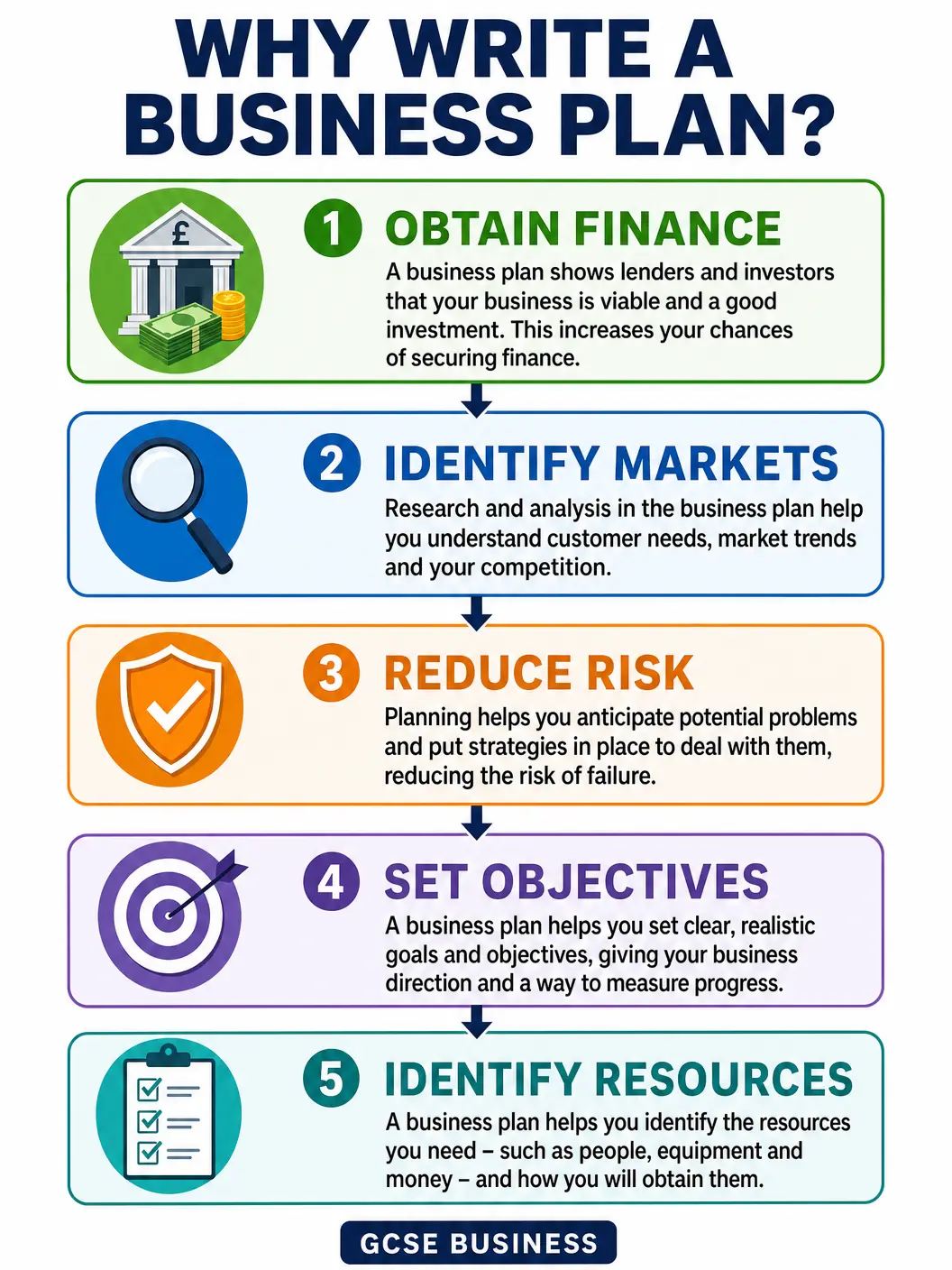
4. To Identify Resources Needed
What it means: Determining the physical, human, and financial resources required to operate.
Why it matters: A business cannot function without the right resources. The plan details what premises, equipment, staff, and start-up capital are required. This ensures the business doesn't launch under-resourced, which is a common cause of early failure.
Specific Knowledge: Factors of production (land, labour, capital, enterprise), recruitment needs, suppliers.
5. To Achieve Aims and Objectives
What it means: Setting clear targets and mapping out the steps to reach them.
Why it matters: Aims provide the overall direction, while objectives provide specific, measurable targets. Examiners look for the understanding that a plan acts as a benchmark; actual performance can be compared against the plan to see if the business is on track.
Specific Knowledge: SMART objectives (Specific, Measurable, Achievable, Realistic, Time-bound), difference between aims (long-term) and objectives (short-term).
The Components of a Business Plan
While you don't need to write a full business plan in the exam, you must know what goes into one:
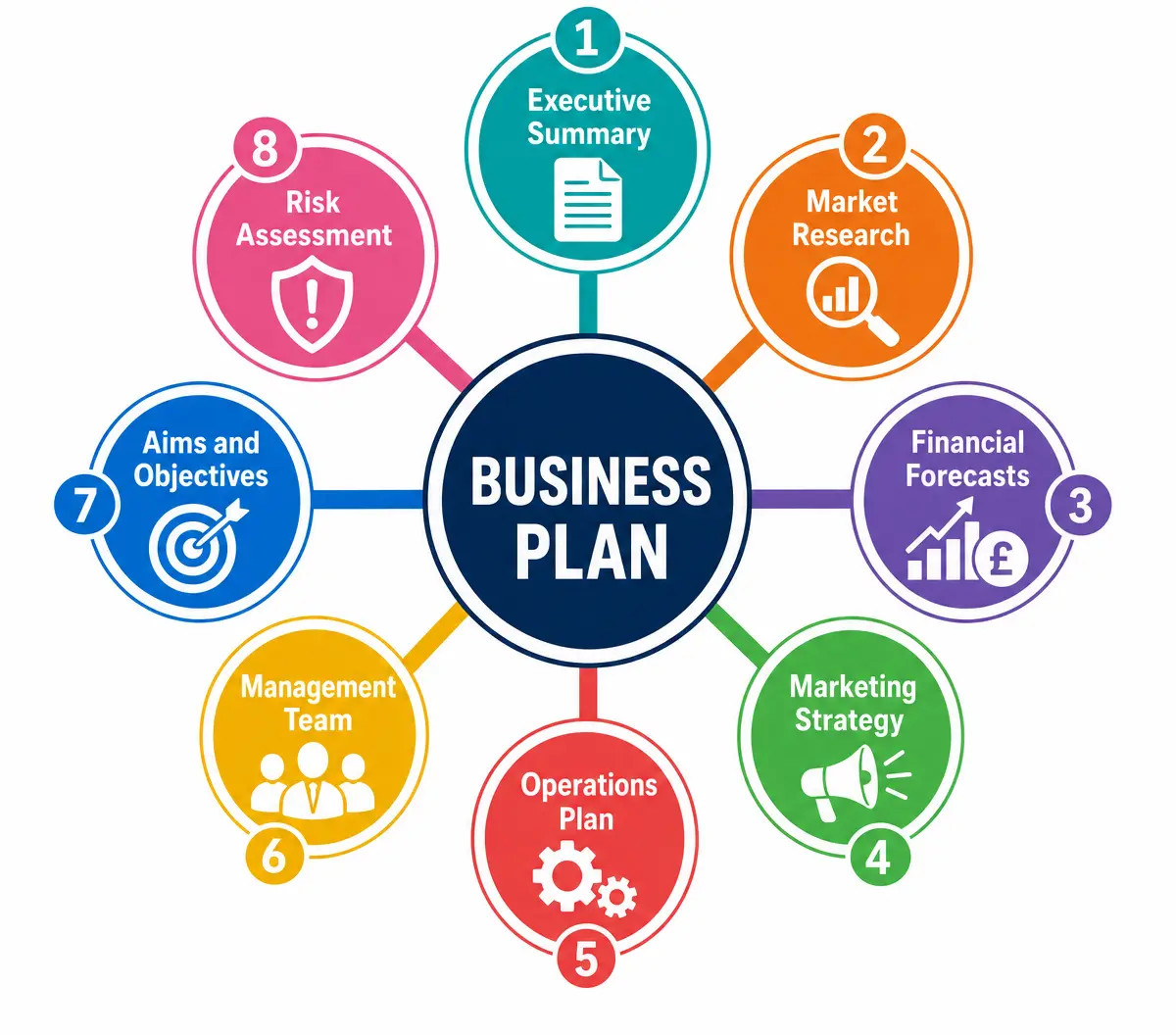
- Executive Summary: A brief overview of the entire plan.
- The Business and its Objectives: Details of the product/service and what the business wants to achieve.
- Market Research: Evidence of demand, target market details, and competitor analysis.
- Marketing Strategy: How the product will be priced, promoted, and distributed (the Marketing Mix / 4Ps).
- Operations Plan: How the product will be produced or the service delivered.
- Financial Forecasts: Cash flow forecasts, profit and loss projections, and break-even analysis.
Evaluating the Usefulness of a Business Plan
For higher-tariff 'Evaluate' or 'To what extent' questions, candidates must understand the limitations of a business plan:
- Accuracy of Data: A plan is only as good as the research behind it. If market research is flawed or financial forecasts are overly optimistic, the plan may lead to poor decision-making.
- Dynamic Markets: In fast-changing markets (e.g., technology), a rigid plan can quickly become outdated. Businesses must remain flexible.
- Opportunity Cost: Creating a detailed plan takes significant time and money, which could be spent on actually launching the business.
- Lack of Experience: A new entrepreneur may lack the skills to create accurate financial forecasts, reducing the plan's reliability.
Podcast Revision
Listen to this 10-minute deep dive into Business Planning, featuring core concepts, exam tips, and a quick-fire recall quiz.
Interactive Diagrams
1 interactive diagram to visualise key concepts
Conceptual Flow Outline
The Business Planning Process Flow
Worked Examples
3 worked examples — open one to explore the question and available guidance.
Practice Questions
Try the question, then reveal an answer plan or example response
State two pieces of information that are usually included in the financial forecasts section of a business plan. (2 marks)
Hint: Think about the documents that predict money coming in, going out, and overall profitability.
Explain how a business plan helps an entrepreneur to reduce the risk of failure. (3 marks)
Hint: Use the PEEL structure. Point -> How does it help? -> What is the impact?
Sarah is planning to open a new independent bookshop. She has £5,000 of her own savings but estimates she needs £20,000 to start the business. Analyse the importance of a business plan to Sarah. (6 marks)
Hint: You MUST refer to Sarah, the bookshop, and the £15,000 shortfall in your answer.
Evaluate whether the financial forecasts are the most important part of a business plan for a new business. (9 marks)
Hint: Argue why financial forecasts are crucial, then argue why another section (like market research) might be just as or more important. Conclude with a judgement.
Identify two risks that an entrepreneur might face when starting a new business. (2 marks)
Hint: Think about financial risks and market risks.
Exam technique
How to turn what you know into marks
How to approach the question
Always look for the 'context' in the question. If the question mentions a specific type of business (e.g., a local bakery, a tech start-up), you MUST apply your knowledge to that specific scenario to access the highest marks.
How to structure your answer
- Analyse questions
- Focus on the 'domino effect'. Action A leads to Consequence B, which results in Impact C.
- Explain questions
- Use PEEL: Point, Evidence (specific business term), Explanation (chain of reasoning), Link (impact on the business).
- Evaluate questions
- Introduction → Benefit 1 (with context) → Benefit 2 (with context) → Limitation/Drawback (with context) → Conclusion (weighing up which factor is most important and why).
Timing
Aim for 1 minute per mark. For a 9-mark evaluate question, spend 2 minutes planning and 7 minutes writing.
Common pitfalls
- Listing the contents of a business plan instead of explaining the PURPOSE of the plan.
- Confusing 'aims' (long term goals) with 'objectives' (specific, measurable targets).
- Failing to mention that the usefulness of a plan depends on the accuracy of the research behind it.
- Giving generic answers that don't refer to the specific business mentioned in the case study.
What the command words want
- Analyse
- Examine the impacts or consequences in detail, showing how different factors link together.
- Explain
- Make a point and develop it with a chain of reasoning. Use connectives like 'because', 'leading to', 'therefore'.
- State / Identify
- Give a simple fact or term. No explanation needed. (1 mark)
- Evaluate / Recommend
- Provide a balanced argument (pros and cons) and end with a justified conclusion based on the evidence presented.
Watch or listen (optional)
Test your understanding of Business planning
Active recall beats re-reading. Take an instant quiz now to test what you’ve learned and lock it into long-term memory.
A week of Premium from your first lesson · Then the free plan continues · No card, no charge