OCR · GCSE · Business
Course version: J204 · Version from Sept 2019
Employment law
Master the essential UK employment legislation that shapes modern business practices. From the Equality Act to the National Minimum Wage, discover how legal requirements protect workers and influence business decision-making, costs, and reputation.
- 5 min read
- 3 worked examples
- 5 practice questions
- 6 key terms
Check what you remember
Read the wording for your board, then hide it and explain Employment Law in your own words. Rough notes are fine. This is a self-check, with no mark or grade.
Reference: OCR
The legal framework that governs the relationship between employers and employees.
Study Notes
Overview
Employment law is the fundamental framework of rules that governs the relationship between employers and employees in the UK. For GCSE Business candidates, understanding these laws is crucial because they directly impact how a business recruits, manages, and dismisses its staff. Examiners expect you to do more than simply name the laws; you must be able to analyse their impact on business operations, costs, and decision-making.
Historically, employment law developed to protect vulnerable workers from exploitation during the Industrial Revolution. Today, it ensures fair pay, safe working conditions, and protection from discrimination. In your exam, you will often need to apply these legal principles to specific business scenarios, weighing up the costs of compliance against the benefits of a motivated, legally protected workforce.
Key Legislation
The Employment Rights Act 1996
Date: 1996
What it is: The foundation of UK employment rights, primarily dealing with contracts of employment, unfair dismissal, and redundancy.
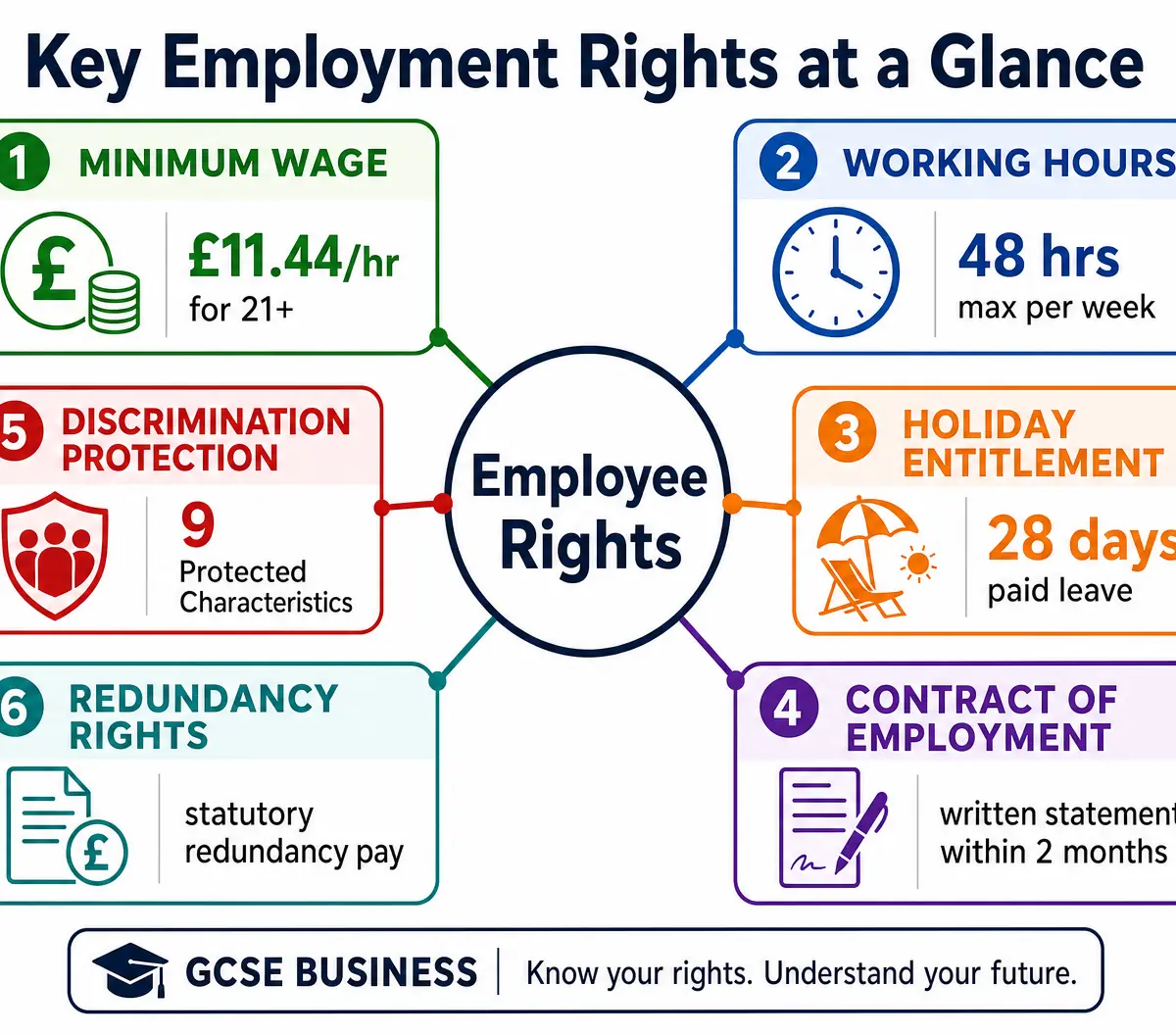
Why it matters: It mandates that employees receive a written statement of employment particulars within two months of starting work. This provides legal certainty for both the business and the employee, reducing the risk of disputes.
Specific Knowledge: Contracts must include: rate of pay, working hours, holiday entitlement, notice periods, and job title.
The National Minimum Wage Act 1998
Date: 1998 (with annual rate updates)
What it is: Legislation that sets the minimum hourly rate an employer can legally pay its workers.
Why it matters: It prevents the exploitation of low-skilled workers. For businesses, it represents a significant, non-negotiable cost that must be factored into financial planning and pricing strategies.
Specific Knowledge: The National Living Wage applies to workers aged 21 and over (currently £11.44/hr as of April 2024). There are different, lower rates for younger workers and apprentices.
The Working Time Regulations 1998
Date: 1998
What it is: Rules governing working hours, rest breaks, and holiday entitlement.
Why it matters: It protects worker health and well-being by preventing excessive hours. Businesses must manage staffing levels carefully to ensure compliance while maintaining productivity.
Specific Knowledge: Maximum average working week is 48 hours (though workers can opt out). Full-time employees are entitled to 28 days of paid annual leave. Workers are entitled to a 20-minute rest break if working more than 6 hours.
The Equality Act 2010
Date: 2010
What it is: Comprehensive legislation that legally protects people from discrimination in the workplace and in wider society.
Why it matters: It fundamentally shapes how businesses recruit, train, and promote staff. Non-compliance can lead to severe financial penalties at an employment tribunal and massive reputational damage.
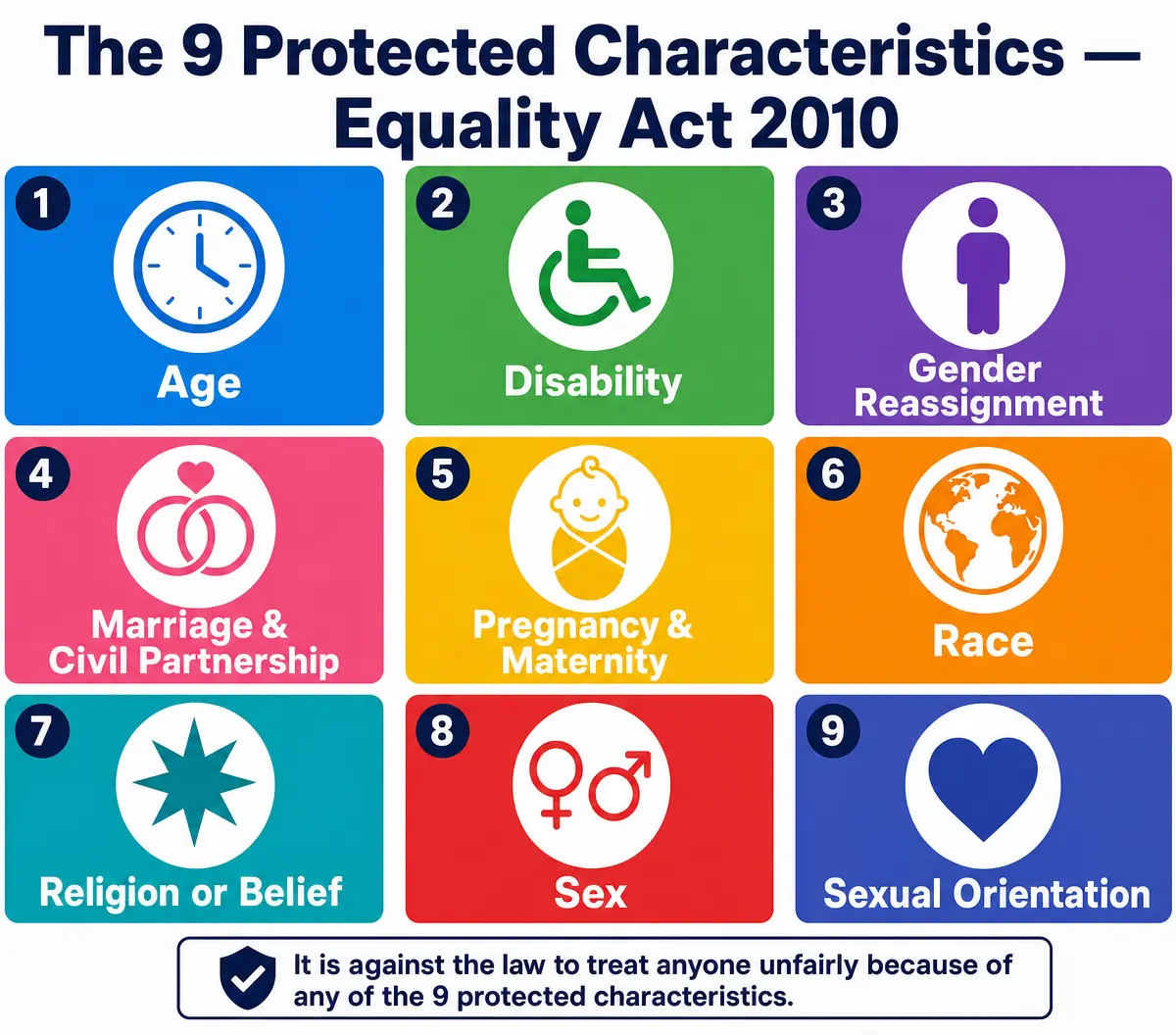
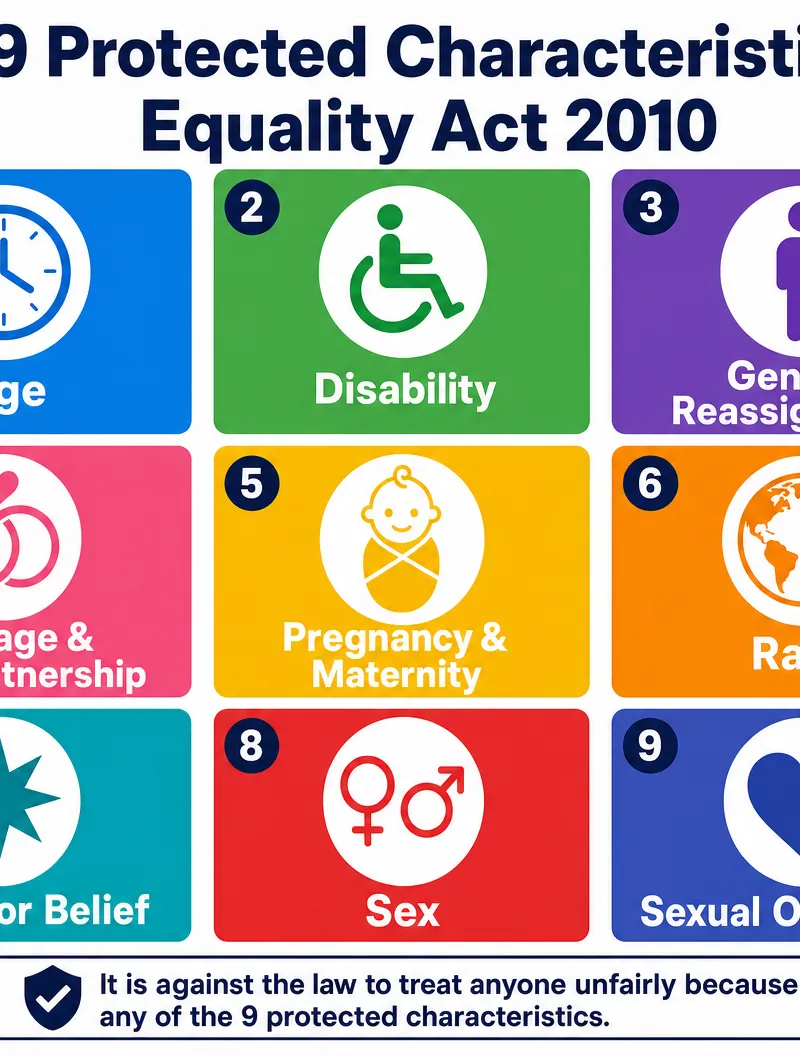
Specific Knowledge: There are 9 Protected Characteristics: Age, Disability, Gender reassignment, Marriage and civil partnership, Pregnancy and maternity, Race, Religion or belief, Sex, Sexual orientation.
Key Concepts in Employment Law
Discrimination
Treating a person unfairly or less favourably than others based on a protected characteristic. This can be direct (e.g., refusing to hire someone because of their age) or indirect (e.g., setting a blanket policy that disproportionately disadvantages a specific group).
Contracts of Employment
A legally binding agreement between an employer and an employee. While a contract exists as soon as an employee accepts a job offer, the law requires a written statement of particulars to be provided, outlining the core terms of the employment relationship.
Health and Safety
Under the Health and Safety at Work Act 1974, employers must provide a safe working environment, adequate training, and safe equipment. Employees also have a duty to follow safety procedures.
Podcast Episode
Listen to our 10-minute podcast episode for a deep dive into these concepts, exam tips, and a quick-fire recall quiz.
Exam Skills: Analysing Legal Impacts
When evaluating the impact of employment law on a business, always consider both sides:
Costs to the Business:
- Higher wage bills (National Minimum Wage)
- Administrative costs of compliance (drafting contracts, monitoring hours)
- Potential costs of employment tribunals if laws are broken
- Training costs (e.g., equality and diversity training)
Benefits to the Business:
- Improved employee motivation and retention (fair pay and safe conditions)
- Wider talent pool (non-discriminatory recruitment)
- Better reputation (seen as an ethical employer)
- Fewer workplace accidents and associated costs
Visual Resources
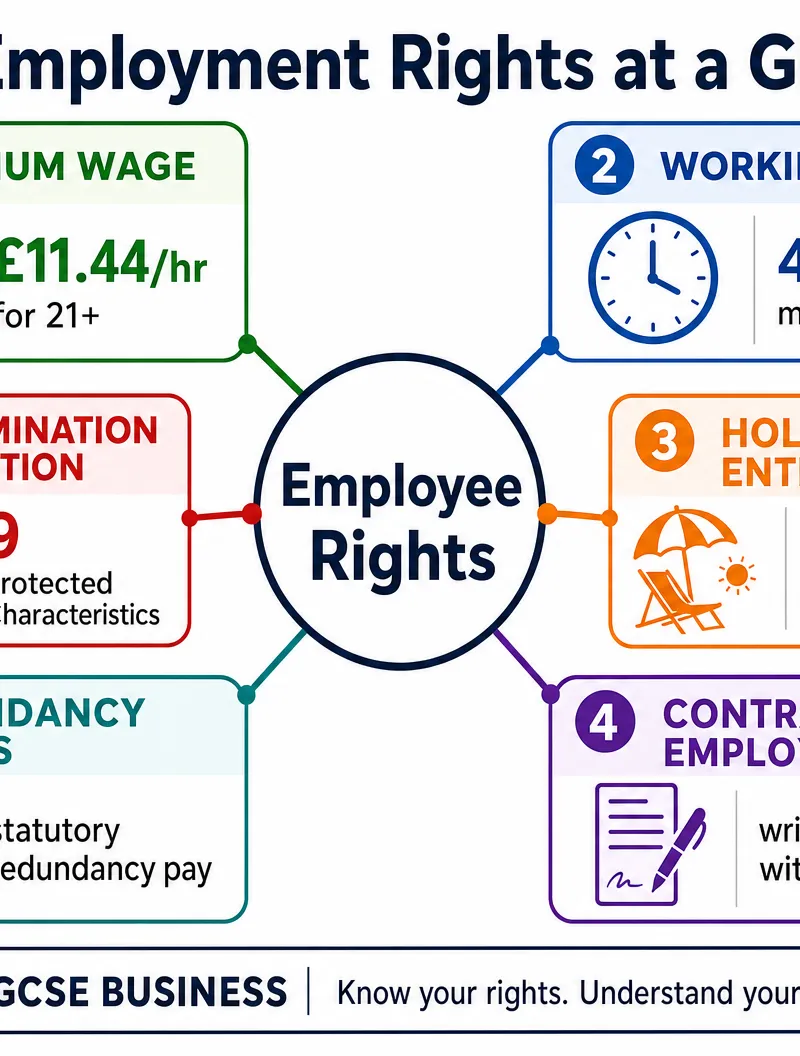
2 diagrams and illustrations
Interactive Diagrams
1 interactive diagram to visualise key concepts
Conceptual Flow Outline
The dual impact of employment legislation on a business
Worked Examples
3 worked examples — open one to explore the question and available guidance.
Practice Questions
Try the question, then reveal an answer plan or example response
Identify two pieces of information that must be included in a written statement of employment. (2 marks)
Hint: Think about what you would want to know before starting a new job.
Explain one impact on a business of failing to comply with the Equality Act 2010. (3 marks)
Hint: Think about the financial and reputational consequences.
Analyse how the Working Time Regulations 1998 might affect a delivery company. (6 marks)
Hint: Apply the rules on maximum hours and rest breaks to drivers.
State the maximum average working week allowed under the Working Time Regulations. (1 mark)
Hint: It's just under 50 hours.
Evaluate the impact of the National Minimum Wage Act on a fast-food restaurant. (9 marks)
Hint: Consider the costs of paying staff versus the benefits of a motivated workforce, and reach a conclusion.
Exam technique
How to turn what you know into marks
How to approach the question
Always link the law to the specific business context provided in the case study.
How to structure your answer
- Analyse questions
- Develop chains of reasoning showing cause and effect (e.g., Law -> Action -> Cost -> Profit impact).
- Explain questions
- Point (identify the law/effect) -> Evidence (specific detail) -> Explanation (impact on the business).
- Evaluate questions
- Provide a balanced argument (costs vs benefits) followed by a justified conclusion based on the specific business scenario.
Timing
Approximately 1 minute per mark.
Common pitfalls
- Listing laws without explaining their impact on the business.
- Confusing the National Minimum Wage with the Living Wage.
- Failing to apply the answer to the specific business context in the question.
What the command words want
- Analyse
- Examine the impacts in detail, showing a chain of events.
- Explain
- Give a reason and develop it with a consequence.
- State/Identify
- Provide a simple fact (e.g., name a protected characteristic).
- Evaluate/Justify
- Weigh up pros and cons, and make a final decision or judgement.
Watch or listen (optional)
Test your understanding of Employment law
Active recall beats re-reading. Take an instant quiz now to test what you’ve learned and lock it into long-term memory.
A week of Premium from your first lesson · Then the free plan continues · No card, no charge