OCR · GCSE · Business
Course version: J204 · Version from Sept 2019
Motivation and retention
Master the essential HR concepts of motivation and retention to secure top marks in GCSE Business. Understand how financial and non-financial rewards drive productivity, and why keeping staff is crucial for business success.
- 4 min read
- 3 worked examples
- 5 practice questions
- 6 key terms
Check what you remember
Read the wording for your board, then hide it and explain Motivation in your own words. Rough notes are fine. This is a self-check, with no mark or grade.
Reference: OCR
The desire and willingness of an employee to work hard and perform well.
Study Notes
Overview
This study guide covers the critical role of human resources in motivating and retaining employees, a core topic across all GCSE Business specifications (AQA, Edexcel, OCR, WJEC). Examiners expect candidates to not only define motivation methods but to apply them to specific business contexts. You must be able to evaluate the suitability of financial versus non-financial methods and explicitly link employee motivation to staff retention and overall business performance.

Listen to the companion podcast for a comprehensive audio review of this topic:
Key Concepts & Developments
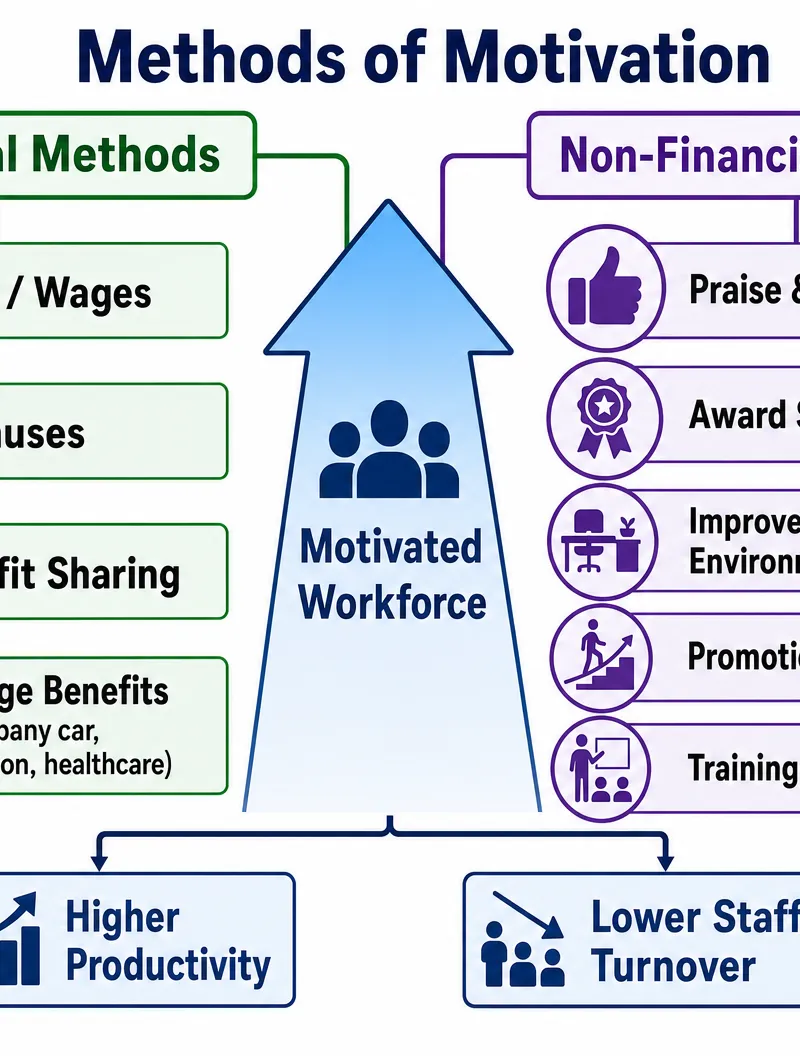
Financial Methods of Motivation
Definition: Methods of motivating employees using monetary rewards.
Key Types:
- Pay/Wages: The basic monetary reward for work done. Can be time-rate (per hour) or piece-rate (per item produced).
- Bonuses: Extra payments given on top of the basic wage, usually for achieving specific targets or exceptional performance.
- Profit Sharing: Distributing a percentage of the business's overall profits to its employees, aligning their interests with the company's success.
- Fringe Benefits (Perks): Non-cash financial rewards, such as a company car, private healthcare, or gym memberships.
Why it matters: Financial methods are often the primary reason people work. However, examiners want to see you recognize that they increase business costs and may not be the sole motivator for all employees.

Non-Financial Methods of Motivation
Definition: Methods of motivating employees that do not involve direct monetary payment.
Key Types:
- Praise and Recognition: Acknowledging an employee's hard work, which boosts self-esteem and morale.
- Award Schemes: Formal recognition programmes, like 'Employee of the Month'.
- Working Environment: Improving the physical workspace to make it safer, more comfortable, and enjoyable.
- Promotion Opportunities: Offering a clear career path to motivate ambitious staff.
- Training and Development: Investing in employees' skills, making them feel valued and capable.
Why it matters: These methods often cost less than financial rewards but can lead to deeper, longer-lasting commitment and job satisfaction.
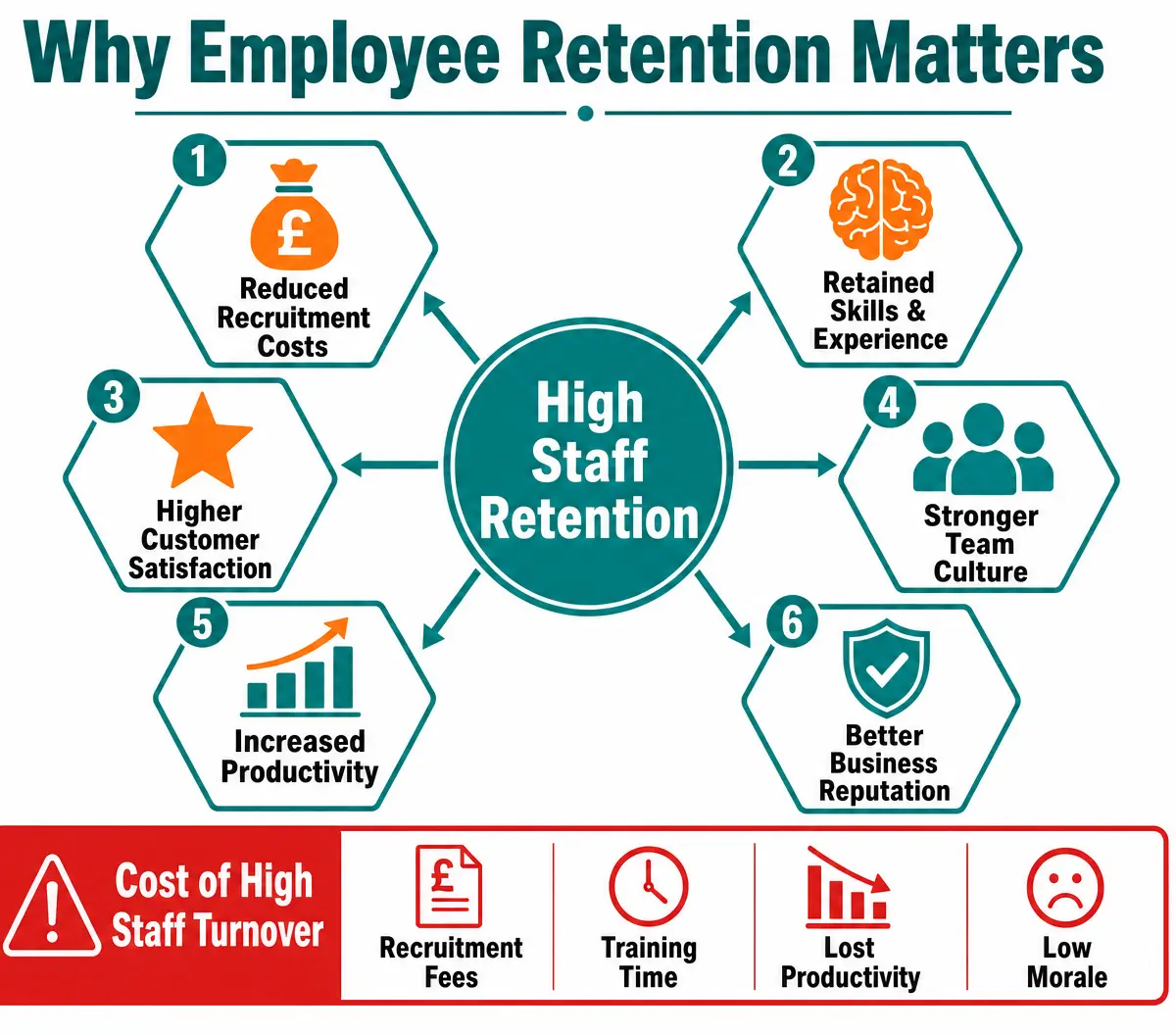
The Importance of Employee Retention
Definition: The ability of a business to keep its employees. The opposite is high staff turnover (employees frequently leaving).
Key Impacts:
- Reduced Costs: Lower recruitment and training expenses.
- Maintained Productivity: Experienced staff work faster and make fewer mistakes.
- Stronger Culture: Stable teams collaborate better and maintain high morale.
- Better Customer Service: Experienced staff understand the product and the customers better.
Why it matters: This is the crucial 'so what?' for examiners. You must link motivation directly to retention. Highly motivated staff stay, saving the business money and improving output.
Second-Order Concepts
Causation
What causes an employee to be motivated? It is usually a combination of fair financial reward (to meet basic needs) and non-financial recognition (to meet psychological needs).
Consequence
The consequence of poor motivation is high staff turnover, increased costs, low productivity, and poor customer service. The consequence of high motivation is strong retention and competitive advantage.
Significance
Motivation and retention are significant because human resources are often a business's biggest cost and its greatest asset. A motivated workforce can be the difference between business failure and success.
Visual Resources
2 diagrams and illustrations

Interactive Diagrams
1 interactive diagram to visualise key concepts
Conceptual Flow Outline
The Chain of Impact: Motivation to Business Performance
Worked Examples
3 worked examples — open one to explore the question and available guidance.
Practice Questions
Try the question, then reveal an answer plan or example response
State two non-financial methods of motivation. (2 marks)
Hint: Think about things that don't involve direct monetary payment.
Explain how fringe benefits can help a business retain its employees. (3 marks)
Hint: Define the term, then explain the impact on the employee's decision to stay.
A fast-food restaurant is experiencing high staff turnover. Analyse the impact this will have on the business. (6 marks)
Hint: Think about costs (recruitment) and quality/speed of service.
Evaluate whether increasing pay is the most effective way to motivate employees in a factory. (9 marks)
Hint: Argue for pay (basic needs, clear reward), argue against (costs, short-term effect), conclude.
Explain the link between employee motivation and customer satisfaction in a hotel. (3 marks)
Hint: How does a motivated receptionist act compared to a demotivated one?
Exam technique
How to turn what you know into marks
How to approach the question
Always identify the command word first. Then highlight the context (e.g., 'small bakery', 'large factory') to ensure your application marks.
How to structure your answer
- Analyse questions
- Two distinct points, developed with clear chains of reasoning linking back to the business context.
- Explain questions
- BLT structure: Because, Leading to, Therefore (Point -> Explanation -> Impact).
- Evaluate questions
- Option A benefits -> Option B benefits -> Clear conclusion choosing one option with a justified reason.
Timing
Approximately 1 minute per mark.
Common pitfalls
- Listing methods without explaining HOW they motivate staff.
- Giving generic answers that ignore the specific business scenario in the question.
- Failing to link motivation to retention and overall business performance.
What the command words want
- Analyse
- Explore the causes and consequences in detail, using connective language (6 marks).
- Explain
- Make a point and develop it with a reason or consequence (2-3 marks).
- State/Identify
- Give a simple fact or term. No explanation needed (1 mark).
- Evaluate/Justify
- Consider both sides of an argument and provide a supported final judgement (9-12 marks).
Watch or listen (optional)
Test your understanding of Motivation and retention
Active recall beats re-reading. Take an instant quiz now to test what you’ve learned and lock it into long-term memory.
A week of Premium from your first lesson · Then the free plan continues · No card, no charge