OCR · GCSE · Business
Course version: J204 · Version from Sept 2019
Organisational structures and different ways of working
Master the architecture of business! This guide decodes how businesses organise their people and choose different ways of working, ensuring you're ready to secure top marks on any structure-related exam question.
- 5 min read
- 3 worked examples
- 5 practice questions
- 6 key terms
Check what you remember
Read the wording for your board, then hide it and explain Hierarchy in your own words. Rough notes are fine. This is a self-check, with no mark or grade.
Reference: OCR
The system of ranking and organising people in an organisation, with those having more authority at the top.
Study Notes
Overview
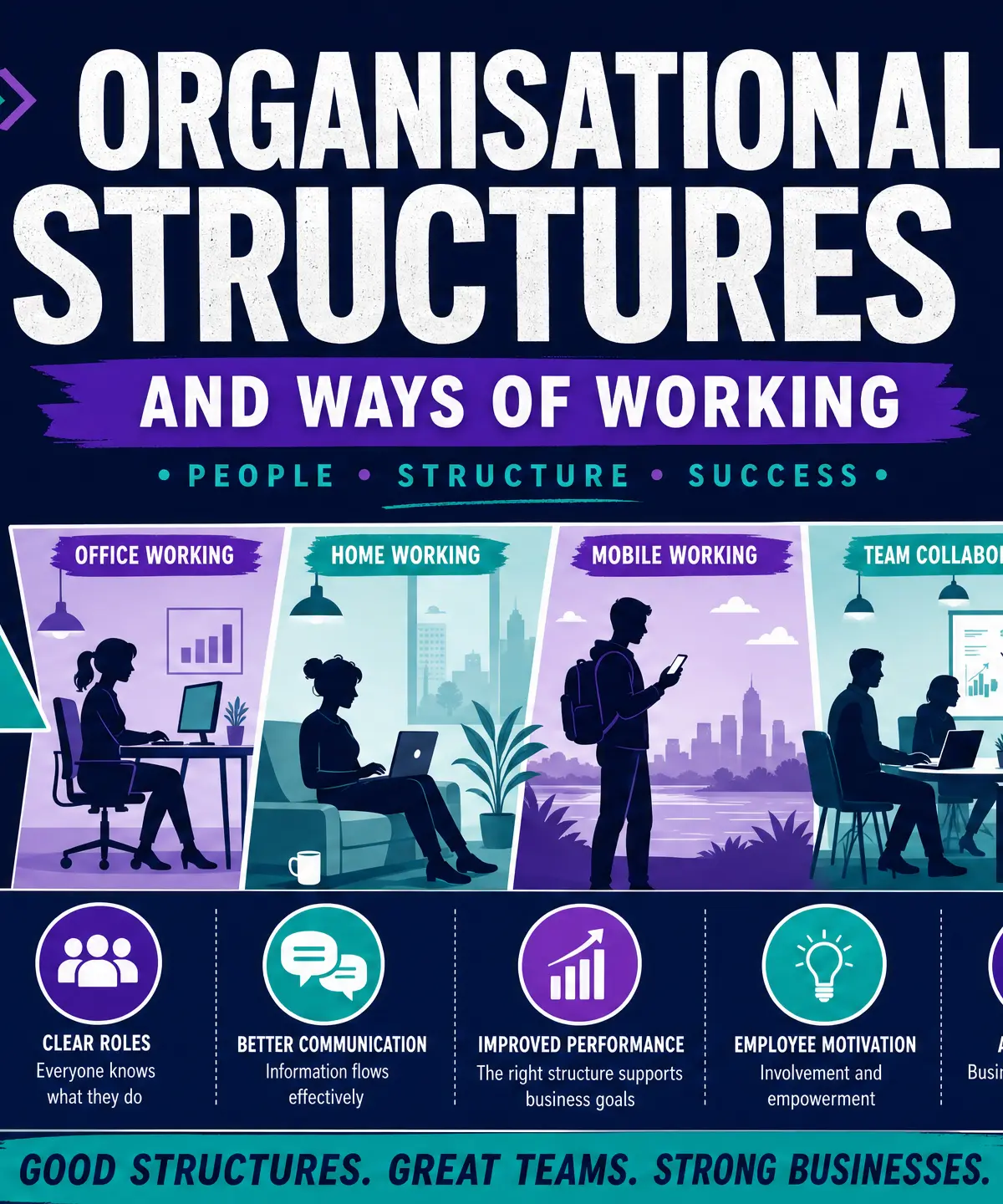
Welcome to one of the most foundational topics in GCSE Business: Organisational Structures and Ways of Working. Every business, from a local independent café to a multinational corporation, needs a system to organise its human resources. This topic explores the 'skeleton' of a business—how roles are defined, how authority flows, and the various working arrangements employers use to meet their objectives.
Examiners consistently test this topic because it links directly to business success. You must be able to define key terms precisely, compare different structures, and evaluate the impacts of various working practices on both the employer and the employee. Strong candidates don't just list features; they apply their knowledge to specific business scenarios, showing how a structure might help or hinder communication, motivation, and decision-making.
Listen to our comprehensive audio guide below for a deep dive into the core concepts, examiner tips, and a quick-fire recall quiz.
Organisational Structures
An organisational structure defines how activities, roles, and responsibilities are directed to achieve a business's goals. It determines how information flows from level to level within the company.
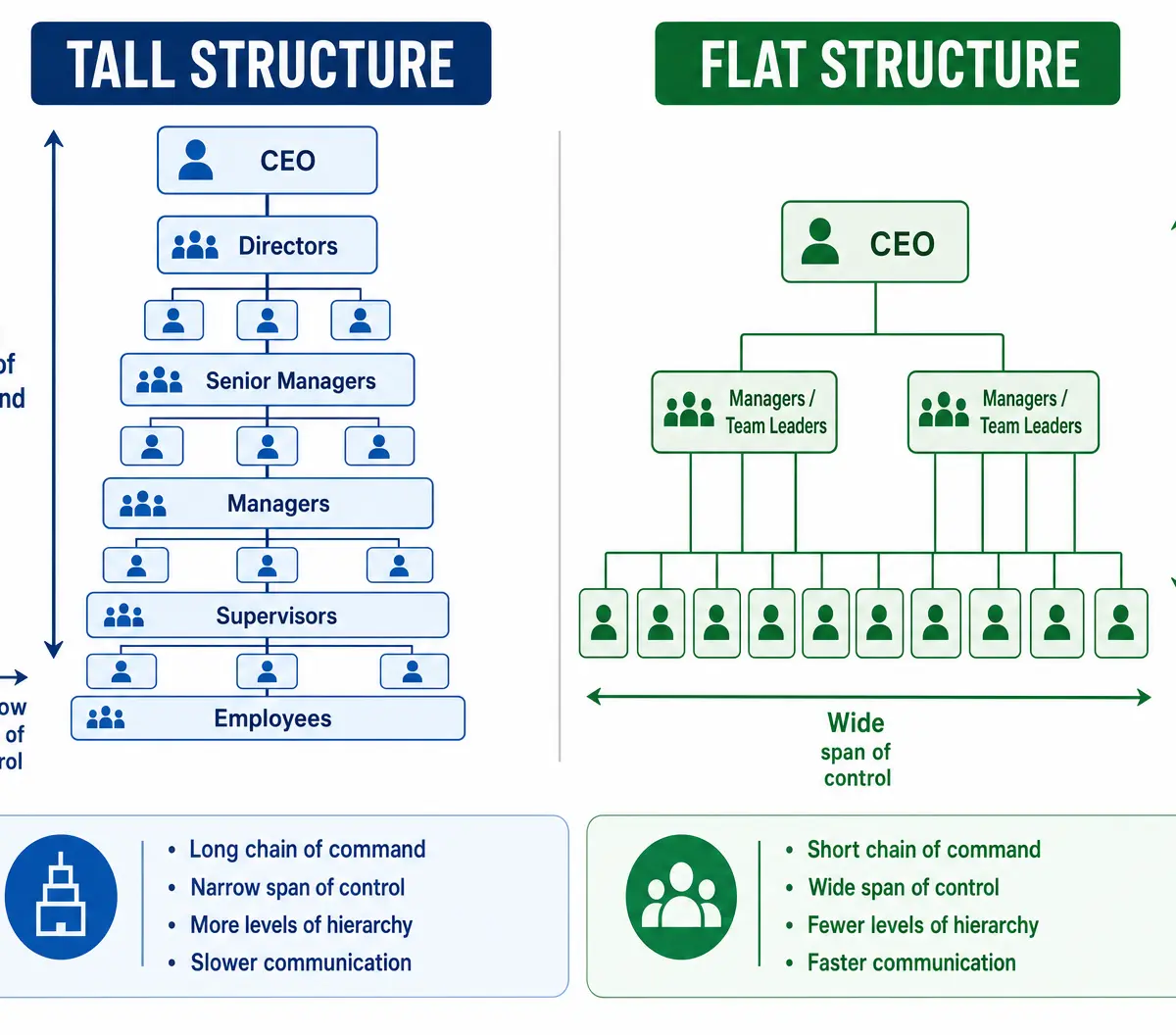
Tall Organisational Structures
A tall structure (often called a hierarchical structure) features many levels of management.
Key Characteristics:
- Long chain of command: Information has to pass through many layers from top to bottom.
- Narrow span of control: Each manager is responsible for only a few subordinates.
Why it matters: Tall structures provide close supervision and clear progression paths, which can motivate employees. However, communication can be slow, and decision-making may become bureaucratic. The high number of managers also makes this structure expensive to maintain.
Flat Organisational Structures
A flat structure has very few levels of management between the chief executive and the frontline employees.
Key Characteristics:
- Short chain of command: Information flows quickly between the top and bottom.
- Wide span of control: Managers are responsible for a large number of subordinates.
Why it matters: Flat structures encourage faster communication and quicker decision-making. Employees often feel more empowered because they are trusted with more responsibility (delegation). However, managers can become overworked, and there are fewer opportunities for promotion.
Delayering
What happened: Many modern businesses choose to remove layers of management from a tall structure to make it flatter. This process is called delayering.
Impact: It reduces costs (fewer managerial salaries to pay) and speeds up communication. However, it can lead to redundancies, decreased morale in the short term, and increased workload for the remaining managers.
Ways of Working
Businesses must decide not only how to structure their organisation but also when and where their employees work.
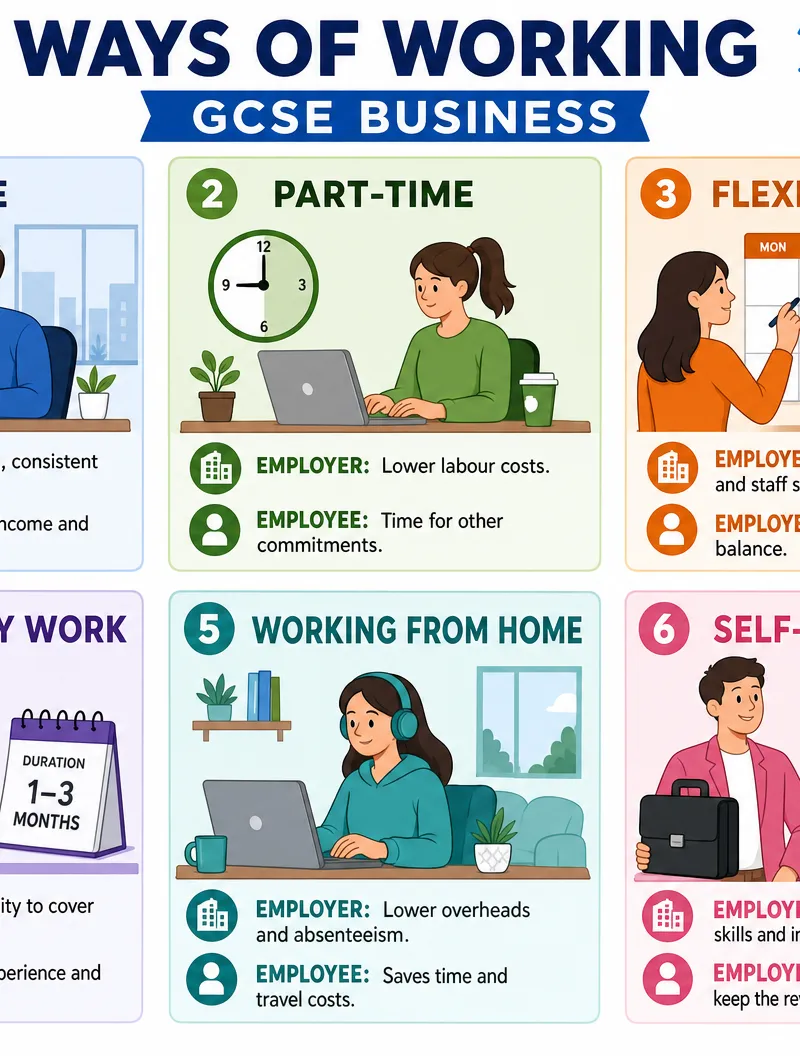
Full-Time vs Part-Time
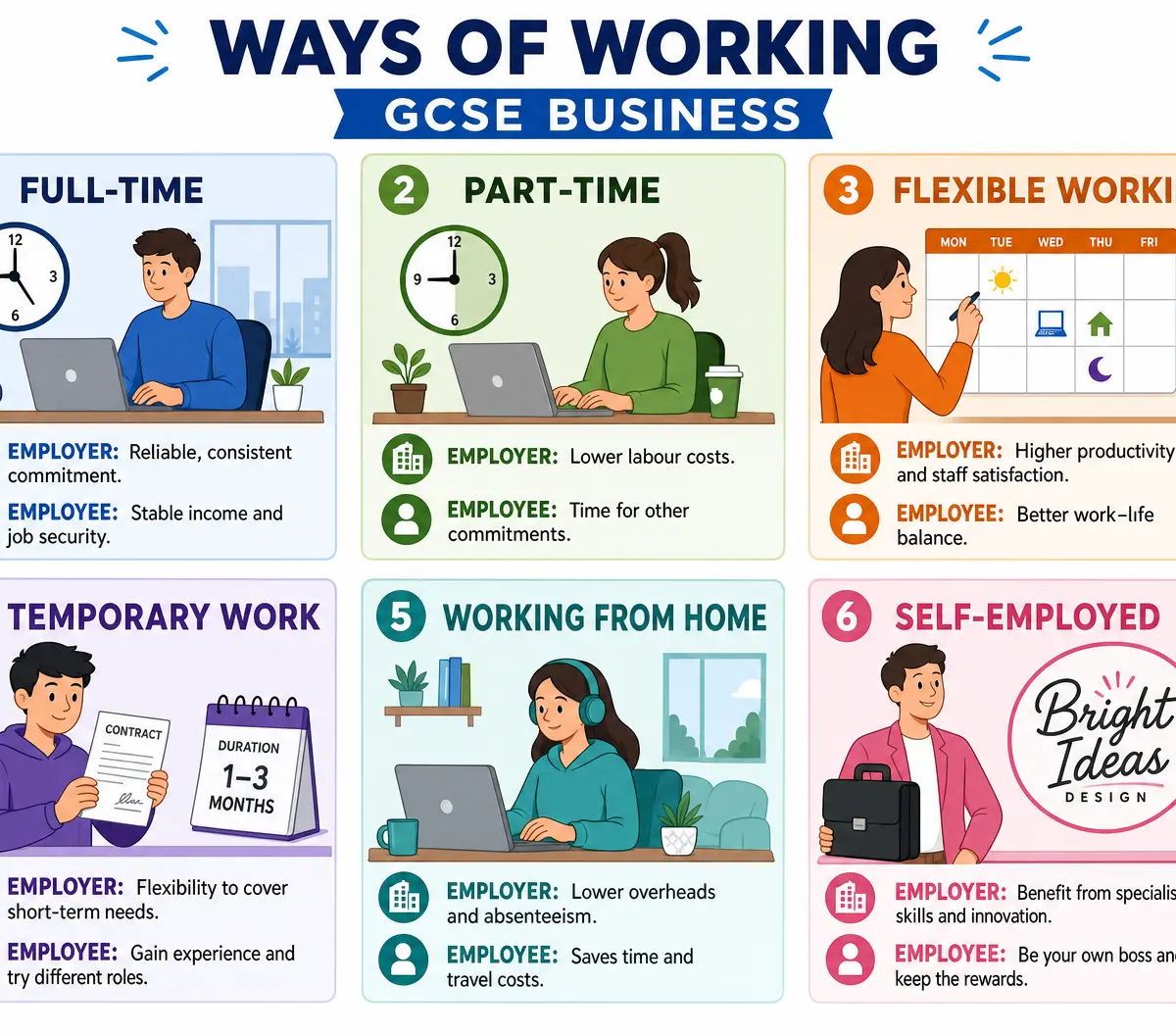
- Full-Time: Employees work standard contracted hours (usually 35-40 hours per week). Provides stability for the employee and consistent availability for the employer.
- Part-Time: Employees work fewer hours than a full-time contract. Provides flexibility for the employee (e.g., to manage childcare) and allows the employer to cover busy periods cost-effectively.
Flexible Working
Employees have some choice over how, when, or where they work (e.g., flexitime, compressed hours).
Impact: Increases employee motivation and work-life balance, which can reduce absenteeism and staff turnover for the employer. However, it can be complex for managers to coordinate teams.
Temporary Work
Employees are hired for a fixed period (e.g., a 3-month contract to cover a busy retail period like Christmas).
Impact: Gives the employer immense flexibility to adjust staffing levels without long-term commitment. For the employee, it provides experience but lacks job security.
Working from Home & Mobile Working
- Working from Home: Employees complete their duties from their residence using technology.
- Mobile Working: Employees work on the move (e.g., sales reps visiting clients).
Impact: Saves commuting time and reduces office overheads for the business. However, it requires significant trust and can make team collaboration more challenging.
Self-Employed
Individuals work for themselves and offer their services to businesses as contractors or freelancers.
Impact: Businesses benefit from specialist skills without paying benefits like sick pay or pensions. The individual gains independence but takes on financial risk.
Visual Resources
2 diagrams and illustrations
Interactive Diagrams
1 interactive diagram to visualise key concepts
Conceptual Flow Outline
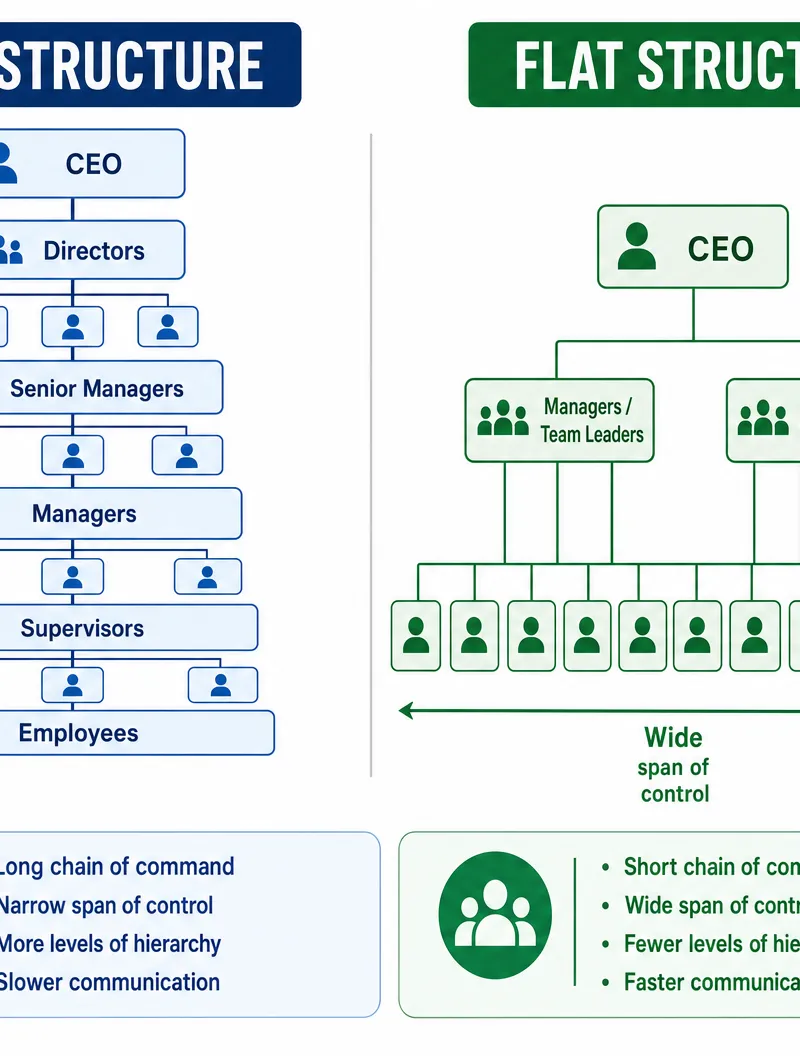
Example of an Organisation Chart showing Hierarchy and Chain of Command
Worked Examples
3 worked examples — open one to explore the question and available guidance.
Practice Questions
Try the question, then reveal an answer plan or example response
State two features of a tall organisational structure. (2 marks)
Hint: Think about the length of the chain and the width of the span.
Explain one reason why a business might decide to delayer its organisational structure. (3 marks)
Hint: What happens to costs or communication when you remove middle managers?
Analyse the impact on a business of offering flexible working to its employees. (6 marks)
Hint: Look at both the positive impacts (motivation/retention) and negative impacts (coordination/communication).
Explain the difference between delegation and authority. (2 marks)
Hint: One is a power, the other is an action.
Evaluate whether a small, newly established graphic design agency should use a flat organisational structure. (9 marks)
Hint: Consider the size of the business, the nature of creative work, and the need for agility.
Exam technique
How to turn what you know into marks
How to approach the question
Always look for the context in the question. If a business name or industry is given, you MUST refer to it in your answer.
How to structure your answer
- Essay questions
- Define key terms → Paragraph FOR → Paragraph AGAINST → Justified Conclusion based on the specific business.
- Source questions
- Read the case study carefully and highlight clues about the business size, industry, and current problems.
- Explain questions
- Point → Reason (Because...) → Consequence (This leads to...). Give two distinct points for a 6-mark question.
Timing
Approximately 1 minute per mark. Spend 2-3 minutes planning a 12-mark evaluation question.
Common pitfalls
- Confusing span of control (number of subordinates) with chain of command (levels of hierarchy).
- Writing generic answers that don't apply to the specific business in the case study.
- Listing advantages and disadvantages without explaining *why* they matter to the business.
- Failing to reach a final decision in 'Evaluate' or 'Justify' questions.
What the command words want
- Analyse
- Examine the impacts in detail, showing a chain of reasoning.
- Explain
- Make a point and develop it showing cause and effect.
- Evaluate
- Look at both sides (pros and cons) and make a supported judgement.
- State / Identify
- One word or a short phrase. No explanation needed.
Watch or listen (optional)
Test your understanding of Organisational structures and different ways of working
Active recall beats re-reading. Take an instant quiz now to test what you’ve learned and lock it into long-term memory.
A week of Premium from your first lesson · Then the free plan continues · No card, no charge