OCR · GCSE · Business
Course version: J204 · Version from Sept 2019
The marketing mix
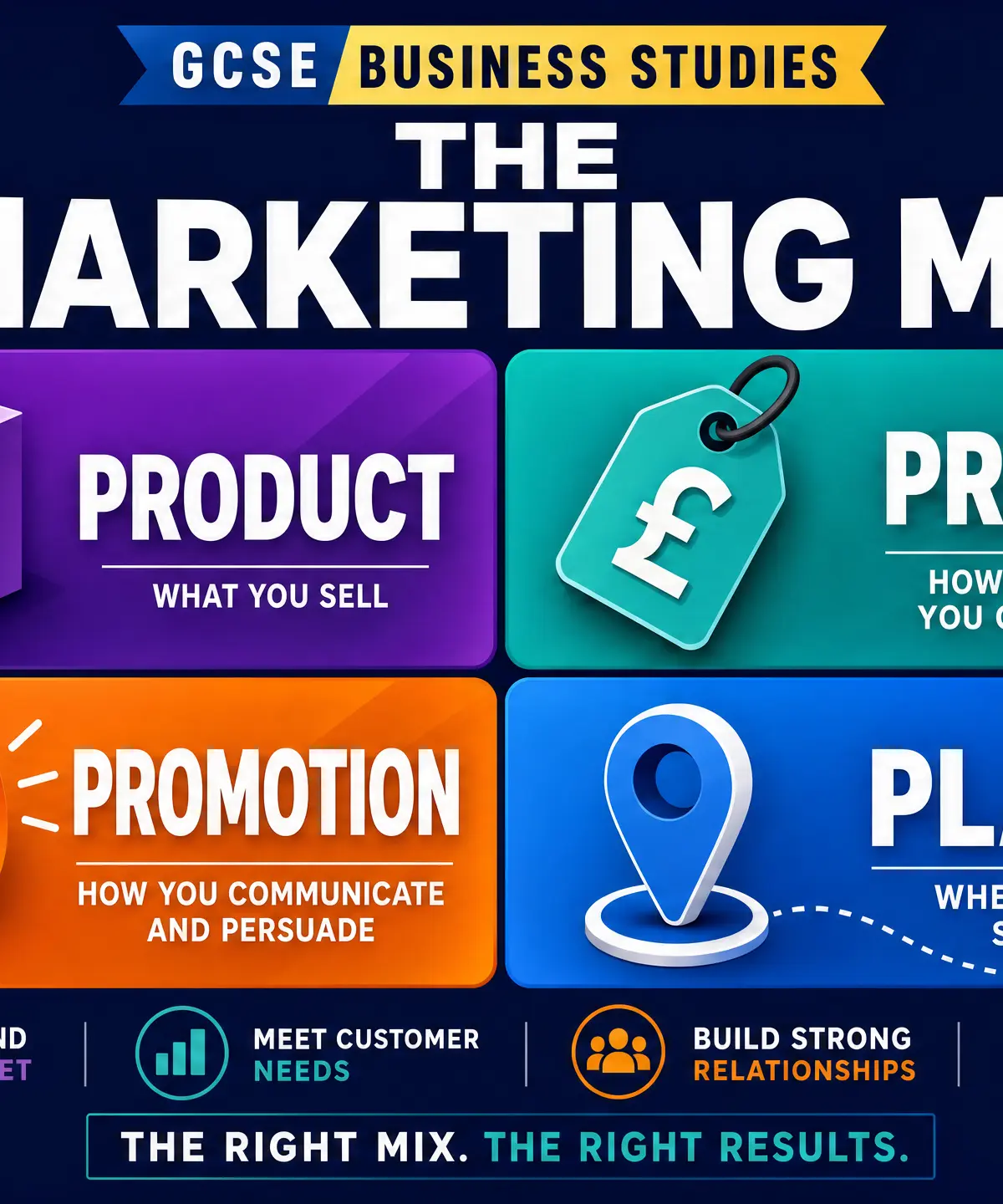
The Marketing Mix is the foundation of business strategy, blending Product, Price, Promotion, and Place to meet customer needs. Mastering this topic is crucial for the exam, as examiners heavily reward the ability to explain how these four elements work interdependently.
- 5 min read
- 3 worked examples
- 5 practice questions
- 6 key terms
Check what you remember
Read the wording for your board, then hide it and explain Marketing Mix in your own words. Rough notes are fine. This is a self-check, with no mark or grade.
Reference: OCR
The combination of product, price, promotion, and place that a business uses to meet customer needs and achieve its objectives.
Study Notes
Overview
The marketing mix, commonly known as the 'four Ps', represents the core strategic decisions a business must make to successfully market its goods or services. It encompasses Product (what is sold), Price (how much is charged), Promotion (how it is communicated), and Place (where and how it is distributed). For GCSE candidates, understanding each element individually is only the starting point. Examiners consistently reward responses that demonstrate how these four elements are interdependent. A change in the target market, a shift in the product's life cycle stage, or a new pricing strategy will inevitably force adjustments across the entire marketing mix.
Listen to our revision podcast to reinforce your understanding:
The Four Ps Explained
1. Product
Definition: The physical good or intangible service offered to the consumer.
Key Concepts:
- Differentiation: How the product stands out from competitors (e.g., unique selling point, branding, design).
- Product Portfolio: The range of items a business sells.
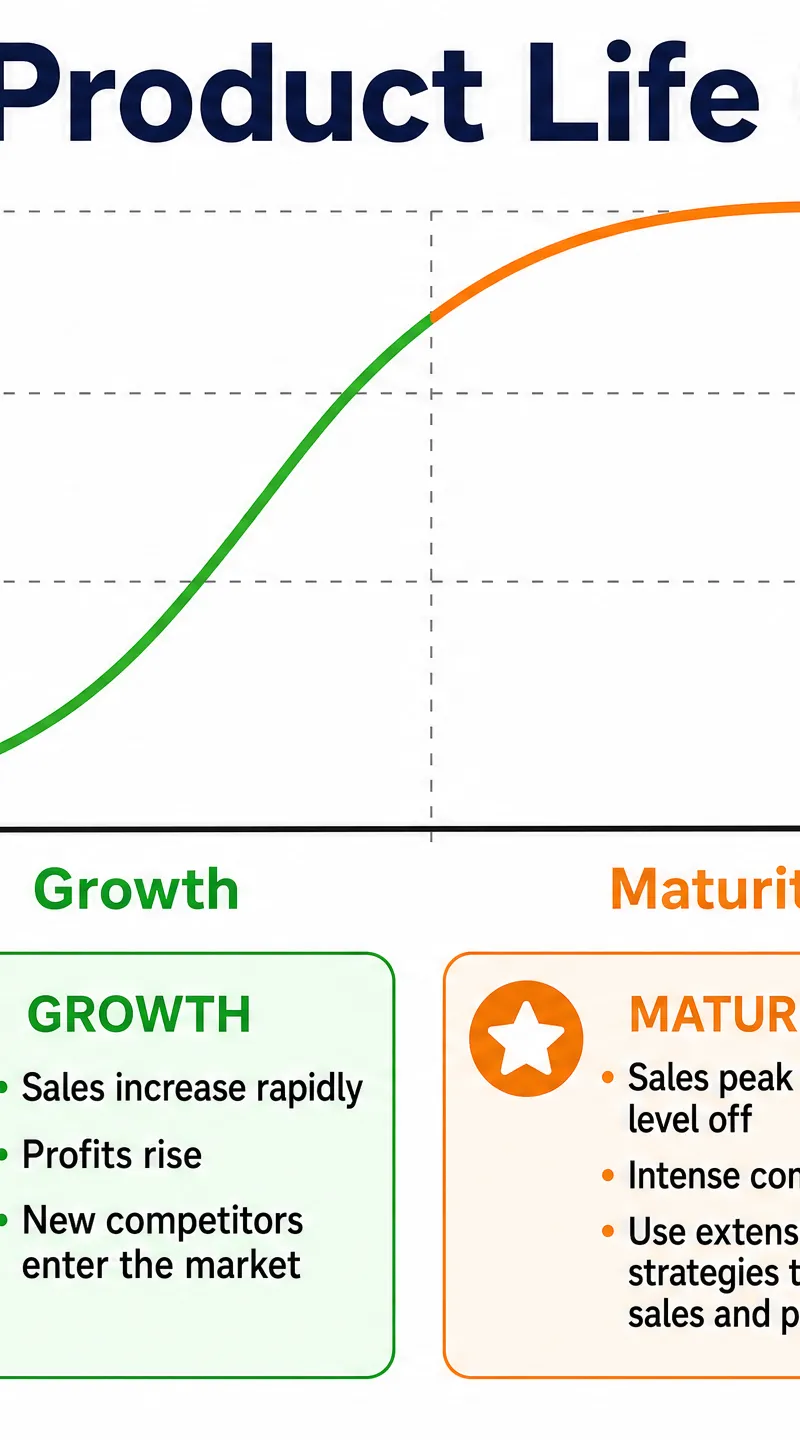
The Product Life Cycle:
Products typically pass through four distinct stages. Candidates must be able to link these stages to changes in the wider marketing mix.
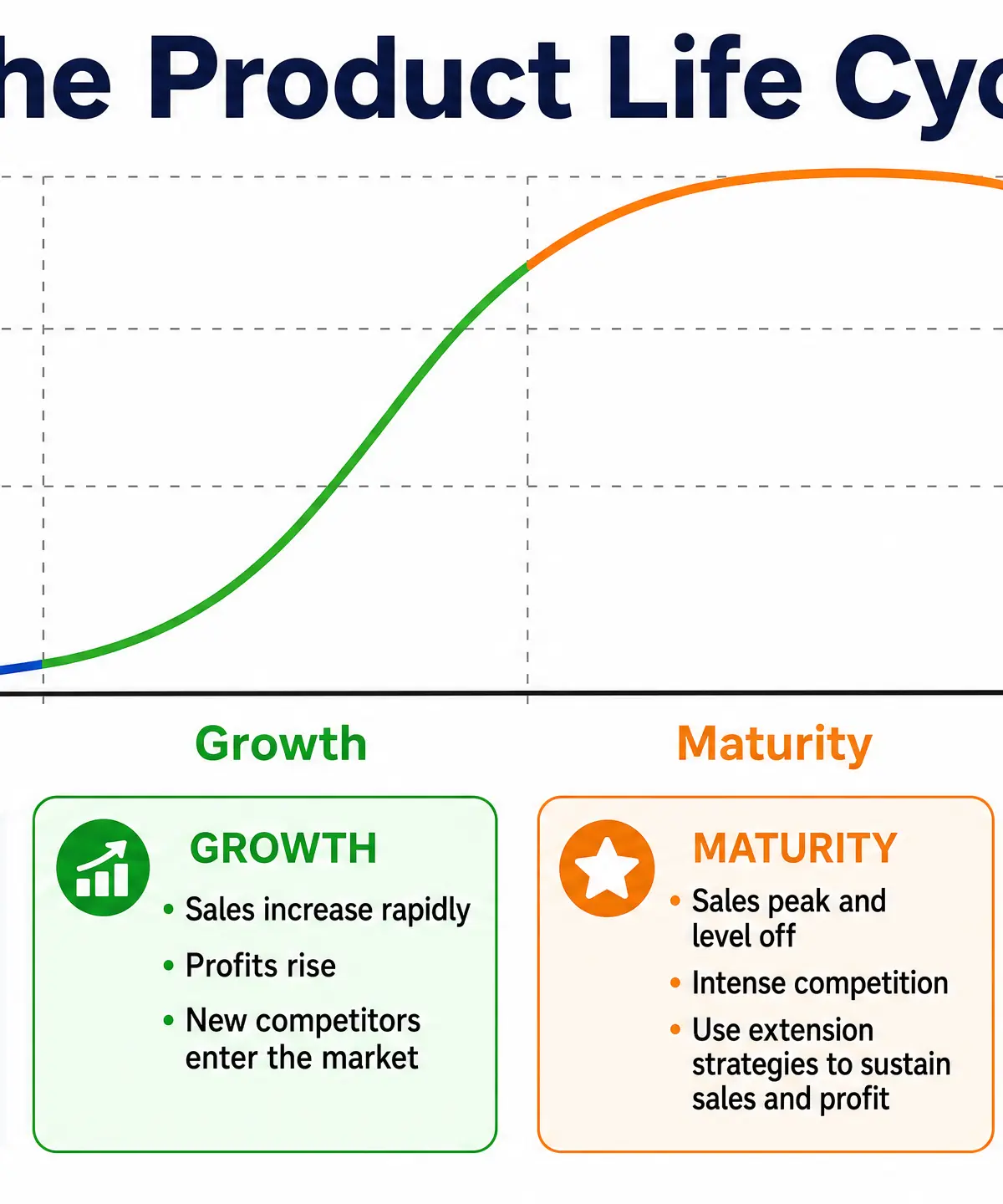
- Introduction: The product is launched. Sales are low, costs are high due to heavy promotion, and the business may use price skimming or penetration pricing.
- Growth: Sales rise rapidly. Profits increase, but new competitors enter the market.
- Maturity: Sales peak and level off. Competition is intense. Businesses use extension strategies (e.g., new features, new markets) to sustain sales.
- Decline: Sales and profits fall. The business must decide whether to reduce costs, use heavy discounting, or withdraw the product entirely.
2. Price
Definition: The amount of money a customer pays for the product.
Key Concepts:
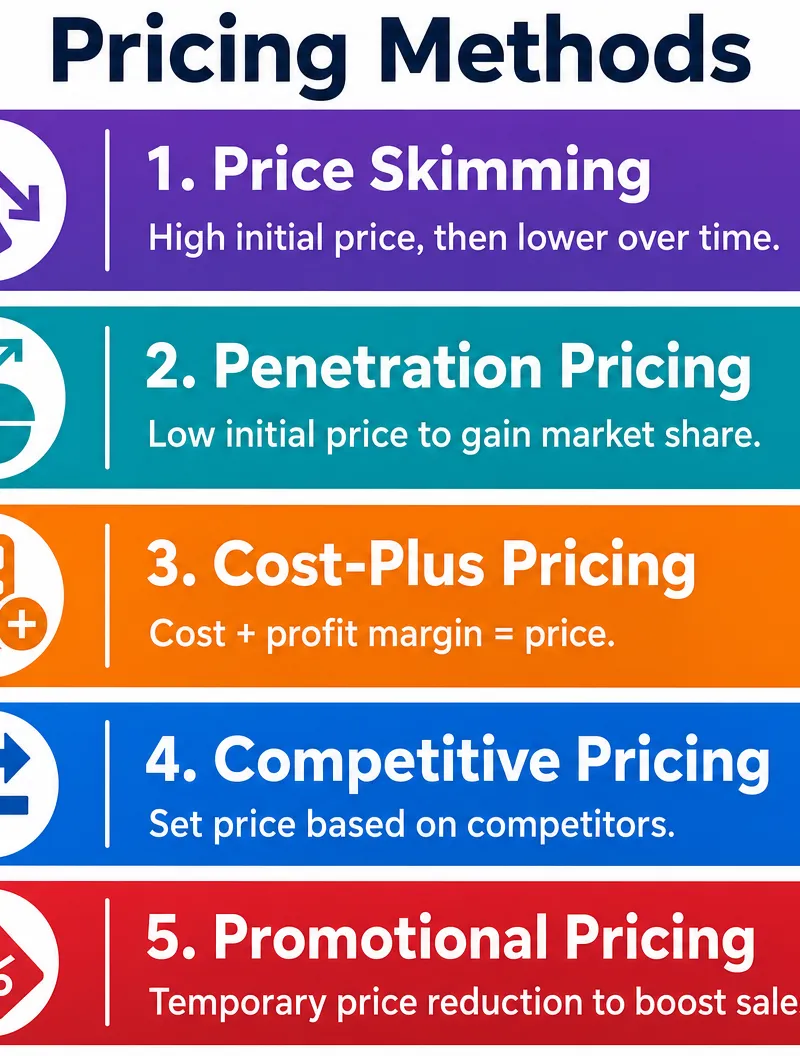
Pricing decisions must align with the product's quality, the target market's income, and competitor actions. Examiners expect candidates to evaluate the suitability of the following pricing methods:
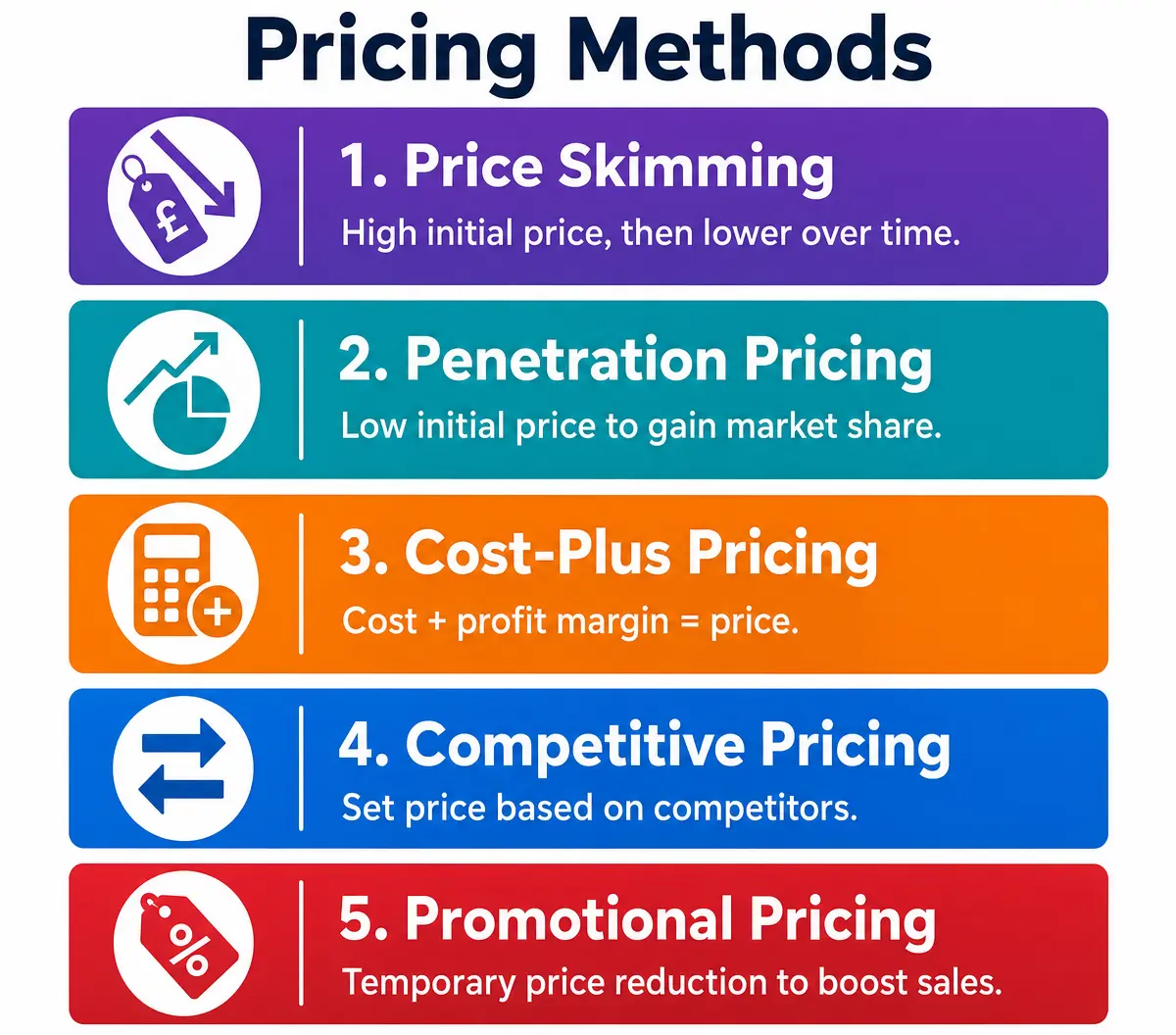
- Price Skimming: Setting a high initial price to maximise revenue from early adopters, then lowering it over time (suitable for innovative tech).
- Penetration Pricing: Setting a low initial price to rapidly gain market share, then increasing it once loyalty is established.
- Cost-Plus Pricing: Calculating the cost of production and adding a percentage mark-up for profit.
- Competitive Pricing: Setting prices based on what rivals are charging (common in highly competitive markets).
- Promotional Pricing: Temporary price reductions to boost short-term sales.
3. Promotion
Definition: The methods used to communicate with customers, raise awareness, and persuade them to buy.
Key Concepts:
- Advertising: Paid communication through media (e.g., television, social media, print). Social media allows for precise targeting, while television reaches a mass audience but at a high cost.
- Point of Sale Promotion: Activities at the location of purchase to encourage immediate sales (e.g., price reductions, loss leaders, competitions, free samples).
4. Place (Distribution)
Definition: How and where the product reaches the customer.
Key Concepts:
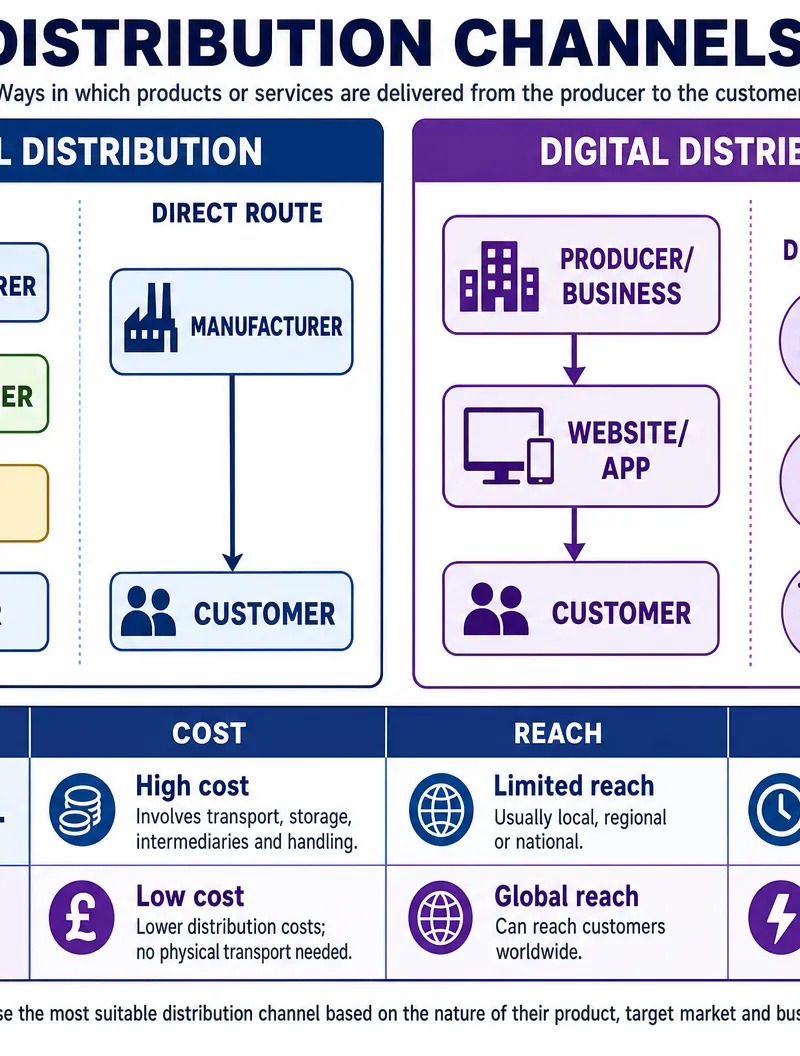
Candidates must evaluate the advantages and disadvantages of different distribution channels.
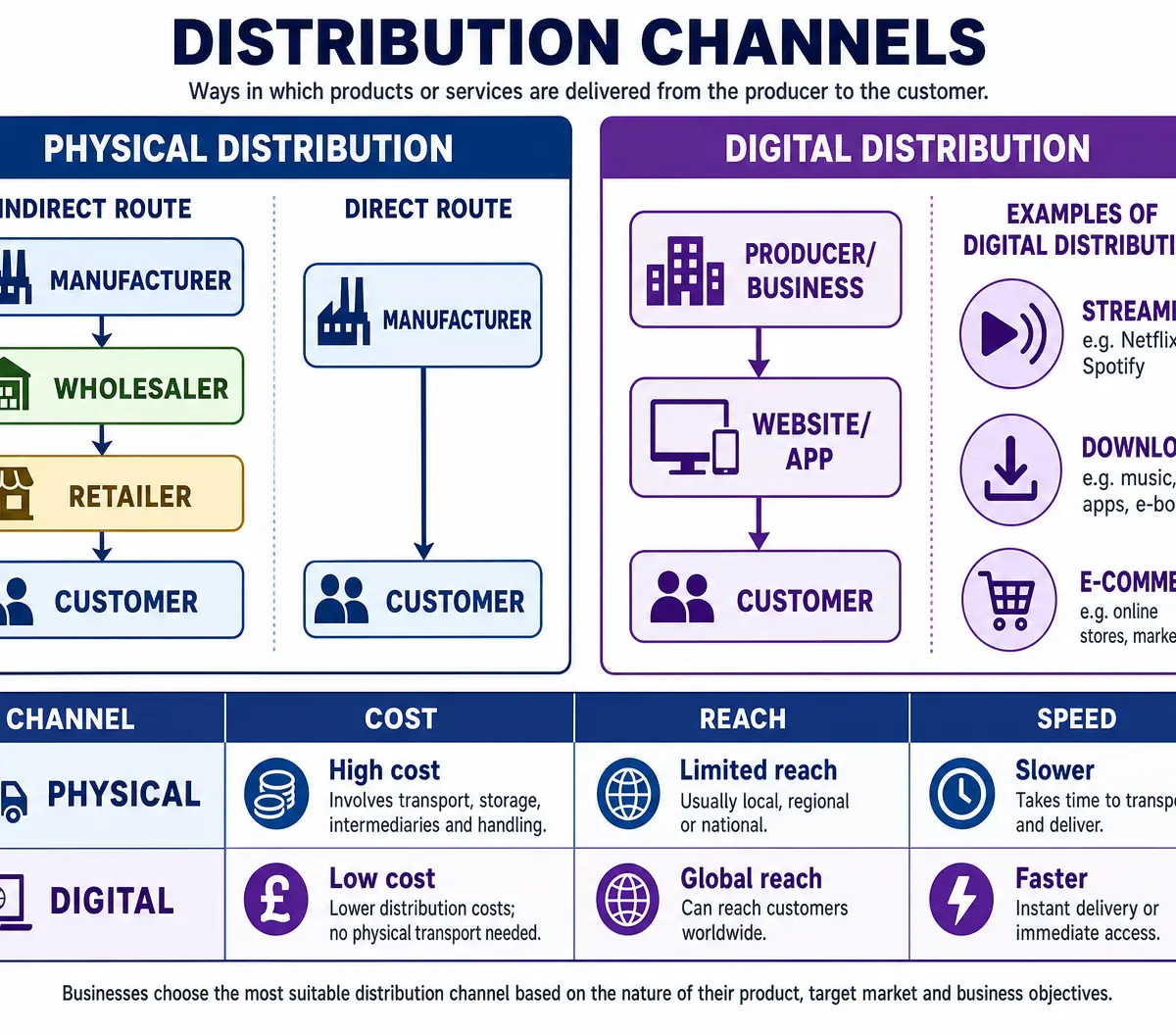
- Physical Distribution: Selling through physical locations. This can be direct (manufacturer to customer) or indirect (using wholesalers and retailers). Indirect routes reach more customers but reduce the manufacturer's profit margin.
- Digital Distribution: Selling online via websites or apps (e-commerce), or delivering digital products via streaming and downloads. This offers global reach and lower costs but requires significant investment in technology and logistics.
Interdependence of the Marketing Mix
The most critical skill for this topic is explaining interdependence. If a business decides to sell a premium luxury product (Product), it must use price skimming or high competitive pricing (Price), promote in high-end magazines rather than mass social media (Promotion), and use exclusive physical retailers (Place).
Visual Resources
3 diagrams and illustrations
Interactive Diagrams
1 interactive diagram to visualise key concepts
Conceptual Flow Outline
The Interdependence of the Marketing Mix
Worked Examples
3 worked examples — open one to explore the question and available guidance.
Practice Questions
Try the question, then reveal an answer plan or example response
State two stages of the product life cycle. (2 marks)
Hint: Think of the acronym 'I Go Make Dinner'.
Explain one reason why a business might use cost-plus pricing. (3 marks)
Hint: What does this method guarantee about the revenue from each sale?
A manufacturer of luxury watches currently sells its products through independent jewellers. It is considering opening its own branded stores. Analyse the impact of this change in distribution channel on the business. (6 marks)
Hint: Consider both the financial costs and the impact on brand image/control.
Evaluate the importance of the 'Product' element of the marketing mix compared to 'Promotion' for a business launching a new video game. (9 marks)
Hint: Can great promotion save a bad product? Can a great product sell with no promotion?
Explain how a business might use the marketing mix to extend the life cycle of a product in the maturity stage. (6 marks)
Hint: Pick two of the 4 Ps and explain how changing them can boost sales.
Exam technique
How to turn what you know into marks
How to approach the question
Always identify the business context first. Is it a start-up or an established brand? Is it selling a mass-market product or a niche luxury item? Your application of the 4 Ps must match this context.
How to structure your answer
- Essay questions
- AJIM: Answer the question, Justify your choice, It depends on (evaluate), Most importantly (final conclusion).
- Source questions
- Use data from the case study to support your points. If market share is falling, quote the percentage drop.
- Explain questions
- Use the BLT structure: State the Business concept, Link it to the context, and say Therefore what the impact is on the business.
Timing
Approximately 1 minute per mark, plus planning time for 9 and 12-mark evaluation questions.
Common pitfalls
- Treating the 4 Ps in isolation. Always mention how a change in one affects another.
- Confusing 'Place' with the location of the factory. 'Place' means the distribution channel to the customer.
- Recommending 'Advertising' without specifying which type (e.g., social media vs TV) and why it suits the target market.
What the command words want
- Analyse
- Build a chain of reasoning showing causes and consequences. Show the impact on the business (e.g., impact on profit, sales, or reputation).
- Explain
- Give a reason and develop it using connectives like 'because', 'leading to', or 'therefore'.
- Describe
- State a point and give one piece of supporting detail. No need for long explanations.
- Evaluate/Justify
- Look at both sides (pros and cons, or Option A vs Option B) and provide a supported conclusion.
Watch or listen (optional)
Test your understanding of The marketing mix
Active recall beats re-reading. Take an instant quiz now to test what you’ve learned and lock it into long-term memory.
A week of Premium from your first lesson · Then the free plan continues · No card, no charge