OCR · GCSE · Business
Course version: J204 · Version from Sept 2019
The role of business enterprise and entrepreneurship
This topic is the foundation of all business studies. It explores how entrepreneurs turn ideas into reality by taking risks, spotting opportunities, and solving problems in the market, ultimately driving the economy forward.
- 5 min read
- 3 worked examples
- 5 practice questions
- 6 key terms
Check what you remember
Read the wording for your board, then hide it and explain Enterprise in your own words. Rough notes are fine. This is a self-check, with no mark or grade.
Reference: OCR
The willingness to take risks, show initiative, and undertake new business ventures.
Study Notes

Overview
This study guide covers the fundamental purpose of business activity, the role of enterprise, and the characteristics of entrepreneurs. Examiners expect you to understand how businesses are formed, why individuals choose to start them, and the delicate balance between risk and reward. This is a core topic that underpins the entire GCSE Business specification. You will be assessed on your ability to define key terms accurately (AO1), apply them to specific business scenarios (AO2), and analyse the impact of entrepreneurial decisions (AO3).
The Purpose of Business Activity
A business is an organisation that produces goods or provides services to satisfy customer needs and wants.
Needs vs Wants:
- Needs are essential for survival (e.g., food, water, shelter, clothing).
- Wants are desires that are not essential but improve quality of life (e.g., designer clothes, smartphones, holidays).
Businesses exist to identify these needs and wants and provide solutions, usually with the aim of making a profit.
Enterprise and the Entrepreneur
Enterprise refers to the willingness to take risks and show initiative to establish a new business venture. It is the process of identifying a business opportunity and bringing together the resources to meet it.
An entrepreneur is an individual who takes the financial risk of starting and managing a new business. They are the driving force behind enterprise.
Characteristics of an Entrepreneur
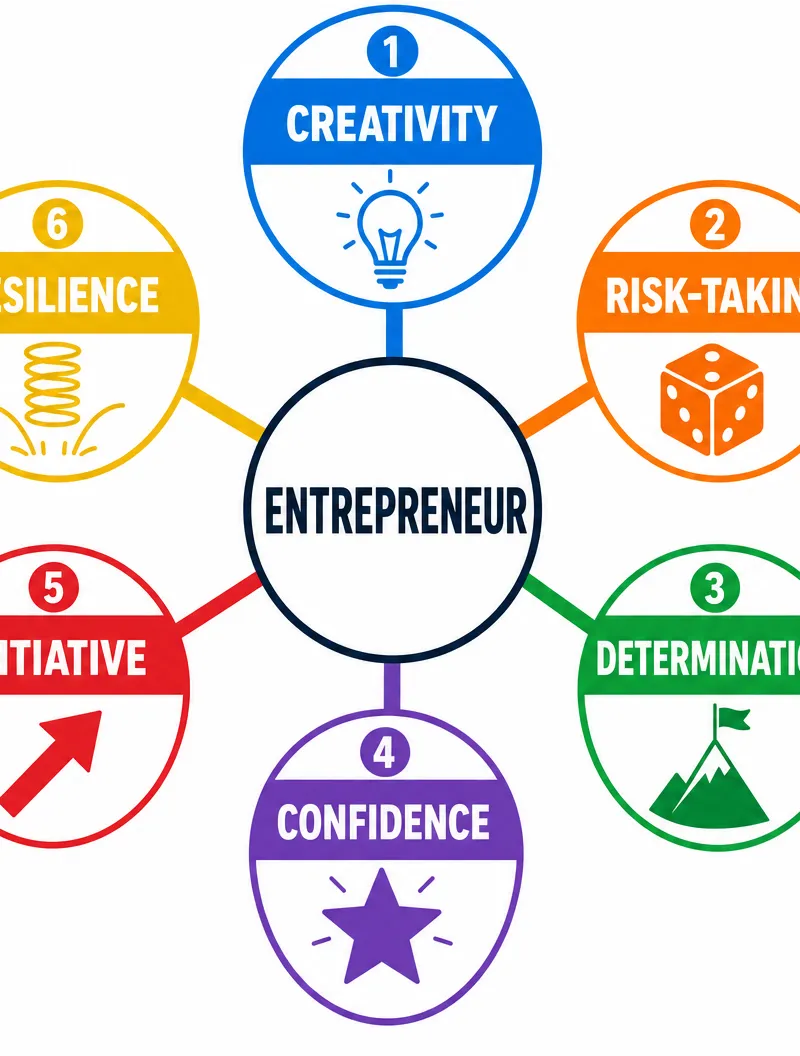
Examiners frequently ask you to identify and explain the traits that make entrepreneurs successful.
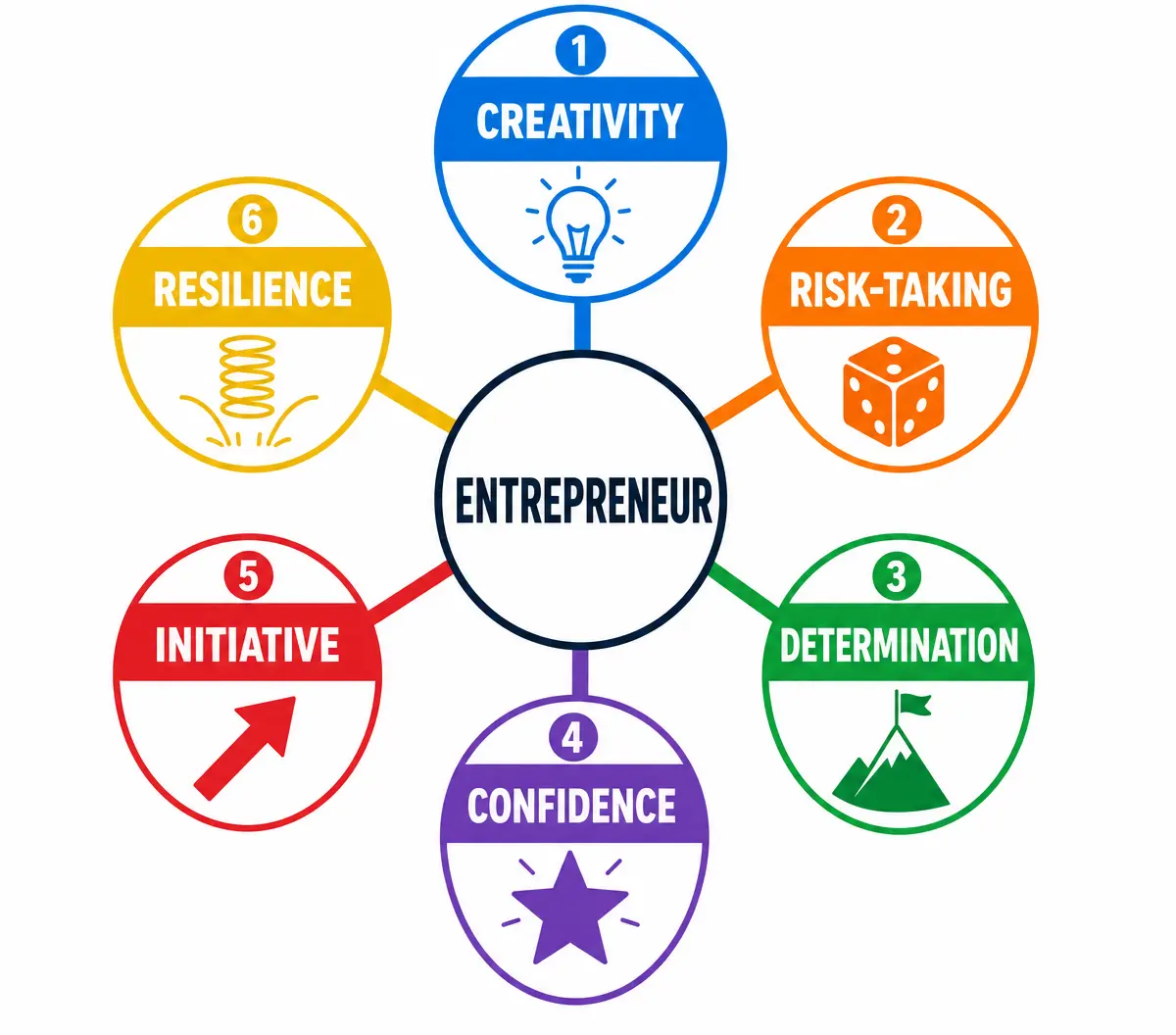
- Creativity/Innovation: The ability to generate new ideas, think outside the box, and find unique solutions to problems (e.g., James Dyson inventing the bagless vacuum cleaner).
- Risk-taking: The willingness to invest time, money, and effort into a venture with no guarantee of success.
- Determination/Resilience: The drive to keep going when faced with setbacks, failures, or obstacles.
- Confidence: Belief in oneself and the business idea, which is essential for persuading investors and attracting customers.
- Initiative: Proactively taking action without waiting to be told what to do.
Examiner Tip: Do not confuse the characteristics of an entrepreneur with the functions of a manager. An entrepreneur creates the business and takes the risk; a manager runs the existing business operations.
Spotting a Business Opportunity
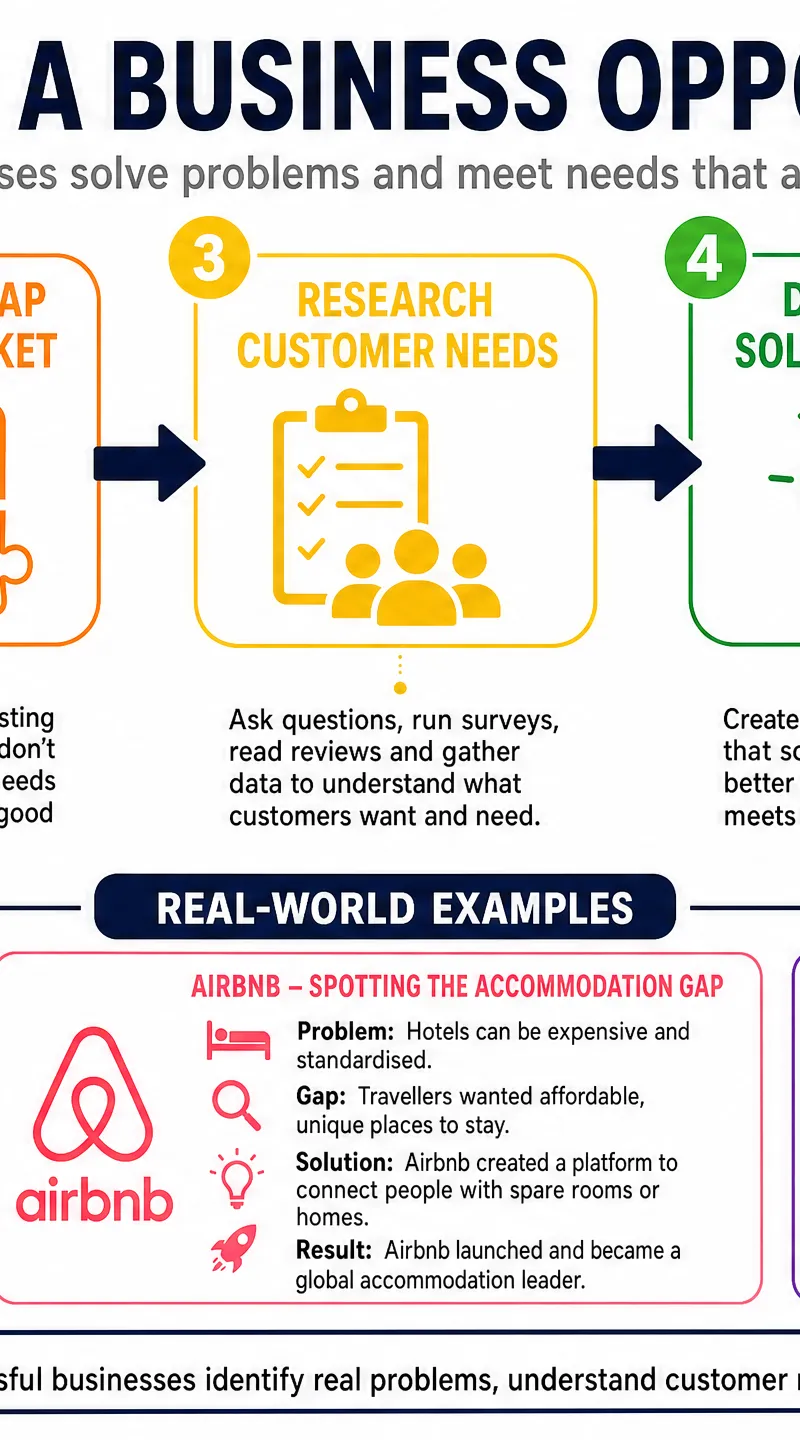
Great businesses are built on strong opportunities. Entrepreneurs spot opportunities in several ways:
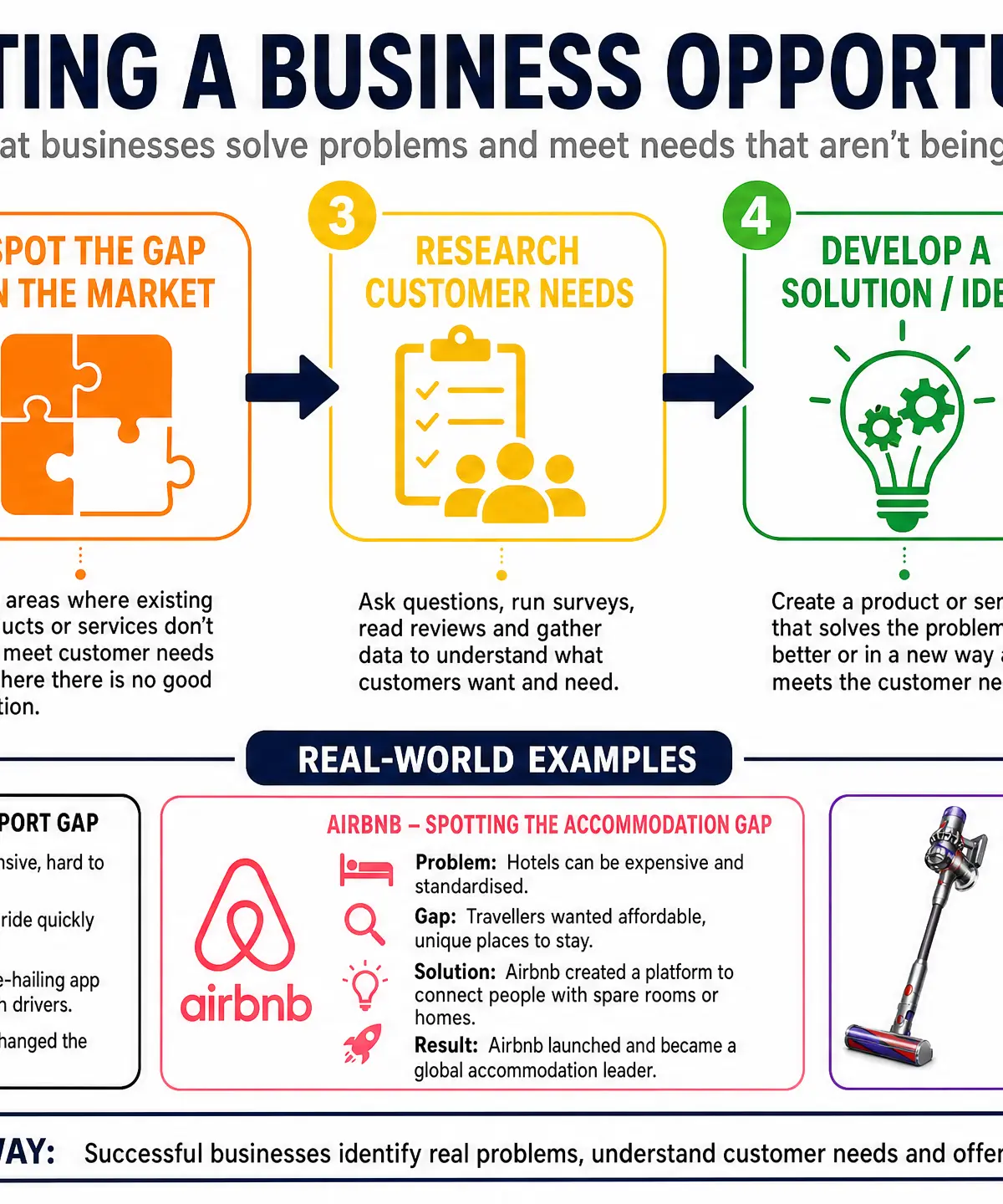
- Identifying a Gap in the Market: Finding a product or service that customers want but is not currently available.
- Solving a Problem: Creating a solution to a common frustration (e.g., Uber solving the problem of unreliable, expensive taxis).
- Changing Customer Trends: Adapting to new tastes, fashions, or ethical concerns (e.g., the rise of plant-based food brands).
- Technological Advancements: Using new technology to offer better or cheaper products.
Risk and Reward
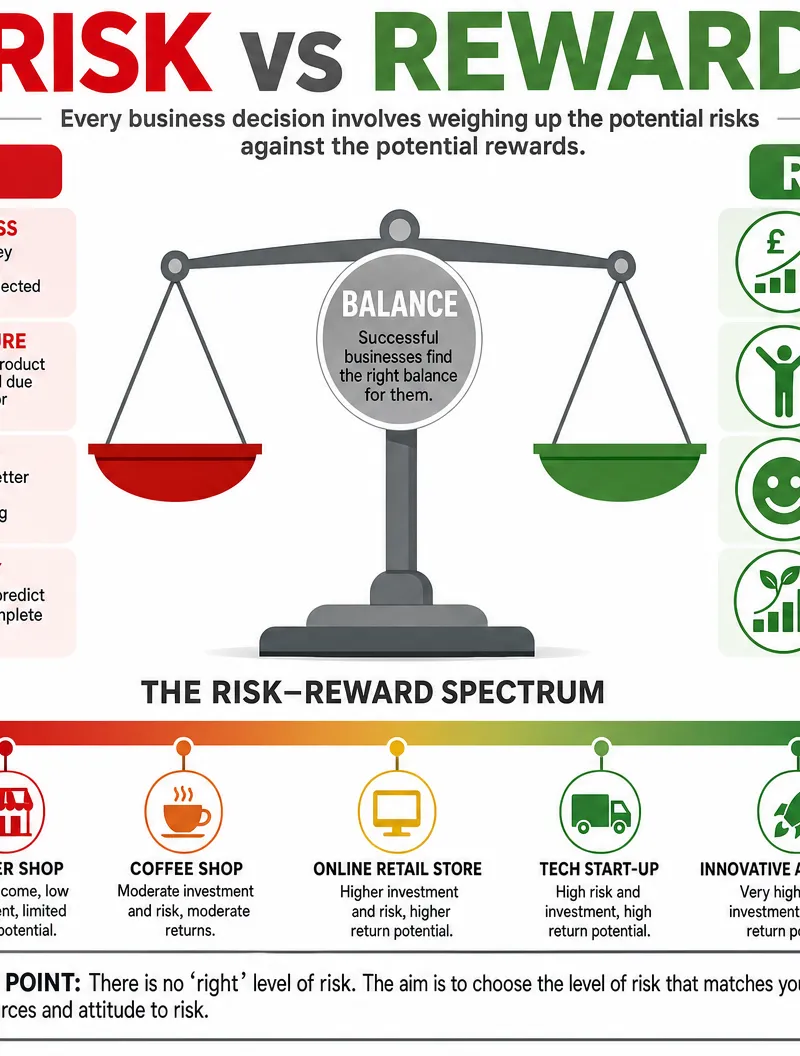
The concept of risk and reward is central to enterprise. Every business decision involves weighing the potential downsides against the potential upsides.
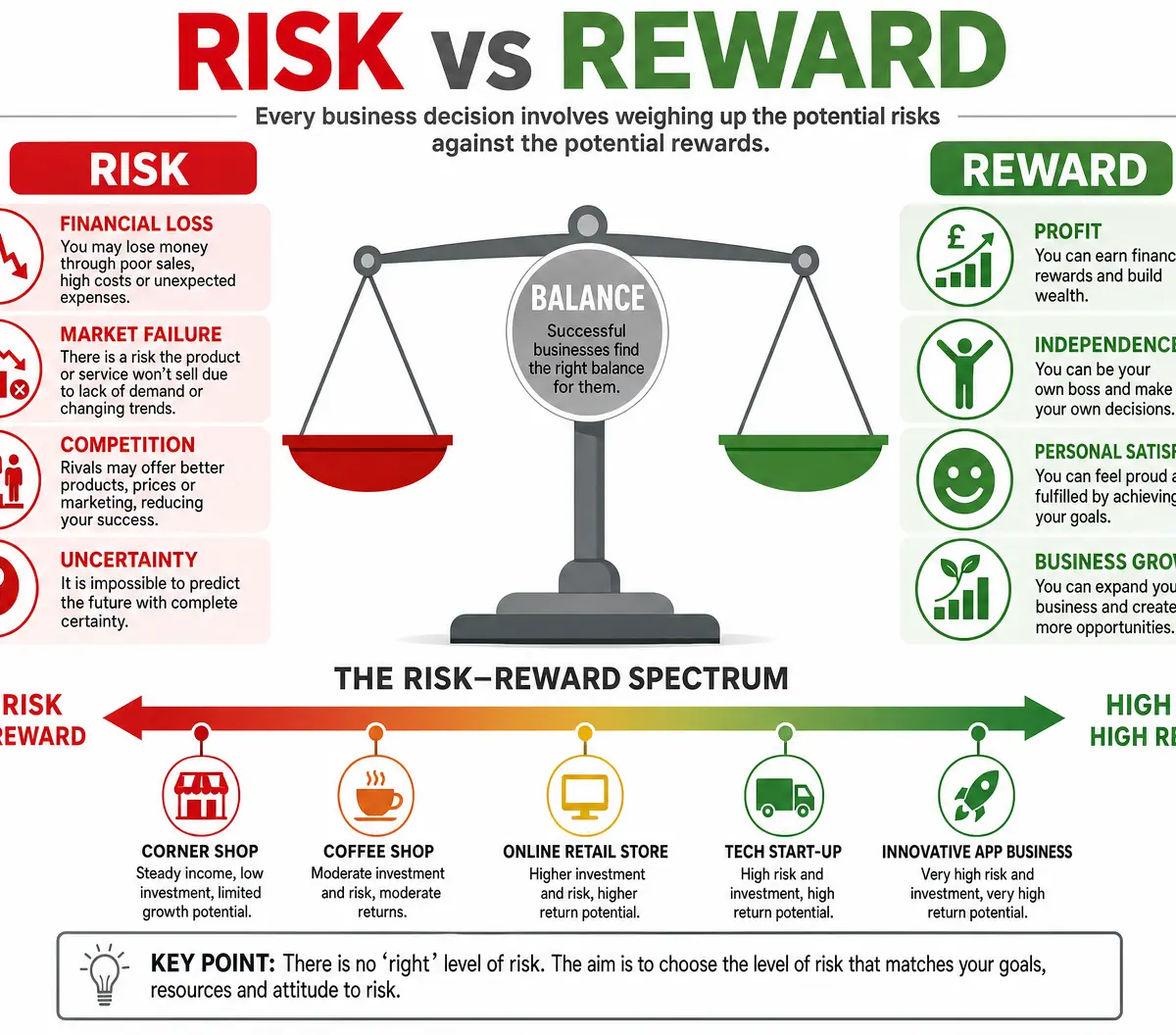
Business Risks
- Financial Loss: The entrepreneur may lose the capital they invested if the business fails.
- Lack of Security: Giving up a regular salary from a secure job to face uncertain income.
- Business Failure: The business may collapse due to poor sales, high costs, or strong competition.
Business Rewards
- Profit: The financial gain when revenue exceeds costs.
- Independence: Being your own boss and making your own decisions.
- Personal Satisfaction: The sense of achievement from building a successful enterprise.
The Risk-Reward Trade-off: Generally, the higher the risk taken by an entrepreneur, the higher the potential reward if the venture is successful.
Podcast Revision Session
Listen to our comprehensive 10-minute podcast covering all these core concepts, exam techniques, and a quick-fire recall quiz to test your knowledge.
Visual Resources
3 diagrams and illustrations
Interactive Diagrams
1 interactive diagram to visualise key concepts
Conceptual Flow Outline
The Process of Enterprise
Worked Examples
3 worked examples — open one to explore the question and available guidance.
Practice Questions
Try the question, then reveal an answer plan or example response
Explain one reason why an entrepreneur might decide to start their own business. (3 marks)
Hint: Think about the rewards of enterprise. Make a point, explain it, and link it to the benefit for the entrepreneur.
State two risks an entrepreneur faces when starting a new business. (2 marks)
Hint: What could go wrong? Think about money and security.
Analyse the importance of determination for an entrepreneur launching a new tech start-up. (6 marks)
Hint: Apply your answer to a 'tech start-up'. Why is determination specifically important here?
Identify which of the following is a non-financial reward of enterprise: A) Profit, B) Dividends, C) Independence, D) Revenue. (1 mark)
Hint: Which of these does not directly relate to money?
Explain how an entrepreneur might identify a gap in the market. (3 marks)
Hint: How do they find out what customers want that isn't currently available?
Exam technique
How to turn what you know into marks
How to approach the question
Always identify the command word first. Highlight the name of the business or person in the scenario to ensure you apply your answer.
How to structure your answer
- Analyse questions
- Requires balanced arguments. Two paragraphs exploring different sides or impacts, heavily applied to the context.
- Explain questions
- Use the BLT structure: Because, Leading to, Therefore. (Or PEEL: Point, Evidence, Explanation, Link).
- Evaluate questions
- Requires a final judgement. Weigh up the arguments and conclude which factor is most significant and why.
Timing
Approximately 1 minute per mark. A 6-mark question should take about 6 minutes.
Common pitfalls
- Writing generic answers that don't refer to the specific business in the case study (loss of AO2 marks).
- Confusing the roles of an entrepreneur with the day-to-day tasks of a manager.
- Only mentioning 'profit' as a reward and forgetting non-financial rewards like independence.
What the command words want
- Analyse
- Examine in detail, showing the impacts or consequences of a business decision in context.
- Explain
- Make a point and develop it showing cause and effect.
- State / Identify
- Give a short, precise answer. No explanation needed.
- Discuss / Evaluate
- Look at both sides (e.g., pros and cons, risks and rewards) and make a justified conclusion.
Watch or listen (optional)
Test your understanding of The role of business enterprise and entrepreneurship
Active recall beats re-reading. Take an instant quiz now to test what you’ve learned and lock it into long-term memory.
A week of Premium from your first lesson · Then the free plan continues · No card, no charge