OCR · GCSE · Business
Course version: J204 · Version from Sept 2019
The role of marketing
Marketing is the beating heart of business success. This study guide unpacks how businesses identify customer needs, conduct research, and manipulate the 'Four Ps' to drive sales and dominate their markets.
- 6 min read
- 3 worked examples
- 5 practice questions
- 6 key terms
Check what you remember
Read the wording for your board, then hide it and explain Market Research in your own words. Rough notes are fine. This is a self-check, with no mark or grade.
Reference: OCR
The process of gathering, analysing, and interpreting information about a market, a product, or its customers.
Study Notes
Overview

Welcome to The Role of Marketing. This topic explores the fundamental purpose of marketing within a business, moving far beyond simple advertising. Examiners expect candidates to understand how marketing influences business activity and drives strategic decisions. You will learn the importance of identifying and understanding customers, the critical role of market research, the mechanics of market segmentation, and how the four Ps of the marketing mix (Product, Price, Promotion, Place) interlock to create a coherent strategy.
Listen to our comprehensive 10-minute podcast review to solidify your understanding before diving into the detailed notes below:
The Purpose of Marketing
Marketing is the management process responsible for identifying, anticipating, and satisfying customer requirements profitably. Examiners look for three specific purposes:
- Identifying and understanding customers: Finding out who they are, what they want, and what they are willing to pay.
- Informing customers: Communicating the benefits and features of products and services.
- Increasing sales: Driving revenue and market share through effective promotion and pricing.
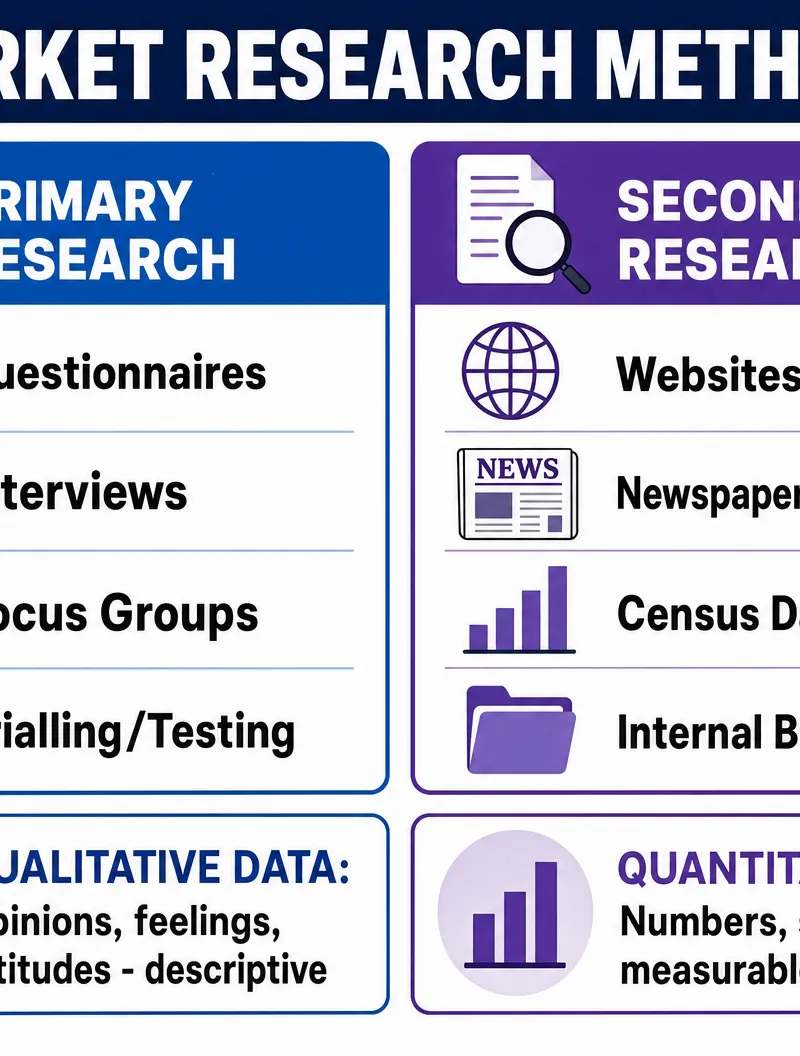
Market Research
Before a business can satisfy needs, it must gather data. Market research reduces the risk of launching a product that nobody wants.
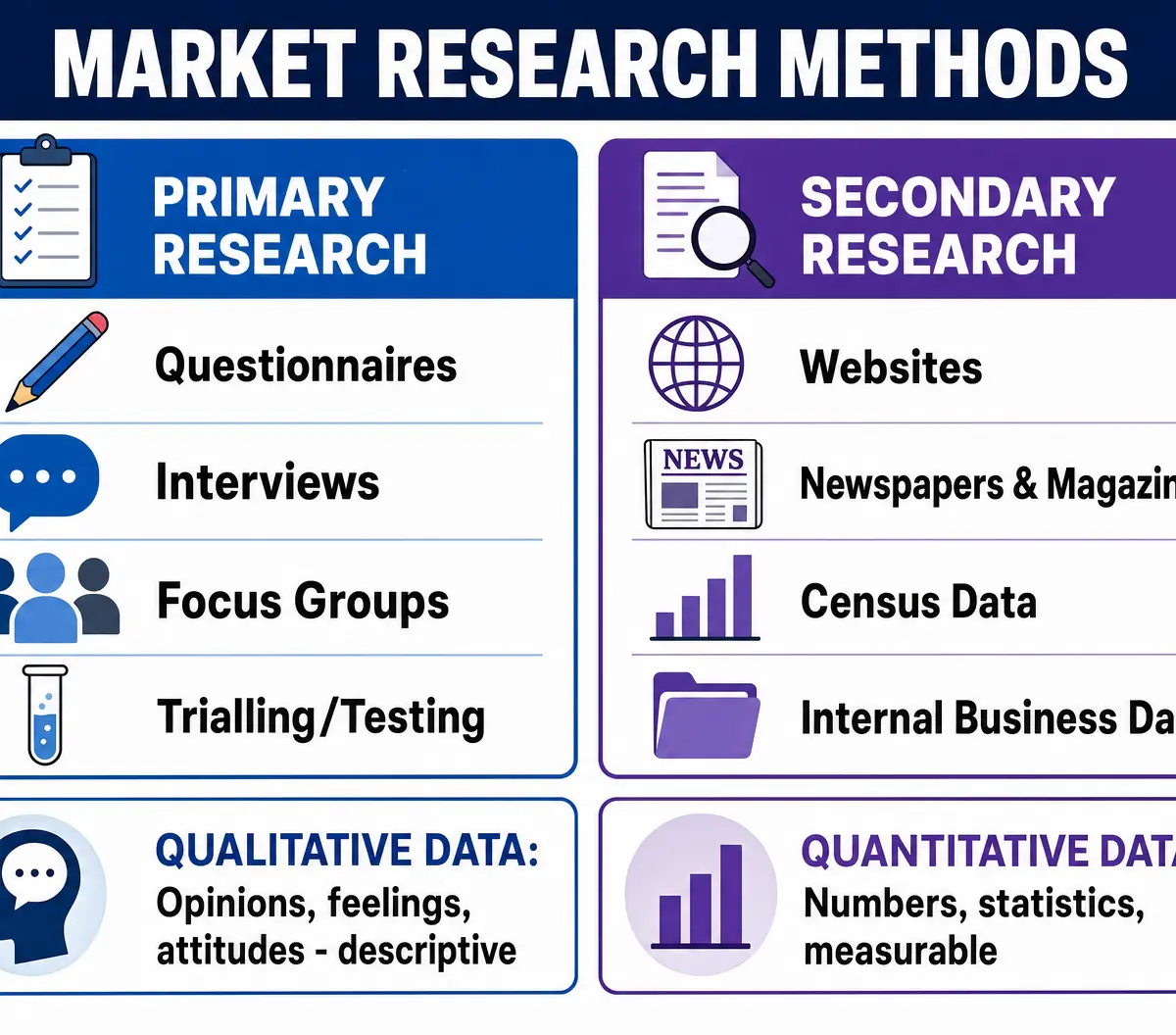
Primary Research (Field Research)
What it is: The collection of new, original data gathered for a specific purpose.
Methods:
- Questionnaires: Standardised questions asked to a sample of people.
- Interviews: In-depth, face-to-face or telephone conversations.
- Focus Groups: A small group discussing a product or concept in detail.
- Trialling/Testing: Releasing a product in a limited area to test customer reaction.
Exam Relevance: Primary research is specific to the business's exact needs and is up-to-date, but examiners expect you to note that it is often expensive and time-consuming.
Secondary Research (Desk Research)
What it is: The use of existing data that has already been collected for another purpose.
Sources:
- Internal Data: Past sales figures, customer records.
- External Data: Websites, newspapers, magazines, government census data, market reports.
Exam Relevance: Secondary research is quicker and cheaper to obtain, but it may be out of date or not specific enough to the business's current problem.
Types of Data
- Qualitative Data: Information about opinions, judgements, and attitudes (e.g., why a customer likes a product). It is descriptive.
- Quantitative Data: Information that can be expressed as numbers and analysed statistically (e.g., the percentage of people who buy a product).
Market Segmentation
Market segmentation is the process of dividing a total market into smaller, more defined groups of consumers who share similar characteristics. This allows a business to target its marketing more effectively.
Key Segmentation Variables:
- Age: Targeting different age groups (e.g., toys for children, life insurance for older adults).
- Gender: Products designed specifically for men or women.
- Income: Segmenting based on how much people earn (e.g., luxury cars vs. budget supermarkets).
- Location: Adapting products for different regions or countries.
- Lifestyle: Segmenting by hobbies, interests, and values (e.g., targeting fitness enthusiasts).
The Marketing Mix: The Four Ps
The marketing mix is the combination of elements a business uses to market its product. Examiners frequently ask how these elements work together.
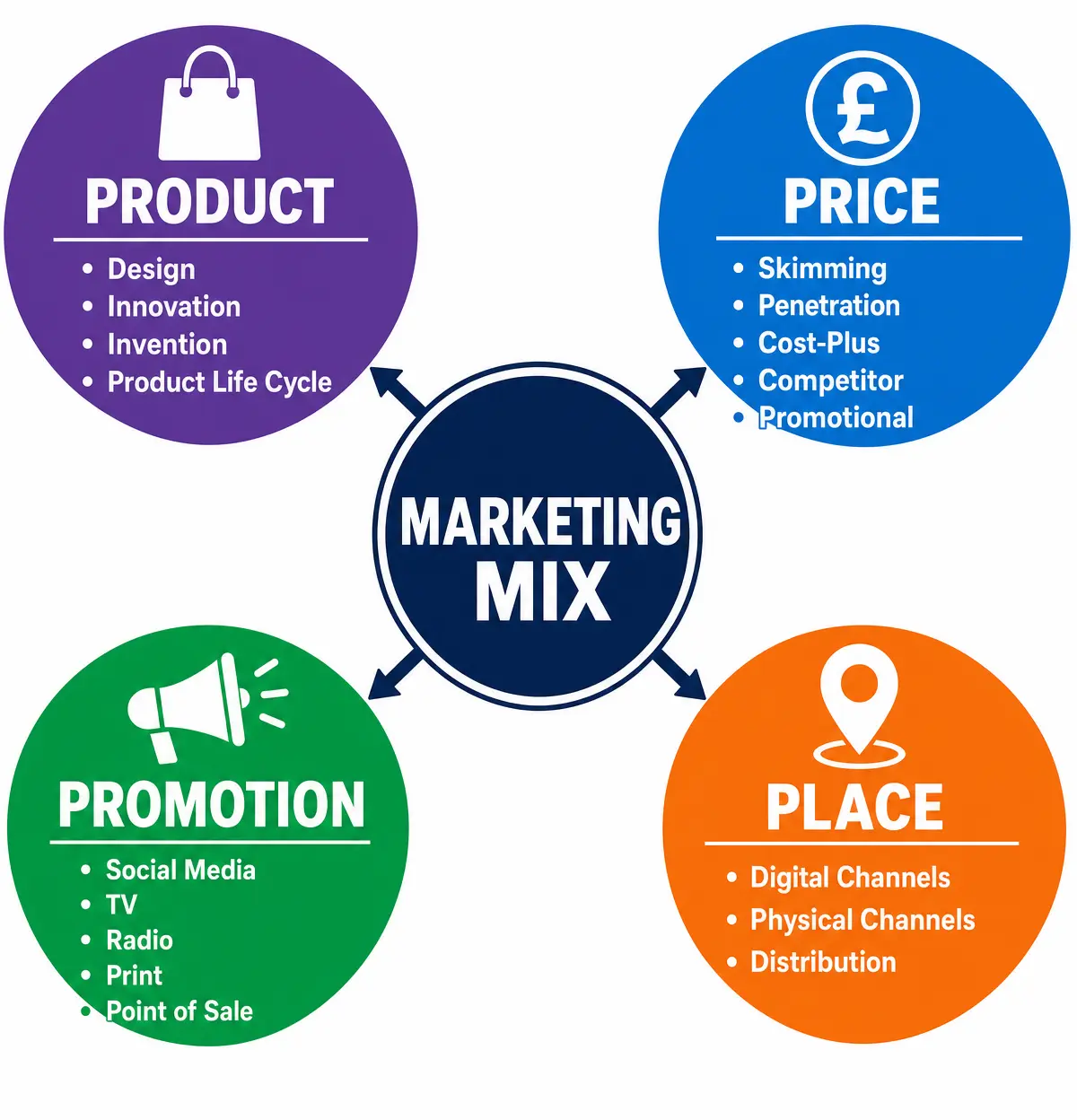
1. Product
The good or service being sold. It must meet customer needs in terms of design, quality, and features.
- Invention: Creating a completely new product that did not exist before.
- Innovation: Improving or adding new features to an existing product.
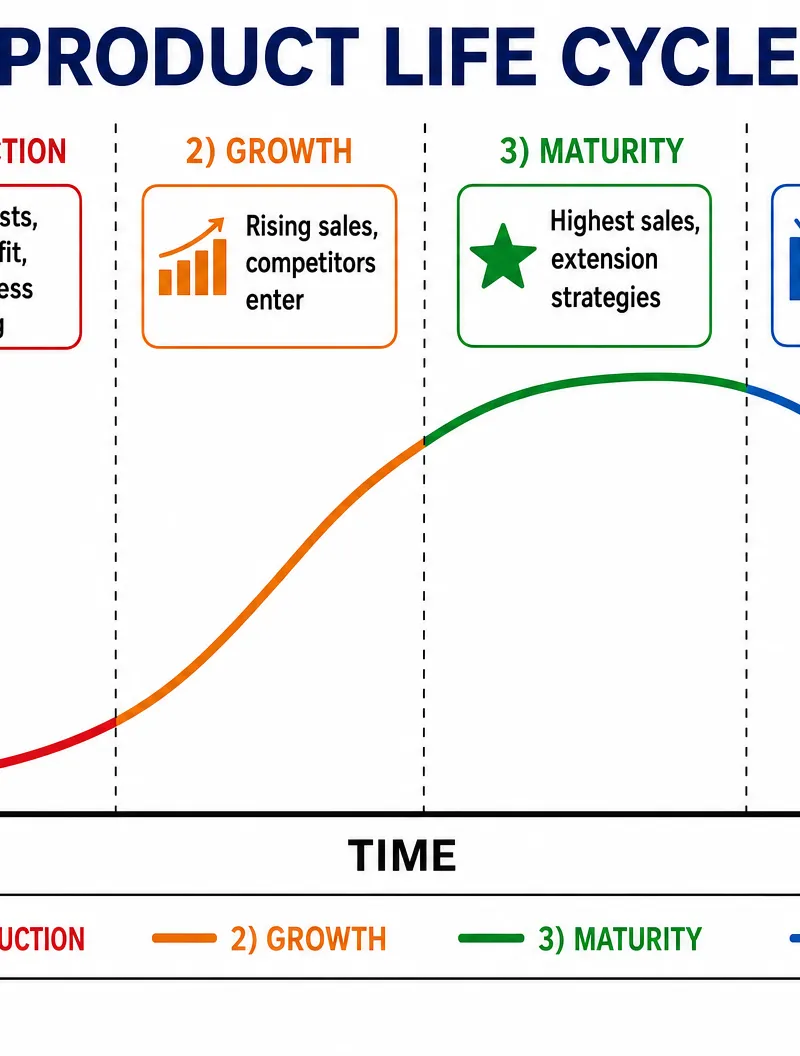
The Product Life Cycle
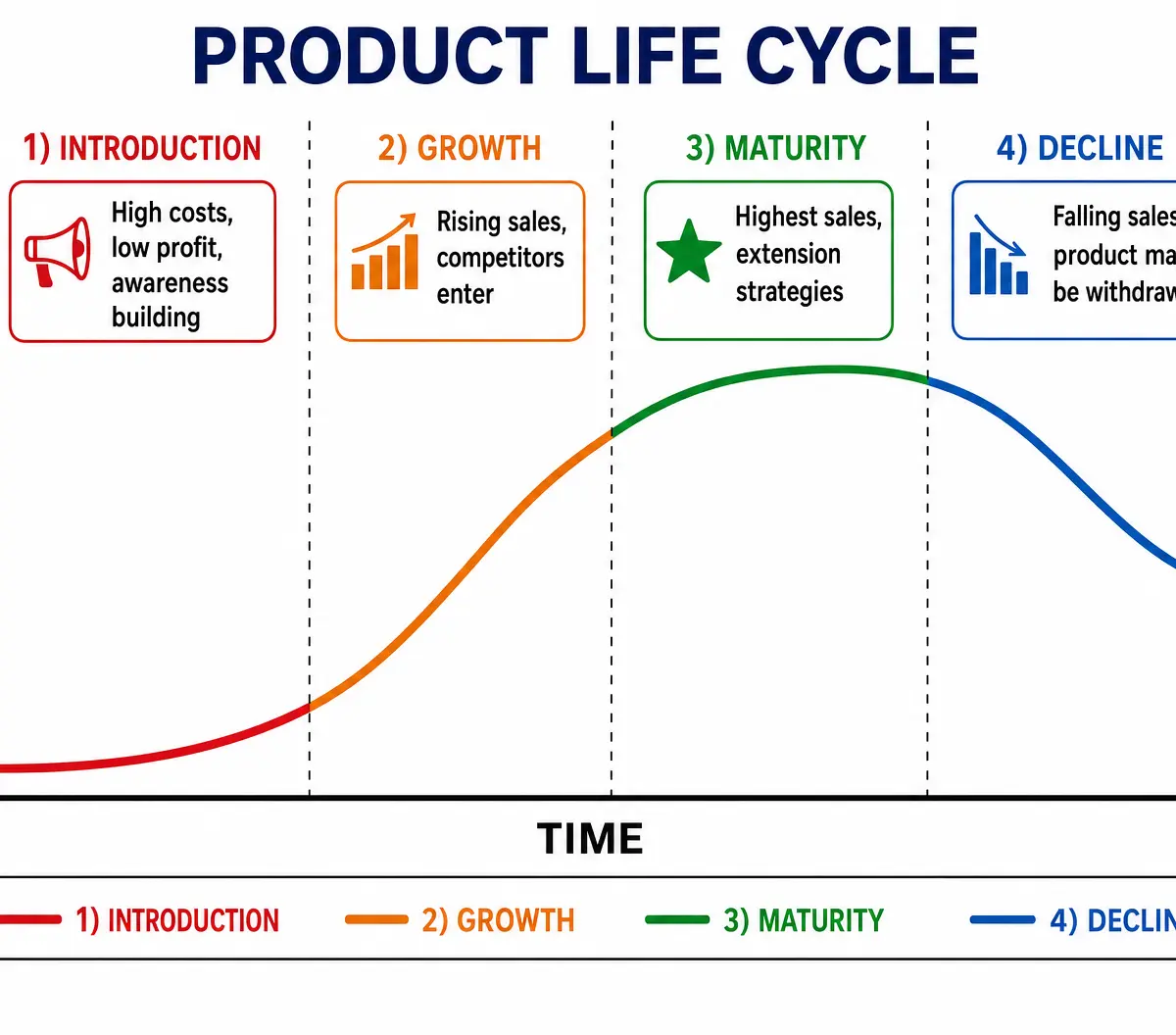
The stages a product goes through from its introduction to its eventual decline:
- Introduction: Product launched. High costs (research, promotion), low sales, negative cash flow.
- Growth: Sales rise rapidly. The product becomes profitable. Competitors may enter the market.
- Maturity: Sales peak and growth slows. High profits, but the market becomes saturated.
- Decline: Sales fall. The product loses appeal or becomes obsolete.
Extension strategies (e.g., updating packaging, adding features, finding new markets) are used to prolong the maturity stage and delay decline.
2. Price
The amount a customer pays for the product. Pricing strategies include:
- Price Skimming: Setting a high initial price for a new, unique product, then lowering it over time (common in tech).
- Penetration Pricing: Setting a low initial price to enter a competitive market and gain market share quickly.
- Cost-Plus Pricing: Calculating the cost of producing the product and adding a percentage mark-up for profit.
- Competitor Pricing: Setting prices in line with or slightly below competitors.
- Promotional Pricing: Temporarily reducing prices to boost sales (e.g., a summer sale).
3. Promotion
How the business communicates with customers to inform and persuade them.
- Point of Sale Promotion: Tactics used where the product is sold, such as price reductions, loss leaders (products sold at a loss to draw customers in), competitions, and free samples.
- Advertising: Paid communication through media such as social media, websites, print media (newspapers/magazines), television, and radio.
4. Place
How the product is distributed to the customer.
- Physical Channels: Selling through physical stores, wholesalers, or direct from the factory.
- Digital Channels: E-commerce, selling through websites or apps directly to the consumer.
Interpreting Market Data
Candidates must be able to analyse data tables or charts showing:
- Changes in Demand: Is the market growing or shrinking?
- Market Share: The proportion of total sales a specific business holds.
- Effects of Promotion: Evaluating whether a marketing campaign successfully increased sales.
Worked Examples
3 worked examples — open one to explore the question and available guidance.
Practice Questions
Try the question, then reveal an answer plan or example response
A local bakery is experiencing a drop in sales. The owner decides to conduct primary market research to find out why. Explain one suitable method of primary research the bakery could use. (3 marks)
Hint: Think about what is practical for a small, local shop to do.
Explain how the 'Place' element of the marketing mix might differ for a start-up clothing brand compared to an established multinational clothing retailer. (6 marks)
Hint: Consider the financial resources and brand awareness of a start-up versus a multinational.
State two variables a business could use to segment its market. (2 marks)
Hint: How do businesses group different types of people?
Analyse the impact on a business of its product entering the 'Decline' stage of the product life cycle. (6 marks)
Hint: What happens to sales, profits, and the decisions the business must make?
A gym wants to attract new members in January. Evaluate whether a 'price reduction' or a 'free sample' (e.g., a free one-week trial) would be the most effective promotional method. (9 marks)
Hint: Think about the psychology of gym memberships and the long-term value of a customer.
Exam technique
How to turn what you know into marks
How to approach the question
Always identify the command word first. Highlight the specific business context in the case study and ensure every paragraph links back to that specific business.
How to structure your answer
- Essay questions
- Introduction → Option 1 analysis → Option 2 analysis → Supported conclusion/judgement.
- Source questions
- Read the data carefully. State what the data shows quantitatively, then explain the qualitative impact on the business.
- Explain questions
- State the point → Give a context example → Explain the impact on the business (use 'This means that...' or 'Therefore...').
Timing
Approximately 1 minute per mark. For a 12-mark question, spend 2 minutes planning and 10 minutes writing.
Common pitfalls
- Failing to apply the answer to the specific business context provided in the case study.
- Confusing qualitative data (opinions) with quantitative data (numbers).
- Describing the 4 Ps in isolation without explaining how they must work together as a cohesive mix.
What the command words want
- Analyse
- Examine a point in detail, showing causes and effects on the business.
- Explain
- Make a point and develop it with a linked reason or consequence.
- State/Identify
- Provide a brief, factual answer. No explanation needed.
- Evaluate/Recommend
- Look at both sides of an argument, apply to the context, and make a final, justified decision.
Watch or listen (optional)
Test your understanding of The role of marketing
Active recall beats re-reading. Take an instant quiz now to test what you’ve learned and lock it into long-term memory.
A week of Premium from your first lesson · Then the free plan continues · No card, no charge